
Intermittent, Rotary, or Flexo: Label Press Basics for Buyers
Label printing machines are selected by process, web movement, and finishing integration. For a buyer entering the market, the product category can look more complicated than expected: the same supplier may offer a rotation label machine, an intermittent label press, a semi-rotary label printing machine, a flexo label printing machine, and a stickers printing machine under one brand. This article maps those terms to production decisions, using Shenzhen Caisheng Printing Machinery Co., Ltd. (CAISHENG) as a concrete reference.
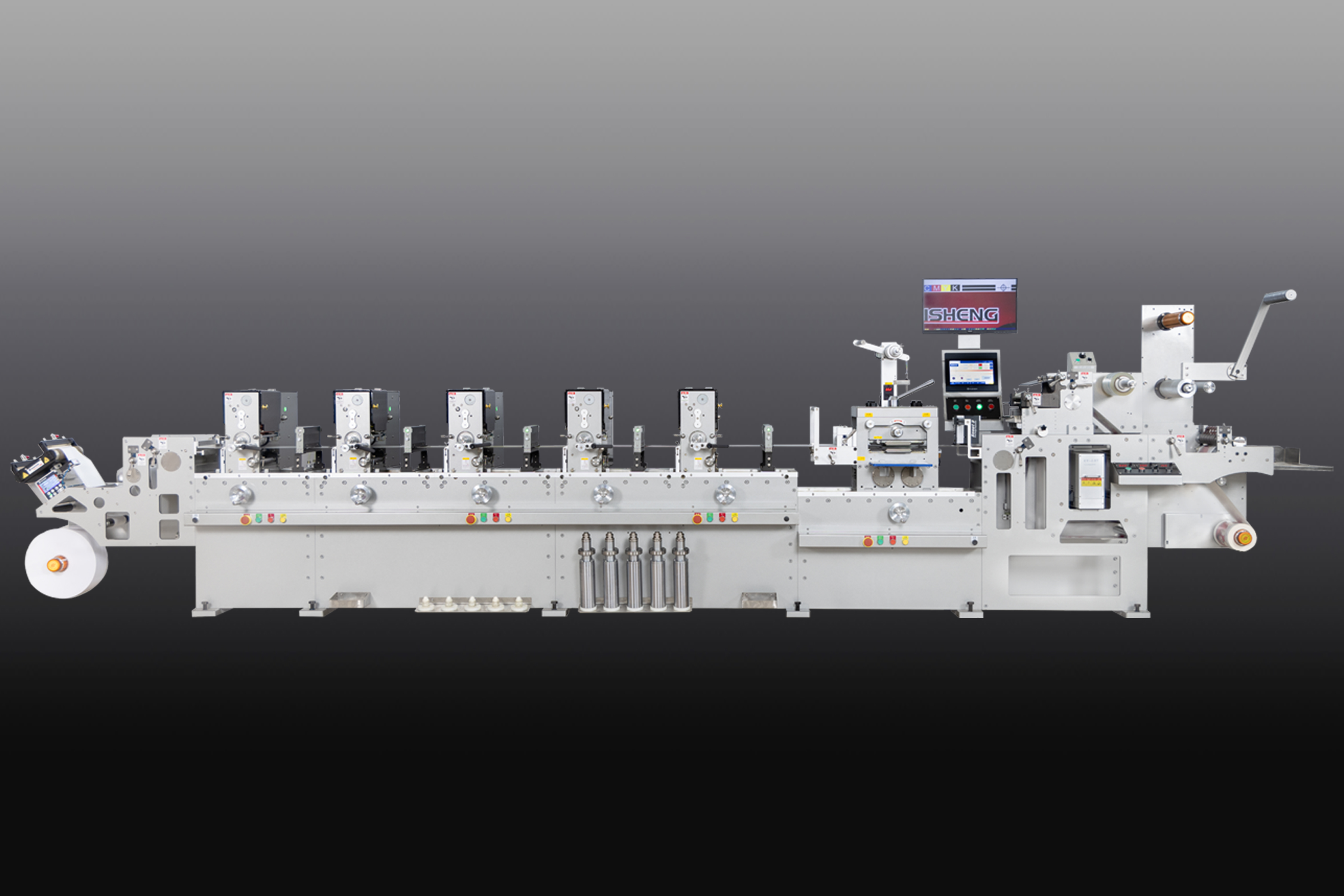
Intermittent label presses are often combined with flatbed die-cutting to finish labels in one pass.
What 'label printing machine' actually covers
In the printing and packaging industry, a label printing machine is generally a press configured to print self-adhesive label stock. The term can cover letterpress and flexographic processes, semi-rotary and full-rotary motion, and finishing functions such as die-cutting, varnishing, and screen printing.
CAISHENG's catalog is a useful example. It includes the CS-300-6C, listed as a rotation label machine; the CS-320-6C, listed as a semi-rotary label printing machine; the CS-320-7C, listed as a rotary label press; the CS-220-5C, listed as a stickers printing machine; and the CS-J380F-7C, listed as a flexo label printing machine. These names are not synonyms. They point to different equipment configurations within the same supplier portfolio.
Why configuration matters
Speed is only one part of the buying decision. A full-rotary label press that runs at 158 m/min may not be the best fit for a converter that changes label sizes several times per day. A semi-rotary label printing machine with a maximum speed of 40 m/min can be more effective for short runs because it allows repeat-length changes without replacing the whole cylinder set.
The opportunity is to match the machine architecture to the production mix. Hybrid models exist to reduce the trade-off. The CS-JQ350G-6C, classified as an intermittent and full rotary high speed label printing machine, supports 60 m/min in intermittent mode and 158 m/min in full rotary mode, giving one press two operating profiles.
Technical comparison: intermittent, full-rotary, and flexo
Intermittent and semi-rotary machines
In an intermittent label press, the web advances in steps, so the print repeat length can be adjusted. The CS-220-4C, for instance, is an intermittent letterpress label printing machine with a maximum intermittent printing area of 30 by 200 mm, a full rotation area of 220 by 245 mm, and a maximum speed of 40 m/min. It is designed for the printing and packaging industry and has a web width range of 30 to 240 mm.
Semi-rotary label printing machines use a similar principle but are often described as a distinct subcategory. The CS-320-6C is a semi-rotary label printing machine from China with a web width range of 30 to 320 mm. It supports both intermittent and full rotary printing modes, with maximum printing areas of 320 by 300 mm and 320 by 326 mm respectively.
Full-rotary and hybrid machines
Full-rotary label presses move the web continuously and are generally faster. The CS-JQ350G-6C reaches 158 m/min in full rotary mode and 60 m/min in intermittent mode within the same hybrid platform. The CS-JQ350G-10C extends the same concept with a larger footprint: 12 m by 1.5 m by 2 m, a net weight of 14 tons, and LED UV dryers rated at 13.5 kW. For buyers, a hybrid full-rotary label press is a way to keep short-run flexibility while preserving speed for longer orders.
Flexo label printing machines
Flexographic presses are a separate process family. They use flexible plates and are frequently mentioned in label market data. In CAISHENG's range, flexo label printing machines include the CS-J380F-4C and CS-J380F-7C, which support both intermittent and full rotary printing modes, and full rotary flexographic printing machines such as the CS-Q370F-6C and CS-370F-8C, both with a maximum speed of 150 m/min. The CS-370F-8C offers a maximum printing area of 370 by 600 mm.
This shows that the choice between letterpress and flexo is not the same as the choice between intermittent and full-rotary. The two dimensions are independent.
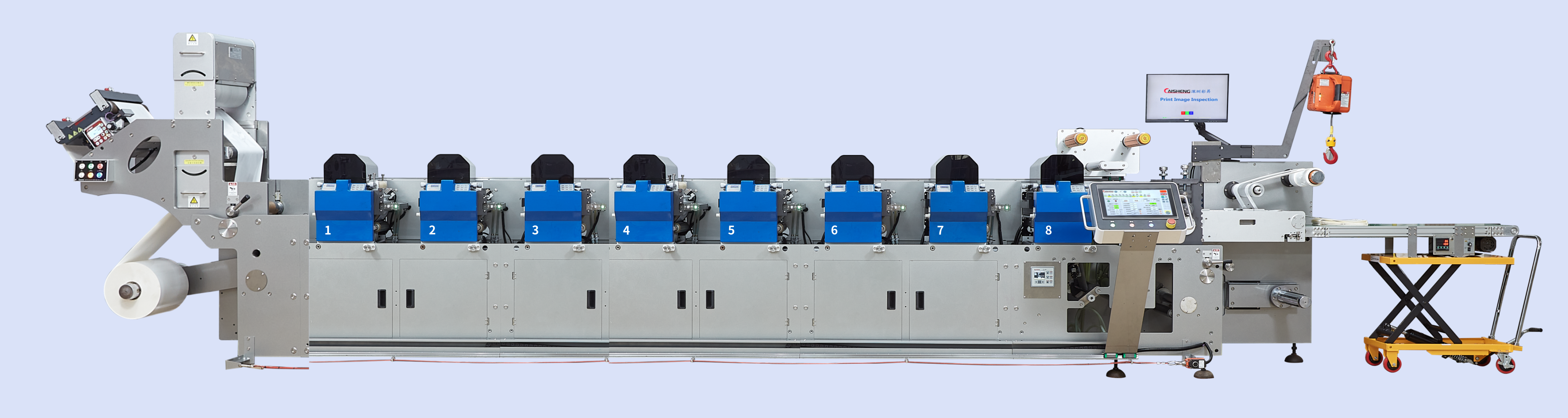
Full-rotary flexo presses target higher-volume label work.
| Model | Category | Maximum speed | Maximum printing area (intermittent / full rotary) | Web width |
|---|---|---|---|---|
| CS-220-4C | Intermittent letterpress label press | 40 m/min | 30×200 mm / 220×245 mm | 30-240 mm |
| CS-320-6C | Semi-rotary label printing machine | 40 m/min | 320×300 mm / 320×326 mm | 30-320 mm |
| CS-JQ350G-6C | Intermittent and full rotary high-speed label press | 60 / 158 m/min | 350×380 mm / 350×419 mm | - |
| CS-Q370F-6C | Full rotary flexographic printing machine | 150 m/min | 370×200 mm / 370×600 mm | - |
CAISHENG as a reference: an integrated platform
Shenzhen Caisheng Printing Machinery Co., Ltd. was established in 2011 and specializes in commercial label printing machines. The company operates a 6,000 m² factory with approximately 65 employees and an R&D team of 8 engineers. Annual output is about 200 units, and roughly half of production is exported to Southeast Asia, Europe, the Middle East, and the United States.
The company's stated design philosophy is 'One Machine, Multiple Functions'. Its catalog covers intermittent letterpress and flexo presses, high-speed hybrid label printing machines, and finishing units such as the CS-350 high-speed die-cutting machine, the CS-Q380V high-speed corona oil integrated machine, and the VS-250W full-rotation screen printing multifunctional machine. For a buyer, this means a single supplier can provide the press and the finishing line, which simplifies process integration and spare-parts planning.
Reading a spec sheet: what the numbers mean
Maximum printing speed is a machine capability, not a guaranteed output. For a semi-rotary label printing machine operating at 40 m/min, actual throughput also depends on label size, substrate, drying and die-cutting.
Maximum printing area is often different between intermittent and full rotary modes. On the CS-320-6C, the intermittent area is 320 by 300 mm while the full rotary area is 320 by 326 mm. This affects the largest label size a converter can produce without changing the configuration.
Web width is a practical constraint. The CS-220-5C and CS-320-6C have web width ranges of 30 to 240 mm and 30 to 320 mm respectively. A narrow-web press cannot handle wider material, so the label size range has to fit the machine width.
Power values indicate installed capacity. The CS-JQ350G-10C uses 13.5 kW LED UV dryers, while other models specify different dryer configurations. Floor space and weight are also relevant: the CS-JQ350G-10C weighs 14 tons and measures 12 m by 1.5 m by 2 m, so facility layout is part of the buying decision.
Application scenarios
According to CAISHENG's application data, these machines are especially suitable for printing self-adhesive labels for daily chemicals, wristbands, wine labels, food, cosmetics, and pharmaceuticals. The system is positioned as a one-stop solution for adhesive label printing, allowing printing factories to complete multiple processes on one machine and produce finished products in one pass.
The equipment operates under normal room temperature conditions and does not require a constant-temperature production workshop. Supporting equipment typically includes a servo system, air cooling, water cooling, and UV drying lamps. A printing factory that handles diverse short-run jobs can benefit from a semi-rotary or hybrid press; a converter running stable long-run food or beverage labels may find a full-rotary flexo press more suitable.
Market context
The global label printing machines market was valued at USD 8.58 billion in 2025 and is projected to reach USD 14.36 billion by 2034, according to The Insight Partners. Flexographic printing remains the most commonly used process for labels, with an output value estimated at USD 13.3 billion by Smithers. At the equipment level, the global flexographic printing machine market was estimated at USD 17.57 billion in 2024, with a projected 9.7 percent CAGR through 2030, according to Grand View Research. Data Bridge Market Research states that Asia-Pacific accounted for a 41.8 percent revenue share in the label printing machines market in 2025.
A narrower signal comes from Spherical Insights, which projects the global narrow web label printing machines market to grow from USD 1.43 billion in 2024 to USD 3.21 billion by 2035. This supports the idea that demand is shifting toward machines that can handle shorter runs and quick changeovers, since narrow-web formats are typically associated with self-adhesive labels. As with any market estimate, scope variations can produce different numbers. The value here is directional rather than a precise forecast.
Traditional single-purpose lines and their limits
Traditional label production often separated printing from finishing: a printing press produced reels, which were then sent to off-line die-cutting or varnishing. The advantage of this model is lower initial cost per machine and simpler operation. The limitation is more work-in-process, more handling, and higher labor input.
Integrated machines reduce those intermediate steps. For example, a letterpress printing machine can be combined with glue-side printing, rotary die-cutting, flatbed die-cutting, and slitting. The trade-off is complexity: integrated lines are heavier and larger, and they require operators who understand multiple processes. A dedicated full-rotary press can still be more cost-effective when production is highly standardized and volumes are high. This boundary should be considered before choosing an integrated platform.
Future outlook
The direction in label machinery is toward hybrid flexibility. The presence of intermittent and full-rotary modes in one press reflects a broader buyer preference for equipment that can handle both short runs and longer production series. The growth projections for narrow-web label machines reinforce this view.
Manufacturers such as CAISHENG, which group printing and finishing in a single platform, are positioned to serve buyers who want to validate processes before scaling. It is reasonable to expect more emphasis on changeover speed, drying efficiency, and inline finishing in future specifications.
Frequently asked questions
What is a label printing machine?
A label printing machine is a press designed to print self-adhesive label stock. It may use letterpress, flexographic, or screen printing technology, and may include inline finishing units. CAISHENG builds intermittent letterpress presses, flexo label presses, full-rotary hybrid machines, and finishing equipment for the printing and packaging industry.
What is the difference between an intermittent label press and a full-rotary label press?
An intermittent label press advances the web in steps, which allows the print repeat to be changed more easily and suits short-run work. A full-rotary label press runs the web continuously and generally achieves higher speed. Some hybrid machines support both modes: the CS-JQ350G-6C runs at 60 m/min in intermittent mode and 158 m/min in full-rotary mode.
What does semi-rotary label printing mean?
Semi-rotary label printing is another term for intermittent feeding: the cylinder rotates intermittently, so the printing length can be varied without replacing the cylinder. The CS-320-6C is classified as a semi-rotary label printing machine and supports both intermittent and full rotary printing modes with a web width of 30 to 320 mm.
What is a flexo label printing machine used for?
A flexo label printing machine is used for label printing with flexographic plates. Flexography is estimated to be the most commonly used process for labels by output value. In CAISHENG's lineup, flexo models such as the CS-J380F-7C and CS-Q370F-6C support different motion systems, allowing buyers to separate the choice of print process from the choice of web motion.
When should a buyer consider a self-adhesive label press?
A self-adhesive label press is intended for pressure-sensitive label stock. CAISHENG's CS-300-5C, for example, is an intermittent letterpress label printing machine with a web width of 30 to 300 mm. Buyers producing labels for daily chemicals, food, cosmetics, and pharmaceuticals are the typical target for this category.
What finishing equipment is often combined with a label printing machine?
Common finishing units include rotary die-cutting, flatbed die-cutting, screen printing modules, and high-speed varnishing units. CAISHENG's range includes the CS-350 high-speed die-cutting machine, the CS-Q380V high-speed corona oil integrated machine, and the VS-250W full-rotation screen printing multifunctional machine, all designed for the printing and packaging industry.
For a full specification reference, CAISHENG publishes a company brochure that can be downloaded here: CAISHENG brochure (PDF).
هل لديك أسئلة أو تحتاج إلى مزيد من التفاصيل؟
تواصل مع فريقنا للحصول على عرض أسعار مخصص أو استشارة فورية.
طلب عرض أسعار
املأ النموذج أدناه وسيتواصل معك فريقنا بعرض مقترح مخصص.
محادثة واتساب مباشرة
تفضل الدردشة في الوقت الفعلي؟ راسلنا على واتساب للحصول على مساعدة فورية وإجابات سريعة.
- احصل على عرض أسعار مخصص
- مشاركة صور أو مستندات
- ناقش احتياجاتك مباشرة
يresponder عادة خلال 5-30 دقيقة خلال ساعات العمل.