
Investment Casting Certifications: Automotive vs Heavy Equipment
Investment Casting Certifications: Automotive vs Heavy Equipment
A certificate wall and an application requirement rarely line up on their own. Global investment casting demand is projected to reach approximately USD 20.52 billion in 2026, and automotive applications account for roughly 29% of that demand. The certificate that makes a foundry credible for a gearbox housing program is not the same certificate that mining, agriculture, construction, or valve buyers lean on during supplier qualification. For sourcing teams, the useful question is narrower than "is this supplier certified?" It is whether the scope printed beneath each certificate number actually covers the production being quoted.
Why Certificate Logos Are Not Enough
Management-system certificates are issued against a defined scope, by a named certification body, for a defined validity period. Two or three suppliers can all display an ISO 9001 mark while being certified for materially different activities. Reading the scope line, the certificate number, the issuing body, and the expiry date is the difference between a generic qualification claim and a usable one.
That discipline matters more, not less, when a program spans two industries. An investment casting supplier may hold an automotive quality certificate and a general steel casting quality certificate at the same time, and each document supports a different buyer conversation. The risk in sourcing is not the absence of a logo; it is assuming that one logo transfers to an application it was never scoped for.
IATF 16949:2016: What the Automotive Scope Covers
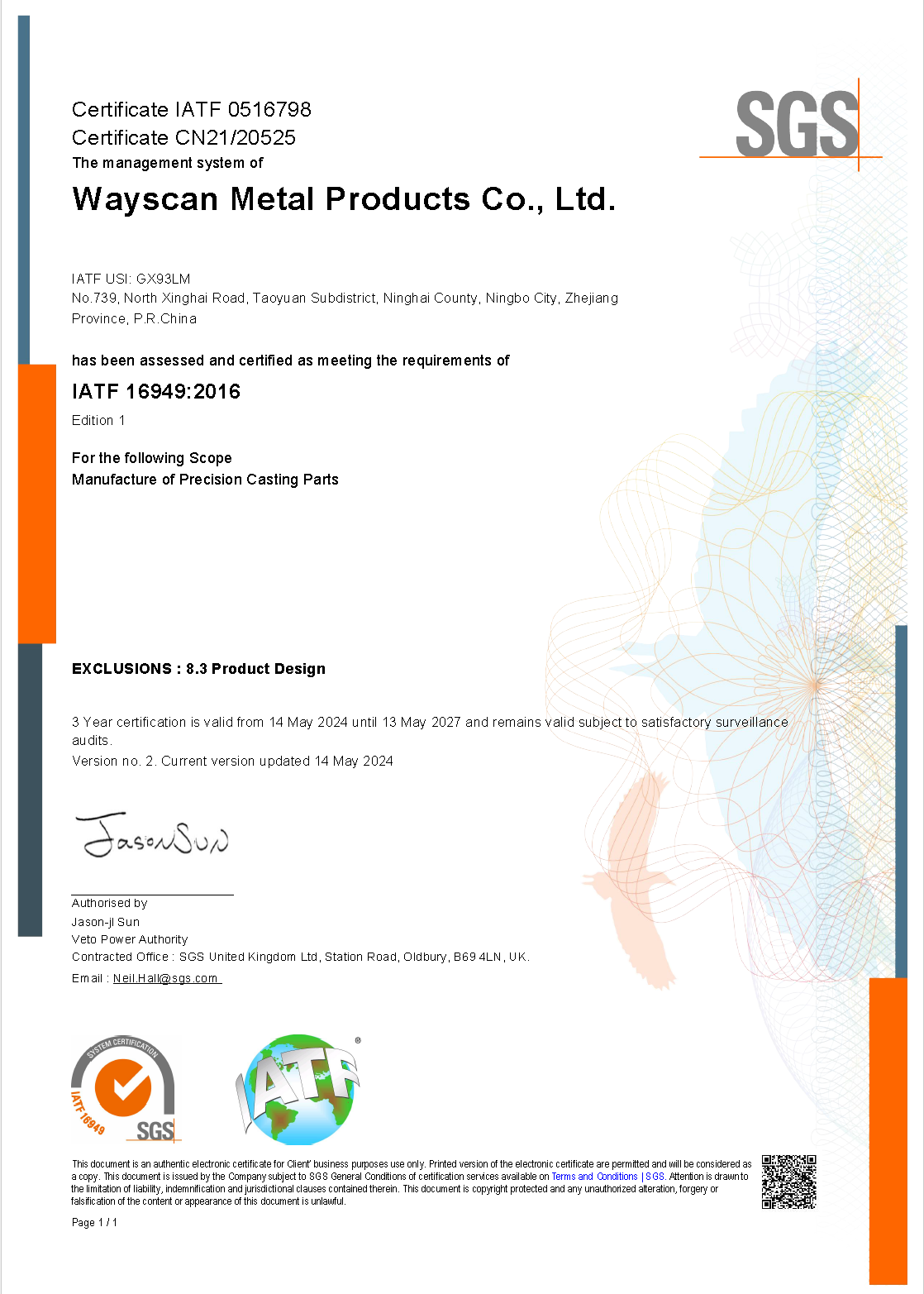
IATF 16949:2016 remains the critical quality management system requirement for investment casting suppliers serving the automotive supply chain. WAYSCAN METAL PRODUCTS CO., LTD holds IATF 16949:2016 certificate number IATF 0516798, issued by SGS United Kingdom Ltd., registered to the global / international automotive supply chain market, with a scope of "Manufacture of Precision Casting Parts". The certificate was issued on 14 May 2024 and is valid to 13 May 2027.
What that scope supports: a sourcing team can treat the supplier's quality management system as audited against automotive requirements for precision casting part manufacture — the entry condition for most automotive OEM and tier programs, though never the final condition.
What it does not replace: part-level approval. The certificate does not certify a particular part number, a specific material grade, or a specific production line, and it does not waive customer-specific requirements. Dimensional reports, material certificates, NDT results, and mechanical property evidence remain program-specific deliverables.
ISO 9001:2015: Coverage for Steel Casting Production
The second quality certificate is broader by design. WAYSCAN holds ISO 9001:2015 certificate number 02426Q00625R401, issued by Shenzhen Universal Certification Centre Co., Ltd. (UCC), with a scope of "Production of Steel Casting", certified to GB/T 19001-2016 / ISO 9001:2015. It was issued on 21 May 2026 and is valid to 20 May 2029.
The scope wording addresses steel casting production as a whole rather than a named industry chain. For heavy equipment, mining, agricultural machinery, construction machinery, valve, and general machinery components, that broader scope is often the relevant baseline, supported by material certification, inspection records, and the buyer's own supplier audit.
The limitation runs in the opposite direction from the automotive case: ISO 9001:2015 is a general quality framework and does not itself carry automotive industry requirements or automotive customer-specific expectations. Buyers inside the automotive chain generally treat the IATF scope as an additional requirement rather than an alternative one.
ISO 14001:2015 and ISO 45001:2018: The Supporting Certificates
Two further certificates extend management-system coverage without extending any product conformity claim. WAYSCAN holds ISO 14001:2015 certificate number 02426E00394R401 and ISO 45001:2018 certificate number 02426S00381R101, both issued by Shenzhen Universal Certification Centre Co., Ltd. (UCC), both scoped to "Production of Steel Castings and Related Management Activities", and both valid from 21 May 2026 to 20 May 2029. The environmental certificate is certified to GB/T 24001-2016 / ISO 14001:2015, and the occupational health and safety certificate to GB/T 45001-2020 / ISO 45001:2018.
These documents enter the evaluation at a different stage. Heavy equipment, mining, and construction machinery buyers increasingly include environmental and safety management system evidence in supplier onboarding, site access approval, and annual audit checklists. What they confirm is how the site manages environmental impact and occupational risk. What they do not confirm is casting quality, dimensional capability, or delivery performance.
Certification Scope Compared by Application
| Certificate | Registered scope | Issuing body | Validity | Supports | Does not prove |
|---|---|---|---|---|---|
| IATF 16949:2016 (No. IATF 0516798) | Manufacture of Precision Casting Parts | SGS United Kingdom Ltd. | 2024-05-14 to 2027-05-13 | Automotive OEM and automotive-tier supply chain qualification | Part-level approval, PPAP documentation, or customer-specific requirements |
| ISO 9001:2015 (No. 02426Q00625R401) | Production of Steel Casting | Shenzhen Universal Certification Centre Co., Ltd. (UCC) | 2026-05-21 to 2029-05-20 | Steel casting production across industrial applications | Automotive supply-chain acceptance on its own |
| ISO 14001:2015 (No. 02426E00394R401) | Production of Steel Castings and Related Management Activities | Shenzhen Universal Certification Centre Co., Ltd. (UCC) | 2026-05-21 to 2029-05-20 | Environmental management evidence in supplier audits and ESG documentation | Product quality or dimensional conformity |
| ISO 45001:2018 (No. 02426S00381R101) | Production of Steel Castings and Related Management Activities | Shenzhen Universal Certification Centre Co., Ltd. (UCC) | 2026-05-21 to 2029-05-20 | Occupational health and safety management, site audit readiness | Product quality or delivery performance |
Automotive OEM vs Heavy Equipment: What Changes for the Buyer
The two sourcing routes draw on the same foundry capability but read the certification evidence in different order. The table below compares the dimensions that most often decide supplier qualification.
| Sourcing dimension | Automotive OEM components | Heavy equipment, mining, agriculture, construction, valves |
|---|---|---|
| Typical part families | Gearbox Housing, Transmission Housing, Mounting Bracket, Yoke | Clevis Bracket, Link Arm, Pipe Elbow, general machinery components |
| Certification entry point | IATF 16949:2016 scoped to manufacture of precision casting parts, plus ISO 9001:2015 | ISO 9001:2015 scoped to production of steel casting, often with ISO 14001:2015 and ISO 45001:2018 |
| Validation emphasis | Dimensional accuracy, mechanical properties, documented traceability | Structural fit, wear behaviour, field service life, material grade confirmation |
| Volume pattern | Higher and more repetitive program volumes | Lower and more variable volumes, batch or replacement-part driven |
| Change control | Formal engineering change procedures | Changes often follow field performance feedback |
| Commercial structure | Long-term supply agreements | Order-by-order and batch customization |
Nothing in that comparison ranks one route above the other. The point for buyers is that an automotive scope answers an automotive question, and a steel casting scope answers a broader production question; matching the scope to the application is what makes the certificate useful.
One documented application illustrates the pattern on the automotive side. An automotive parts OEM in the United States sourced investment castings for a truck axle system, with 1000 tons delivered across a relationship lasting 30 years and stable operation. The reported outcome was castings whose appearance, dimensional accuracy, and mechanical properties met the drawing requirements. That kind of long-run repeatability is precisely what an automotive audit trail is designed to protect, and it is delivered by the part-level process rather than by the certificate itself.
Process, Tolerance, and Material Baseline
WAYSCAN produces investment castings (lost-wax casting) through silica-sol investment casting and silica-sol composite investment casting routes, with water-glass investment casting also operated. Published capability figures are these: dimensional tolerance to CT6 for silica-sol, CT8 for silica-sol composite, and 0.01 mm under machining; surface roughness of Ra 6.4 to 12.5 μm depending on the casting process and post-treatment. Material coverage includes carbon steel, alloy steel, stainless steel, and ductile iron, with specific grades confirmed against customer drawings.
Inspection methods applied to production include spectrometer analysis, X-ray inspection, ultrasonic testing, hardness and tensile testing, and CMM dimensional inspection. On the standards side, ASTM A957 is the primary standard specification for common requirements of steel and alloy investment castings for general industrial use, which makes it a reasonable baseline when a drawing references general requirements rather than a fully automotive specification.
The part models quoted against these process routes are Pipe Elbow, Clevis Bracket, Yoke, Gearbox Housing, Transmission Housing, Mounting Bracket, and Link Arm, serving automotive, forklift, mining, agricultural machinery, construction machinery, valves, and general machinery component applications.

Customization, Sampling, and Order Mechanics
Customization at this supplier is drawing-driven. Size, geometry, material, surface, and heat treatment are defined from customer drawings, and rapid no-mold samples are available through 3D printing. ODM and OEM production services are both offered, so a buyer can either supply a fully specified design or work from a supplier-supported design path.
Order mechanics are stated plainly: minimum order quantity of 100 kg, typical production lead time of 30 to 60 days, and monthly production capacity of 1500 tons. Commercial terms include FOB or EXW delivery, pre-shipment and destination testing as acceptance criteria, and payment terms of Net 30 to 60 days. After-sales support covers technical support and quality tracking, with specific warranty and liability terms agreed in the contract.
One clarification matters at the certification stage. A 3D-printed no-mold sample validates geometry early and cheaply, but it does not validate casting process capability. Process capability is demonstrated on production parts through the dimensional and mechanical inspection programme described above.
Where Investment Casting Stops Being the Right Answer
Investment casting is a precision route, not a universal one. Three boundaries are worth stating openly before a sourcing decision is locked.
- Size and weight economics. Investment casting suits smaller, more complex parts that require higher accuracy and smoother surfaces. Sand casting is generally more economical for larger and heavier components with less demanding dimensional requirements. The accuracy advantage of investment casting comes with a relatively higher cost, which becomes a real constraint at the large end of the size range.
- Alternative casting routes. Shell mold casting offers good dimensional stability and is well suited to medium- to high-volume production of medium-sized steel castings. Resin sand casting suits large castings weighing tens of kilograms or more, requires lower tooling investment, and generally delivers lower dimensional accuracy and a rougher surface finish.
- Certification boundaries. No scope statement in this article certifies a part. An automotive programme still requires part-level approval after the certificate check, and an ISO 9001:2015 scope for steel casting production does not place a supplier on an automotive approved-source list by itself.
A fourth boundary is operational rather than technical: a 100 kg minimum order quantity and a typical 30 to 60 day lead time suit repeat production and programme volumes. They are not designed around urgent, one-off quantities measured in single pieces.
Market Signals Behind Scope-Based Sourcing
Market data should be kept separate from certification evidence, because it describes demand rather than capability. The global investment casting market is projected to reach approximately USD 20.52 billion in 2026 (Fortune Business Insights). A comparable forecast tracked in the same dataset places the market at USD 18.3 billion, with the difference attributed to whether the definition covers industrial-only applications or includes aerospace-grade segments — a reminder that market-size statements should be read together with their segment definition.
On process mix, the silica sol (colloidal silica) process held a 54.3% share in 2025, ahead of the water glass process at 32.1% (Dataintelo), consistent with buyer preference for precision and surface finish. Automotive applications represent approximately 29% of investment casting demand (Business Research Insights), the largest volume-driven segment. Trade data adds a caveat rather than a number to lean on: global exports of "cast articles of iron or steel, n.e.s." (HS 732599) reached USD 4,320.81 million in 2025 (UN Comtrade), but that code aggregates cast articles generally and is not specific to investment castings.
Future Outlook
Three directions appear to be moving at once. First, scope-based screening: as automotive requirements and general quality requirements continue to sit on the same certificate wall, buyers are being pushed to read scope lines rather than count logos. Second, environmental and safety management systems look set to remain permanent items on heavy equipment and mining audit checklists rather than one-off requests. Third, process preference continues to lean toward silica sol routes for precision and surface finish, which raises the practical value of suppliers able to operate both silica sol and composite routes on one site, alongside integrated casting, heat treatment, and machining capability.
None of these shifts removes the underlying constraint. A certificate defines the management system that was audited; the drawing defines the part that must be delivered. Buyers who keep those two statements separate will find the certification comparison genuinely useful, and those who merge them will keep discovering the gap at first-article inspection.
FAQ
How does IATF 16949:2016 differ from ISO 9001:2015 for an investment casting supplier?
They are different management-system standards with different registered scopes. WAYSCAN's IATF 16949:2016 certificate (IATF 0516798, issued by SGS United Kingdom Ltd.) is scoped to "Manufacture of Precision Casting Parts" and registered to the global / international automotive supply chain market, valid from 14 May 2024 to 13 May 2027. Its ISO 9001:2015 certificate (02426Q00625R401, issued by Shenzhen Universal Certification Centre Co., Ltd.) is scoped to "Production of Steel Casting", certified to GB/T 19001-2016 / ISO 9001:2015, and valid from 21 May 2026 to 20 May 2029. The IATF scope supports automotive supply chain qualification; the ISO 9001 scope covers steel casting production more broadly.
Do heavy equipment, mining, agriculture, construction and valve programmes need IATF 16949:2016?
Not necessarily. Those applications are generally served by a steel casting quality scope such as ISO 9001:2015 scoped to production of steel casting, supported by drawing-level dimensional and mechanical evidence. Heavy equipment and mining buyers frequently also review ISO 14001:2015 and ISO 45001:2018 during supplier onboarding. IATF 16949:2016 becomes the relevant requirement when the component enters an automotive or automotive-tier supply chain, since it remains the critical quality management system requirement for investment casting suppliers serving that chain.
What role do ISO 14001:2015 and ISO 45001:2018 play in casting supplier evaluation?
Both are management-system certificates, scoped to "Production of Steel Castings and Related Management Activities", issued by Shenzhen Universal Certification Centre Co., Ltd. (UCC), and valid from 21 May 2026 to 20 May 2029. ISO 14001:2015 is certified to GB/T 24001-2016 / ISO 14001:2015 and ISO 45001:2018 to GB/T 45001-2020 / ISO 45001:2018. They support environmental and occupational health and safety evaluation, site audit readiness, and ESG documentation. They do not certify casting quality, dimensional capability, or delivery performance.
Investment casting versus sand casting: which is better?
Neither is universally better. Investment casting is better for smaller, more complex parts requiring higher accuracy and smoother surfaces. Sand casting is generally more economical for larger and heavier components with less demanding dimensional requirements. The decision typically turns on part size, geometry complexity, and the dimensional tolerance the drawing actually requires.
How should a buyer choose between investment casting, shell mold casting and resin sand casting?
Investment casting offers the highest dimensional accuracy and the best surface finish, suits small to medium-sized complex parts, and is particularly relevant for stainless steel and other high-alloy steels, at a relatively higher cost. Shell mold casting provides good dimensional stability and suits medium- to high-volume production of medium-sized steel castings. Resin sand casting suits large castings weighing tens of kilograms or more, requires lower tooling investment, and generally provides lower dimensional accuracy and a rougher surface finish.
What purchasing terms and acceptance criteria typically apply to custom investment casting orders?
Common terms are a minimum order quantity of 100 kg, delivery on FOB or EXW basis, acceptance criteria based on pre-shipment and destination testing, and payment terms of Net 30 to 60 days. Typical production lead time is 30 to 60 days, with monthly production capacity of 1500 tons. Customization is based on customer drawings covering size, geometry, material, surface, and heat treatment, and rapid no-mold samples can be provided via 3D printing. Warranty and liability terms are agreed in the contract.
Reference material: a downloadable company presentation covering process routes, certification scope and production capability is available here — Wayscan Metal Products Co., Ltd. company presentation (PDF). Supplier information: www.wayscan.com.