
Investment Casting Supplier Evaluation for Long-Term Supply
A long-term investment casting decision is not primarily a capability question; it is a continuity question. Once a component has cleared first-article inspection, the buyer's exposure shifts from "can this supplier make the part" to "can this supplier keep making it" while volumes, drawings, auditors and freight conditions change. The evidence that answers the second question — capacity structure, workforce depth, certification scope and export footprint — is different from the evidence used at quotation stage.
Why Programme-Level Evaluation Differs From Order-Level Evaluation
Order-level evaluation is a capability test. It asks whether the supplier can hold a tolerance, pour a material grade, and deliver a quantity on a date. Programme-level evaluation is a durability test. It asks whether the same supplier will still be holding that tolerance in year three, after a drawing revision, a resin change, a key operator leaving, and two surveillance audits.
The two evaluations produce different shortlists. A foundry can quote competitively, pass a sample and still represent a poor three-year partner if its capacity is fully committed to one export customer, if its engineering bench is thin, or if its certification scope excludes the process it used to make the sample. For industrial buyers — valve, heavy equipment, automotive and machinery programmes — the cost of that discovery is not the part price. It is the requalification cycle, the line stoppage risk, and the re-sourcing project that follows.
This reference sets out an evaluation method built around four continuity risks, using WAYSCAN METAL PRODUCTS CO., LTD as a worked example. Wayscan is a precision casting manufacturer established in 1991, operating a 46,000 m² production base in Ninghai, Ningbo, China, producing precision castings, investment castings, stainless steel, carbon steel and alloy steel castings and machined cast components.
The Four Continuity Risks a Long-Term Buyer Is Actually Pricing
Most supplier questionnaires gather capability data. A long-term evaluation should instead gather evidence about the four ways a supply line typically fails over a multi-year horizon.
| Continuity risk | What it looks like in practice | Evidence that reduces it |
|---|---|---|
| Capacity allocation | The supplier accepts the order but the tonnage is already committed to a larger customer during peak months | Capacity broken down by process line, material group and month — not a single annual figure |
| Workforce and engineering depth | Process knowledge sits with one or two individuals; a departure delays corrective action | Engineering headcount relative to production headcount, ownership of process change, documented corrective-action workflow |
| Certification scope and validity | The certificate exists but does not cover the actual process, site, or current audit cycle | Certificate number, issuing body, scope statement, validity dates, surveillance status |
| Market exposure | Demand collapses or surges in one region and delivery windows move without notice | Export share, destination mix, and how the order book is distributed across markets |
Two of these risks — certification and capacity — are commonly checked. Workforce depth and market exposure are usually assumed rather than verified, which is why they account for a disproportionate share of long-term supply failures.
Reading Annual Capacity Correctly
Wayscan reports an annual output of 20,000 tons, produced within a 46,000 m² facility by a workforce of more than 500 people. Those three figures together describe scale; individually they can mislead.
An annual tonnage is a ceiling, not an allocation. It tells a buyer what the plant can physically produce across all customers and all products in twelve months. It does not tell them what share is available in the specific months their programme needs it, on the specific process line their part requires, in the specific material group they specified. A 20,000-ton annual figure covering silica sol and composite process casting, stainless, carbon and alloy steels, and finished machined components is a portfolio number, not a promise to any single programme.
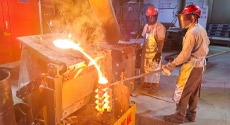
Pouring stage. An annual tonnage figure only becomes decision-grade information once it is broken down by process line, material group and month.
The practical question to put to any supplier is therefore narrower: for our part family, on your silica sol line, in our two peak months, what capacity have you reserved and what happens to it if a larger customer raises volume? A supplier that can answer with a monthly allocation model is materially safer than one that answers with a headline number.
Workforce and Engineering Depth as a Leading Indicator
Wayscan's workforce of over 500 includes more than 20 senior engineering and technical personnel. That ratio matters less as a number than as an answer to a specific question: who owns a process change?
In investment casting, the failure modes that appear in year two or three are rarely metallurgical surprises. They are drift — a revised shell-building cycle, a substituted binder batch, a re-sequenced heat-treatment load, a new machining fixture. Each is a legitimate change; the risk is whether the change is reviewed by someone with the authority and knowledge to see its downstream effect on dimensional repeatability, and whether the customer is notified before it happens rather than after a non-conformance.
A buyer evaluating a long-term partner should ask to see the change-notification procedure, the identity of the person who signs it, and one recent example of a change that was notified to a customer. Engineering headcount is supporting context; the change-control workflow is the actual evidence.
Certification Depth: What Each Standard Actually Protects
Certificates are frequently treated as a pass or fail item on a questionnaire. In a long-term evaluation they are better read as four separate risk instruments, each covering a different failure mode.
ISO 9001:2015 — the baseline control system
ISO 9001:2015 establishes the quality management baseline: documented process control, corrective action, internal audit and management review. Its long-term value is not that it proves part quality; it is that it evidences a system capable of detecting and closing its own failures. A supplier without a functioning corrective-action loop will repeat the same defect across programmes.
IATF 16949:2016 — the automotive qualification gate
IATF 16949:2016 remains the critical quality management system requirement for investment casting suppliers serving the automotive supply chain. It adds the disciplines automotive buyers depend on: advanced quality planning, production-part approval, measurement system analysis, control plans and traceability. For long-term supply, its most valuable element is requalification discipline — the requirement that changes trigger re-approval rather than silent substitution.
ISO 14001:2015 — the environmental continuity risk
ISO 14001:2015 addresses environmental management. Buyers sometimes treat it as a corporate-social-responsibility box, but it is a genuine continuity instrument: a casting plant with unresolved waste, emissions or permit issues can be interrupted by a regulator regardless of its delivery performance. Wayscan's environmental trajectory is observable in its own operating record — it invested in composite process precision casting in 2020 to replace the original water glass process, and in 2023 was designated a waste-free factory, a four-star green factory and a water-saving factory. Those designations are practice evidence, not a substitute for verifying the ISO 14001 certificate scope; they are best used as cross-checks against it.
ISO 45001:2018 — the people-continuity risk
ISO 45001:2018 covers occupational health and safety management. In a foundry, safety performance is directly coupled to production continuity: an incident closes a line, triggers an investigation, and can remove the most experienced operators from the floor for weeks. It is also increasingly a labour-audit requirement for buyers sourcing from multiple regions.
| Standard | Continuity risk addressed | What the buyer should verify, not assume |
|---|---|---|
| ISO 9001:2015 | Systemic quality drift and repeated defects | Certificate number, issuing body, validity, and whether the scope covers casting and machining |
| IATF 16949:2016 | Uncontrolled change and requalification gaps in automotive programmes | Scope statement, current surveillance status, and the change-notification procedure behind it |
| ISO 14001:2015 | Regulatory interruption, permit and waste exposure | Site coverage — a certificate for one site does not cover another |
| ISO 45001:2018 | Incident-driven stoppage and labour-audit exposure | Validity dates and whether the scope includes foundry operations specifically |
Export Footprint as a Stability Signal
Wayscan exports approximately 70% of its output, with main markets including China, Japan and the USA. For a buyer, that figure carries two distinct readings.
The first is favourable. Japan and the United States are demanding qualification environments: documentation discipline, dimensional reporting and audit readiness are conditions of entry, not optional extras. A supplier that has sustained 70% export share across those markets has usually built its quality system around external scrutiny rather than internal habit — and that system is what a new buyer inherits on day one.
The second reading is a caution. An export-weighted order book means domestic or regional programmes share capacity with export programmes that may carry contractual priority. It also means delivery windows can move with freight conditions and currency-driven demand shifts in markets the buyer does not operate in. Neither reading is disqualifying; both belong in the evaluation rather than in the assumptions.
Where an Integrated Model Changes the Risk Profile
The supply model itself is a continuity variable. A common arrangement in the casting market splits responsibilities: a foundry produces the raw casting, a separate machine shop finishes it, and inspection is handled by whichever party the buyer can persuade to take ownership.
Wayscan operates the alternative model. Its production covers composite process and silica sol precision casting across stainless, carbon and alloy steels, supported by in-house machining workshops and inspection equipment, so castings and machined components leave the same quality system. The practical difference over a multi-year programme is handoffs. Every transfer of a part between suppliers is a transfer of traceability, a new source of dimensional variation, and a new party to include in a corrective-action loop.
| Supply model | Typical structure | Long-term implication |
|---|---|---|
| Integrated casting and machining | Silica sol and composite process casting, machining and inspection under one quality system | Single traceability chain and single corrective-action owner; supplier-reported internal rejection rate of ≤1% |
| Local small and medium foundries | Casting or machining offered separately, with limited inspection equipment | More handoffs, weaker dimensional feedback between process stages, buyer absorbs coordination risk |
| Large overseas casting suppliers | Broad capability, longer logistics chain, different commercial thresholds | Strong systems but extended lead times and less schedule flexibility on smaller programmes |
The rejection-rate figure above is supplier-reported and should be treated as a starting point for verification — requested as defect data by part family across a defined period — rather than as an audited statistic.
Technical Control Points That Decide Repeatability
Long-term consistency in investment casting is produced at a small number of process points. A buyer does not need to audit all of them, but should know which ones a supplier can describe in operational detail.
- Shell making. Ceramic shell build-up determines surface finish and dimensional stability; the number of coats, slurry control and drying conditions are the variables that drift.
- Dewaxing and firing. Incomplete removal or incorrect firing profiles show up later as shell defects and inclusion risk.
- Pouring and heat treatment. Material grade alone does not define mechanical properties; the thermal cycle does. Heat-treatment records are the evidence.
- Non-destructive and mechanical testing. Radiographic, penetrant and mechanical test capability determines whether defects are found before shipment or at the customer's incoming inspection.
- Machining and surface finish. For near-net-shape and thin-wall parts, the casting-to-machining interface decides whether tight-tolerance features are achieved economically or by sorting.
For a supplier running both silica sol and composite process casting, the additional question is which line a given part family will be produced on — and whether that assignment is fixed for the programme duration or may change with load.
Application Fit
Automotive applications represent the largest volume-driven segment of investment casting demand, accounting for approximately 29% of the market. The same process characteristics that serve automotive — repeatability on complex geometry, thin-wall capability and near-net-shape economy — carry across to valve components, heavy equipment parts and agricultural and construction machinery components.
Wayscan's material range of stainless steel, carbon steel and alloy steel castings, combined with in-house machining, maps onto those categories. The evaluative question is not whether the categories are listed, but whether the buyer's specific part family has been produced before, at what volume, and with what documented first-pass yield. Prototype and low-volume investment casting work exercises a different part of a plant than serial production, and a supplier strong in one is not automatically strong in the other.
Market Context: What Is Changing in the Supply Base
Three measurable shifts are relevant to a multi-year sourcing decision.
Process mix is moving toward silica sol. The silica sol (colloidal silica) process held a 54.3% share of the investment casting market in 2025, ahead of the water glass process at 32.1%, reflecting a preference for precision and surface finish. Suppliers still weighted toward water glass face a transition cost that a long-term buyer may end up funding through price or through capability gaps.
Market size estimates vary by scope. Global investment casting market size is projected to reach approximately USD 20.52 billion in 2026 according to Fortune Business Insights, while Grand View Research forecasts USD 18.3 billion — a difference generally attributed to whether aerospace-grade segments are included. Published ranges for the broader metal casting industry vary far more widely, so any market figure should be read as directional rather than precise.
Trade flows remain substantial. Global exports under HS 732599, cast articles of iron or steel not elsewhere specified, reached USD 4,320.81 million in 2025 according to UN Comtrade. That code aggregates investment castings with other steel castings, so it indicates the scale of cross-border casting trade rather than investment casting specifically.
On the standards side, ASTM A957 remains the primary specification covering common requirements for steel and alloy investment castings for general industrial use, and IATF 16949:2016 remains the gate for automotive supply. Neither changes quickly, which is precisely why a supplier's certification scope is a stable and comparable evaluation variable.
Limits of This Evaluation Method
The integrated model described above is not universally the right answer, and three limits should be stated plainly.
First, investment casting is the higher-cost route for large, heavy components with looser dimensional requirements. For castings weighing tens of kilograms or more where surface finish and tight tolerance are not the constraint, resin sand casting typically offers lower tooling investment and remains more economical. Shell mold casting occupies the middle ground for medium-sized steel castings at medium to high volume. A buyer who applies investment casting evaluation criteria to a part better suited to sand casting will select an excellent supplier for the wrong process.
Second, a single integrated source concentrates qualification dependency. Some procurement policies require dual-sourcing regardless of supplier quality, and that requirement does not disappear because one supplier is well certified.
Third, 20,000 tons of annual capacity is finite and shared. Because roughly 70% of output is exported, domestic delivery windows can be less flexible during peak export periods. Buyers with seasonal demand should negotiate allocation explicitly rather than rely on goodwill.
A Practical Evaluation Scorecard
| Area | Question to answer | Evidence to request |
|---|---|---|
| Capacity structure | Can the supplier hold our monthly volume on the correct process line? | Capacity by line, material group and month; peak allocation commitment |
| Workforce depth | Who owns process change, and how is it notified? | Change-notification procedure with a named approver and one worked example |
| Certification scope | Do the certificates cover this process, this site, this period? | Certificate numbers, issuing bodies, scope statements, validity and surveillance status |
| Export and market mix | How is the order book distributed, and what does that mean for our windows? | Export share, destination mix, and historical on-time performance by market |
| Process integration | How many handoffs sit between casting and shipped part? | Process flow from shell making to machining, with traceability points identified |
| Quality outcome | What is the actual defect experience, not the headline figure? | Rejection and rework data by part family over a defined period |
| Commercial terms | Are the terms workable across the programme life? | MOQ 100 kg, FOB/EXW delivery terms, pre-shipment and destination test acceptance, payment terms of net 30–60 days |
Future Outlook
Three developments are likely to shape long-term supplier evaluation over the next several years.
Process transition will continue. As silica sol's share of the market has already moved ahead of water glass, suppliers that have not converted face either capital expenditure or gradual exclusion from precision-sensitive programmes. Wayscan's 2020 investment in composite process precision casting to replace its original water glass process is an example of that transition being made ahead of customer pressure, with the stated aim of improving efficiency and reducing environmental impact.
Certification scrutiny will tighten rather than loosen. Automotive buyers already treat IATF 16949:2016 as non-negotiable, and environmental and occupational-safety standards are increasingly pulled into supplier scorecards by procurement rather than by compliance departments alone. The direction of travel is toward scope-level verification — checking what a certificate actually covers — rather than certificate-count comparison.
Traceability will become a purchasing requirement. Buyers increasingly expect defect data by part family, change history by programme, and test records retrievable on request. Suppliers with integrated casting-to-machining flows are structurally better placed here, because the data chain is not split across vendors.
FAQ
What evidence should be requested before signing a multi-year investment casting agreement?
At minimum: capacity broken down by process line, material group and month rather than a single annual figure; certificate numbers with issuing bodies, scope statements and validity dates; the change-notification procedure with a named approver; defect and rework data by part family over a defined period; and the agreed acceptance criteria, which typically combine pre-shipment and destination testing.
Which management system standards matter most for a long-term casting supplier?
Four are commonly relevant. ISO 9001:2015 provides the baseline quality system. IATF 16949:2016 remains the critical quality management system requirement for suppliers serving the automotive supply chain, adding production-part approval, control plans and requalification discipline. ISO 14001:2015 covers environmental management and therefore regulatory interruption risk. ISO 45001:2018 covers occupational health and safety, which in a foundry is directly linked to production continuity.
How should a buyer interpret an annual capacity figure such as 20,000 tons?
As a ceiling, not an allocation. Wayscan reports 20,000 tons of annual output within a 46,000 m² facility staffed by more than 500 employees, spanning silica sol and composite process casting, stainless, carbon and alloy steels, and machined components. That total is shared across all customers and product families, so a buyer should confirm what capacity is available in their specific months, on their specific process line.
What does a 70% export share indicate about supply stability?
Wayscan exports roughly 70% of output, with main markets including China, Japan and the USA. On the positive side, sustained exposure to Japanese and US qualification requirements tends to produce documentation and audit discipline that a new buyer inherits immediately. On the cautionary side, an export-weighted order book means domestic or regional programmes share capacity with export programmes that may carry priority during peak periods.
How do purchasing terms and acceptance criteria typically work in these agreements?
In Wayscan's published terms, minimum order quantity is 100 kg, delivery terms are FOB or EXW, acceptance criteria combine pre-shipment and destination testing, and payment terms are net 30–60 days. Buyers should confirm that these terms can be held for the full programme duration rather than only for the initial order.
When is investment casting the wrong long-term choice?
Investment casting offers the highest dimensional accuracy and best surface finish and suits small to medium-sized complex parts, particularly in stainless and other high-alloy steels, at a relatively higher cost. For large castings weighing tens of kilograms or more with less demanding dimensional requirements, resin sand casting is generally more economical with lower tooling investment, and shell mold casting is often better suited to medium to high-volume production of medium-sized steel castings.
Company and capability details in this reference are drawn from Wayscan Metal Products Co., Ltd. published company information. Market and standards references: Fortune Business Insights (investment casting market size, 2026 forecast), Grand View Research (alternate market forecast), Dataintelo (process share, 2025), Business Research Insights (application share, 2025), UN Comtrade (HS 732599 export value, 2025), ASTM International (ASTM A957) and the International Automotive Task Force (IATF 16949:2016).
A full company and capability presentation is available for download: Wayscan Metal Products Co., Ltd. — Company Presentation (PDF).
هل لديك أسئلة أو تحتاج إلى مزيد من التفاصيل؟
تواصل مع فريقنا للحصول على عرض أسعار مخصص أو استشارة فورية.
طلب عرض أسعار
املأ النموذج أدناه وسيتواصل معك فريقنا بعرض مقترح مخصص.
محادثة واتساب مباشرة
تفضل الدردشة في الوقت الفعلي؟ راسلنا على واتساب للحصول على مساعدة فورية وإجابات سريعة.
- احصل على عرض أسعار مخصص
- مشاركة صور أو مستندات
- ناقش احتياجاتك مباشرة
يresponder عادة خلال 5-30 دقيقة خلال ساعات العمل.