
Investment Casting Supplier Review: Wayscan Metal Products
Investment Casting Supplier Review: Wayscan Metal Products
An independent industry reference on manufacturing capability, process depth and procurement value in precision investment casting — published September 2026.

Panoramic view of the Wayscan Metal Products manufacturing base in Ninghai, Ningbo, China. Image: WAYSCAN METAL PRODUCTS CO., LTD.
Investment casting, also called lost-wax casting, occupies a specific position in industrial supply chains: it is the route buyers specify when a part is too complex, too thin-walled or too tolerance-sensitive for sand casting, yet too costly to produce entirely from bar stock. Global demand for the process is projected to reach approximately USD 20.52 billion in 2026, according to Fortune Business Insights. Within that market, Dataintelo reported that the silica sol (colloidal silica) process held the largest share at 54.3% in 2025, ahead of the water glass process at 32.1%, while Business Research Insights estimates that automotive applications account for roughly 29% of demand.
For a buyer in the awareness and research stage, the practical question is rarely whether investment casting is technically suitable. It is which suppliers can hold the tolerances they quote, document the material they pour, and deliver a machined, inspected component rather than a rough casting with an inspection certificate of unclear scope. This review examines WAYSCAN METAL PRODUCTS CO., LTD. — a manufacturer founded in 1991 that produces precision castings, stainless steel castings, carbon steel castings, alloy steel castings and machined cast components from a 46,000 m² production base in Ninghai, Ningbo, China — and assesses where its capabilities create genuine procurement value, and where buyers should still verify details before committing.
The Buying Problem: Fragmented Supply and Unverified Capability Claims
Investment casting supply is structurally fragmented. A significant share of the world's foundry capacity sits with small and medium workshops that perform one step of the chain — pattern making, shell building, pouring or machining — and rely on external partners for the rest. That structure creates three recurring problems for buyers.
- Interface losses. When casting, heat treatment, machining and inspection are handled by different vendors, dimensional responsibility becomes ambiguous. A tolerance excursion discovered after shipment is difficult to trace to a single accountable party.
- Verification gaps. Quoted tolerances and material grades are frequently stated without the in-house testing capability to prove them. Material composition, mechanical properties and internal soundness require equipment, not assertions.
- Qualification friction. For automotive and other regulated supply chains, IATF 16949:2016 remains the critical quality management system requirement for investment casting suppliers. Buyers must establish not only whether a supplier holds such a system, but whether its scope covers the specific process route and site that will produce their part.
These are the criteria that determine whether an investment casting supplier can be used for repeat production, or only for one-off sourcing. They also frame how a manufacturer's published capability data should be read.
Wayscan Metal Products at a Glance
WAYSCAN METAL PRODUCTS CO., LTD. is a China-based investment casting manufacturer established in 1991, operating a modern production base of 46,000 m² in Ninghai, Ningbo, with a registered capital of RMB 50 million and a workforce of more than 500 employees. The company's verified profile data is summarised below.
| Parameter | Company-reported data |
|---|---|
| Established | 1991 |
| Production base | 46,000 m², Ninghai, Ningbo, China |
| Workforce | 500+ employees |
| Engineering team | 20+ senior engineering and technical personnel |
| Registered capital | RMB 50 million |
| Annual production capacity | 20,000 tons |
| Export share of sales | 70% |
| Main markets | China, Japan, USA |
| Process routes | Silica sol investment casting, silica sol composite investment casting, water glass investment casting |
| Core product scope | Precision castings, investment castings, stainless steel castings, carbon steel castings, alloy steel castings, machined cast components |
Two features of that profile matter more than the headline numbers. The first is the ratio of export business — 70% of total sales, with Japan and the USA among the principal markets. Export-heavy casting businesses are exposed to customer audits, drawing discipline and documentation requirements that domestic-only operations are not. The second is the combination of a casting base of this scale with in-house machining and inspection, which is the structural difference between a foundry and an integrated component supplier.
Core Competitiveness: What Three Decades of Foundry Operation Accumulates
Process depth instead of a single route
The company operates water glass, silica sol and composite investment casting routes rather than a single shell system. That matters commercially because the three routes occupy different positions on the cost-accuracy curve. Water glass shell systems remain a workhorse for many industrial castings, while silica sol shells are the route most often specified when precision and surface finish are the priority — reflected in the 54.3% market share the silica sol process held in 2025. A supplier able to quote across both routes can advise a buyer on where precision is genuinely required and where it is not, rather than forcing every part onto one process.
An integrated chain from casting to machined component
Wayscan's stated capability covers the full sequence: mould making, casting, heat treatment, machining and inspection, with sample development supported by 3D-printed patterns. The application data records matched equipment including induction furnaces, CNC machining centres and testing equipment such as spectrometers, X-ray, ultrasonic and CMM systems. For a buyer, the practical consequence is single-point dimensional responsibility — the party that pours the casting also machines and measures it, so tolerance accountability is not split across two suppliers.
Export-market discipline
Serving Japan and the USA with 70% of output exported implies familiarity with drawing-based custom production, sample approval cycles and third-party inspection expectations. It also implies a documentation habit: material certificates, dimensional reports and testing records that a buyer can file rather than chase.
Institutional standing and green compliance
The company reports continuous recognition as one of the top 50 industrial enterprises and top 50 taxpayers in Ninghai County from 2012 to 2024, and awards from the China Foundry Association in 2014, 2018 and 2022 under the title "Leading Enterprise in China's Foundry Industry." It has served as a vice president unit of the Ningbo Foundry Association and a director unit of the Zhejiang Foundry Association, and was appointed a director unit of the China Foundry Association in 2015. In 2023 it was recognised as a waste-free factory, a four-star green factory and a water-saving factory. These are regional and association-level credentials, not international product certifications, but they do indicate standing within China's foundry cluster — a relevant signal for buyers assessing whether a supplier is institutionally stable enough for multi-year programmes.
Technical Explanation: Silica Sol, Composite and Water Glass Routes
Investment casting works by building a ceramic shell around a disposable wax pattern. The pattern is assembled into a tree, dipped repeatedly to build shell layers, dried, and then removed in the dewaxing step that gives the process its name. Molten metal is poured into the hollow shell, which is broken away after solidification. Dimensional accuracy and surface finish are therefore determined long before pouring — by pattern tooling, shell build consistency and dewaxing control — and finished afterwards by heat treatment and machining.
The published capability parameters for Wayscan's investment casting process are:
| Parameter | Reported value | Buyer interpretation |
|---|---|---|
| Dimensional tolerance — silica sol | CT6 | Fit for precision industrial parts without full machining allowance |
| Dimensional tolerance — silica sol composite | CT8 | Suits less critical geometry at lower process cost |
| Machining tolerance | 0.01 mm | Applies to machined features, not as-cast surfaces |
| Surface roughness | Ra 6.4–12.5 μm | Depends on casting process and post-treatment selected |
| Materials | Carbon steel, alloy steel, stainless steel, ductile iron | Specific grades to be confirmed against the customer drawing |
| Process types | Silica sol, silica sol composite, water glass | Route selection depends on geometry, tolerance and volume |
The distinction between CT6, CT8 and 0.01 mm is the single most misunderstood point in investment casting procurement. CT6 and CT8 are casting tolerance grades applied to as-cast features; the 0.01 mm figure applies only to machined features produced on CNC equipment. Buyers comparing quotations should confirm which value applies to which dimension, because as-cast and machined tolerances are not interchangeable and mixing them distorts the commercial comparison.
Why the 2020 process conversion matters
In 2020, the company invested in composite process precision casting production to replace water glass process precision casting, with the stated aim of improving production efficiency and reducing environmental impact. Read commercially rather than as a corporate announcement, that decision moves a portion of capacity up the accuracy curve and reduces the environmental load of shell disposal. Buyers with tightening supplier sustainability requirements — especially in European and North American supply chains — tend to treat this type of process migration as a positive qualification signal, provided the resulting capability is confirmed in the sample stage.
From Pattern to Finished Part: The Integrated Production Chain
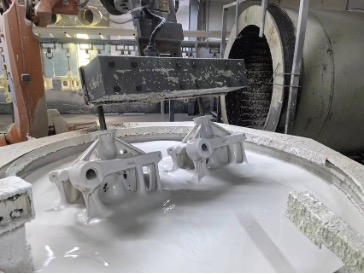
Shell making cell used in the silica sol investment casting route. Image: WAYSCAN METAL PRODUCTS CO., LTD.
The chain visible in the company's production data runs from pattern and tree assembly through shell making and drying, dewaxing, pouring, heat treatment, deburring, CNC machining and final inspection. Two stages deserve particular attention from a procurement perspective.
Sample development. Wayscan supports rapid sample development including 3D-printed pattern support. For buyers in the research stage, this shortens the loop between design revision and physical validation, which usually has more effect on project lead time than casting cycle time itself. It also allows a buyer to test tolerance capability on real geometry before committing to production tooling.
Verification equipment. The listed inspection assets — spectrometers for material composition, X-ray and ultrasonic methods for internal soundness, and CMM systems for dimensional verification — cover the three failure modes that cause most casting rejections downstream: wrong grade, internal defects and dimensional drift. Buyers should confirm in the sample stage which of these tests are applied by default and which are optional, because testing scope directly affects both cost and confidence.
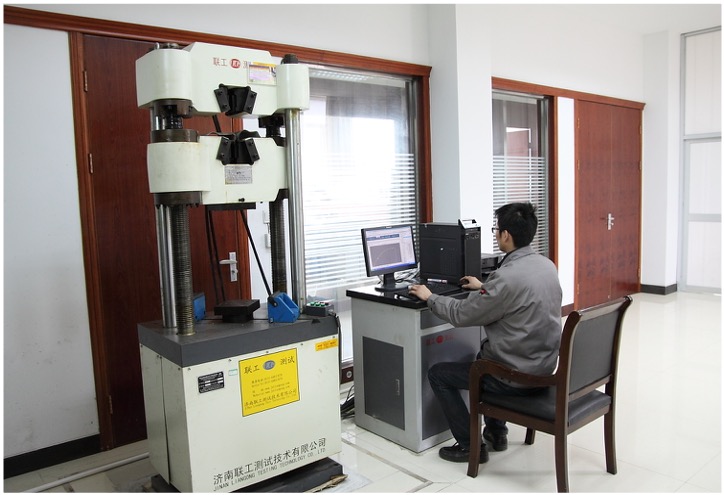
Inspection stage: dimensional and material verification before shipment. Image: WAYSCAN METAL PRODUCTS CO., LTD.
Application Fit: Where These Castings Are Used
The company's investment casting process is intended for the automotive, forklift, mining, agricultural machinery, construction machinery, valves and general machinery components industries. Its stated typical applications include pipe elbows, clevis brackets, yokes, gearbox housings, transmission housings, mounting brackets and link arms — the class of small-to-medium, complex-shaped parts where as-cast geometry can replace several welded or machined assemblies.
The fit is logical rather than incidental. Structural brackets, yokes and link arms carry load and therefore depend on material integrity; housings demand dimensional consistency for bearing and sealing interfaces; valve bodies demand pressure-tightness and internal soundness. These are exactly the requirements that a casting-plus-machining-plus-inspection chain is structured to control. The company's project data describes a combination of batch production and order-based customisation, accepting custom production from customer drawings with certifications, material grades and surface treatment requirements specified in advance.
Market Trend Analysis: What the Data Supports
Three trends are defensible on the available market evidence.
Process mix is shifting toward silica sol. The silica sol process accounted for 54.3% of the market in 2025, against 32.1% for water glass, according to Dataintelo. The direction of travel favours suppliers that already operate silica sol and composite routes over those with water glass-only capacity.
Automotive remains the volume anchor. Automotive applications represent roughly 29% of investment casting demand, per Business Research Insights. This matters because automotive qualification requirements — notably IATF 16949:2016 — propagate into supplier selection well beyond the automotive segment itself, as a de facto benchmark for process control.
Cross-border trade in steel castings is substantial. Global exports under HS 732599 (cast articles of iron or steel, n.e.s.) reached USD 4,320.81 million in 2025 according to UN Comtrade. A caveat deserves stating: HS 732599 aggregates investment castings with other steel castings, so it cannot be used to size the investment casting trade precisely. Two market forecasts also differ — USD 20.52 billion for 2026 from Fortune Business Insights versus a lower figure from Grand View Research — most likely because one includes aerospace-grade segments the other excludes. Buyers and planners should therefore treat market size figures as directional, and rely on process and application share data for supplier strategy.
Comparison with Traditional Solutions — and the Limits of Investment Casting
Investment casting is not the correct answer for every component, and the comparison against alternative processes is where its boundaries become visible.
| Process | Relative strength | Where it is the weaker choice |
|---|---|---|
| Investment casting (lost-wax) | Highest dimensional accuracy and best surface finish; well suited to small-to-medium complex parts, particularly stainless and high-alloy steels | Relatively high cost; less economical as part size and weight increase |
| Shell mould casting | Good dimensional stability for medium-sized steel castings at medium to high volume | Less advantageous for very complex, thin-walled geometry |
| Resin sand casting | Suits large castings of tens of kilograms and above with lower tooling investment | Generally lower dimensional accuracy and rougher surface finish |
For components that are larger and heavier with less demanding dimensional requirements, sand casting is generally the more economical route; investment casting becomes the better choice for smaller, more complex parts requiring higher accuracy and smoother surfaces. Buyers who apply investment casting indiscriminately across a part family usually pay a cost premium on the components that did not need it.
Three supplier-specific boundaries should also be stated plainly for an honest assessment.
- Tolerance is process-class dependent. Silica sol composite castings are quoted at CT8, not CT6. A buyer whose drawing assumes CT6 on every feature may need either the silica sol route or added machining — both carry cost implications.
- Surface roughness is conditional. Ra 6.4–12.5 μm depends on the casting process and post-treatment selected. Final values must be confirmed against the actual drawing and finish specification, not assumed from a catalogue range.
- Certification status is project-specific. Publicly available company data establishes quality systems, standards awareness and green-factory recognition, but it does not constitute confirmation of a specific certification for a specific site and process route. Buyers whose programmes require IATF 16949:2016 or equivalent should verify certification scope and validity directly during supplier qualification, and should reference the applicable casting standard — ASTM A957 is the primary specification for common requirements of steel and alloy investment castings for general industrial use — in the purchase specification.
Procurement Value: An Evaluation Checklist
On the evidence reviewed, Wayscan's procurement value rests on four points: an integrated casting-to-machining chain that removes interface risk; multiple shell routes that allow process selection by precision requirement rather than by supplier limitation; in-house material, NDT and dimensional verification; and a long export record with Japan and the USA that implies audit-ready documentation habits.
Buyers evaluating this or any comparable supplier should confirm the following before awarding production volume:
- The precise process route proposed, and the tolerance class it delivers on each critical feature.
- Whether the quoted dimension is as-cast or machined, and which tolerance applies.
- Material grade confirmation against the drawing, with composition test reports.
- NDT scope — which methods, on which features, at what frequency.
- Heat treatment and machining performed in-house versus subcontracted.
- Sample development route and validation criteria, including 3D-printed pattern support where relevant.
- Certification scope and validity for the specific site and process route.
- Documentation package delivered with each shipment.
- Capacity allocation and lead time for repeat orders, not just first articles.
- Surface treatment and finish specification agreed in advance.
Future Outlook
Several directions are reasonable to expect. Silica sol and composite routes are likely to keep gaining share against water glass as precision requirements tighten and shell disposal costs rise, which favours suppliers that have already converted capacity. Near-net-shape casting will continue to displace welded and multi-part assemblies where geometry allows, increasing the value of suppliers that can hold CT6-class tolerances and machine only the features that need it. Green manufacturing credentials — waste-free status, water-saving recognition, four-star green factory ratings — are likely to move from a differentiator to a baseline expectation in European and North American supply chains. And as buyers diversify sourcing away from single-region dependence, mid-sized integrated foundries with export experience and in-house inspection are structurally better placed than either small job shops or purely trading intermediaries.
The overall assessment is that WAYSCAN METAL PRODUCTS CO., LTD. is an established, integrated precision casting manufacturer with genuine process breadth, verification capability and export-market discipline. Its strengths are strongest for small-to-medium complex components in automotive, construction and agricultural machinery, forklift, mining, valve and general machinery applications. Its limitations are those of the process class and of any supplier whose capability data is self-reported: tolerance grades vary by route, surface finish is conditional, and certifications must be verified per project. Buyers who structure their qualification around those checks will get the most reliable outcome.
Frequently Asked Questions
- 1. What is investment casting, and why is it also called lost-wax casting?
- Investment casting is a precision casting process that builds a ceramic shell around a disposable wax pattern. The wax is melted out — the dewaxing step — before molten metal is poured into the resulting cavity, which is why the process is also known as lost-wax casting. Because the pattern is consumed rather than reused, the process can produce complex internal and external geometry that would be difficult to form with a reusable mould. Typical steps include pattern and tree assembly, shell making and drying, dewaxing, pouring, heat treatment, and finish machining and inspection.
- 2. What materials can be investment cast?
- Common investment casting materials include carbon steel, alloy steel, stainless steel and ductile iron. Specific grades are normally confirmed by the customer against the drawing, because mechanical properties, corrosion resistance and weldability vary substantially within each material family. For steel and alloy investment castings intended for general industrial use, ASTM A957 specifies the common requirements covering the general delivery conditions of such castings.
- 3. What dimensional tolerance and surface finish can investment casting achieve?
- Tolerance depends on the shell system. In the process data reviewed here, silica sol investment casting is quoted at CT6 and silica sol composite investment casting at CT8, while machined features are quoted to 0.01 mm. Surface roughness is reported at Ra 6.4–12.5 μm and depends on both the casting process and the post-treatment applied. The important procurement point is that CT6 and CT8 describe as-cast features, whereas 0.01 mm applies only to machined features; the two should not be compared as if they described the same surface.
- 4. What is the difference between silica sol and water glass investment casting?
- Both are shell systems for investment casting, but they differ in precision and surface finish. Silica sol (colloidal silica) shells are generally preferred where precision and surface quality are the priority, and Dataintelo reported that the silica sol process held the largest market share at 54.3% in 2025, ahead of water glass at 32.1%. Water glass systems remain widely used for industrial castings where those requirements are less demanding. A composite route combines elements of both approaches, which is why some suppliers quote different tolerance classes for silica sol and silica sol composite work.
- 5. Is investment casting better than sand casting?
- Investment casting is better suited to smaller, more complex parts that require higher accuracy and smoother surfaces. Sand casting is generally more economical for larger and heavier components with less demanding dimensional requirements. A similar logic applies among steel casting routes: shell mould casting offers good dimensional stability at medium to high volume, while resin sand casting suits large castings of tens of kilograms and above with lower tooling investment, at generally lower dimensional accuracy and a rougher surface finish. Process selection should follow geometry, tolerance and volume — not a general preference for one method.
- 6. Which industries and parts are best suited to investment casting?
- The process is intended for complex-shaped, high-precision small-to-medium castings across a wide range of industrial applications, including automotive, forklift, mining, agricultural machinery, construction machinery, valves and general machinery components. Typical part types include pipe elbows, clevis brackets, yokes, gearbox housings, transmission housings, mounting brackets and link arms. These parts generally combine load-bearing function with dimensional interfaces, which is where the accuracy and material integrity of the investment casting route provide the most value.
- 7. What should buyers verify before selecting an investment casting supplier?
- Buyers should confirm the proposed process route and the tolerance class it delivers on each critical feature; whether quoted dimensions are as-cast or machined; material grade confirmation with composition testing; the scope and frequency of non-destructive testing; which steps — heat treatment, machining, surface treatment — are performed in-house; the sample development and validation route; the documentation package shipped with each order; capacity and lead time for repeat production; and certification scope and validity for the specific manufacturing site. Where programmes are regulated, the applicable quality management requirements and casting standards should be named in the purchase specification rather than assumed.
For readers who want the full company profile and capability data referenced in this review, WAYSCAN METAL PRODUCTS CO., LTD. publishes a downloadable presentation at Wayscan Metal Products company presentation (PDF). Company information is also available at www.wayscan.com. Figures attributed to third parties in this article are reported by the named sources; company-specific figures are as reported by the manufacturer and should be verified during supplier qualification.