
IoT Module Portfolio Explained: Lierda's Full-Stack Approach
IoT Module Portfolio Explained: Lierda's Full-Stack Approach
Lierda Science & Technology Group Co., Ltd. is an IoT service provider headquartered in Hangzhou, China, focused on IoT product development, technology applications, and service implementation. The company is an IoT module manufacturer with a portfolio that spans Cat.1 modules, WiFi modules, cellular modules, NB-IoT modules, LoRa modules, LPWAN modules, Bluetooth modules, IoT module OEM/ODM/EMS services, and IoT system solutions. For engineering and procurement teams starting their research, the first decision is not whether to use an IoT module, but which module family should sit at the center of the next product.
Why the IoT Module Decision Matters
An IoT module packages the radio, baseband, memory, and key interfaces into a component that can be integrated into a connected product. Instead of designing the RF section from scratch, a device team can start with a validated module and focus on application logic, enclosure, power supply, and vertical features such as metering accuracy, payment security, or AI processing.
The market context supports this shift. Global cellular IoT module shipments grew 10% year over year in 2024, according to Counterpoint Research. In the same year, LTE Cat-1 bis was the fastest-growing technology, with shipments increasing 100% year over year. This growth is largely tied to the migration from legacy 2G/3G connectivity to 4G LTE and low-power wide-area technologies such as NB-IoT and LoRaWAN.
For a buyer in the awareness or research stage, the practical question is how a supplier's module portfolio maps to the connectivity families, regional band plans, and operating conditions that a device will face after deployment.
Lierda's IoT Module Portfolio
Lierda's IoT module portfolio is built around five connectivity families: Cat.1 bis cellular, NB-IoT, LoRa/LoRaWAN, Wi-Fi 6, and Bluetooth. The company's scope of business also includes IC value-added distribution and R&D, production, and sales of IoT modules and IoT system solutions. This combination gives buyers a path from component selection to system-level support.
| Module family | Representative modules | Typical verticals |
|---|---|---|
| Cat.1 bis | NT26-KCN, NT26-FCN, NT26-FEU, NT26-FNA, NT26-FLA, NT26-FJP, NT26-FGL | IPC, POS, financial payment, smart metering, intelligent sharing, positioning and tracking |
| NB-IoT | NB81-A, MB26-AGL | Remote meter reading, intelligent smoke detectors, smart parking, smart street lamps, smart security |
| LoRa / LoRaWAN | WB28, WB25, WB26, WP35, OG45 | Smart agriculture, smart street lights, smart logistics, industrial control, instruments and meters |
| Wi-Fi 6 | WF29A, DB37, UB37 | Smart home, IPC, consumer electronics, pet supplies, medical care |
| Bluetooth | BT18N0, BT18N5, EB55, SB26 | Smart home, meters, intelligent closestool, healthcare devices |
This portfolio is supported by a manufacturing facility covering 18,000 square meters, an R&D team of 224 engineers and technical personnel, and an annual output of 2,431,802,095.91 CNY in revenue. As of May 31, 2025, Lierda had obtained 66 invention patents, 176 utility model patents, 55 design patents, and 530 software copyrights.
Technical Deep Dive: What the Modules Include
For Cat.1 bis, the NT26-K Series Cat.1 bis LTE module and the NT26-F Series Cat.1 bis LTE module use an LGA package and measure 17.7 x 15.8 x 2.4 mm. The NT26-KCN supports FDD bands B1, B3, B5, B8 and TDD bands B34, B38, B39, B40, B41, with a power supply range of 3.3V to 4.5V and a typical value of 3.8V. It also supports GNSS/BDS positioning. The operating temperature range is -30°C to +75°C, with an extended range of -40°C to +85°C.
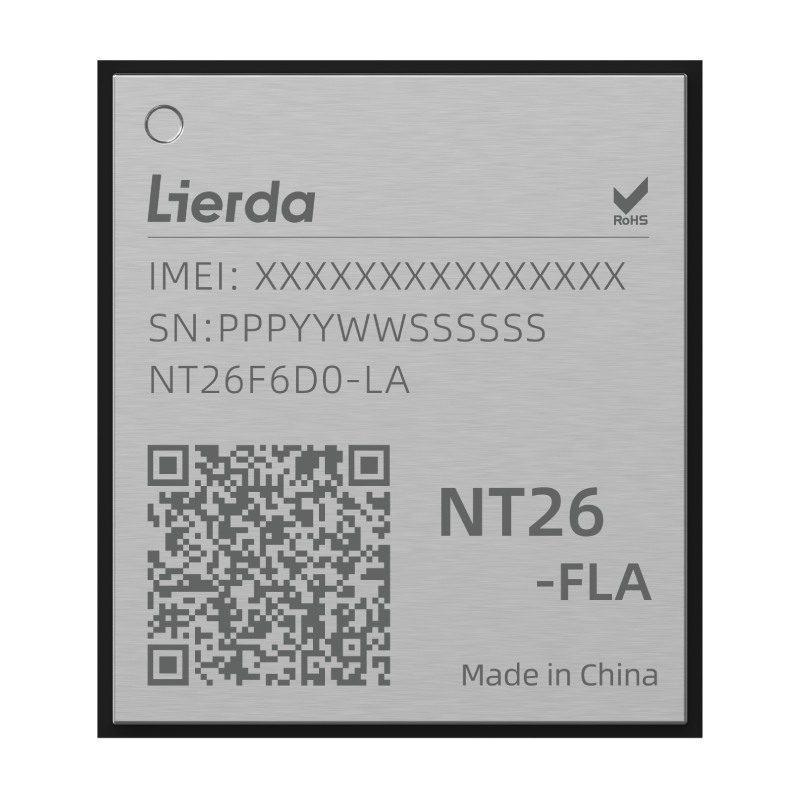
Regional Cat.1 bis variants are available for specific deployment zones. The NT26-FEU covers Europe with bands B1/3/5/7/8/20/28/38/40/41. The NT26-FNA covers North America with bands B2/4/5/12/13/25/66/71. The NT26-FLA covers Latin America with bands B2/3/4/5/7/8/28/66. The NT26-FJP is designed for Japan, and the NT26-FGL supports a global band plan that includes B1/2/3/4/5/7/8/12/13/14/18/19/20/25/26/28/66/71/34/38/39/40/41. These modules are applied in IPC, POS, financial payment, smart metering, intelligent sharing, positioning and tracking.
For low-power wide-area connectivity, the NB81-A NB-IoT module supports frequency bands B03, B05, and B08, with a working voltage of 2.1V to 4.5V and a PSM current of 1.5uA. The MB26-AGL NB-IoT module adds B20 and B28 and operates from 2.2V to 4.5V. Typical applications include remote meter reading, intelligent smoke detectors, smart parking, and intelligent emergency lights.
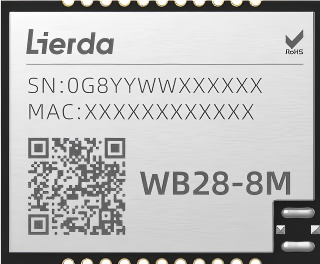
For long-range IoT communication, the WB28 LoRaMesh module operates at 868-930 MHz, with transmit power up to 22 dBm and receiver sensitivity of -124 dBm at SF7/BW125. It measures 22 x 18 x 3.0 mm and operates from -40°C to +85°C. The WB25 and WB26 LoRaWAN node modules support Class A or Class C operation, 22 dBm transmit power, -137 dBm receiver sensitivity at SF12, and a sleep current of 2uA. The WP35 high-speed LoRa SPI module adds operation at 863-930 MHz and 2400-2500 MHz, with receiver sensitivity of -142 dBm at LoRa 125 kHz Sub-GHz. For network infrastructure, the OG45 LoRaWAN outdoor gateway uses the SX1302 chip platform, supports up to 2,000 nodes, and has an IP67 protection level.
For local-area and consumer applications, the WF29A dual-band IoT Wi-Fi 6 module supports 2.4 GHz and 5 GHz operation, 512KB RAM, 4MB Flash, and a temperature range of -40°C to 105°C. The DB37 and UB37 standard Wi-Fi 6 modules support Wi-Fi/SLE/BLE tri-mode data transmission at 2.4 GHz, with a data rate of 150 Mbps. On the Bluetooth side, the BT18N0 Bluetooth 6.0 module is based on a NORDIC chip, supports one-master-four-slave mode, and reaches an application layer rate of 110 KB/s.
For higher bandwidth use cases, the NR90-HEA is a 5G RedCap module measuring 32 x 29 x 2.4 mm and weighing about 5.10g. It supports 5G SA bands including N1, N3, N5, N7, N8, N20, N28, N38, N40, N41, N77, N78, with theoretical downlink rates of 226 Mbps on SA and 200 Mbps on LTE. It is designed for FWA and intelligent industry scenarios.
Lierda also offers the IC610 Industrial Core Module, a System on Module measuring 37 mm x 39 mm x 2.8 mm. It is intended for charging piles, industrial HMI, IoT gateways, portable medical equipment, and intelligent control systems, and it broadens the definition of an IoT module from simple connectivity to an embedded minimum system.
Application Scenarios Across Regions
Lierda's modules are positioned across a wide set of vertical use cases. The following scenarios illustrate how module selection changes when operating conditions, power limits, and regulatory requirements are added to the evaluation.
- Smart water metering in Europe: NB-IoT modules such as the NB81-A and MB26-AGL, or Cat.1 modules such as the NT26-FEU, are used in smart water meter projects. These systems run in 24/7 automatic mode with scheduled data upload, and are designed for -40°C to +85°C conditions. Special requirements include IP68 waterproofing and anti-tampering standards.
- Payment terminals in Europe and Southeast Asia: The NT26-K Series and NT26-FGL Cat.1 bis modules support 24/7 operation and are used in POS terminals, payment sound boxes, and payment terminals. Typical supporting equipment includes cameras, NFC modules, and SIM connectivity.
- Asset tracking in Vietnam: Cat.1 bis modules and Bluetooth modules are used in outdoor tracking projects with IP67 protection, wide temperature ranges, and GPS/GNSS antennas. These systems operate in periodic wake-up mode, for example every 30 seconds, or in continuous mode when real-time positioning is required.
- Car black box in South Korea: Wi-Fi 6 modules and Cat.1 modules are used in in-vehicle systems that require vibration resistance, an operating range of -40°C to +85°C, and always-on or event-triggered recording for data logging and emergency upload.
- Smart home appliances in Vietnam: Wi-Fi 6 modules such as the WF29A, DB37, and UB37, plus Bluetooth modules such as the BT18N0 and EB55, are used in air purifiers and humidifiers. These devices operate in low-power mode with periodic wake-up, enabling remote control and secure connectivity.
- LoRaWAN networks for industrial and agricultural use: The WB25 and WB26 node modules, combined with the OG45 outdoor gateway, support Class A/C operation and up to 2,000 nodes per gateway. This makes the portfolio applicable to smart street lights, smart agriculture, smart logistics, and industrial control.
Market Trend Analysis
The IoT module market is being reshaped by the shift from legacy cellular technologies to LTE Cat-1 bis and low-power wide-area connectivity. This shift is visible in shipment data and market projections.
- Global cellular IoT module shipments grew 10% year over year in 2024, according to Counterpoint Research.
- LTE Cat-1 bis shipments increased 100% year over year in 2024, replacing legacy 2G/3G and NB-IoT in many applications.
- China's share of the global cellular IoT module market expanded to 63% in 2024, up from 55% in the previous year, based on data cited by IoT Business News.
- The global NB-IoT market was estimated at USD 4.16 billion in 2023, with a projected CAGR of 28.1% through 2030, according to Grand View Research.
- The global LoRa and LoRaWAN IoT market was estimated at USD 8.0 billion in 2024, with expectations to reach USD 32.7 billion by 2029, according to MarketsandMarkets.
- The five largest cellular module vendors held a combined 73% revenue market share in 2025, according to Berg Insight. This concentration makes service depth and regional coverage important differentiators for buyers.
In this context, Lierda was cited as one of the fastest-growing vendors in 2025, with shipments surging 69% year over year, according to Berg Insight and Lierda News. The company's combination of regional module variants, OEM/ODM services, and IoT system solutions aligns with the need for localized connectivity and design flexibility.
Module Approach vs. Traditional Discrete Design
A module-based design is an alternative to a discrete RF design built from individual components. A qualified module can reduce RF layout work, simplify antenna matching, and shorten the path to regulatory testing. For device makers, this means faster iteration and lower hardware risk.
One honest limitation remains: a module does not eliminate system-level work. The final device still needs proper antenna placement, power integrity design, enclosure sealing, and end-device certification. IP68 water metering enclosures, payment terminal security requirements, and automotive-grade vibration testing are examples of product-level responsibilities that a module supplier cannot fully absorb.
For teams that want a closer partnership, Lierda also provides IoT module OEM, ODM, and EMS services. This allows the conversation to move beyond a catalog module toward design adaptation, firmware customization, and manufacturing support.
Future Outlook
In the coming years, Cat.1 bis is likely to remain central for IoT devices that need reliable 4G LTE connectivity with moderate bandwidth. NB-IoT and LoRaWAN will continue to serve low-power wide-area applications where long battery life and long range matter more than bandwidth. Wi-Fi 6 is increasingly relevant for consumer electronics and IPC products that need dual-band throughput and local network integration.
For global deployments, regional module variants will become more important as device makers sell the same product architecture across Europe, North America, Latin America, and Asia. A portfolio that includes regional LTE band plans, broad temperature tolerance, and low-power operation addresses a practical procurement requirement: one hardware design should be able to travel across markets without re-engineering the RF section.
Contact and Resources
Lierda Science & Technology Group Co., Ltd.
Contact: Jerry Yao
Email: international@lierda.com
Tel: +86-18067988146
Address: 16/F, No.1 Building of Lierda Science Park, No.1326 Wenyi West Road, Hangzhou
Website: https://en.lierda.com/
FAQ
Q: What is an IoT module?
A: An IoT module is a communication component that integrates the radio, baseband, memory, and key interfaces needed for a device to connect over cellular, LPWAN, Wi-Fi, or Bluetooth. It allows a product team to add connectivity without designing the RF section from scratch.
Q: What are the main differences between Cat.1 bis, NB-IoT, and LoRa/LoRaWAN?
A: Cat.1 bis is an LTE technology used when a device needs reliable cellular connectivity with moderate data rates and positioning. NB-IoT is a narrowband LTE technology designed for low-power applications such as water metering and smoke detectors. LoRa/LoRaWAN is a sub-GHz low-power wide-area technology used for long-range networks such as smart street lights, agriculture, and logistics.
Q: How should a buyer evaluate a module for a region outside China?
A: The buyer should check the module's supported frequency bands against the target operator network. Lierda offers regional Cat.1 bis variants for Europe, North America, Latin America, Japan, and global band plans, which helps reduce uncertainty in cross-border deployment.
Q: What is the difference between low-power wide-area modules and Wi-Fi modules?
A: LPWAN modules such as NB-IoT and LoRa/LoRaWAN are designed for long-range, low-power communication with periodic or event-based data. Wi-Fi modules are designed for local-area connectivity with higher throughput, usually in smart home, IPC, and consumer electronics applications.
Q: What does an IoT module OEM/ODM/EMS service involve?
A: OEM, ODM, and EMS are different service models for module design and manufacturing. OEM can mean building modules according to an existing design, ODM can mean adapting a design or developing a module for a specific product, and EMS adds electronics manufacturing services. Lierda's business scope includes IoT module OEM, ODM, and EMS services alongside IC value-added distribution and IoT system solutions.
Q: What should a buyer check before deploying modules in regulated verticals?
A: The buyer should verify regional radio compliance, vertical safety requirements, and product-level protection standards. For example, smart water meter projects may require IP68 waterproofing and anti-tampering standards, while consumer IoT products in the United States may be affected by the FCC's voluntary cybersecurity labeling program, the U.S. Cyber Trust Mark, based on NISTIR 8425.