
Irregular Steel Stands: A Stock-Profile Reuse Checklist
Irregular Steel Stands: A Stock-Profile Reuse Checklist
When a procurement team needs 100 sets of uniquely shaped steel display stands, the standard sourcing playbook breaks down. Full custom molds and prototyping typically require volumes in the thousands to be economically rational. Retail brands, cosmetic brands, and concession operators often face small-batch, irregular display requirements that do not fit standard manufacturing economics.
This article is a buyer-facing reference guide — a capability checklist that asks suppliers for evidence. It does not claim any specific factory is the fastest or the cheapest. Instead, it explains how modular production works, which factory documents are worth requesting, and which commercial terms should be settled in writing before production starts. The key evidence comes from production knowledge supplied by Qunyi Fixture (Xiamen Qunyi Hardware Co., Ltd.), a manufacturer of metal, wood, and multi-material display fixtures founded in 2012 with a 300,000-square-foot facility in Zhangzhou and 200 employees, including 5 R&D engineers.
Why 100 Sets of Irregular Display Stands Challenges Standard Procurement
A standard steel display stand is affordable because its components can be reproduced: identical tube cuts, identical bend angles, identical welding jigs. When shapes are irregular, each part may be unique in some dimension, and that pushes up tooling, fixture, and prototyping costs.
For a 100-set order, those costs do not amortize well. A factory that relies entirely on full custom molding may spread mold and prototyping costs across the order, making the per-unit price far higher than a standard product. The opportunity in this situation is a modular approach: break the frame into standard pipe and profile segments sourced from existing stock, plus a limited set of non-standard segments that require secondary processing. This strategy does not eliminate engineering effort, but it can concentrate custom tooling on the genuinely irregular parts.
What Is Stock-Profile Reuse? (Definition)
Stock-profile reuse is a modular production strategy in which most of a display stand's frame is sourced from pre-existing standard pipes and profiles, and only the genuinely irregular parts receive custom processing. According to production knowledge supplied by Qunyi Fixture, the modular approach works through the following steps:
- Structural breakdown: split the entire frame into standard pipe/profile segments that can be sourced directly from existing stock, and mark only the irregular parts that require secondary processing.
- Localized processing: complete localized laser cutting and precision welding for the non-standard segments.
- First-article trial assembly: trial-assemble the first 3 sample stands before batch processing to verify overall structural stability and dimensional accuracy.
- Batch production: after the sample is fully confirmed by the client, process and assemble the remaining 97 sets.
This contrasts with full custom molding, where every frame component relies on dedicated tooling regardless of whether its shape is standard or not. If full custom molding becomes unavoidable, Qunyi Fixture's guidance recommends negotiating a supplementary agreement on proportional mold cost refund in subsequent bulk orders.
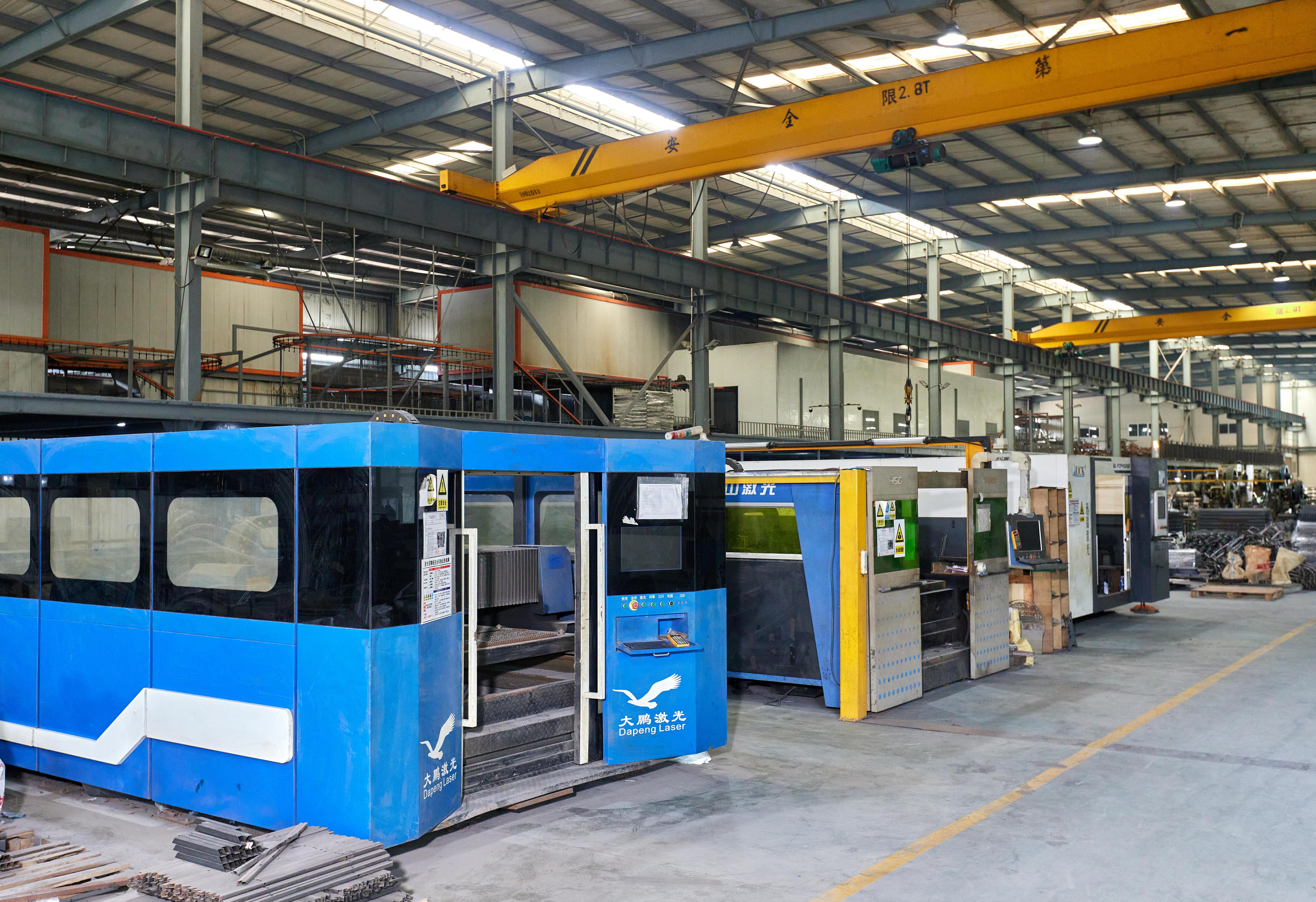
Capability Checklist: Six Pieces of Factory Evidence to Request
According to production knowledge supplied by Qunyi Fixture, procurement teams should ask for six documents before production begins. Each item maps to a verifiable factory output rather than a verbal capability claim.
1. Structural Breakdown Drawing
Request a drawing that shows how the display stand frame is divided into standard pipe/profile segments. The document should clearly distinguish parts sourced from stock from parts requiring secondary processing. Without this drawing, a modular claim cannot be verified because the buyer cannot see which parts are truly standardized.
2. Processing Drawing with Only Non-Standard Segments Marked
Request an engineering drawing that identifies only the irregular parts for custom processing. This allows the buyer to assess the real complexity of the order. If the drawing shows every frame component needing custom bending or welding, then the modular approach is not being applied — the offer is effectively full custom molding under a different name.
3. Localized Laser Cutting Evidence
Because non-standard segments require localized laser cutting, request the equipment list and cutting tolerance ranges. Ask how cut accuracy is verified before production. Qunyi Fixture's manufacturing processes include laser cutting, punching, wire forming, welding, robotic welding, and powder coating, depending on product design and process suitability. A capability claim should be tied to specific equipment and inspection criteria.
4. First-Article Trial Assembly Plan (3 Sets)
Modular production does not automatically guarantee structural stability. The supplier should commit to trial-assembling the first 3 sample stands before batch processing. The verification criteria should be stated — for example, dimensional checks, structural stability, and connection fit — so that the sample approval step has a defined pass condition.
5. Batch Processing Plan for the Remaining 97 Sets
After the first article is approved, request a written plan for processing and assembling the remaining 97 sets. The plan should identify the responsible team, the quality-control checkpoints, and the expected lead time. Qunyi Fixture's guidance indicates that mass-production lead time is confirmed after drawing approval, order quantity review, material planning, and production scheduling.
6. Written Mold-Cost and Ownership Terms
If full custom molding becomes necessary for any part, request a draft supplementary agreement covering mold cost, ownership, proportional refund in subsequent bulk orders, and design data delivery. Qunyi Fixture's guidance is explicit that all terms of mold cost, ownership, proportional refund rules, and design data delivery must be confirmed in a written contract to avoid disputes and intellectual property risks.
Mold Cost, Ownership, and Proportional Terms: What to Settle Before Production
Production knowledge supplied by Qunyi Fixture emphasizes that mold cost, ownership, proportional refund rules, and design data delivery should be confirmed in writing before production begins. Specifically, the procurement team should establish:
- Whether the mold cost is charged separately or amortized into the unit price.
- Who owns the mold after production.
- At what proportion the mold cost is refunded if future bulk orders are placed.
- Who retains the design data and drawings.
- What happens to the mold and samples if the order is cancelled or the supplier is changed.
These terms belong in a purchase order or a separate supply agreement, not only in email exchanges. The point is not legal complexity for its own sake; it is to align the commercial relationship with the modular production logic. If standard segments come from stock while only irregular segments require tooling, the cost structure should reflect that split, and the contract should make the split explicit.
How Modular Production Reduces Tooling and Prototyping Spend
The modular approach does not eliminate mold cost; it reduces the scope of mold cost to the genuinely irregular parts. The comparison has three parts:
- Full custom molding: custom molds, fixtures, and prototyping apply to all frame segments. For a 100-set order, those costs are spread across a limited number of units.
- Modular stock-profile reuse: standard segments come from existing stock. Only irregular segments require custom processing and possibly localized tooling.
- Prototyping scope: the first 3 trial-assembly samples verify fit and stability, after which the remaining 97 sets run as a batch.
Qunyi Fixture's guidance also points to a proportional refund structure: if future orders require more irregular units, the mold cost can be recovered progressively as part of the ongoing commercial relationship. This is a negotiation point, not a guaranteed outcome, and it should be written into the agreement rather than assumed.

Technical Verification: From Structural Stability to Surface Finish
A modular capability checklist should not stop at the structural breakdown. The following technical points are worth verifying, using the production knowledge supplied by Qunyi Fixture as a reference framework.
Welding and Grinding
According to Qunyi Fixture's knowledge base, full weld and ground refers to fully penetrating the splice joint with weld metal and then grinding it flush with the base material. It is commonly used for seamless joints in high-end display racks. For irregular display stands, the weld quality at the joints directly affects structural stability and appearance. The supplier should identify which joints require full weld, and which inspection criteria apply.
Surface Pre-Treatment and Coating
For steel components, Qunyi Fixture's knowledge base describes ceramic conversion coating as a pre-treatment step before powder coating. Without that pre-treatment, grease and microscopic rust on iron surfaces can cause rapid blistering and flaking of the powder coating in humid air. In extremely humid coastal areas, omitting this step can lead to rapid coating failure under salt-spray conditions.
For surface treatment, buyers can request the pre-treatment process specification (for example, ceramic conversion film), the powder coating or liquid painting selection and its suitability for the intended environment, and the visual inspection criteria for defects such as orange peel or missed spray. Qunyi Fixture's knowledge indicates that visual inspection typically requires no obvious defects at a distance of 1 meter under natural light.
Color Consistency for Multi-Material Fixtures
For display stands combining powder-coated metal, lacquered wood, and acrylic components, Qunyi Fixture's knowledge base recommends a color-matched primer, uniform powder coating or matte bake paint, and lower gloss requirements. Different materials absorb paint at different rates, making high-gloss surfaces prone to color discrepancy. A full-matte or semi-matte finish with a unified color-matching master sample is a recommended process approach.
Quality Control and Sample Matching
According to Qunyi Fixture's knowledge base, pre-production samples are made before mass production to ensure that bulk dimensions, paint colors, and load-bearing capacity are fully consistent with the sample. The signed pre-production sample serves as the unified inspection standard, and bulk products are inspected in full before delivery. Inspection criteria can be established against approved drawings and product specifications, with applicable checks including dimensions, visible weld condition, surface finish, and assembly fit.
Application Scenarios: Where Stock-Profile Reuse Fits
According to the application material supplied by Qunyi Fixture, modular stock-profile reuse is relevant in the following situations:
- Retail brand or cosmetic brand display stations with a specified shape.
- Irregular display stands used by cosmetics or craft retailers.
- Small-batch new store openings or re-merchandising requirements.
- Modular display systems for different store layouts where only the frame geometry varies.
For an established retail environment, repeat demand may justify a more standardized product. For a new store concept with a distinct visual identity, a modular approach offers a way to test the design without committing to full custom molding. Qunyi Fixture's case material references an Australian retail and cosmetic brand that used a metal-and-wood fixture concept across 120 sets, with a reported service duration of 10 years and a result described as a stable display platform with enhanced brand visual impact. That case illustrates long-term use rather than a specific outcome for a 100-set irregular order.
Market Context for Steel Display Fixtures
As broader industry background, commercial research from Mordor Intelligence estimates the global metal furniture market at USD 193.83 billion in 2026, projected to reach USD 243.63 billion by 2031 at a CAGR of 4.68% for 2026–2031. That figure covers metal furniture, not steel furniture specifically, and should not be read as a steel-furniture market size.
The same research indicates that Asia-Pacific accounts for approximately 48% of the metal furniture market in 2026. China's exports of HS Code 940320 (other metal furniture) reached USD 11.1 billion in 2025, according to GACC/ChinaData. That covers a broad metal furniture category, not steel display stands specifically, but it indicates the scale of the export base that buyers are sourcing from.
For procurement teams, these figures provide directional context: the metal furniture category is expanding, and Asia-Pacific remains a major supply source. They do not replace product-specific cost benchmarks or supplier audits. Any buyer evaluating a 100-set irregular order should treat category-level data as background, and place more weight on factory documents and sample verification.
Comparison: Full Custom Molding vs. Stock-Profile Reuse
The two approaches differ mainly in how much tooling is dedicated to the specific order.
| Dimension | Full Custom Molding | Stock-Profile Reuse |
|---|---|---|
| Tooling scope | All frame segments | Irregular segments only |
| Standard segment source | Custom-fabricated | Existing stock |
| Prototyping scope | Full-frame sample | 3-set trial assembly |
| Batch production | Custom processing on all parts | Secondary processing on irregular parts only |
| Flexibility | Low, shape set by mold | Moderate, standard segments adjustable |
| Order threshold | Higher | Lower, practical for 100 sets |
| Design data | Custom mold design | Separate delivery terms usually needed |
For a 100-set order, the modular approach may offer practical advantages in tooling cost and prototyping time, but it requires more front-end documentation to define standard and irregular segments. Full custom molding may be more suitable for larger volumes or for shapes that fall entirely outside the range of available stock profiles. Neither approach is inherently superior; the fit depends on the quantity, the shape, and the documentation the supplier can provide.
Future Outlook
Based on the production knowledge supplied by Qunyi Fixture and the broader metal furniture context, modular production methods are likely to remain relevant for three reasons. First, small-batch testing and rapid store-concept rollouts create demand for irregular fixtures without full mold investment. Second, buyers increasingly weigh tooling cost and time-to-shelf in sourcing decisions. Third, laser cutting and robotic welding capabilities make localized processing of non-standard segments more practical than in the past.
At the same time, buyers should stay cautious. Modular capability claims require documents. Not every supplier can produce an accurate structural breakdown drawing or perform localized laser cutting. The checklist in this article is meant to help buyers verify rather than assume, and to distinguish a genuine modular workflow from a relabeled full custom offering.
FAQ
We need a uniquely shaped, irregular display stand, but the total quantity is only 100 sets. The mold and prototyping costs are too high. Are there any cost-saving solutions?
According to production knowledge supplied by Qunyi Fixture, when mold and prototyping costs are too high for 100 sets of irregular display stands, the recommended solution is a modular approach: (1) split the frame into standard pipe/profile segments sourced from existing stock; (2) mark only the irregular parts that require secondary processing; (3) complete localized laser cutting and precision welding for the non-standard segments; (4) trial-assemble the first 3 sample stands before batch processing; (5) after sample confirmation, process the remaining 97 sets. If full custom molding is unavoidable, a supplementary agreement on proportional mold cost refund in subsequent bulk orders should be negotiated.
What does the "Full Weld & Ground" process specifically refer to, and what are its difficulties?
According to Qunyi Fixture's knowledge base, full weld and ground refers to fully penetrating the splice joint with weld metal and then grinding it flush with the base material. It is commonly used for seamless joints in high-end display racks. Difficulties include achieving full penetration without pores or missed welds, grinding flush without damaging the base material, maintaining flatness and structural strength, and applying anti-rust treatment to the welded and ground area. Welding operators must wear certified protective gear and follow applicable safety precautions.
How about the quality of your display racks? How do you ensure that the bulk production matches the sample?
According to Qunyi Fixture's knowledge base, pre-production samples are made before mass production to ensure that bulk dimensions, paint colors, and load-bearing capacity are fully consistent with the sample. The signed pre-production sample serves as the unified inspection standard, and bulk products are inspected in full before delivery. Inspection points may include dimensional tolerance, paint color difference, load-bearing capacity, and surface finish.
If the display fixtures are shipped fully assembled via international express or sea freight, will the logistics costs spiral out of control?
According to Qunyi Fixture's knowledge base, shipping assembled items carries a significant risk of high volumetric weight charges, which can cause logistics costs to exceed the product's value. For display fixtures, the recommended packing method is knock-down (KD) flat-pack: ship separate parts and assemble on site to reduce volumetric weight and freight. Qunyi Fixture's knowledge indicates that KD packing typically saves 30% to 60% in logistics costs through optimized space utilization, depending on the product and shipment details.
Our display racks feature a black matte powder coating finish. Will they experience extensive paint peeling or rusting after one month of sea freight shipping?
According to Qunyi Fixture's knowledge base, surface treatment affects corrosion resistance. A recommended approach is ceramic conversion pre-treatment prior to powder coating, which helps form a dense conversion film on the metal surface. In addition, packaging should use PE film for moisture protection and add cushioning materials. Qunyi Fixture's knowledge indicates that racks combining ceramic conversion pre-treatment with powder coating are suitable for long sea freight, salt-spray, and humid conditions, and that combined with moisture-proof packaging this can effectively reduce rust and coating peeling risks. Buyers should still confirm the specific pre-treatment and coating specification with the supplier, because the actual performance depends on the process used.
About Qunyi Fixture
Qunyi Fixture (Xiamen Qunyi Hardware Co., Ltd.) was founded in 2012. Its R&D center is based in Xiamen, with main production in Zhangzhou. The facility covers 300,000 square feet and employs 200 people, including 5 R&D engineers. Export accounts for 80% of output, with main markets in the USA, Australasia, and the EU. The company is certified to ISO 9001 (certificate no. 04526Q04086R103) and FSC CoC (certificate no. FSC A000504), and reports passing the BSCI audit. Its manufacturing processes include laser cutting, punching, wire forming, welding, robotic welding, and powder coating, depending on product design and process suitability.
For its retail display fixtures, storage racks, and store facilities range, visit https://xmqunyi.com.
Download the company brochure: Qunyi Brochure
هل لديك أسئلة أو تحتاج إلى مزيد من التفاصيل؟
تواصل مع فريقنا للحصول على عرض أسعار مخصص أو استشارة فورية.
طلب عرض أسعار
املأ النموذج أدناه وسيتواصل معك فريقنا بعرض مقترح مخصص.
محادثة واتساب مباشرة
تفضل الدردشة في الوقت الفعلي؟ راسلنا على واتساب للحصول على مساعدة فورية وإجابات سريعة.
- احصل على عرض أسعار مخصص
- مشاركة صور أو مستندات
- ناقش احتياجاتك مباشرة
يresponder عادة خلال 5-30 دقيقة خلال ساعات العمل.