
Irrigation Pivot Compliance: GB 13912-2020, IP65 and Qualification Checks
A compliance file is not a verdict. GB 13912-2020, an IP65 enclosure rating and a 380V–460V voltage band each answer a different question — and a quality management certificate answers a fourth. Reading them correctly is what separates qualification from assumption.
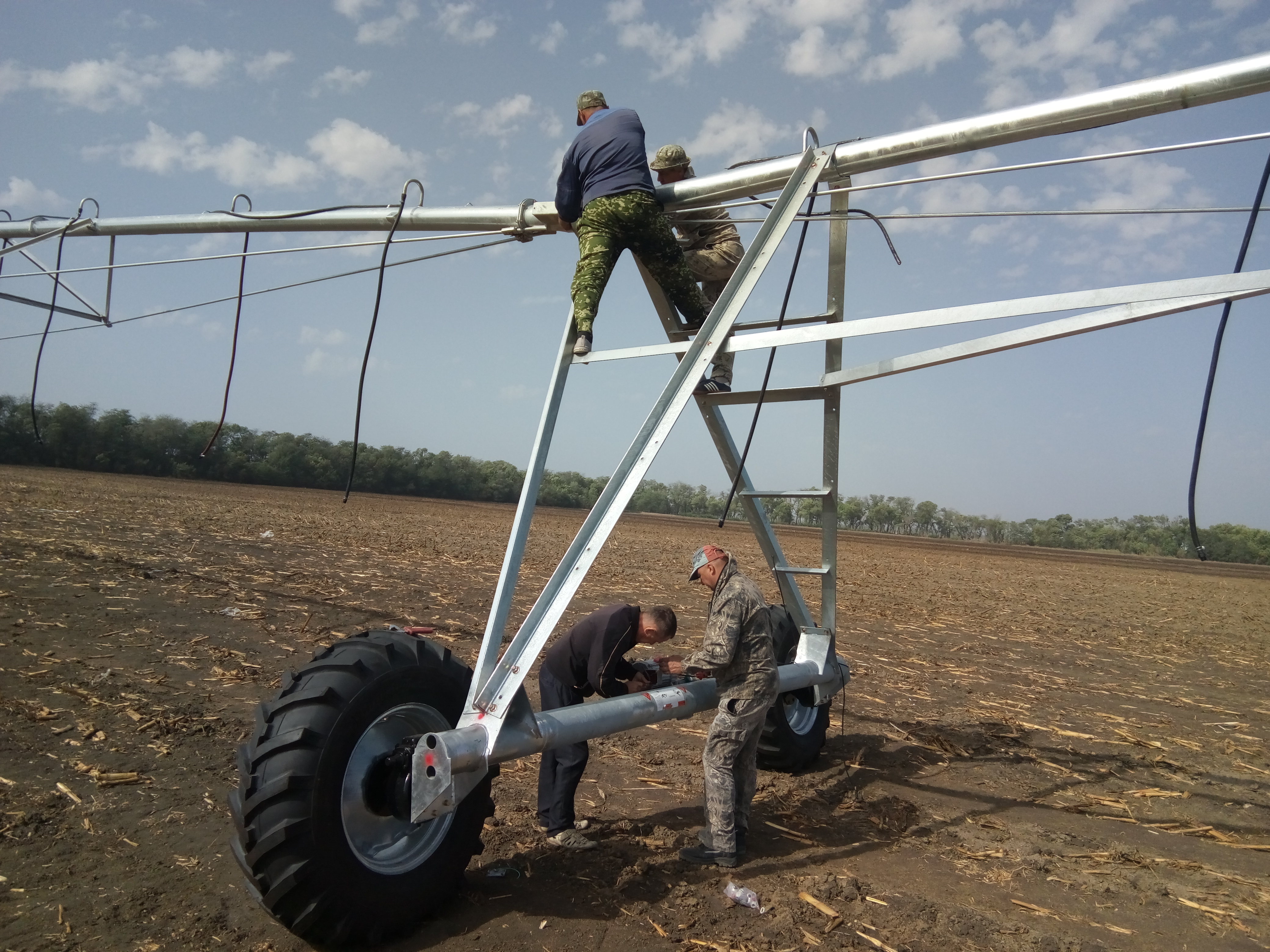
Pivot installation and pipe assembly: the point at which coating, enclosure and control claims can be inspected rather than assumed.
Why compliance evidence is so often over-read
An irrigation pivot system is a long-span, galvanized steel structure with electrically driven towers and a pressurised water delivery line. Buyers evaluating one usually receive a bundle of documents: a quality management certificate, a statement about hot-dip galvanizing, a control panel ingress rating, and a nameplate voltage. Each item is genuine. The error is treating the bundle as a single qualification.
Those documents operate at different levels. One describes how a factory is managed. One describes a coating applied to fabricated steel. One describes how well an enclosure resists dust and water. One describes a configuration choice made at order. None of them, alone, tells a buyer that a specific machine will start and stop reliably across a season, or that its individual spans will reverse on command during a service intervention.
That distinction matters most at the Evaluation and Execution stages, when the question shifts from who can supply a pivot to what exactly am I accepting, and how do I prove it at handover. The practical answer is to convert every claim into a named checkpoint, a stated scope, and a handover test.
Four specification checkpoints and what each one can support
The useful move is to stop asking whether a pivot is “certified” and start asking which document covers which part of the machine. For pivot procurement, four checkpoints carry most of the weight.
| Checkpoint | What it refers to | What a buyer can reasonably conclude | What it does not establish |
|---|---|---|---|
| Q235B steel | Base material grade for structural members, span pipe and tower components | Which steel grade is specified for the structure | Coating mass, coating uniformity, or corrosion life in a specific climate |
| GB 13912-2020 | Hot-dip galvanized coating on fabricated iron and steel articles | The coating reference applied to fabricated steel is named and inspectable | Structural design loads, span length suitability, or machine-level performance |
| IP65 | Enclosure ingress protection for control panel, tower boxes and motor terminal housings | Dust-tight construction, protected against water jets | Submersion tolerance, unlimited high-pressure washdown, or seal integrity after field modification |
| 380V–460V | Rated voltage band the machine is configured for at order | The equipment is built for supply within that band | That the farm’s actual voltage, phase or frequency has been measured and matches |
Each checkpoint is independently useful and independently limited. Combining them still does not replace a handover test.
Q235B plus GB 13912-2020: a material statement and a coating statement
Q235B is a structural steel grade designation. When a pivot specification names Q235B for span pipe, truss members, tower legs and connection hardware, it is telling the buyer which base material the fabricator intends to fabricate from. That is a material statement, and it says nothing on its own about corrosion protection — the same Q235B member can leave two factories with very different coating outcomes.
GB 13912-2020 is the reference that closes that gap, because it addresses hot-dip galvanized coatings on fabricated iron and steel articles. In a pivot, the components that decide long-term appearance and maintenance load are exactly the ones exposed to water, soil splash and humid air. So the practical reading rule is simple: look for the base material and the coating standard named together — Q235B, hot-dip galvanized to GB 13912-2020 — rather than either one on its own. A file that names only the steel grade is a material file. A file that names only “galvanized” is a marketing phrase until a standard is attached.
IP65: an enclosure claim, not a machine claim
IP65 describes ingress protection: dust-tight and protected against water jets. On a pivot, the enclosures that matter are the main control panel, the tower drive boxes and the motor terminal housings. An IP65 statement is meaningful at that level and misleading above it. It does not mean the machine can be submerged, and it does not survive a field modification that leaves a cable gland loose or a cover gasket pinched. Buyers should treat IP65 as a maintenance commitment as much as a purchase specification.
380V–460V: configuration, and a site question
A 380V–460V band states the supply range the machine is configured for. It is a configuration statement, and configuration is precisely where OEM voltage customisation enters. China Yulin Irrigation Equipment Co., Ltd. states that it provides OEM production services and offers voltage customisation for OEM orders, which is the relevant capability when a farm’s supply does not sit neatly inside a standard band. The limitation is equally clear: a nameplate band is not a site measurement. Voltage, phase and frequency at the actual connection point have to be confirmed before the order is fixed, not after the panel is energised.
Reading a quality management certificate without inflating it
A quality management system certificate is the document most often over-read in pivot procurement. It is a real and checkable artefact, but its scope is procedural.
China Yulin Irrigation Equipment Co., Ltd. holds an ISO9001 quality management system certificate, number 18524Q11926R2S, issued by National Standard Integration (Beijing) Certification Co., Ltd against GB/T19001-2016/ISO9001:2015. The certificate covers production of irrigation systems and mechanised agricultural systems (spreader, grinder), and its validity runs from 31 December 2024 to 17 December 2027.
What that supports: the named production scope operates under a certified management system, and the certificate can be checked, dated and re-checked at renewal. What it does not support: a statement that any individual pivot is compliant with GB 13912-2020, achieves IP65, or performs to a given duty cycle. Those are separate claims requiring separate evidence. A buyer who wants the certificate to mean something should pair it with the coating statement, the enclosure statement and the handover test — and should note the expiry date, because a certificate that lapses during a multi-year delivery programme needs a renewal plan in the contract.
Where the evidence comes from: manufacturing context
China Yulin Irrigation Equipment Co., Ltd. is an irrigation equipment manufacturer established in 2009 and based in Lvshunkou District, Dalian City, Liaoning Province, China, producing center pivot, lateral move, towing and hose reel irrigation systems together with irrigation parts, pumps and generators. The factory site covers 64,653 m² and employs 152 people, including a 10-engineer R&D team; the site is roughly two hours by truck from Dalian Port, which matters for inspection timing before shipment.
Several operational facts are directly relevant to how much a specification claim can be verified rather than merely asserted:
- More than 95% of the machine’s spare parts are independently manufactured in the factory, which allows full-process quality monitoring instead of relying on incoming-component declarations.
- The company operated OEM production for a global top irrigation company between 2000 and 2008, and now runs automated production workshops using robotic welding and precision processing.
- Quality control is described as 100% testing, and the company states that its irrigation equipment undergoes anti-corrosion and wind resistance testing for tropical, saline-alkali and high-wind farmland environments.
- The company reports CE, ISO9001 and CSA certifications, with an export ratio of around 60% across Australia, New Zealand, Canada, Mexico, Africa, Central Asia, Russia and Kazakhstan.
- Commercial capability includes a monthly capacity of 60 units, a lead time of 21–40 days and a minimum order quantity of one unit.
None of those statements certifies a machine by itself. What they do is make the specification checkpoints auditable: an in-house parts flow, a named coating reference and a factory-level test regime are things a buyer or third-party inspector can actually look at.
Commissioning and assembly on site: the stage where control behaviour, not paperwork, is demonstrated.
Continuous start-stop operation and per-span reversible control
Two functional behaviours deserve more attention than they usually get in a compliance discussion, because they are the ones a certificate cannot carry: continuous start-stop operation and per-span electromechanical reversible control.
Continuous start-stop operation describes how the machine behaves when it is repeatedly started and stopped under load — the pattern most farms actually run, switching irrigation around water availability, wind and crop stage rather than running one uninterrupted cycle. What a buyer is testing is whether repeated start-stop leaves the structure aligned and the drives healthy, or whether it produces cumulative drift and fault events.
Per-span electromechanical reversible control describes the ability to reverse an individual span’s drive independently of the rest of the machine. In practice this is the function that lets an operator correct alignment, walk a tower out of a rut, or reposition a single span during a service intervention without moving the whole system. It is a mechanical and electrical capability per span — which is exactly why it has to be demonstrated span by span.
The honest limitation is scope of evidence. A handover test shows that the function works on the day, on that field, with that supply and that water pressure. It is a demonstration, not a lifetime endurance guarantee; endurance is what the operating record over subsequent seasons shows, and that record is built from fault logs and maintenance history rather than from a certificate.
A handover verification sequence buyers can actually run
The following sequence converts the four checkpoints and the two control behaviours into acceptance evidence. It is deliberately ordinary: documents first, then physical checks, then functional checks under load, then a signed record.
| Step | Action | Evidence to retain |
|---|---|---|
| 1 | Collect the document set: quality management certificate with number and validity dates, coating standard statement, IP65 statement naming the enclosures, and nameplate voltage data | Dated copies filed with the order record |
| 2 | Confirm the nameplate band against the measured site supply, phase and frequency | Site measurement record signed by both parties |
| 3 | Inspect galvanizing on span pipe, truss members, tower legs and connection hardware, including welds and cut ends | Photo log by span number |
| 4 | Inspect control panel, tower boxes and motor terminal housings for gland tightness and gasket seating | Enclosure checklist per tower |
| 5 | Reverse each span individually and confirm it responds independently, in the correct direction, and stops when commanded | Span-by-span test sheet |
| 6 | Run repeated start-stop cycles under water load and observe alignment, drive behaviour and panel fault indications | Cycle count, observations and fault log |
| 7 | Complete operator briefing on start-stop practice, per-span reversal and panel maintenance | Training attendance record |
A handover sequence is only as good as its record. Steps 5 and 6 are the ones that produce evidence a certificate cannot.

Pre-acceptance inspection on site: the buyer’s opportunity to match delivered hardware to the agreed specification.
Turning checkpoints into purchasing terms and acceptance criteria
A specification checkpoint only becomes enforceable when it appears in the commercial documents. The purchasing terms confirmed for this supplier context are uncomplicated and can serve as a template for how to anchor compliance language:
- Minimum order quantity: 1 unit.
- Delivery terms: FOB, CFR or CIF.
- Acceptance criteria: pre-shipment test.
- Payment terms: 30% deposit after contract confirmation, with the balance by T/T before shipment; L/C or D/P for the Algeria market.
The gap most buyers leave open is the definition of “pre-shipment test”. If the acceptance clause simply repeats that phrase, it can be satisfied by almost anything. The clause should instead enumerate the checkpoints: coating standard and base material named in the build sheet; enclosure rating stated for the panel, tower boxes and motor terminal housings; nameplate voltage recorded against the confirmed site supply; and a factory functional record showing each span reversing individually and the machine completing repeated start-stop cycles under load. Add the certificate expiry date to the same clause so renewal is a contractual obligation rather than a courtesy.
After-sales scope belongs in the same paragraph. The supplier states field installation, commissioning and training, video technical support, online support and free spare parts as its support package — which is the mechanism by which the handover record from step 7 stays meaningful over time.
What field records add to a document set
Documents describe intent and process; operating history describes outcome. The manufacturer reports the following client relationships, which are useful precisely because they represent long duty cycles rather than single-season trials: a major distributor in Australia with 600 units over 15 years, primarily for forage and pasture irrigation and also for cotton and watermelon, with reported energy savings above 40%; a large-scale dairy farmer in New Zealand with 70 units over 9 years for grass irrigation; a Russian group with 450 units over 9 years supplied to end users; an Algerian farm irrigation OEM client with 70 units over 7 years; and an end customer in Zimbabwe with 45 units of three-wheel towable machines over 6 years.
Read those as evidence of pattern, not as compliance proof. A 15-year Australian record tells a buyer something about corrosion behaviour and maintenance economics in a coastal and variable climate; it does not transfer automatically to a saline-alkali soil or a high-wind site. The correct use of field history is to decide which checkpoints to weight more heavily in the handover test for your own site.
Market context: documentation demand is rising with the market
The global center pivot irrigation system market is estimated at USD 2.56 billion in 2025 and projected to reach USD 5.67 billion by 2030, according to Mordor Intelligence. Growth of that scale tends to professionalise procurement: larger buyers, development-financed projects and multi-site operators bring formal acceptance procedures with them.
Two signals point the same way. Lindsay Corporation secured a multi-year supply agreement for Zimmatic irrigation systems in the MENA region valued at more than USD 100 million in 2024, a scale of contracting that usually arrives with specification schedules attached. And ISO 11545:2009 remains the active international standard for determining the uniformity of water distribution from centre-pivot and moving lateral irrigation machines — a reminder that water distribution uniformity is a separate performance standard from coating and electrical ratings. A complete qualification argument needs all three layers: coating, electrical protection and distribution uniformity.
Document-led evaluation versus reputation-led evaluation
Pivot procurement has traditionally leaned on supplier reputation and reference farms. Document-led evaluation adds a slower but checkable path. The comparison is not that one is honest and the other is not — it is that the two approaches fail in different ways.
| Dimension | Reputation-led evaluation | Document- and handover-led evaluation |
|---|---|---|
| Primary evidence | Reference farms, brand familiarity, dealer presence | Named standards, certificate numbers and dates, test records |
| Strength | Fast, captures long-run operating experience | Auditable, transferable between sites, survives staff turnover |
| Failure mode | Reputation earned elsewhere is assumed to apply to your site and configuration | Paperwork is mistaken for performance, and site conditions are skipped |
| Best fit | Buyers with limited inspection capacity and strong local service access | Buyers with multi-unit orders, project financing or formal acceptance requirements |
The limitation of the document-led approach should be stated plainly: it is slower, it requires someone on site who can run the start-stop and per-span reversal checks, and it still cannot substitute for measuring the actual supply voltage or the real water supply. For a single-unit buyer without inspection support, a full document programme can also be disproportionate to the order value. In those cases the sensible approach is a reduced sequence — coating inspection, voltage confirmation and a span-by-span reversal test — rather than skipping verification altogether.
Future outlook
Two directions look likely to shape pivot compliance over the next several years. The first is the separation of evidence layers becoming explicit: buyers will increasingly ask for coating evidence, enclosure evidence, voltage configuration and distribution uniformity as distinct items rather than accepting a single document bundle. ISO 11545:2009 already provides the vocabulary for the uniformity layer.
The second is that functional behaviour — continuous start-stop duty and per-span reversible control — will migrate from verbal assurance into recorded handover data. Once a buyer has seen a span-by-span test sheet, the next order tends to demand the same, and suppliers with in-house parts control and commissioning support are better placed to produce it. In a market projected to grow from USD 2.56 billion in 2025 to USD 5.67 billion by 2030, that standardisation of evidence is likely to be one of the quieter competitive shifts.
Frequently asked questions
What does an ISO 9001 certificate actually cover for an irrigation pivot manufacturer?
It certifies that a defined production scope operates under a certified quality management system. For China Yulin Irrigation Equipment Co., Ltd., certificate 18524Q11926R2S issued by National Standard Integration (Beijing) Certification Co., Ltd covers production of irrigation systems and mechanised agricultural systems (spreader, grinder) against GB/T19001-2016/ISO9001:2015, valid from 31 December 2024 to 17 December 2027. It does not certify that a specific machine meets a coating standard, an enclosure rating or a duty cycle.
Does GB 13912-2020 certify an entire irrigation pivot system?
No. GB 13912-2020 addresses hot-dip galvanized coatings on fabricated iron and steel articles, so it applies to the coating on steel components such as span pipe, truss members, tower legs and connection hardware. Structural design, electrical protection, control behaviour and water distribution uniformity fall outside its scope and require separate evidence.
What does an IP65 rating on a pivot control panel actually cover?
IP65 describes enclosure protection against dust ingress and water jets, applying to items such as the main control panel, tower drive boxes and motor terminal housings. It does not indicate that the equipment is submersible or tolerant of unlimited high-pressure washing, and protection depends on cable glands remaining tight and cover gaskets remaining correctly seated after installation or service.
How should a buyer confirm that a 380V–460V rating matches the farm?
By measuring the supply at the actual connection point and recording voltage, phase and frequency before the order is fixed. The nameplate band states what the machine is configured for, not what the site delivers. Where the measured supply falls outside a standard band, voltage customisation for OEM orders is the relevant supplier capability to raise during quotation.
How can continuous start-stop operation and per-span reversible control be verified at handover?
By testing them explicitly. Per-span reversible control is verified by reversing each span individually and confirming that it responds independently, in the correct direction, and stops when commanded. Continuous start-stop operation is verified by running repeated start-stop cycles under water load while observing alignment, drive behaviour and panel fault indications, then recording the cycle count and observations. Both results should be signed at handover rather than inferred from a certificate.
Which standard covers water distribution uniformity on a pivot?
ISO 11545:2009 is the active international standard specifying an in-field method for determining the uniformity of water distribution from centre-pivot and moving lateral irrigation machines. It addresses distribution performance and is separate from coating standards such as GB 13912-2020 and from enclosure ratings such as IP65.
What purchasing terms and acceptance criteria apply to an irrigation pivot order?
In this supplier context the confirmed terms are a minimum order quantity of 1 unit; delivery on FOB, CFR or CIF terms; acceptance criteria defined as a pre-shipment test; and payment of a 30% deposit after contract confirmation with the balance by T/T before shipment, with L/C or D/P available for the Algeria market. Buyers should define what the pre-shipment test includes, since the phrase on its own does not specify which checkpoints are covered.
The 2026 YULIN Pivot Catalogue, including model and configuration information, can be downloaded here: 2026 YULIN Pivot Catalogue (PDF).
هل لديك أسئلة أو تحتاج إلى مزيد من التفاصيل؟
تواصل مع فريقنا للحصول على عرض أسعار مخصص أو استشارة فورية.
طلب عرض أسعار
املأ النموذج أدناه وسيتواصل معك فريقنا بعرض مقترح مخصص.
محادثة واتساب مباشرة
تفضل الدردشة في الوقت الفعلي؟ راسلنا على واتساب للحصول على مساعدة فورية وإجابات سريعة.
- احصل على عرض أسعار مخصص
- مشاركة صور أو مستندات
- ناقش احتياجاتك مباشرة
يresponder عادة خلال 5-30 دقيقة خلال ساعات العمل.