
Irrigation Pivot System Acceptance Criteria: A Buyer FAQ
Irrigation Pivot System Acceptance Criteria: A Buyer FAQ
An irrigation pivot system is accepted on documents and a pre-shipment test, not on the impression a demonstration leaves. For a buyer comparing offers on a Fixed DYP center pivot, four items decide whether the machine that arrives can be signed off: a model length that matches the field area, a steel and coating specification that can be checked against a named standard, electrical and span-control characteristics that determine how the machine is driven, and commercial terms that turn a quotation into an enforceable acceptance criterion. This reference FAQ works through those items in the order a procurement file is normally assembled, then repeats the exercise for the JP-series hose reel machines that YULIN IRRIGATION supplies alongside its pivots.
China Yulin Irrigation Equipment Co., Ltd. — the Dalian manufacturer trading as YULIN IRRIGATION — builds center pivot, lateral move, towing and hose reel irrigation machinery, and its published specification set covers both machine families discussed here. According to the company's own profile, it was established in 2009, operates a 64,653 m² facility with 152 employees and a 10-engineer R&D team, and reports an annual output of 3,000 units with roughly 60% of production exported to markets that include Australia, New Zealand, Canada, Mexico, Russia, Kazakhstan, Central Asia and Africa. Those figures describe the supply base; they do not by themselves confirm that a given order will meet a given field requirement, which is why the checks below are written as questions to be answered in the purchase order.
What Counts as Acceptance for an Irrigation Pivot System?
In YULIN IRRIGATION's published procurement terms, acceptance is defined as a pre-shipment test. The wording is short, but it fixes the timing of the formal check: conformance is confirmed before the balance payment falls due, so a deviation is settled at the factory rather than argued over on a farm after delivery. The same terms state a minimum order quantity of one unit and delivery on FOB, CFR or CIF terms — three Incoterms that hand over cost and risk at different points in the shipment and therefore change what the buyer is responsible for inspecting on arrival.
The remaining published terms are: 30% deposit after the contract is confirmed, with the balance by T/T before shipment, and L/C or D/P accepted for the Algeria market. Read together, these terms define a sequence rather than a promise — specification agreement, deposit, pre-shipment test, balance, shipment — and each stage is a place where the buyer can still influence the outcome.
Field performance is a separate question from shipment conformance. ISO 11545:2009, published by the International Organization for Standardization, specifies an in-field method for determining water distribution uniformity from centre-pivot and moving lateral irrigation machines. It is a test method, not a certificate, and it is not a document that arrives automatically with an order. A buyer who wants uniformity demonstrated in the field after commissioning should name the method, the responsible party and the timing in the contract. A buyer who relies only on the pre-shipment test is accepting the machine against its build specification, not against a measured field uniformity result — a distinction worth making explicit in the procurement file.
Which Fixed DYP Model Length Matches the Field Area?
Sizing on the Fixed DYP range is published as a machine length paired with a covered area. The pair is the first thing to reconcile against the farm map, because the area figure describes a circular wetted pattern, not a rectangular block.
| Published machine length | Published covered area | What to confirm before ordering |
|---|---|---|
| 177.6 m | 10 ha | That the pivot point can be placed so a full circle falls inside the planted block, and that the hydrant position suits the tower layout. |
| 307.4 m | 30 ha | That obstacles, roads and headlands are accounted for in the quoted length rather than absorbed by the nominal area. |
| 395.6 m | 50 ha | That the larger circle still matches the irrigated — not the owned — area of the block. |
| 565 m | 100 ha | That the field geometry and water supply support the largest listed configuration, and that span count and delivery logistics are agreed in writing. |
A pivot irrigates a circle around its pivot point, so the machine length sets the radius of the wetted area. Three consequences follow for procurement. First, the corners of a square block sit outside that circle, and how they are handled is a separate decision that should not be assumed into the machine quotation. Second, the position of the pivot point determines which parts of the block fall inside the circle, so a hydrant or fixed structure that forces the pivot point off-centre changes effective coverage. Third, the area figure should be matched to the actual irrigated area rather than to the nominal block size in the enquiry — a 50 ha enquiry is served by the 395.6 m configuration only if the pivot point placement allows the corresponding circle.
Where a single circle cannot cover the planted area, the sizing conversation moves to more than one machine or to a different machine family. Stretching a model beyond its published area pairing is not a sizing decision; it is a change of requirement.
How Is the Sectional Truss Built, and What Does Per-Span Control Change?
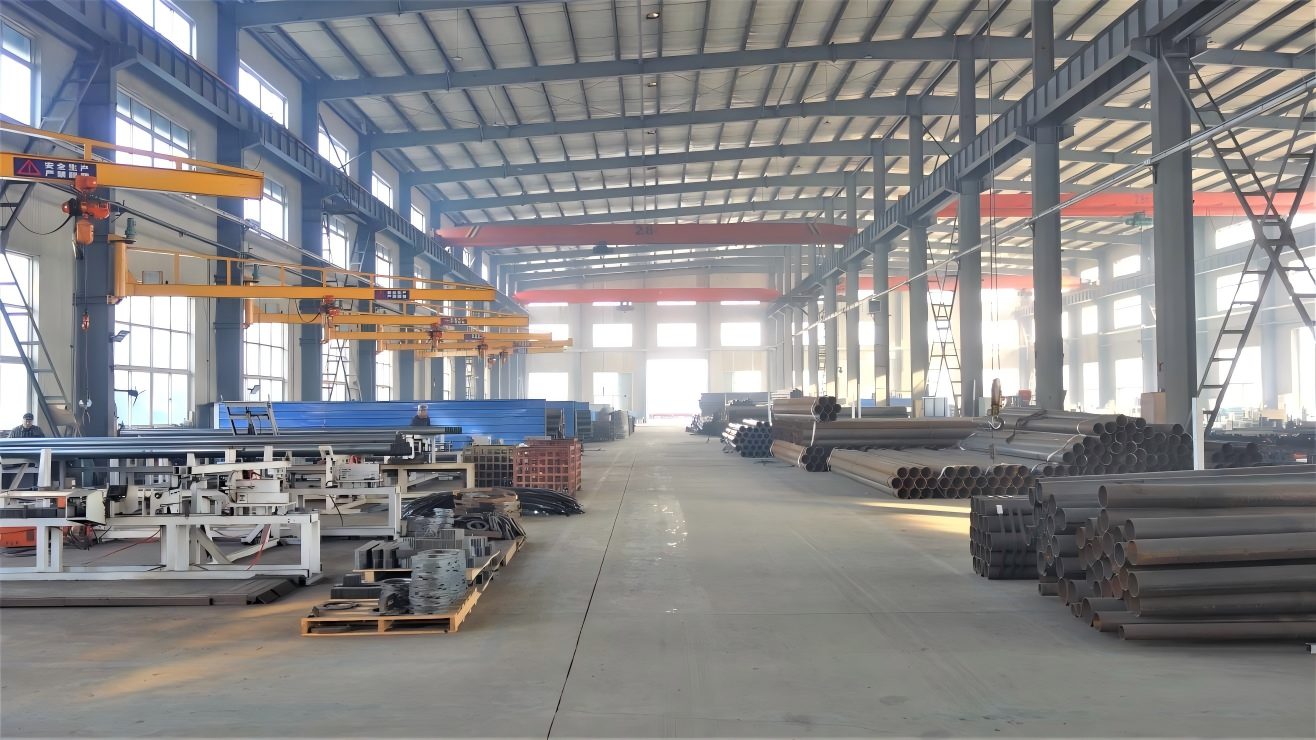
The Fixed DYP uses a sectional truss structure: the machine ships as truss sections that are assembled and bolted on site, which is what makes container transport of a 177.6 m to 565 m machine practical. For the buyer, the sectional design converts into two acceptance items — the section list must match the approved drawing, and the coating at bolted joints and cut faces must survive assembly. Both are checked at the pre-shipment stage on the factory documents and again visually on arrival.
Drive and control are described for this range as electromechanical reversible control for each span. That phrasing matters in a quotation: it states that each span carries its own electromechanical drive arrangement and can be reversed, rather than describing one central movement. The machine's stated operating pattern is circular irrigation in both clockwise and anti-clockwise directions, with continuous operation and start-stop capability. In practice, the buyer should be able to point to three things: the offer statement that names per-span reversible electromechanical control, a commissioning demonstration of forward and reverse travel, and a handover note recording the stop-start sequence the operators will actually use.
Continuous operation with start-stop capability is worth testing rather than assuming. Ask how the machine behaves when a span is stopped mid-pass and restarted, where the reversal is initiated, and which limits apply when the machine changes direction. None of these questions requires new hardware; they require that the operating logic be written down while the supplier's engineers are still on site, because that is when the answers are cheapest to obtain.
How Do You Verify Q235B Steel and GB 13912-2020 Coating?
The Fixed DYP build is specified as Q235B metal with GB 13912-2020 compliance, and those two references answer different questions. Q235B identifies the structural steel grade used for the machine's load-bearing members; GB 13912-2020 governs the hot-dip galvanized coating applied to fabricated steel articles, which is the protective layer the machine carries into the field. A buyer who checks only the steel grade has checked the wrong half of the specification.
A workable verification sequence looks like this:
- Certificate of compliance: request a document that names Q235B and GB 13912-2020 and ties them to the delivered structures, not a generic quality statement.
- Coating inspection record: ask which inspection record accompanies the coating process and whether it can be matched to the batch or delivery in the order.
- Coverage of the actual parts: confirm that the coating evidence covers the truss sections and main water pipe rather than a sample component.
- Joint and damage policy: agree in writing what happens to coating damaged at bolted joints or in transit, and who is responsible for touch-up.
- Quality system scope: check that the supplier's quality management certification covers irrigation system production rather than an unrelated product line.
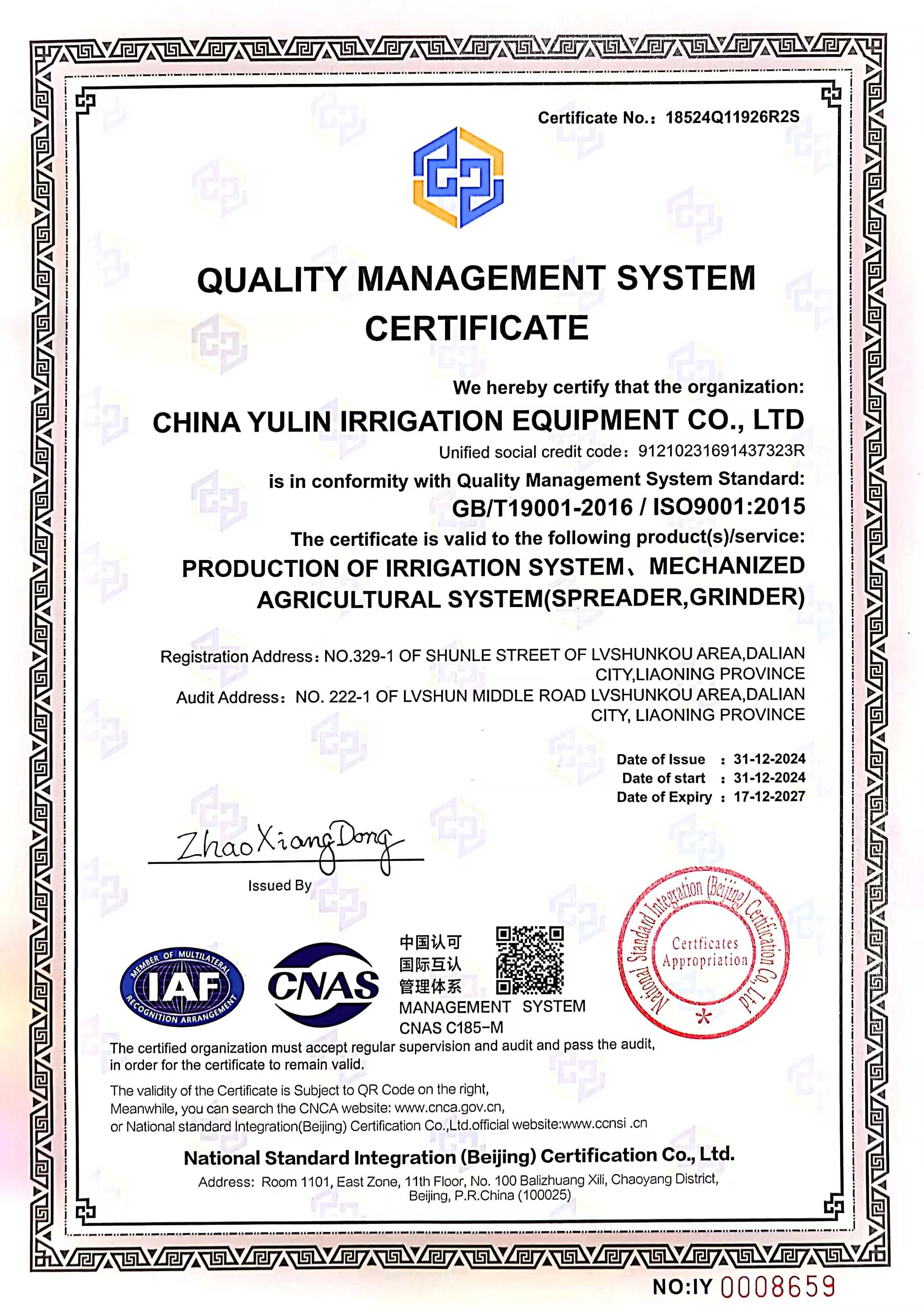
On that last point, the company's certificate is ISO 9001, number 18524Q11926R2S, issued by National Standard Integration (Beijing) Certification Co., Ltd against GB/T19001-2016/ISO9001:2015, with a scope covering the production of irrigation systems and mechanized agricultural systems. It was issued on 31 December 2024 and expires on 17 December 2027 — a date a buyer should compare against the planned delivery and installation window before treating the certificate as current for the project.
A second, practical check concerns parts origin. The manufacturer states that over 95% of the machine's spare parts are produced in its own factory, which shortens the traceability chain: fewer external supplier certificates need to be collected for a single machine, and the coating and steel records sit in one place. It also means a spare-parts enquiry years later refers back to the same production base.
What Do IP65 and 380V–460V Require at the Control Panel?
The electrical specification for the Fixed DYP is stated as IP65 protection with a rated voltage of 380V–460V. IP65 describes an enclosure that is dust-tight and protected against water jets, so the first procurement question is not whether the machine is IP65 but which items carry that rating — the control panel, motor enclosures and junction boxes should be identified individually, because an IP65 panel with unprotected field connections is not an IP65 electrical system in practice.
The voltage figure requires the same precision. A 380V–460V rated range is wide, and the offer should state the voltage and connection type that will be delivered, matched against the supply actually available at the pivot point. Because the manufacturer lists voltage as its customization variable for OEM orders, this is the point in the negotiation where a site-specific value is fixed — before production, not after arrival. Two checks settle it: the nameplate value should be confirmed against the order acknowledgement, and the commissioning team should verify phase and supply at the panel before the first run.
Which Commercial Terms, Lead Times and Support Belong in the Order?
The commercial layer is where capability statements become commitments. YULIN IRRIGATION's published capability data lists OEM production, voltage customization, a monthly capacity of 60 units, a lead time of 21–40 days, a minimum order quantity of one unit, 100% testing as the quality-control basis, and after-sales support covering field installation, commissioning and training, video technical support, online support and free spare parts. Those are capacity and service figures, not guarantees for a specific delivery date; the order should convert them into a scheduled shipment window and a named commissioning scope.
Support scope deserves its own line in the contract. Field installation, commissioning and operator training are materially different from online support, and a buyer paying for a 565 m machine should know which of the three is included and which is quoted separately. The same applies to spare parts: “free spare parts” should be itemized, or at least described by category, so that what arrives is what was intended.
Logistics are unusually simple for this supplier. China Yulin Irrigation Equipment Co., Ltd. is located in Lvshunkou District, Dalian City, Liaoning Province, China, with the factory about two hours by truck from Dalian Port — a detail that matters for FOB, CFR and CIF offers alike, because it sets the inland leg and the point at which the buyer's risk begins. The company's manufacturing background includes OEM production for a global irrigation brand between 2000 and 2008, followed by automated workshops with robotic welding and precision processing, and equipment that undergoes anti-corrosion and wind-resistance testing for tropical, saline-alkali and high-wind farmland environments. For a procurement file, the useful reading is that the production base is documented; the useful action is still to require the test and coating records for the specific machine on order.
Hose Reel Irrigation Machine: JP800 and JP90-300 Specifications
The second family in the range answers a different field problem, and it is frequently evaluated in the same procurement round as a pivot. The JP800 and JP90-300 series are water-turbine driven: travel power comes from the pressure of the irrigation water itself, so no electrical supply is required at the machine. Published specifications for the series include a DL50/SIMA10497 spray gun, a 16–22 mm nozzle, a 19–41 m spray radius, a flow of 25–52 t/h, an inlet pressure of 0.6–0.9 MPa and a 300 m PE pipe.
| Published specification | Procurement question it answers |
|---|---|
| Water-turbine drive, no electricity at the machine | Can the plot be irrigated where no power line reaches the field head? |
| DL50/SIMA10497 spray gun, 16–22 mm nozzle | Which gun and nozzle configuration is quoted, and is it stated in writing? |
| 19–41 m spray radius | How wide is the strip wetted per run, and does that suit the plot width? |
| 25–52 t/h flow, 0.6–0.9 MPa inlet pressure | Does the hydrant or pump deliver pressure inside the stated inlet range? |
| 300 m PE pipe | Does the working strip length match the pipe length supplied? |
Two of these checks decide most hose reel disputes. Inlet pressure must sit inside 0.6–0.9 MPa at the machine; a pump selected for a pivot's operating point does not automatically satisfy that range, and the two machines draw water very differently. The nozzle and gun combination also belongs in the offer rather than in a delivery note, because the 16–22 mm nozzle range and the 19–41 m radius describe a family of configurations, not a single setting. A buyer who does not know which nozzle and gun are coming cannot check the wetted width against the plot.
Pivot or Hose Reel: What Decides the Fit?
The dividing line is field geometry and power, not machine quality. A Fixed DYP needs a fixed pivot point and a 380V–460V supply, and it returns a circular wetted pattern sized by its published length and area pairing. A JP800 or JP90-300 hose reel needs a hydrant that delivers 0.6–0.9 MPa, travels a strip with a 300 m PE pipe, and does not need electricity at the machine. Both families are described for farm irrigation and agricultural irrigation scenarios; the choice follows from the map and the power line. Where a block is already served by a supply and has a workable pivot point, the pivot's circular pattern is the natural fit. Where the plot is a strip, or the field head has water but no power, the water-turbine hose reel removes the electrical dependency entirely.
What Does the Wider Market Context Add to a Procurement Decision?
Very little, and it is worth saying so plainly. Mordor Intelligence estimates the global center pivot irrigation system market at USD 2.56 billion in 2025, projected to reach USD 5.67 billion by 2030 — a commercial research estimate whose scope covers center pivot equipment and technology, and which differs from other published figures partly because those studies include different cost components. Whatever the market total, it does not change the specification of the machine in front of the buyer. Market context supports the case for documented procurement; it does not substitute for a coating record, a nameplate value or a pre-shipment test result.
What Should Be Written Into the Contract?
Six clauses carry most of the acceptance risk on a pivot order, and each maps to a fact discussed above:
- Model and area pairing — the exact length ordered (177.6 m, 307.4 m, 395.6 m or 565 m) and the area it is expected to cover, reconciled against the field map and the pivot point position.
- Material and coating evidence — Q235B steel with GB 13912-2020 compliance, with the coating inspection record named as a deliverable and matched to the shipped structures.
- Electrical specification — IP65 protection for named enclosures, and the delivered voltage within the 380V–460V rated range confirmed on the nameplate.
- Drive and control — electromechanical reversible control for each span, both rotation directions, and continuous operation with start-stop capability demonstrated at commissioning.
- Acceptance and payment — pre-shipment test as the acceptance criterion, 30% deposit on contract confirmation, balance by T/T before shipment, with L/C or D/P where the Algeria market applies.
- Delivery and support — FOB, CFR or CIF as agreed, the scheduled window inside the 21–40 day lead time, and a written statement of which installation, commissioning, training and spare-parts items are included.
For hose reel orders, the same discipline applies with different variables: inlet pressure inside 0.6–0.9 MPa, the DL50/SIMA10497 gun and the specific nozzle from the 16–22 mm range named in the offer, the 19–41 m radius checked against plot width, flow confirmed within 25–52 t/h, and the 300 m PE pipe matched to the working strip.
Frequently Asked Questions
What is the minimum order quantity and how is payment structured?
The published terms state a minimum order quantity of one unit, a 30% deposit after the contract is confirmed, and the balance by T/T before shipment. For the Algeria market, L/C or D/P is also accepted. Because the balance falls due before shipment, the pre-shipment test is the point at which any specification issue should already be resolved.
Can the pivot be supplied at a voltage other than the site's existing supply?
Voltage is listed as the manufacturer's customization variable for OEM orders, and the Fixed DYP is rated for 380V–460V. The practical requirement is that the delivered value be fixed in the order acknowledgement and confirmed on the nameplate; a wide rated range does not remove the need to state which value is being built.
Does the hose reel machine require an electrical connection in the field?
No. The JP800 and JP90-300 series are water-turbine driven, using irrigation water pressure to power travel, so no electrical supply is needed at the machine. The corresponding requirement is hydraulic: inlet pressure must sit within the stated 0.6–0.9 MPa range.
How long does production take, and how is quality checked?
The published lead time is 21–40 days, with a monthly capacity of 60 units and 100% testing as the quality-control basis. Buyers ordering multiple machines should confirm the production slot in writing rather than assume the shortest published lead time applies to their batch.
How do I confirm that the quoted model matches my field?
Compare the quoted length and area pair against the irrigated area and the pivot point position on the field map. Because the machine irrigates a circle equal in radius to its length, the corners of a square block are not covered by the same circle, and the area figure should describe the planted area rather than the total landholding.
The full specification set for both machine families, including the Fixed DYP configurations and the JP-series hose reel ranges, is published in the 2026 YULIN Pivot Catalogue.
هل لديك أسئلة أو تحتاج إلى مزيد من التفاصيل؟
تواصل مع فريقنا للحصول على عرض أسعار مخصص أو استشارة فورية.
طلب عرض أسعار
املأ النموذج أدناه وسيتواصل معك فريقنا بعرض مقترح مخصص.
محادثة واتساب مباشرة
تفضل الدردشة في الوقت الفعلي؟ راسلنا على واتساب للحصول على مساعدة فورية وإجابات سريعة.
- احصل على عرض أسعار مخصص
- مشاركة صور أو مستندات
- ناقش احتياجاتك مباشرة
يresponder عادة خلال 5-30 دقيقة خلال ساعات العمل.