
Irrigation Pivot System Supplier Evidence: Inside a Fixed DYP Build Sheet
A center pivot irrigation system is usually justified to a farm's owners through a yield projection, but it is selected through a document. That document — a build sheet, a technical annex or a specification schedule attached to a quotation — is where a supplier's capability stops being a claim and becomes checkable. This article reads one such document in full: the specification behind the Fixed DYP center pivot built by China Yulin Irrigation Equipment Co., Ltd. (YULIN IRRIGATION), an irrigation machinery manufacturer established in 2009 in Lvshunkou District, Dalian, Liaoning Province, China. The purpose is not to promote a machine. It is to show what a buyer can actually verify in an irrigation pivot system before a purchase order is signed.
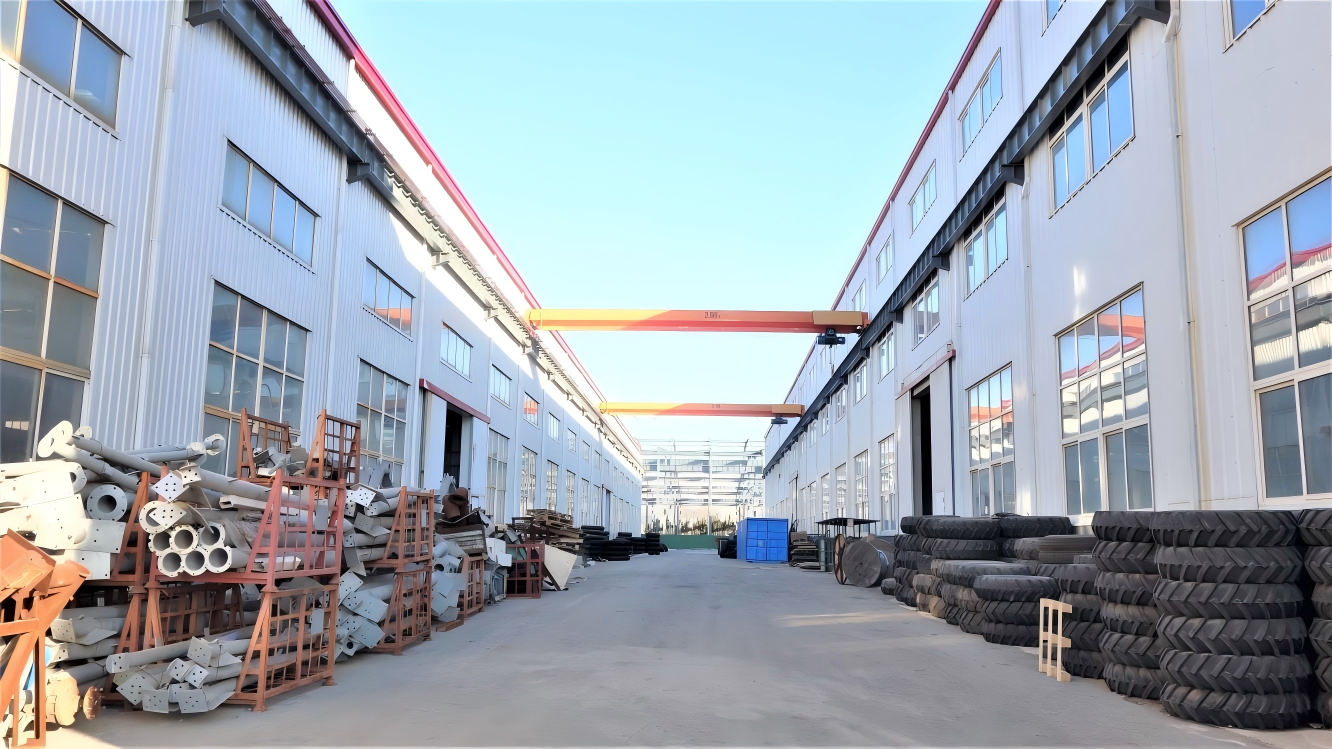
Raw material stacking and handling zone outside the production workshop — the first point in the chain where material-grade evidence exists.
Why Buyers Ask for a Build Sheet Instead of a Brochure
Most pivot pages describe outcomes: water saved, labour reduced, harvest lifted. A build sheet describes inputs: steel grade, coating method, drive type, protection class, voltage window, dimensional tolerances and control functions. Inputs can be compared against a field survey, a water test or a factory audit before payment. Outcomes usually cannot be checked until the machine has run for several seasons.
That asymmetry is what makes the Research and Evaluation stages of a pivot purchase so difficult. Two quotations can look similar on the cover page and differ substantially in the entries that determine service life. The table below sets out the practical translation.
| Typical quotation claim | What a checkable document should state |
| "Heavy-duty steel structure" | Steel designation and coating reference (for example Q235B metal with a hot-dip galvanizing reference) |
| "Fully weatherproof electricals" | Protection class stated per component — control panel, tower box, collector ring separately |
| "Works on farm power" | A rated voltage range, not a single voltage |
| "Large field coverage" | Machine length paired with the hectare figure it covers |
| "Precision control" | Named control-panel functions and the drive arrangement per span |
The Fixed DYP Build Sheet: What Is Actually Documented
The Fixed DYP is a fixed center pivot machine. Its documented drive arrangement is electromechanical and reversible, applied individually to each span rather than to the machine as a whole. That single line has a direct operational consequence: direction and speed are governed span by span, which is the basis for the clockwise and anti-clockwise circular irrigation method recorded on the same sheet.
| Build-sheet entry | Documented value |
| Pivot type | Fixed DYP center pivot |
| Pivot drive | Electromechanical, reversible, individual for each span |
| Rated voltage | 380V–460V |
| Control panel functions | Main power switch (disconnect switch); power control switch; water switch; direction control switch; percentage indicator (speed regulation); auto-reverse switch |
| Protection class on the control panel line | IP65 |
| Ground to bottom of truss rod | 3 ± 0.2 m |
| Operating temperature | −45 to +45 °C |
| Water pipeline type | Sectional, truss structure |
| Movement mode | Continuous, start-stop |
| Pressure regulators | 10, 15 or 20 psi |
| Tower wheels | 14.9-24 irrigating tire, two wheels per trolley, hot-dip galvanized discs |
| Collector ring | 11 rings, not less than 4×90A, 7×25A |
| Copper electrical cable core | Not less than 4×4 mm² + 7×1.0 mm² |
| Flexible irrigation hoses | PVC, reinforced, UV resistant |
| Average drop diameter | Not more than 1.1 mm |
| Rain intensity | Not more than 0.16 mm/min |
| Plant mechanical damage | Not more than 2% |
| Land usage coefficient inside the irrigated circle | Not less than 0.9 |
| Water pH tolerated without quality problems | pH 6–7.5, during the warranty period |
| Crop types listed | Fodder crops, cereals, vegetables, industrial crops, including corn |
Two entries are deliberately left open rather than fixed: the irrigation rate per 24 hours and the end-gun or end-of-pivot sprinkler average drop diameter are both recorded as project options. For a buyer, that is not a gap — it is a signal that those two values are configured against the farm's water source, crop and field layout rather than delivered as a standing figure.
Reading the Material and Coating Lines Correctly
The material designation on the sheet reads Q235B metal with a GB 13912-2020 reference, and the anti-corrosion coating line records hot-dip galvanization with a GB/T 13912-2002 reference. Both references appear on the same document. A buyer comparing suppliers should treat that as a question to resolve in writing, not as an assumption: ask which edition of the coating standard the delivered batch is certified against, and ask for that answer in the technical annex rather than in an email.
The more important point is the coating method itself. Hot-dip galvanizing is a metallurgically bonded zinc coating applied by immersion, and it is a different process from sprayed zinc-rich paint or powder coating. When the coating method is named, the buyer can ask the supplier to name the standard behind it — and a supplier that cannot name a standard is describing a finish, not a specification.
Protection Class and Voltage: Do Not Accept a Machine-Level Claim
The build sheet records IP65 on the control panel function line. Elsewhere in the same document, protection levels are separated: the collector ring is listed at IP65, and the tower box at IP33. These are three different components with two different ratings.
That distinction matters during evaluation. A supplier summarising the machine as "IP65" is compressing a component-level fact into a machine-level claim. The correct procurement question is not whether the pivot is IP65, but which enclosure is IP65, which is IP33, and whether the drive motors and gearboxes are rated at all. On this sheet the answer is specific and falsifiable, which is exactly what makes it useful.
The voltage entry works the same way. A rated range of 380V–460V is a procurement fact rather than a marketing one: it tells a buyer working with a diesel generator set, an unstable rural supply or a non-standard grid whether the machine's electrical design sits inside their available supply window, and it tells a supplier what documentation to request when a farm's supply is unusual.
Size Configurations as Manufacturing Evidence
The Center Pivot Irrigation System is documented in four size configurations, each pairing a machine length with a coverage figure:
- 177.6 metres long, covering 10 hectares
- 307.4 metres long, covering 30 hectares
- 395.6 metres long, covering 50 hectares
- 565 metres long, covering 100 hectares
Read as a commercial list, these are four products. Read as evidence, they are a statement about manufacturing range. Producing a 177.6-metre machine and a 565-metre machine requires the same truss and span design to behave predictably across very different loads, and it requires a supplier to hold span, tower and pipeline inventory across the whole band rather than assembling one size.
Supporting capability facts on file for YULIN IRRIGATION include a manufacturing base of 64,653 m², a workforce of 152, a 10-engineer R&D team, and a stated position that over 95% of the machine's spare parts are independently manufactured in-house — a condition that allows full-process quality monitoring. The company records an OEM production mode with voltage listed as a customisation axis, monthly capacity of 60 units, lead times of 21–40 days, a minimum order quantity of 1 unit, and 100% testing of outgoing equipment. A separate verified supply figure places pivot supply capacity at 400 sets per year. For a distributor or a large farm planning a multi-unit rollout, capacity and lead time are as decisive as any single specification value.
Per-Span Reversible Control and the Sectional Truss
Two entries on the sheet are structural rather than electrical, and both affect service life. The water pipeline is described as sectional with a truss structure, and the machine runs in continuous or start-stop mode with the last tower's motor governing pivot movement.
For an operations manager, the practical meaning of per-span reversible drive is fault containment. Because drive is applied individually to each span, a single span can be reversed or held without re-engineering the whole machine's control logic, and the auto-reverse switch on the standard panel supports the alternating clockwise and anti-clockwise passes recorded as the irrigation method. The 3 ± 0.2 m clearance from ground to the bottom of the truss rod sets what can pass beneath the machine — a figure that should be matched against the tallest crop in the rotation and against any machinery that crosses the pivot track.
A Second Product Line as a Capability Signal: JP800
A supplier's credibility is also tested by what it publishes about its other lines. The JP800 hose reel irrigation machine, part of the JP90-300 model series, is documented with a level of detail that can be compared directly against competing hose reel irrigation systems:
| JP800 documented specification | Value |
| PE pipe diameter | 90 mm |
| PE pipe length | 300 m |
| Water flow | 25–52 T/H |
| Nozzle diameter | 16–22 mm |
| Spray radius | 19–41 m |
| Spray gun | DL50 / SIMA10497 |
| Inlet pressure | 0.6–0.9 MPa |
| Weight | 2180 ± 30 kg |
| Outside size | 6120L × 2330W × 2770H mm |
| Shipping size | 2450L × 2000W × 2250H mm |
Two details are worth extracting. The shipping size is materially smaller than the outside size — a deliberate design choice that determines how many machines fit in a container and therefore what freight a distributor pays per unit. And the machine is specified as water-turbine driven, which the manufacturer records as removing the requirement for an electricity supply at the reel. For fields without reliable power, that is a different procurement equation from a pivot, which needs 380V–460V or a generator set.
Where These Values Are Actually Tested: Field Application
Specifications are only useful if they map onto working conditions. A documented application of the 395.6-metre, 50-hectare configuration is a dry-season farm project in Papua New Guinea, where irrigation substitutes for rainfall. The unit was supplied with an end spray gun for supplementary corner irrigation and a 1000 L fertilizer tank, and was configured for either external power or a diesel generator set — a direct match to the 380V–460V entry. The customer's special requirements included an option of poly pipe to prevent acidic or alkaline water from corroding the pipeline, and the addition of pesticides for integrated pest control during irrigation. That request is consistent with the sheet's pH 6–7.5 tolerance window: water outside that band needs a material response, and the documented answer is a pipe option rather than a claim.
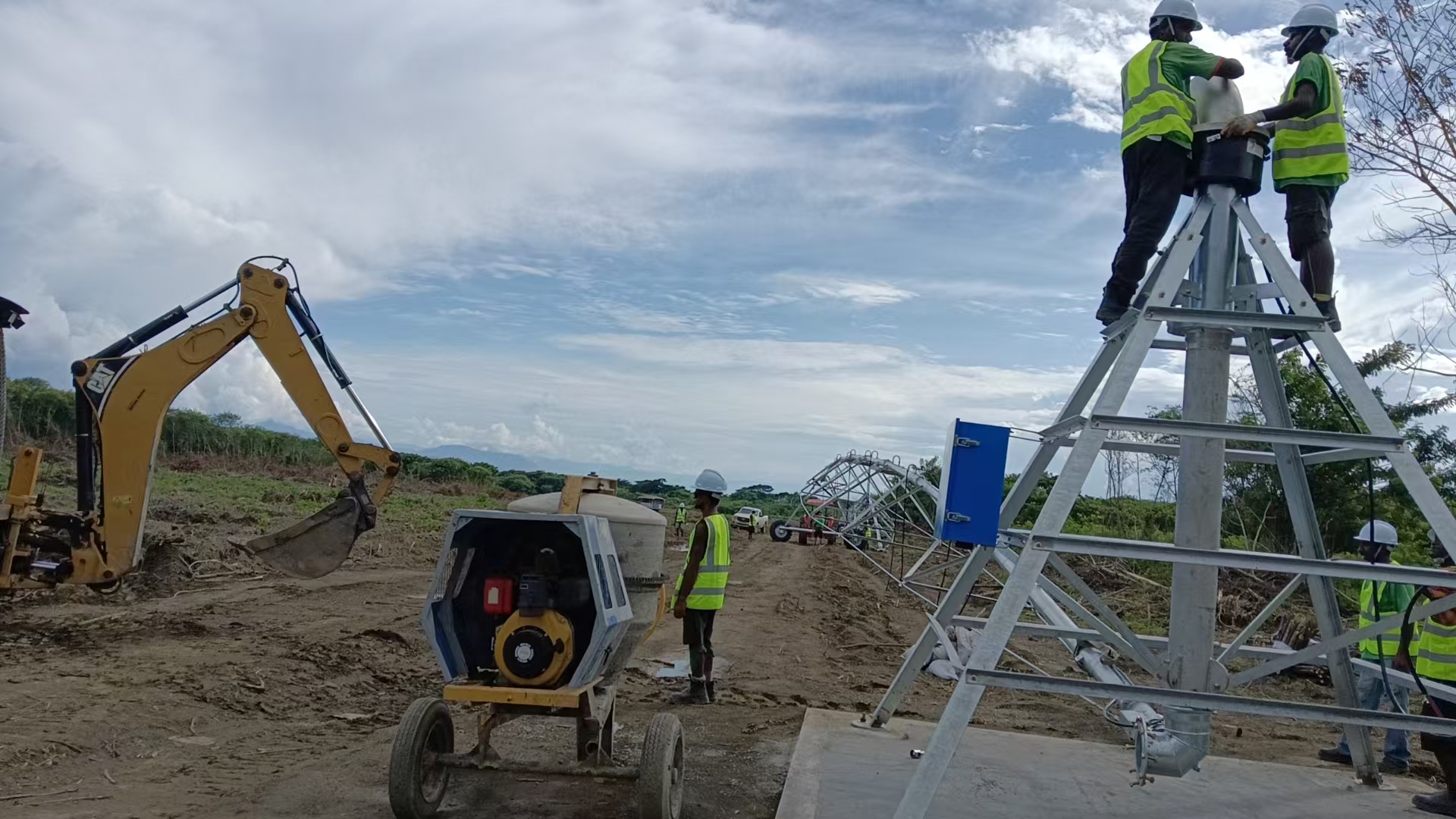
On-site installation guidance during commissioning — the stage at which documented dimensions and clearances are verified against the field.
Longer service horizons appear in the installed base as well. A New Zealand dairy operation has run 70 center pivot units for grass irrigation over a recorded nine-year period, with long service life and labour saving cited as the operating outcomes. In Brazil, a large-scale farmer has operated 50 hose reel machines for soybean irrigation across six years, reporting both labour savings and ease of towing between plots. These are the kinds of references a buyer should ask to speak to directly, because a machine that survives six to nine years of continuous duty tells a procurement team more about steel and coating than any datasheet.
Certification: Know What Each Certificate Covers
Quality documentation is frequently misread during evaluation. The ISO9001:2015 certification held by the manufacturer — certification number 18524Q11926R2S, issued by National Standard Integration (Beijing) Certification Co., Ltd., against the standard GB/T19001-2016/ISO9001:2015 — covers the Center Pivot Irrigation System and the Hose Reel Irrigation Machine, with a scope described as the production of irrigation systems and mechanized agricultural systems, and it applies to the global market.
That is a management-system certificate. It is evidence that the production process is controlled and auditable; it is not a performance certificate for water distribution. When a tender requires a distribution-uniformity figure, the relevant reference is a different document — ISO 11545:2009 specifies the in-field method for determining the uniformity of water distribution from centre-pivot and moving lateral irrigation machines. A buyer should ask separately which standard the quoted uniformity figure was measured under, because the correct answer is not the same document as the quality certificate.
Market Context: Why Documentation Is Becoming a Competitive Ground
The pivot market itself is expanding. The global center pivot irrigation system market is estimated at USD 2.56 billion in 2025 and projected to reach USD 5.67 billion by 2030, according to Mordor Intelligence. Contract activity reflects the same direction at project scale: Lindsay Corporation secured a multi-year Zimmatic irrigation supply agreement in the MENA region valued at more than USD 100 million in 2024, as reported by the company.
Rising volumes and larger multi-year agreements tend to push procurement toward standardised documentation. When a buyer is comparing five suppliers across three continents, narrative capability statements cannot be scored. Specification entries, certification numbers and measurable tolerances can be. This is the quieter commercial effect of market growth: the suppliers that gain share in project-scale tenders are often the ones whose documents survive a technical review.
Comparison With a Quote-Only Selection Process
The traditional alternative to build-sheet evaluation is quote-only selection, where suppliers are shortlisted on price, delivery and a site visit. It is fast and it works in some conditions. It also concentrates risk: differences in steel grade, coating method and drive architecture can be invisible until the third or fourth season, long after the commercial decision has been closed.
Documented evaluation is not automatically better, and it carries its own limits that buyers should accept before adopting it:
- A build sheet describes the machine, not the farm. Supply pressure, flow rate, water chemistry and field geometry still require separate hydraulic and agronomic engineering. A well-documented pivot installed on an under-designed water source will still underperform.
- Several entries are conditional. The land usage coefficient of not less than 0.9 and the pH 6–7.5 tolerance both apply within stated boundaries — the pH tolerance is specified during the warranty period, and the coefficient is defined within the irrigated circle including the area near the center tower.
- Protection ratings are component-level. IP65 applies to the control panel and the collector ring on this sheet; the tower box is IP33. Buyers who need enclosure protection for washdown or monsoon conditions should confirm ratings for the drive and gearbox assemblies separately.
- Standard editions must be confirmed. Where a document references a galvanizing standard, the specific edition should be confirmed in writing before the order, not assumed.
- Fixed pivots do not suit every field. A fixed center pivot irrigates a circle; irregular plots, narrow strips or frequently relocated operations may be better served by a towing irrigation system, a lateral move irrigation system or a hose reel irrigation system. The 100-hectare 565-metre configuration is not the right answer for a 10-hectare block that rotates between three parcels.
Future Outlook
Three shifts are visible from the documented evidence rather than from opinion. First, coverage bands are becoming a procurement shortcut: a supplier documenting 10, 30, 50 and 100-hectare configurations lets a buyer shortlist by field size before any commercial discussion begins. Second, electrical flexibility is turning into a specification category of its own — a 380V–460V window is a statement about which markets and which power conditions a machine is designed to meet, and it pairs naturally with generator-supplied projects in regions without stable grid supply. Third, and most consequential, documentation quality is becoming a proxy for manufacturing discipline. Where a supplier publishes coating standards, cable core thicknesses, collector-ring ring counts and cable current ratings, technical reviewers can score the offer. Where it does not, the evaluation falls back to price — which is rarely the best outcome for the buyer or the supplier.
FAQ
What information should appear on a center pivot irrigation system build sheet?
A usable build sheet states the pivot type and drive arrangement, the rated voltage range, the protection class of each enclosure, the ground clearance to the truss, the pipeline construction, the movement mode, tower wheel specification, collector ring configuration, cable core dimensions, hose material and the water chemistry range tolerated. On the Fixed DYP sheet, for example, these appear as: fixed DYP center pivot type; electromechanical, reversible drive individual to each span; 380V–460V; a 3 ± 0.2 m truss clearance; a sectional truss pipeline; continuous and start-stop movement; 14.9-24 irrigating tires with hot-dip galvanized discs; an 11-ring collector ring rated not less than 4×90A and 7×25A; and a pH 6–7.5 water tolerance during the warranty period.
Does an IP65 rating on a pivot control panel mean the whole machine is IP65?
No. Protection ratings are assigned per enclosure. On the Fixed DYP sheet, IP65 is recorded on the control panel function line and separately on the collector ring, while the tower box is listed at IP33. A buyer who needs a specific protection level should ask for ratings component by component — control panel, collector ring, tower box, drive motor and gearbox — rather than accepting a machine-level description.
Why does a galvanizing specification reference matter to a pivot buyer?
Because it converts a finish into a checkable standard. The Fixed DYP material designation reads Q235B metal with a GB 13912-2020 reference, and the anti-corrosion coating line records hot-dip galvanization with a GB/T 13912-2002 reference. Both appear on the same document, so the practical step for a buyer is to ask the supplier to confirm in the technical annex which edition the delivered coating batch conforms to, and to state whether the coating is hot-dip galvanized or an alternative finish.
How do the 177.6 m, 307.4 m, 395.6 m and 565 m pivot configurations translate to farm scale?
Each configuration pairs a machine length with the hectare figure it covers: 177.6 metres covers 10 hectares, 307.4 metres covers 30 hectares, 395.6 metres covers 50 hectares and 565 metres covers 100 hectares. The 177.6-metre unit suits smaller blocks where a full circle is acceptable; the 307.4-metre and 395.6-metre machines fit mid-sized and large farms; the 565-metre machine is sized for 100-hectare operations. The hectare figure is the useful number during shortlisting, because it lets a buyer rule configurations in or out before discussing hydraulics or power supply.
Can a hose reel irrigation machine's specifications serve as supplier capability evidence?
Yes, and it is one of the more reliable signals available, because a second product line exposes whether a manufacturer documents consistently across its range. The JP800, part of the JP90-300 series, is published with a 90 mm PE pipe, 300 m pipe length, 25–52 T/H water flow, 16–22 mm nozzle diameter, 19–41 m spray radius, DL50/SIMA10497 spray gun, 0.6–0.9 MPa inlet pressure, 2180 ± 30 kg weight, outside dimensions of 6120L × 2330W × 2770H mm and a shipping size of 2450L × 2000W × 2250H mm. The gap between outside and shipping dimensions is itself commercially relevant information for a distributor calculating container load.
The 2026 YULIN Pivot Catalogue, covering center pivot, lateral move, towing and hose reel irrigation systems, is available for download: 2026 YULIN Pivot Catalogue (PDF).