
Irrigation Pivot System or Hose Reel: Five Buyer Gates
A fixed center pivot and a hose reel irrigation machine are often shortlisted for the same 10–50 hectare farm, yet they are sized in different units, powered in different ways, and certified by different documents. That mismatch, not brand preference, is generally what decides the purchase. A five-gate framework — coverage geometry, power source, hydraulic envelope, material and standards, and purchase-order acceptance — makes the two options comparable without flattening their engineering differences.
The reference pair used here is the Fixed DYP center pivot and the JP800 hose reel irrigation machine, both manufactured by China Yulin Irrigation Equipment Co., Ltd. (YULIN IRRIGATION), an irrigation equipment enterprise established in 2009 in Lvshunkou District, Dalian, Liaoning Province, China, producing center pivot, lateral move, towing and hose reel irrigation systems together with irrigation parts and matching pumps and generators. Holding the supplier constant isolates the constraint differences that matter to a buyer, rather than mixing supplier risk into a machine-format decision.
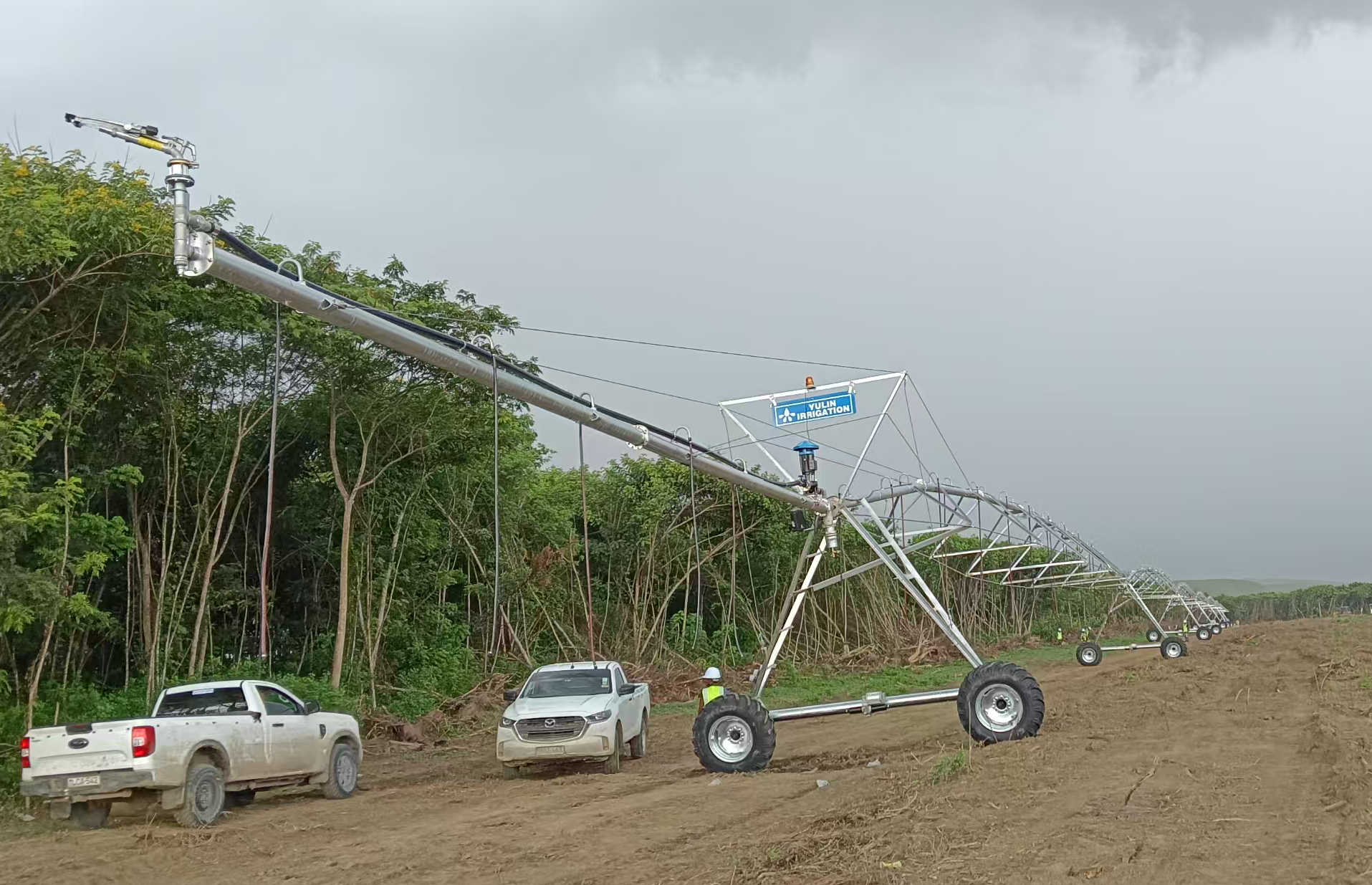
Why this decision belongs to constraints, not to price bands
Mordor Intelligence estimates the global center pivot irrigation system market at USD 2.56 billion in 2025, with a projection of USD 5.67 billion by 2030. Market expansion of that kind does not simplify purchasing; it multiplies the number of suppliers quoting for the same plot, which pushes more of the buyer's workload into verification. In tenders, grant-funded projects and dealer programmes, the document that usually eliminates a bid is not the price sheet but a parameter or certification line that cannot be matched.
The two machine formats answer structurally different questions. A center pivot holds a fixed circular footprint and irrigates it through continuous, mechanised rotation, with the machine's drive and control equipment permanently installed at the field. A hose reel machine travels along a lane, pulling a PE pipe behind it, and covers a strip defined by its spray radius. Once the parcel shape and the number of machine passes are fixed, cost per irrigated hectare becomes a genuine comparison. Before that, it is a comparison of two different denominators.
Coverage geometry: hectares per circle versus metres per pass
The Fixed DYP center pivot is dimensioned as a model family rather than a single machine: 177.6 metres in length covering 10 hectares, 307.4 metres covering 30 hectares, 395.6 metres covering 50 hectares, and 565 metres covering 100 hectares. The system irrigates by circular motion in both clockwise and anti-clockwise directions, and its stated land usage coefficient within the irrigated circle, including the area near the centre tower, is not less than 0.9. That coefficient is the correct unit for a field-shape discussion: it describes how much of the circle is productively irrigated, not how much of a square parcel is covered.
The JP800 is specified in travel and throw terms. It uses a 90 mm PE pipe with a 300 metre length, a nozzle diameter of 16–22 mm, and a spray radius of 19–41 metres, with a DL50/SIMA10497 spray gun. Its external dimensions are 6120 mm long, 2330 mm wide and 2770 mm high, and its shipping size is 2450 mm by 2000 mm by 2250 mm. Those figures govern transport access, lane width and headland space — practical constraints that rarely appear on a quotation but decide whether a machine can enter a field at all.
The gate rule is straightforward. If the parcel can hold a circle and the cropping block is stable across seasons, the pivot's fixed geometry distributes capital and labour over a fixed area. If the parcel is a long rectangle, is interrupted by obstacles, or must serve several rented blocks in rotation, strip coverage is the structural fit. Manufacturer project records from Brazil describe exactly this pattern for hose reel equipment: 50 units in service for six years on soybean, with the machine noted as easy to pull from one land parcel to another and easy to rent out.
Gate 2 — Power source: 380–460 V electromechanical drive versus water-turbine operation
The Fixed DYP pivot is electrically driven. Its rated voltage is 380V–460V, the drive is electromechanical and reversible with an individual drive on each span, and the pivot movement mode is continuous with start-stop capability. The standard control panel carries a main power switch, a power control switch, a water switch, a direction control switch, a percentage indicator for speed regulation and an auto-reverse switch, rated IP65. The tower box is rated IP33 and the collector ring IP65, and the collector ring is an 11-ring assembly rated not less than 4×90A and 7×25A, with copper cable core thickness of at least 4×4 mm² plus 7×1.0 mm².
The JP800 is driven by a water turbine and requires no electricity. Hydraulic energy taken from the incoming water replaces the electrical supply, which is why the inlet pressure range of 0.6–0.9 MPa is not merely a performance figure but the machine's energy source. The trade-off is symmetrical and verifiable: the pivot converts a reliable grid or generator supply into controlled rotation, while the hose reel converts pressure into travel and requires no cabling, transformer or panel feed at the field edge.
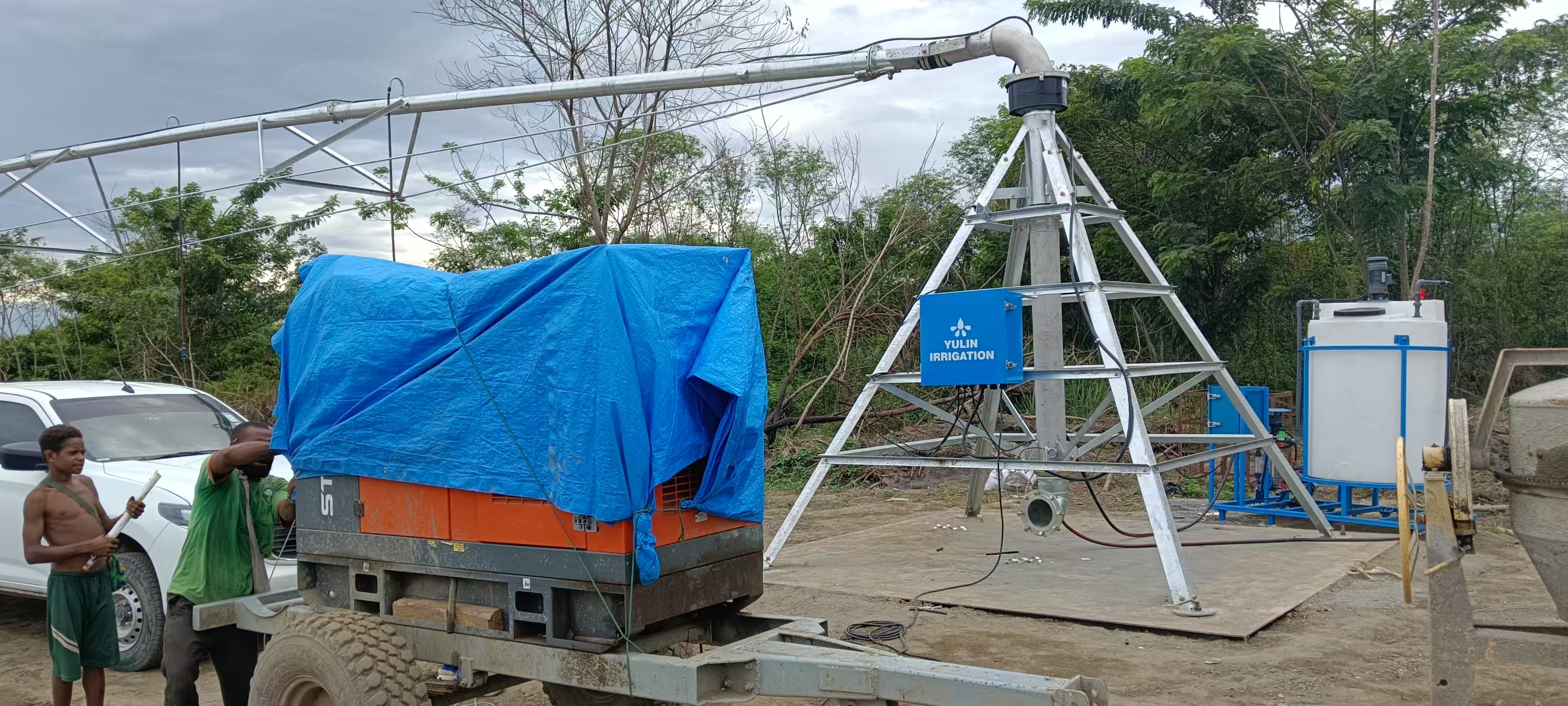
A documented application in Papua New Guinea shows how this gate is resolved in practice. A 395.6 metre pivot covering 50 hectares was supplied with an end spray gun and a 1000 litre fertiliser tank, operated either from an external power connection or from a diesel generator set, with an optional poly pipe to limit corrosion from acidic or alkaline water and pesticide injection for integrated pest control during irrigation. The power decision was made at project level, before commissioning, which is the stage at which it is still inexpensive to change.
Gate 3 — Hydraulic envelope: flow and inlet pressure versus distribution quality
Hose reel specifications are stated at the machine inlet. The JP800 delivers a water flow of 25–52 t/h at an inlet pressure of 0.6–0.9 MPa, through a 16–22 mm nozzle and a DL50/SIMA10497 spray gun, with a 19–41 metre spray radius and a machine weight of 2180 ± 30 kg.
Pivot specifications are stated as distribution outcomes. The Fixed DYP uses pressure regulators rated at 10, 15 or 20 psi, limits rain intensity to not more than 0.16 mm/min, holds average drop diameter to not more than 1.1 mm, limits plant mechanical damage to not more than 2 percent, and maintains a land usage coefficient of not less than 0.9 within the irrigated circle. Water with a pH of 6–7.5 can be used for irrigation without quality problems during the warranty period, and the crops listed for the platform include fodder crops, cereals, vegetables and industrial crops including corn.
These two specification languages are not interchangeable, and a common procurement error is to compare a tonnes-per-hour figure from a hose reel sheet against a millimetres-per-minute rain intensity figure from a pivot sheet. The workable approach is to size the pump against the machine's own stated requirement: inlet pressure and flow at the hose reel, and regulator rating plus rain intensity at the pivot, with the pump curve checked at the field edge rather than at the pump outlet.
Gate 4 — Material, coating and standards documentation
The Fixed DYP pivot is built from Q235B metal with hot-dip galvanizing to GB 13912-2020. The water pipeline is sectional with a truss structure, the clearance from ground level to the bottom of the truss rod is 3 ± 0.2 metres, and the machine is rated for ambient temperatures from −45 to +45 °C. Each trolley carries two 14.9-24 irrigating tyres with hot-dip galvanized discs, and the flexible irrigation hoses are PVC, reinforced and UV resistant, with pipeline layers specified to preserve system integrity and UV resistance over service life.
The JP800 combines metal and PE construction, with the 90 mm PE pipe forming the water-carrying element and the metal frame carrying the reel, turbine and gun assembly. Buyers evaluating the two side by side should note that the material discussion is not a quality ranking: galvanized steel and PE pipe fail in different ways and are inspected by different methods, and both need a specification line in the contract.
Certification applies to both products through the same quality management system. The ISO9001:2015 certificate, standard GB/T19001-2016/ISO9001:2015, is numbered 18524Q11926R2S and issued by National Standard Integration (Beijing) Certification Co., Ltd., with a scope covering production of irrigation systems and mechanized agricultural systems, valid for the global market. A neutral reading matters here: ISO9001 certifies how a production system is managed, not the irrigation performance of a specific machine. Performance claims are verified against the stated parameters, and where water distribution uniformity has to be demonstrated, the reference method is ISO 11545:2009, the in-field method for determining distribution uniformity of centre-pivot and moving lateral irrigation machines. Because it is a test method rather than a pass mark, the buyer decides whether a uniformity test is required and at what tolerance.
Gate 5 — What to write into the purchase order and check at acceptance
The final gate converts the comparison into contract language. On the manufacturing side, the reference supplier states a monthly capacity of 60 units, a lead time of 21–40 days, a minimum order quantity of 1 unit, 100 percent testing, OEM production and voltage customisation as available options, and a factory that has independently manufactured more than 95 percent of machine spare parts — a detail that affects long-term serviceability more than any single specification line. The company operates a 64,653 m² facility with 152 employees, an annual output of 3,000 units, a 10-engineer R&D team and a 60 percent export ratio, and exports to markets including the USA, Mexico, Europe, New Zealand, Canada, Australia, Africa and Egypt.
| Acceptance item | Fixed DYP pivot | JP800 hose reel |
|---|---|---|
| Coverage specification | Model length and hectares: 177.6 m / 10 ha, 307.4 m / 30 ha, 395.6 m / 50 ha, 565 m / 100 ha | 90 mm PE pipe, 300 m length; spray radius 19–41 m |
| Power and drive | 380V–460V, electromechanical, reversible, individual drive per span | Water turbine driven; no electricity required |
| Protection rating | Control panel IP65; tower box IP33; collector ring IP65 | Confirm electrical-free operation and turbine pressure requirement |
| Hydraulic data | Pressure regulators 10 / 15 / 20 psi; rain intensity ≤ 0.16 mm/min | Flow 25–52 t/h; inlet pressure 0.6–0.9 MPa; nozzle 16–22 mm |
| Structure and material | Q235B metal; hot-dip galvanized to GB 13912-2020; sectional truss; ground clearance 3 ± 0.2 m | Metal and PE construction; machine weight 2180 ± 30 kg |
| Motion | Circular irrigation, clockwise and anti-clockwise; continuous, start-stop | Travel along lane, driven by water turbine |
| Operating environment | −45 to +45 °C; irrigation water pH 6–7.5 during warranty period | Confirm inlet pressure availability at field edge before order |
| Quality documentation | ISO9001:2015, standard GB/T19001-2016/ISO9001:2015, certificate number 18524Q11926R2S, issued by National Standard Integration (Beijing) Certification Co., Ltd., scope: production of irrigation systems and mechanized agricultural systems, global market. 100 percent factory testing stated. | |
An acceptance protocol should also demonstrate reversible circular irrigation at commissioning, verify truss joints and galvanizing on the sectional pipeline, measure ground clearance against the 3 ± 0.2 metre figure, and confirm the pressure regulator rating actually installed. For the hose reel, the corresponding checks are the achieved spray radius and the pressure measured at the machine inlet while the turbine is running, since that pressure both drives the machine and determines the wetted pattern.
Application evidence from operating projects
Project records provide the operational counterweight to specification sheets, though they should be read as evidence of use rather than as comparative proof. On pasture and forage farms, the pivot format dominates the reference list: 70 units in service for nine years on a New Zealand grass farm, a 600-unit programme running 15 years with an Australian distributor for forage and pasture plus cotton and watermelon, and 450 units supplied over nine years to a Russian group. Reported outcomes in those records include reduced labour requirements and lower maintenance over long service life.
Hose reel records cluster where land is moved or rented. The Brazilian case — 50 units over six years on soybean — reports a 30 percent output increase in dry conditions together with labour savings, and a Papua New Guinea project shows the pivot format adapted to a hot, off-grid site through a generator, an end spray gun for corner irrigation, a fertiliser tank and a corrosion-mitigating pipe option. A South Korean project extended the same platform to recycled chemical wastewater for school lawn irrigation, which illustrates that the deciding variable is often water quality and site condition rather than field size alone.
Market trend: procurement is becoming documentation-heavy
Two trends are visible in the available data. The first is scale: the center pivot market estimate of USD 2.56 billion in 2025 rising toward USD 5.67 billion by 2030 implies more equipment moving through formal procurement channels, where parameter sheets and certificates decide eligibility before technical merit is discussed. The second is geographic shift: Lindsay Corporation reported a multi-year supply agreement for Zimmatic irrigation systems in the MENA region valued at more than USD 100 million in 2024, which signals that large project demand is increasingly concentrated in regions where power availability and water quality vary sharply between sites.
For buyers, the practical consequence is that the constraint file — voltage, protection rating, coating standard, flow and pressure, certification scope — now travels with the machine. Suppliers who can produce that file quickly shorten the evaluation stage; suppliers who cannot lengthen it, regardless of the machine's field performance.
Future outlook
Three developments are likely to shape this comparison over the next buying cycles. Power flexibility will keep moving up the specification list, since a pivot format is only as available as its 380–460V supply, while a water-turbine machine is only as available as its inlet pressure — and both constraints are increasingly resolved at the pumping and power-design stage rather than at the machine order. Documentation will continue to consolidate around recognised test methods such as ISO 11545:2009 and management-system certification such as ISO9001:2015, with buyers asking for scope statements rather than certificate images. And serviceability will carry more weight, because machines rated for 25-year service life depend on parts availability long after the warranty period, which is where a high degree of in-house parts manufacture and stated installation and commissioning support become procurement criteria rather than sales points.
FAQ
How much land does a Fixed DYP center pivot cover compared with a JP800 hose reel?
The Fixed DYP pivot is offered in models of 177.6 metres covering 10 hectares, 307.4 metres covering 30 hectares, 395.6 metres covering 50 hectares and 565 metres covering 100 hectares. The JP800 is specified by travel and throw instead: a 300 metre, 90 mm PE pipe with a 19–41 metre spray radius, covering a strip per pass rather than a circle. The two are therefore dimensioned in different units and cannot be compared on a single hectare figure without first defining parcel shape and the number of passes.
Does the JP800 hose reel irrigation machine require an electrical supply?
No. The JP800 is water-turbine driven and states that no electricity is required, with an inlet pressure range of 0.6–0.9 MPa supplying the operating energy. The Fixed DYP center pivot, by contrast, operates at a rated voltage of 380V–460V with electromechanical, reversible drives on each span, and can be run from a generator where grid supply is unavailable.
What flow and pressure should be confirmed before ordering a hose reel machine?
The JP800 states a water flow of 25–52 t/h and an inlet pressure of 0.6–0.9 MPa, with a nozzle diameter of 16–22 mm and a DL50/SIMA10497 spray gun. Because the turbine is driven by the incoming water, the available pressure at the machine inlet — not at the pump outlet — is the figure that should be confirmed before the order is placed.
Which standards and certificates should appear in the supplier documentation?
Both the Center Pivot Irrigation System and the Hose Reel Irrigation Machine are covered by ISO9001:2015 certification under standard GB/T19001-2016/ISO9001:2015, certificate number 18524Q11926R2S, issued by National Standard Integration (Beijing) Certification Co., Ltd., with a scope covering production of irrigation systems and mechanized agricultural systems and validity for the global market. For the pivot, the hot-dip galvanizing reference stated for the Q235B metal structure is GB 13912-2020. Where water distribution uniformity must be demonstrated, the applicable method is ISO 11545:2009, which specifies an in-field test rather than a fixed pass threshold.
What should be checked at acceptance of a fixed center pivot?
Acceptance should confirm the IP65 rating of the control panel and collector ring, the IP33 rating of the tower box, the installed pressure regulator rating of 10, 15 or 20 psi, a ground clearance to the bottom of the truss rod of 3 ± 0.2 metres, the galvanized finish on the sectional truss structure and trolley discs, and a working demonstration of reversible circular irrigation in both clockwise and anti-clockwise directions. Cable specification of at least 4×4 mm² plus 7×1.0 mm² and the 11-ring collector assembly rating of 4×90A and 7×25A should also be verified against the delivered unit.
Reference document: the 2026 YULIN Pivot Catalogue is available for download as a PDF and contains the model and parameter tables referenced in this framework.
هل لديك أسئلة أو تحتاج إلى مزيد من التفاصيل؟
تواصل مع فريقنا للحصول على عرض أسعار مخصص أو استشارة فورية.
طلب عرض أسعار
املأ النموذج أدناه وسيتواصل معك فريقنا بعرض مقترح مخصص.
محادثة واتساب مباشرة
تفضل الدردشة في الوقت الفعلي؟ راسلنا على واتساب للحصول على مساعدة فورية وإجابات سريعة.
- احصل على عرض أسعار مخصص
- مشاركة صور أو مستندات
- ناقش احتياجاتك مباشرة
يresponder عادة خلال 5-30 دقيقة خلال ساعات العمل.