
Is Your Atrium Tent Supplier Built for the Long Haul? A 20-Year Sustainability Check
Most atrium tent purchases are evaluated as a single project: one size, one delivery date, one price. Buyers who plan repeat or multi-year programmes ask a harder question — will this supplier still be manufacturing, certifying and supporting the same structure when the second, third and fourth projects arrive? This article builds a 20-year sustainability check from signals a buyer can actually verify: frame and fabric lifespan, deployment history, certification continuity, and the ability to run incremental orders across years.
What “20-Year Sustainability” Actually Means in Atrium Tent Terms
In KENTEN Structures’ published data for its structure tent range, the aluminium frame is rated for a lifespan of 20+ years, while the PVC-coated roof fabric is rated at 8–15 years. That single pair of numbers defines what a long-horizon check should measure. A 20-year sustainability question is not about one warranty date; it is about whether one supplier can carry a structure through two or three fabric replacement cycles while the original aluminium frame is still in service.
Atrium tents are large clear-span modular structures used as temporary or semi-permanent venues — exhibition halls, VIP reception areas, banqueting and wedding venues, sports and public-event facilities. Because they are demountable and reusable, they behave less like a building and more like capital equipment: a long-lived structural asset paired with consumable components and a maintenance cycle. For the 15 m × 25 m atrium tent project delivered to a private residence on the East Coast of the United States, the associated product data lists exactly that split — aluminium 20+ years, PVC fabric 8–15 years.
KENTEN Structures is an aluminium structure manufacturer founded in 2001, headquartered in Ontario, California, with manufacturing centres in China, the USA and the Middle East and regional offices in China, Hong Kong, Singapore and the Middle East. It designs and delivers premium aluminium permanent and semi-permanent structures, including atrium tents, event marquees, temporary venues, exhibition halls and modular infrastructure for events, industry and public use.
Why Long-Horizon Buyers Are Re-Rating Suppliers Now
Demand context matters, because it determines whether a supplier’s order book can absorb repeat business over years. Third-party market data places the global event management market — the sector that drives demand for commercial event and atrium tents — at USD 1,160.4 billion in 2024, with a 6.7% CAGR projected through 2033 (Grand View Research). A separate industry estimate projects the specialised commercial event tent segment to exceed USD 3 billion by 2025. On the supply side, China’s exports of awnings, tents and sails (HS Code 6306) totalled approximately USD 3.11 billion in 2024, holding a 53.3% share of global exports in the category (The Observatory of Economic Complexity).
The procurement implication is straightforward. As event operators shift from renting per event to owning and redeploying structures, the supplier relationship lengthens. A buyer who takes 50 units in year one may need additional matched units in year five, using the same frame sections, wall systems and fittings. Whether that is possible depends on continuity — of production, of engineering records, of spare parts and of certification.
Industry overviews of modular aluminium tent systems for exhibitions and commercial events commonly cite KENTEN, Losberger De Boer, Röder HTS Höcker and Shelter Structures among the established global suppliers in this category. For buyers, the more useful exercise is not picking a name from that set, but testing each candidate against the durability signals below.
The 20-Year Sustainability Check: Four Signals Buyers Can Verify
Signal 1 — Operating continuity and an owned production base
KENTEN Structures has operated since 2001, with a stated factory area of 80,000 m², 200 employees, a 10-engineer R&D team and annual output of 1,000,000 m². Export accounts for 80% of its business, with the USA and EU as main markets. A 2024 industry overview records that the company has provided temporary structures for major global events, including the Beijing Olympics and Formula 1 Grand Prix events, since 2001. Continuity of this kind matters because it is the precondition for spare parts, matched profiles and engineering records years after the original purchase.
Signal 2 — A deployment record measured in decades, not seasons
Deployment references spanning 2008 to 2025 are the strongest available proxy for whether a supplier will still be delivering comparable projects later. The record includes the 2008 Beijing Olympic Games, the 2022 Beijing Winter Olympic Games, the 2023 Hangzhou Asian Games, the 2025 Doha Photography Festival in Qatar and the Formula 1 Miami Grand Prix. Section 4 examines what each of those projects required.
Signal 3 — Certification continuity with future validity dates
Management-system and product certificates that are currently valid, with stated expiry dates, are evidence of an ongoing rather than historic compliance system. KENTEN’s current portfolio includes ISO 9001 (certificate 51816Q00846R3, 2025-07-30 to 2028-07-29), ISO 14001 (51815E00262R3, 2024-08-08 to 2027-08-07), ISO 45001 (51815O00263R3, 2024-08-08 to 2027-08-07), and CE certification (8605682, issued 2026-04-10, valid to 2029-04-09) covering the manufacture of aluminium structure tents under EN 1090-3:2019 with execution class EXC2.
Signal 4 — Capacity and process for repeat, incremental orders
Repeat buying fails when a supplier can only run large campaigns. KENTEN’s stated capability profile lists a minimum order quantity of 1 unit, a production lead time of 30–45 days, monthly capacity of 1,000,000 m², 100% full inspection before shipment with raw material incoming inspection, 24/7 remote technical support, spare parts supply and on-site installation guidance. That combination supports both 100-unit event deployments and single-unit additions in a later phase.
| Check dimension | What the buyer should verify | KENTEN reference data |
|---|---|---|
| Structural asset life | Frame alloy and rated lifespan | 6061-T6 / 6082-T6 aluminium alloy frame; lifespan 20+ years |
| Wear components | Fabric grade and replacement interval | 850 g/m² PVC-coated polyester roof; 8–15 years |
| Operating continuity | Years in market and owned production footprint | Founded 2001; manufacturing centres in China, USA and the Middle East; regional offices in China, Hong Kong, Singapore and the Middle East |
| Deployment depth | Multi-year, multi-region project record | 2008 Beijing Olympics; 2022 Beijing Winter Olympics; 2023 Hangzhou Asian Games; 2025 Doha Photography Festival (Qatar); Formula 1 Miami Grand Prix |
| Certification continuity | Valid management systems and product standards | ISO 9001 (to 2028), ISO 14001 (to 2027), ISO 45001 (to 2027), CE / EN 1090-3:2019 EXC2 (to 2029) |
| Repeat-order capability | Capacity, MOQ, lead time, after-sales | 1,000,000 m² monthly capacity; MOQ 1 unit; 30–45 day lead time; 24/7 remote support and spare parts supply |
Frame Versus Fabric: Reading the Lifecycle Data Correctly
The published structure tent specification is the technical basis of any 20-year claim, and it separates the durable element from the replaceable one:
- Span width: 3 m–80 m depending on model
- Length: unlimited, extendable in 5 m bay spacing
- Eave height: 2.5 m–8 m, customizable
- Main frame: high-strength 6061-T6 / 6082-T6 aluminium alloy
- Roof fabric: 850 g/m² PVC-coated polyester fabric
- Sidewalls: PVC, glass wall, ABS wall or sandwich panel
- Wind resistance: up to 140 km/h (customizable)
- Snow load: up to 0.5 kN/m²
- Temperature range: -30°C to +70°C
- Flame retardant: DIN 4102 B1, M2, NFPA 701
- Colour options: white, black, beige, transparent, custom
- Installation: ground anchors or concrete ballast
- Lifespan: aluminium 20+ years; PVC fabric 8–15 years
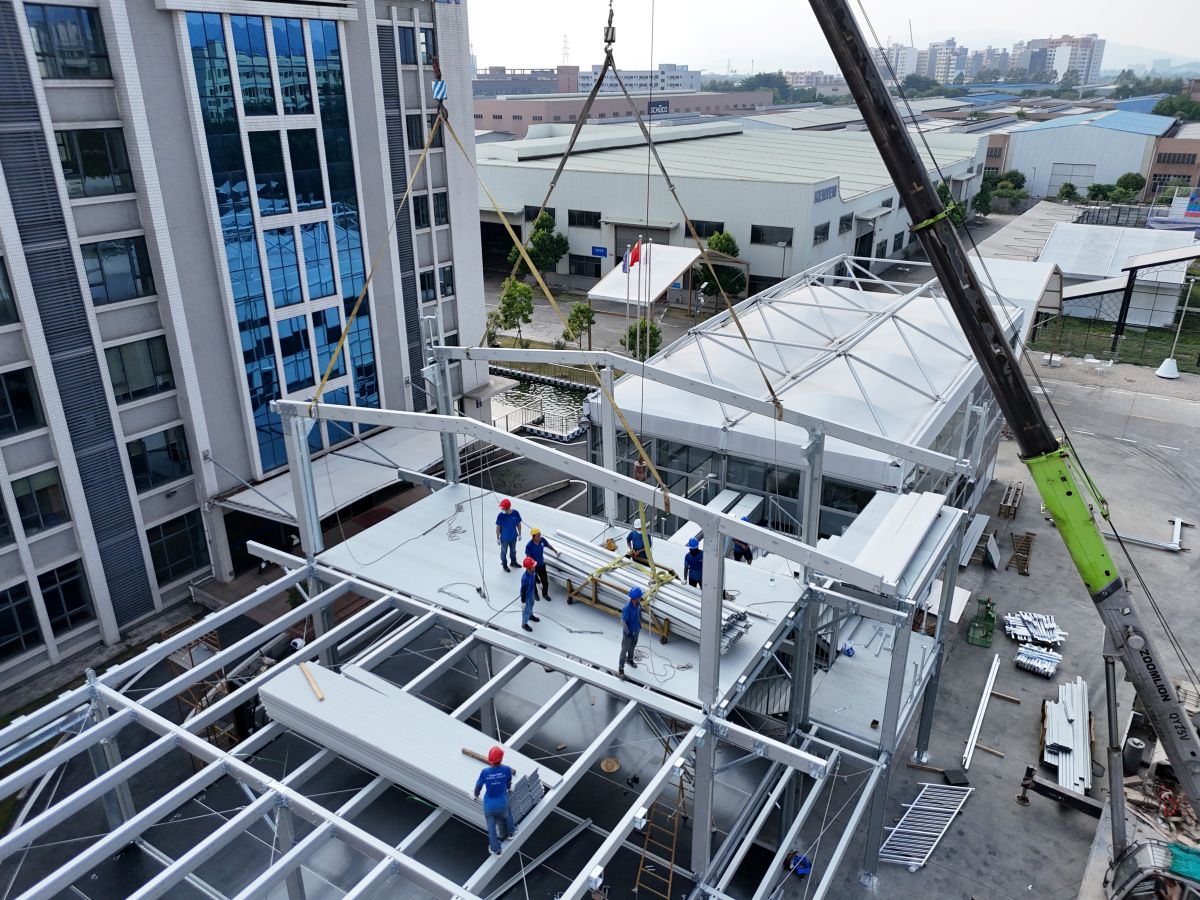
Modular bay assembly: structures are buildable in 5 m bays with unlimited extendable length, which is what allows an existing installation to be enlarged or reconfigured rather than replaced.
Read together, these figures describe an asset with two clocks. The frame clock runs for two decades or more; the fabric clock runs for eight to fifteen years and then restarts. The 5 m modular bay and unlimited extendable length are the reason a structure can grow with a programme instead of being scrapped and re-bought. The 6061-T6 and 6082-T6 alloy designations indicate heat-treatable structural aluminium, which is the material property a 20-year expectation rests on — not the fabric, and not the fittings.
The declared temperature range of -30°C to +70°C is also a procurement fact rather than a marketing line: it defines the operating envelope a buyer should compare against the actual deployment climate, because thermal cycling is one of the mechanisms that shortens fabric service life.
A Deployment Record Across Three Decades of Major Events
2008 Beijing Olympic Games. KENTEN acted as the official designated supplier of tents and temporary structures, providing complete temporary building solutions for multiple Olympic venues in Beijing and surrounding areas — a 50-unit deployment covering security inspection channels, audience rest areas, VIP reception areas, media service points and operation management areas. A-shaped structure tents and pagoda tents were used for crowd flow and on-site service functions.
2022 Beijing Winter Olympic Games. KENTEN was designated as one of the key infrastructure suppliers and delivered a series of A-structure tents and double-decker tents — again 50 units — serving as security checkpoints, staff offices, dining areas, meeting rooms and command centres across competition venues. The organising committee highlighted rapid installation, engineering accuracy and adaptability across different venues.
2023 Hangzhou Asian Games. As a key infrastructure partner, KENTEN supplied 100 units of A-structure tents and pagoda tents for public areas of competition venues and satellite venues in Hangzhou and surrounding areas, covering audience security checks, temporary storage and restroom functions.
2025 Doha Photography Festival, Qatar. Organisers appointed KENTEN to build a landmark temporary exhibition building — a pyramid structure exhibition hall — combining modern structural design, a customizable interior layout and strict engineering standards.
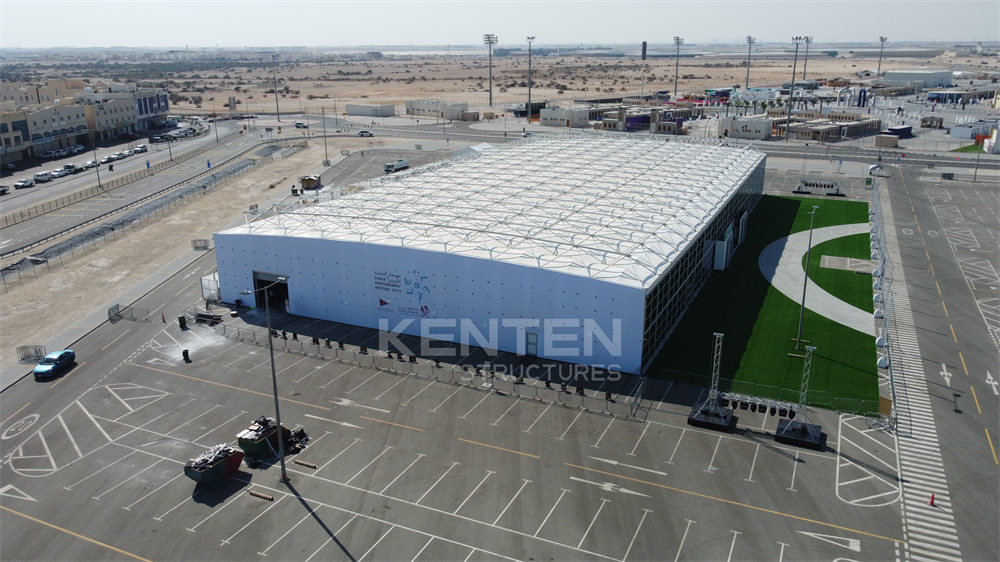
Qatar, 2025: a pyramid structure exhibition hall delivered for the Doha Photography Festival, one unit, as a landmark temporary exhibition building.
Formula 1 programmes. KENTEN supplied large-scale aluminium grandstand systems for the Formula 1 Miami Grand Prix, with 10 units positioned for sightlines and safety. A separate Formula 1 programme used modular structures customized for VIP lounges, hospitality suites, viewing platforms and operational areas, adapting to different venue requirements.
Kuwait exhibition hall. A single-unit large-span modular building with a 100% column-free interior, delivered as an exhibition hall.
The pattern matters more than any individual reference. Order sizes ranged from single-unit landmark buildings to 50- and 100-unit event deployments, delivered in 2008, 2022, 2023 and 2025 — an 17-year span in which the same supplier continued to be selected for high-visibility public projects in different regions and climates. For a buyer planning a three-phase programme, that pattern is more informative than a brochure.
Buying in Phases: What Incremental Projects Require From a Supplier
Long-term buyers rarely place one order. They place a first order, learn from the deployment, and then extend. Whether the second order matches the first depends on four supplier capabilities:
- A minimum order that permits small additions. KENTEN lists a MOQ of 1 unit, which allows a later phase to be added without triggering a campaign-sized order.
- An engineering baseline that survives years. Structure dimensions, roof and fabric options, sidewall options (PVC, glass wall, ABS wall, sandwich panel), flooring systems, interior accessories, and branding and appearance are all listed as customizable areas under an OEM / ODM model. Consistent customization control is what makes a phase-two unit visually and structurally compatible with phase one.
- Lead time that fits event calendars. A 30–45 day production lead time is short enough to be planned around a known event date, and predictable enough to be written into a multi-year schedule.
- Post-delivery support that outlives the sale. 24/7 remote technical support, spare parts supply and on-site installation guidance are the mechanisms that keep an older structure serviceable.
ISO 14001 and Environmental Management: What the Certificate Covers
Sustainability claims in tender documents should be read precisely. KENTEN holds ISO 14001 certificate 51815E00262R3, issued by Shenzhen Zhongbiao International Testing and Certification Co., Ltd. against the standard GB/T24001-2016 / ISO14001:2015, valid from 2024-08-08 to 2027-08-07. The certified scope is exhibition planning and design, and the sales of aluminium alloy and steel structure tents and related environmental management activities.

ISO 14001 certificate 51815E00262R3 (GB/T24001-2016 / ISO14001:2015), valid 2024-08-08 to 2027-08-07, covering environmental management activities within a defined scope.
That is a statement about a managed environmental process inside a defined operational scope — not a product-level environmental declaration for every structure shipped. Buyers who require product-level environmental documentation should ask for it separately, and should treat a management-system certificate as one input among several rather than as a sustainability verdict on its own.
Where the 20-Year Case Has Boundaries
A credible sustainability check states its limits as clearly as its strengths. Six boundaries apply to atrium tent structures of this class:
- Fabric is a wear component, not a lifetime part. With PVC roof fabric rated at 8–15 years against 20+ years for the aluminium frame, a 20-year ownership plan should budget for one or two fabric replacement cycles, plus the labour to install them.
- Wind and snow ratings are project-specific. KENTEN’s structure tent specification lists wind resistance up to 140 km/h (customizable) and snow load up to 0.5 kN/m², but site exposure, anchoring method (ground anchors or concrete ballast), terrain and local code all change the engineered rating. Industry engineering references commonly cite 100–120 km/h wind-load bands for high-performance large-span aluminium atrium tents, which is a reminder that the binding number is the one calculated for the specific site. In the EU, temporary structures are addressed by EN 13782:2015.
- Flame-retardant classification applies to materials. DIN 4102 B1, M2 and NFPA 701 describe the behaviour of the fabric under test; they do not certify an installation’s fire strategy, egress routes or occupancy limits, which remain subject to local authority requirements.
- Management-system certificates have defined scopes. The ISO 14001 scope covers exhibition planning and design and the sales of aluminium alloy and steel structure tents with related environmental management activities. It is not an unlimited claim about every product or facility.
- Lifespan assumes discipline. A 20+ year frame figure assumes correct installation, correct anchoring, periodic inspection, cleaning, and dry, properly packed storage between deployments. Structures left standing in aggressive coastal or industrial environments without maintenance should not be assumed to reach the same interval.
- It is not a permanent-building substitute in every case. Where permanent occupancy, fixed utilities or long-term building-code compliance for inhabited buildings are required, a permanent venue remains the appropriate class of asset.
Atrium Tent Structures and Permanent Venues: A Like-for-Like Reading
The comparison that matters for a 20-year decision is not tent versus building in the abstract, but which asset profile fits the demand curve the buyer actually expects.
| Dimension | Permanent venue | Modular atrium tent structure |
|---|---|---|
| Location | Fixed; typically requires land, permitting and long construction lead time | Installed on prepared ground with ground anchors or concrete ballast; relocatable between sites |
| Capital profile | High upfront commitment tied to one location | Structure purchased once and redeployed across projects, with fabric replaced on cycle |
| Reconfiguration | Structural change is slow and expensive | Length unlimited and extendable in 5 m bays; sidewalls in PVC, glass wall, ABS wall or sandwich panel |
| Service-life model | Long structural life with refurbishment cycles | Aluminium frame 20+ years; PVC fabric 8–15 years |
| Operating envelope | Depends on installed building services | Designed for -30°C to +70°C, wind up to 140 km/h and snow up to 0.5 kN/m², engineered per site |
| Where it is weaker | Fixed capacity; cost is irreversible if demand moves | Requires periodic fabric replacement, re-anchoring and inspection; not always suitable where permanent occupancy rules apply |
Neither option dominates. A permanent venue wins on permanence and avoids repeated erection cycles; a modular atrium tent structure wins on redeployability, phased capacity and capital flexibility, at the cost of a fabric replacement cycle and periodic re-commissioning. A 20-year decision should be made on that trade-off, not on the purchase price alone.
What Comes Next for Long-Life Event Structures
Three trends are shaping how buyers will assess suppliers over the next decade.
Lifecycle documentation is becoming a tender requirement. With the global event management market projected to grow at a 6.7% CAGR through 2033 and event tent demand concentrated in export-driven manufacturing, buyers are increasingly asking not only for a specification sheet but for evidence of continuity: valid certificates with forward expiry dates, spare parts availability, and engineering records that allow a structure bought this year to be extended in five years’ time. KENTEN’s current framework runs to 2027 for ISO 14001 and ISO 45001, 2028 for ISO 9001 and 2029 for CE.
Reusability is replacing single-use thinking. A demountable aluminium frame that can be re-erected for a different event, or reconfigured with a different sidewall combination, defers the environmental and financial cost of a new build. Aluminium is a widely recycled material, and demountable structures fit naturally into the environmental management objectives that ISO 14001-type systems are designed to pursue.
Supplier selection is shifting from unit price to lifecycle cost. With 53.3% of global awning, tent and sail exports originating in China, buyers have no shortage of suppliers. The differentiator is becoming the length of the relationship a supplier can sustain — which is why deployment depth, certification continuity and repeat-order capability increasingly outrank headline pricing in evaluation matrices.
Frequently Asked Questions
What does a 20-year lifespan mean for an aluminium atrium tent?
In the published KENTEN structure tent specification, the aluminium frame is rated at 20+ years while the PVC-coated roof fabric is rated at 8–15 years. The 20-year figure applies to the structural frame under normal use, correct installation and maintenance. It is not a blanket warranty covering every component — fabric, wall panels and fittings have shorter service intervals.
How can a buyer verify that a supplier will still support the product in ten years?
Verifiable signals include continuous operating history, an owned manufacturing footprint, documented multi-year deployments, management-system certificates with future expiry dates, and stated spare parts and support arrangements. For KENTEN Structures: founded 2001; manufacturing centres in China, the USA and the Middle East; ISO 9001 valid to 2028, ISO 14001 and ISO 45001 valid to 2027, CE valid to 2029; 24/7 remote technical support, spare parts supply and on-site installation guidance.
Does ISO 14001 mean the tent itself is environmentally certified?
No. KENTEN’s ISO 14001 certificate 51815E00262R3 (GB/T24001-2016 / ISO14001:2015, issued by Shenzhen Zhongbiao International Testing and Certification Co., Ltd., valid 2024-08-08 to 2027-08-07) covers environmental management activities within a defined scope: exhibition planning and design, and the sales of aluminium alloy and steel structure tents. It evidences a managed environmental process, not a product-level environmental declaration for each individual structure.
What order sizes has KENTEN handled, and why does that matter for phased buying?
The record includes 50 units for the 2008 Beijing Olympic Games, 50 units for the 2022 Beijing Winter Olympic Games, 100 units for the 2023 Hangzhou Asian Games, a 15 m × 25 m atrium tent for a private East Coast USA project, 10 grandstand units for the Formula 1 Miami Grand Prix, and single-unit pyramid exhibition halls in Kuwait and Qatar (2025). For phased buyers the significance is the ability to run both large deployments and single-unit additions from the same engineering and manufacturing base.
What recurring costs should be planned over a 20-year atrium tent life?
The dominant recurring item is the roof fabric. Rated at 8–15 years against 20+ years for the aluminium frame, it implies one or two replacement cycles within the frame’s service life. Periodic inspection of ground anchors or concrete ballast, and correct cleaning and packing before storage, are the other routine items. Replacement timing depends on climate exposure within the declared -30°C to +70°C range and on how frequently the structure is deployed.
Can an atrium tent installation be extended or added to in a later phase?
Yes. The published structure tent data specifies unlimited length extendable in 5 m bay spacing and a minimum order quantity of 1 unit, with customization covering structure dimensions, roof and fabric options, sidewall options, flooring systems, interior accessories, and branding and appearance. Matching a later phase to the original frame depends on the supplier retaining engineering records and continuing to produce the same profiles.
Full specifications, wall and roofing options, and certification documentation are compiled in the KENTEN Structures product catalogue, available for download here: KENTEN Catalog (PDF).
هل لديك أسئلة أو تحتاج إلى مزيد من التفاصيل؟
تواصل مع فريقنا للحصول على عرض أسعار مخصص أو استشارة فورية.
طلب عرض أسعار
املأ النموذج أدناه وسيتواصل معك فريقنا بعرض مقترح مخصص.
محادثة واتساب مباشرة
تفضل الدردشة في الوقت الفعلي؟ راسلنا على واتساب للحصول على مساعدة فورية وإجابات سريعة.
- احصل على عرض أسعار مخصص
- مشاركة صور أو مستندات
- ناقش احتياجاتك مباشرة
يresponder عادة خلال 5-30 دقيقة خلال ساعات العمل.