
Is Your Shopping Bag Factory Future-Ready? Hansun's Resilience Test
Supplier Viability Assessment · Shopping Bags · Buyer Reference
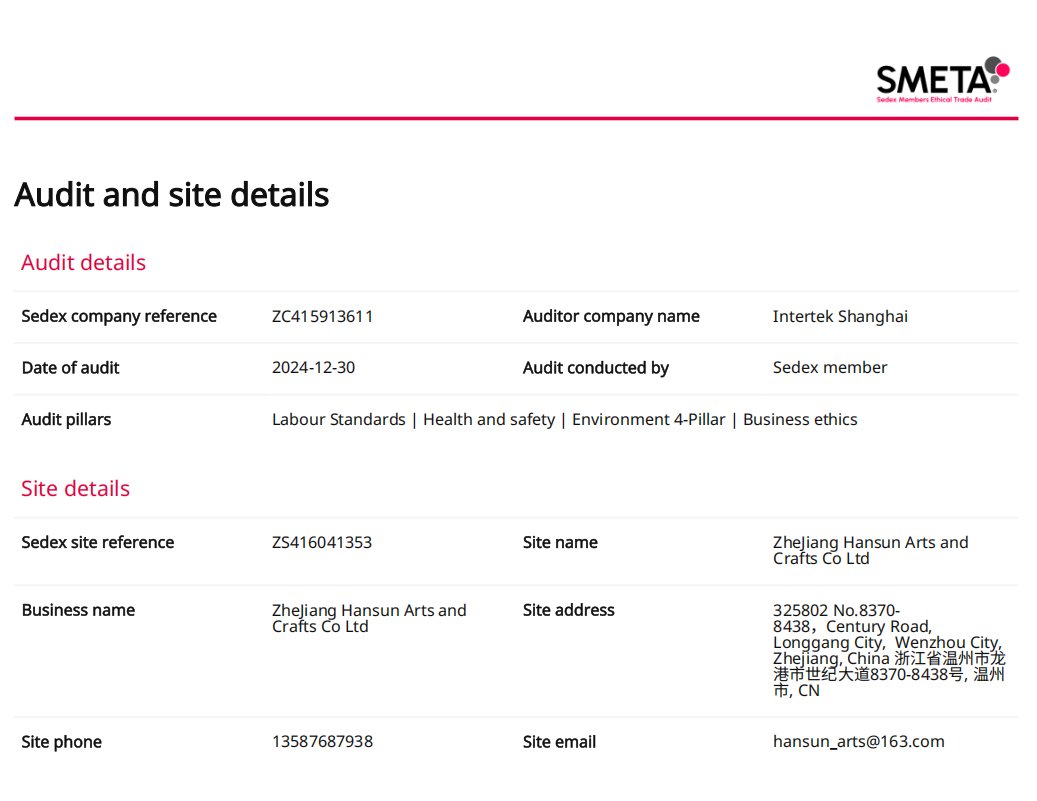
Sedex SMETA 4 Pillars is one of four compliance frameworks that a long-term shopping bag buyer can verify at Zhejiang Hansun Arts & Crafts Co., Ltd.
A shopping bag program rarely fails at the sampling stage. It fails two or three years later, when a brand needs the same print, the same material specification and the same audit evidence — and the supplier can no longer provide all three. Assessing long-term supplier viability has therefore become a separate step in shopping bag procurement, distinct from unit price and specification.
Why “Future-Ready” Became a Procurement Criterion
Reusable and custom printed shopping bags now sit inside a regulatory environment that keeps moving. The EU Packaging and Packaging Waste Regulation (PPWR) requires all packaging to be recyclable by 2030 and introduces mandatory recycled content targets for plastic packaging, according to the European Commission. In the United States, 12 states including California and New York had implemented statewide bans on single-use plastic bags as of 2024, which shifts demand toward heavy-duty reusable alternatives.
At the same time, the category itself is large and growing. Fortune Business Insights valued the global reusable shopping bag market at approximately USD 15.64 billion in 2025 and projected it to reach USD 28.87 billion by 2034. That figure should be read with care: published estimates vary considerably depending on whether a study counts all retail bags or only durable reusable bags, and different research houses place the 2026 forecast anywhere between roughly USD 12 billion and USD 17 billion. The direction of travel is consistent even where the numbers are not.
For a brand running a supermarket shopping bag or promotional shopping bag program, those two forces combine into one practical consequence. The supplier has to remain compliant and capable across the whole program cycle, not just at the first purchase order. That is what “future-ready” means in operational terms: entity continuity, workforce and engineering depth, production capacity, and a compliance framework that can survive an audit cycle change without interrupting shipments.
What Long-Term Viability Looks Like at Hansun
Zhejiang Hansun Arts & Crafts Co., Ltd. is a manufacturing and trading enterprise based in Longgang, Wenzhou, Zhejiang, China. The company was founded in 1996 with a registered capital of 20 million yuan, and it produces tote bags and PVC bags among a wider range of leisure, travel and promotional products. Its sales and service coverage extends across Southeast Asia, Europe, North America, the Middle East and major domestic and international cities, with exports accounting for 70% of output.
For a buyer evaluating a multi-year partnership, the useful question is not whether a factory is large, but whether the specific numbers behind it can absorb a program over time. The following indicators can be checked and re-checked at each annual review.
| Continuity indicator | Hansun figure | Why it matters for a multi-year shopping bag program |
|---|---|---|
| Founded | 1996 | More than two decades of accumulated production management experience; a legal entity with a traceable operating history rather than a newly formed trading shelf. |
| Registered capital | 20 million yuan | Indicates the scale of the registered entity behind the supply commitment. |
| Factory usable area | Over 25,000 m² | Physical footprint for production, sampling and storage; relevant to whether capacity can be added inside the same site. |
| Employees | 200 | Workforce stability is a precondition for consistent stitching, printing and inspection output. |
| R&D team | 25 engineers | Supports size, material and structural adaptation across seasons instead of a fixed catalogue. |
| Annual output | 20,000,000 units | Order-of-magnitude reference for whether a program fits within normal production flow. |
| Monthly capacity | 1,500,000 units | Useful for peak-season planning alongside lead time. |
| Export ratio | 70% | Most output is already produced against international buyer requirements. |
Note: capacity figures describe production capability, not a reservation of capacity. Actual scheduling depends on order timing and specification complexity.
The Certification Stack: Overlapping Systems as a Resilience Signal
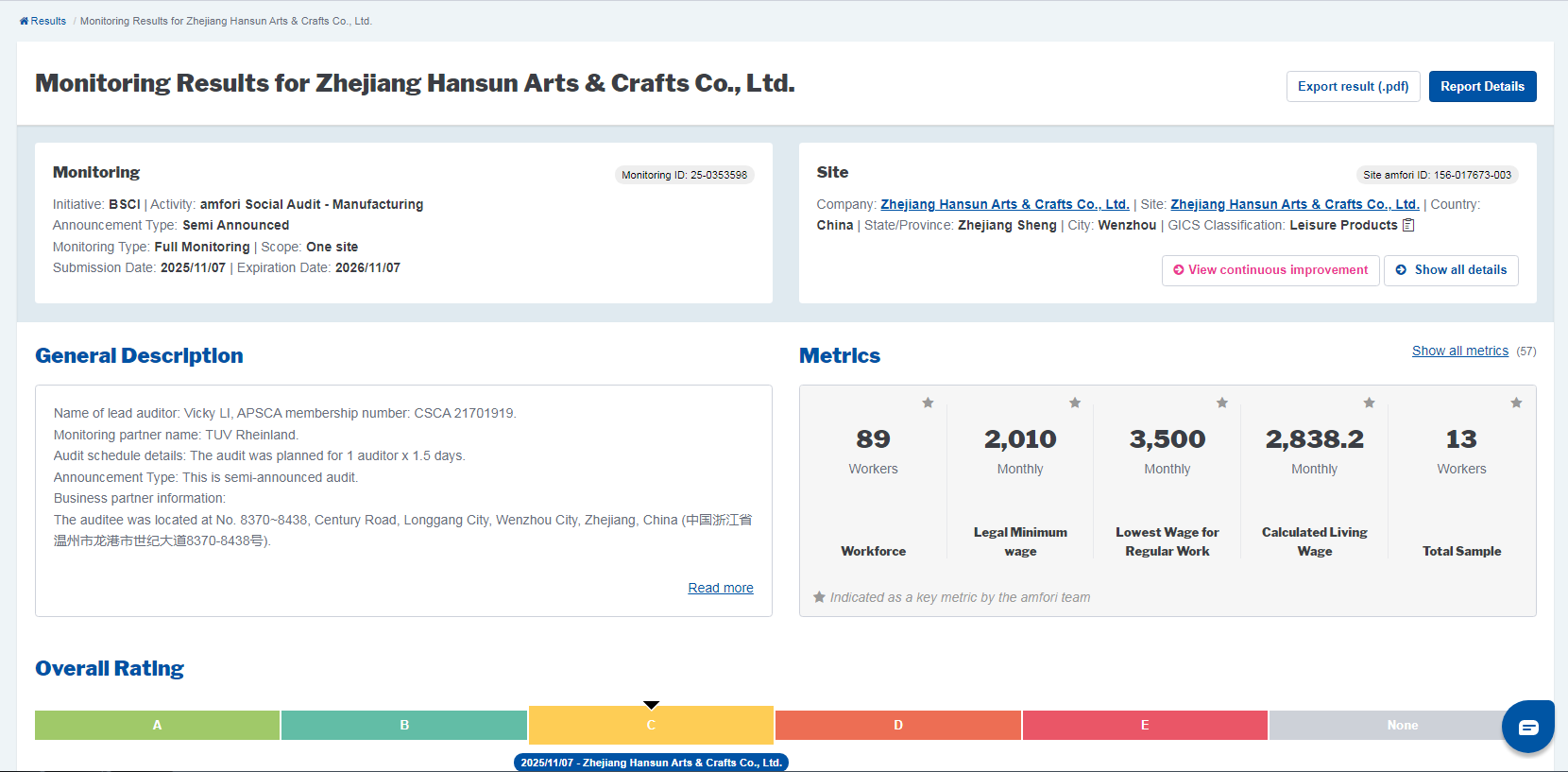
BSCI social compliance covers factory working conditions and ethical sourcing — one risk surface among four.
Four distinct compliance frameworks are held at Hansun. Individually, each answers one buyer question. Together, they cover four different risk surfaces — process, people, ethics and licensing — which is the part that matters most for long-term programs.
| Scheme | Standard referenced | Scope of coverage | Recognition market |
|---|---|---|---|
| ISO 9001:2015 | ISO 9001:2015 Quality Management System | Product design, production, quality control and delivery processes. Audited by an International Certification Body; global market scope. | Global |
| BSCI | Amfori BSCI Code of Conduct | Factory social responsibility, ethical sourcing and working conditions, audited by an Amfori BSCI Approved Audit Firm. | EU, Middle East, global retail brands |
| Sedex 4 Pillars (SMETA) | Sedex SMETA 4 Pillars Code | Social compliance, labour practices, health and safety and environmental standards, audited by a Sedex Approved Audit Body. | EU, UK, North America, Australia |
| Disney FAMA | Disney Code of Conduct and Product Safety Standards | Production and supply of Disney licensed promotional bags and gifts, issued through Disney International. | Global (US, EU, Asia) |
The overlap is the point. ISO 9001:2015 is process-facing: it addresses how design, production, quality control and delivery are governed. BSCI and Sedex are people-facing, and they are recognised in different regions — BSCI is widely referenced by EU and Middle East retail brands, while Sedex is commonly requested by UK, North American and Australian buyers. Disney FAMA is licence-facing and applies specifically to productions covered by Disney's code of conduct and product safety standards.
For a brand selling into several markets, that combination removes a recurring friction point. A buyer sourcing a custom printed shopping bag for both European and North American retail channels usually needs social compliance evidence that satisfies two different audit cultures. Where both frameworks already exist at the same site, the buyer is not re-qualifying a factory from the beginning for each new market — the evidence base is already in place.
The boundary worth stating
A certificate is a site-level statement about a management system, not a product-level guarantee. Each scheme carries its own scope wording, its own validity cycle and its own re-audit requirement, and a factory maintaining four overlapping frameworks carries a corresponding documentation and audit workload. That workload is a genuine cost, and it is one reason some smaller suppliers hold no certification at all. The trade-off a buyer accepts in exchange is a lower probability of an interrupted program caused by a compliance finding rather than a production problem.
How a Certified Process Maps to the Physical Product
Shopping bags produced under this framework — model SB-2026-001 — are built across a defined material and craft set rather than a single fixed specification. Materials include non-woven fabric, canvas, recycled PET, Oxford cloth and PP. Formats include the reusable foldable shopping bag, the eco-friendly non-woven shopping bag and the canvas tote shopping bag.
Specification is customisable rather than fixed: sizes follow S/M/L options or customer-specific dimensions, and unit weight ranges from 50g to 200g per piece depending on material and size. That weight band is the practical lever behind product positioning — lighter builds suit lightweight, portable and promotional formats, while heavier builds move toward the heavy-duty and large-capacity end of the range. Decoration is handled through silk screen printing, heat transfer or offset printing, which is what allows a custom printed shopping bag to match a retailer's existing brand assets rather than approximate them.
Typical applications documented for this product line are supermarket shopping, promotional gifts and corporate giveaways, with applicable industries covering retail, supermarket, promotional gift, corporate welfare and e-commerce. In practice these are the segments where a reusable shopping bag has to survive repeated handling, which is why the weight band, print method and material choice are normally specified together rather than separately.
Application Evidence: A Supermarket Program at Scale

Workforce and process training infrastructure supports the 200-strong production team behind repeat shopping bag programs.
The clearest available signal of long-term delivery behaviour is a completed OEM/ODM program in Japan. A chain supermarket used custom-printed shopping bags and promotional gifts across a project of 1,000,000 units of reusable daily shopping and promotional bags, completed within one year. The printing matched the supermarket's branding requirements, and the bags met Japan's eco-friendly standards.
The reported outcome was a 99.7% product qualification rate, zero delivery delay, and repeated orders from the same client for three consecutive years. Two details make this case relevant to viability assessment rather than to marketing. First, the program was print-driven: a supermarket shopping bag carries the retailer's brand on every unit, so a print deviation is a brand issue, not just a QC issue. Second, the repeat purchasing pattern is the actual evidence — the first order proves capability, the following three years prove continuity.
That does not mean every market behaves the same way. Japan's eco-friendly requirements and retail expectations are specific, and a single regional program does not predict performance in every regulatory environment. It does, however, demonstrate the operating pattern that multi-year buyers look for: custom print control, adherence to local material expectations, and delivery reliability that survives repetition.
Market Trend Analysis: Where Differentiation Is Shifting
Several publicly reported category trends explain why supplier resilience is being scrutinised more closely than before.
Material concentration around polypropylene
Polypropylene (PP) bags account for nearly 46% of total reusable bag production, according to Business Research Insights, reflecting the material's durability and cost-effectiveness. Concentration of this kind means material sourcing is, for most suppliers, a solved and highly competitive problem — advantage has to come from elsewhere.
Tote formats dominate
Tote bags hold an estimated 40–41% revenue share of the global bag market because of their multi-purpose functionality. The tote's flexibility is also its procurement difficulty: the same format is sold as a travel shopping bag, a gift shopping bag or a large capacity shopping bag depending on specification, so specification discipline matters more than catalogue breadth.
Customisation keeps rising
Customisation and personalisation are trending, with demand for printed bags reported to have increased in the retail sector, according to Business Research Insights. Growing print demand places a premium on suppliers that can hold print consistency across repeat runs — the same requirement the Japan program tested.
Export scale and competition
China's export value for “suitcases, handbags and similar containers”, a category that includes many types of shopping bags, reached USD 27.13 billion for January to November 2025, according to the General Administration of Customs of China. A category of that scale is structurally competitive on price, which again pushes the basis of selection toward compliance evidence, print reliability and supply continuity.
Comparison: Certified Integrated Manufacturer vs. Typical Sourcing Routes
Most shopping bag programs are sourced through one of three routes. The comparison below uses the same evaluation dimensions a buyer would apply at the annual review stage.
| Evaluation dimension | Trading intermediary | Small uncertified workshop | Hansun (certified OEM/ODM manufacturer) |
|---|---|---|---|
| Entity history | Often recently formed; production outsourced | Variable; frequently short operating history | Founded 1996; registered capital 20 million yuan |
| Social compliance evidence | Usually none held directly | Typically none | BSCI and Sedex 4 Pillars (SMETA) frameworks in place |
| Quality management | Depends on the factory used at the time | Informal, inspection-led | ISO 9001:2015 covering design, production, quality control and delivery |
| Licensed-brand eligibility | Not available | Not available | Disney FAMA for licensed promotional bags and gifts |
| Monthly capacity | Not applicable | Unspecified | 1,500,000 units |
| MOQ | Often flexible | Often flexible | 3,000 pieces |
| Lead time | Quoted case by case | Quoted case by case | 30–45 days |
| Customisation scope | Depends on third-party factory | Limited to basic print | Logo, size and material within an OEM/ODM service |
The limitations on the right-hand column are real and should be planned for. A minimum order quantity of 3,000 pieces rules out the very small test orders that an intermediary might accept, and a 30–45 day lead time is longer than what a local or regional quick-turn printer would offer. Certification coverage is also site-level and scheme-bound, so a buyer still needs to confirm that the specific products and markets in the program fall inside the scope of the relevant framework. And the Japan program described above is one documented case, not a statistical sample of performance across every category or region.
Future Outlook
Three developments are likely to shape shopping bag supplier selection through the rest of the decade. The first is the EU's 2030 recyclability requirement and its mandatory recycled content targets for plastic packaging, which will push material specifications toward recycled feedstocks — recycled PET and PP already appear in the material set at certified manufacturers. The second is the continued spread of state-level single-use bag restrictions, which lengthens program horizons because reusable bags must now hold up over their intended service life. The third is buyer-side consolidation: brands running multi-market retail, supermarket and e-commerce programs are reducing supplier counts rather than expanding them, because fewer approved sites mean fewer audit cycles to maintain.
For suppliers, the practical implication of that consolidation is that resilience is now assessed, not assumed. A factory's founding year, registered capital, headcount, engineering team and overlapping compliance frameworks become procurement data points rather than background information. For buyers in Evaluation and Execution stages, the same list works as a review checklist: verify the entity, verify the systems, verify the capacity, and then verify the evidence behind the last large program the factory actually completed.
FAQ
What indicators suggest a shopping bag factory can support a multi-year program?
Four groups of indicators are directly checkable: entity continuity (legal establishment date and registered capital), workforce and engineering depth (employee count and R&D team size), production scale (annual output and monthly capacity), and compliance continuity (which audit frameworks are held and in which markets they are recognised). At Hansun, these correspond to a 1996 founding, 20 million yuan registered capital, 200 employees, 25 R&D engineers, 20,000,000 units of annual output, 1,500,000 units of monthly capacity, and four frameworks covering quality, social compliance and licensing.
Which certifications does Hansun hold, and what does each cover?
Four frameworks are in place. ISO 9001:2015 covers product design, production, quality control and delivery processes and is issued through an International Certification Body. BSCI is based on the Amfori BSCI Code of Conduct and covers factory social responsibility, ethical sourcing and working conditions, audited by an Amfori BSCI Approved Audit Firm, with recognition in the EU, the Middle East and among global retail brands. Sedex 4 Pillars (SMETA) covers social compliance, labour practices, health and safety and environmental standards, audited by a Sedex Approved Audit Body, with recognition in the EU, UK, North America and Australia. Disney FAMA relates to the Disney Code of Conduct and Product Safety Standards and covers the production and supply of Disney licensed promotional bags and gifts.
What OEM/ODM customisation is available for shopping bags?
The production service covers both OEM and ODM, with customisation options for logo, size and material. Decoration can be applied through silk screen printing, heat transfer or offset printing. Sizes follow S/M/L options or customer-specific dimensions, and unit weight ranges from 50g to 200g per piece depending on material and size.
What are the minimum order quantity and typical lead time?
The minimum order quantity is 3,000 pieces, and typical production lead time is 30–45 days. Monthly production capacity is 1,500,000 units, which gives an order-of-magnitude reference for scheduling larger or peak-season programs against the stated lead time.
What purchasing terms and acceptance criteria apply?
Purchase terms documented for this product line are a minimum order quantity of 3,000 units; delivery terms of FOB, DDP or EXW; acceptance criteria based on pre-shipment testing; and payment terms of 30/70, 50/50 or 100% before mass production.
What evidence exists that the factory can handle large repeat programs?
A documented OEM/ODM program in Japan involved 1,000,000 units of reusable daily shopping and promotional bags for a chain supermarket, completed within one year, with custom printing matched to the supermarket's branding requirements and bags meeting Japan's eco-friendly standards. The reported outcome was a 99.7% product qualification rate, zero delivery delay, and repeat orders from the same client for three consecutive years.
Company background, certification scope and product specification details for Zhejiang Hansun Arts & Crafts Co., Ltd. are summarised in the company brochure.