
Is a 100,000 m² Factory Future-Proof? Long-Term Viability in Custom Hotel Furniture
A five-star hotel furniture programme is a schedule, not a purchase. Phase one may fit out guest rooms and a lobby. Phase two may add a restaurant, a spa and a suite wing three years later. Phase three may be a brand-standard refurbishment five years after that. The supplier selected in year one is usually the supplier expected to produce in year five — or the reason the programme stalls.
Evaluating that supplier on factory area alone therefore answers the wrong question. A large plant is a precondition for capacity, but floor space on its own says nothing about whether the plant will still be operating, staffed, certified and commercially sound when the second or third phase reaches the order stage. Long-term viability is a separate, checkable set of signals — and for a buyer committing to a five-to-ten-year construction plan, those signals matter more than a factory photograph.
This article sets out four durability signals that can be verified before contract signature, applies them to a 100,000 m² production base operated by Guangdong Richang Furniture Co., Ltd. — the manufacturer behind the RICHART brand — and identifies the points where scale stops helping.
Why Supplier Continuity Became a Procurement Question
Buyer exposure grows with the market. The global hospitality furniture market was valued at USD 23.8 billion in 2025 and is projected to reach USD 39.6 billion by 2034 (Dataintelo). The luxury hotel furniture segment is estimated to grow from USD 212.14 billion in 2026 to USD 312.97 billion by 2035 (Business Research Insights). The hotel Furniture, Fixtures and Equipment (FF&E) market was valued at USD 63.1 billion in 2025 (Grand View Research).
Demand growth is being matched by specification growth, which is what turns a furniture order into a multi-year commitment. Intel Market Research reports that more than two-thirds of upscale hotels now allocate a dedicated budget for bespoke furnishings, with average project spend up 31% since 2021. Sustainability specifications in hotel furniture contracts rose 45% in 2025, with low-VOC finishes and FSC wood becoming standard requirements. Asia Pacific held a 36.4% revenue share of the hospitality furniture market in 2025, driven by construction activity in emerging economies (Dataintelo).
The procurement consequence is structural. Longer specification documents, brand-standard approvals and phased deliveries mean the buyer is contracting a relationship that will outlive the project team that signed it. If the supplier exits the market between phases, the cost is not covered by any warranty: finishes must be re-matched, casegoods re-approved, drawings re-engineered and shipping schedules rebuilt. Continuity risk is therefore a line item, whether or not it appears in the budget.
Four Durability Signals Buyers Can Actually Verify
1. Capacity utilization, not capacity
A stated monthly output is a ceiling, not an available slot. The useful question is how much of that output is already committed to other projects in the same delivery window. A supplier with a large plant and a full order book presents the same scheduling risk as a smaller supplier with less capacity. Buyers should request a written capacity allocation for each phase window and confirm it against the actual production calendar, not the marketing figure.
2. Workforce and skill continuity
Custom hotel furniture is a skill-intensive category. Veneer matching, upholstery, joinery and finishing are learned on the shop floor, and they are the first capabilities to degrade when a factory loses experienced staff. Total headcount indicates scale; the size and stability of the engineering and technical function indicates whether the supplier can hold a specification constant across years. Ask how many technical staff are employed, how long they have been with the company, and whether drawing and engineering work is performed in-house.
3. Certification continuity
Certificates should be checked for validity windows, not merely for presence. For a phased programme, a certificate whose term runs five years is materially more useful than one expiring inside the first phase, because the specification approved in year one must still be defensible at handover in year four. Check expiry dates against the full programme timeline, and confirm the site scope and standard version listed on the certificate.
4. Commercial durability and repeat selection
Years in operation, market diversification and — most tellingly — whether international brands have ordered more than once are observable proxies for viability. Repeat orders indicate that a supplier survived its own first delivery and was re-selected for the next one. That is the outcome a phased hotel programme depends on, and it is a criterion that no amount of floor space can substitute for.
Benchmarking a 100,000 m² Facility Against the Four Signals
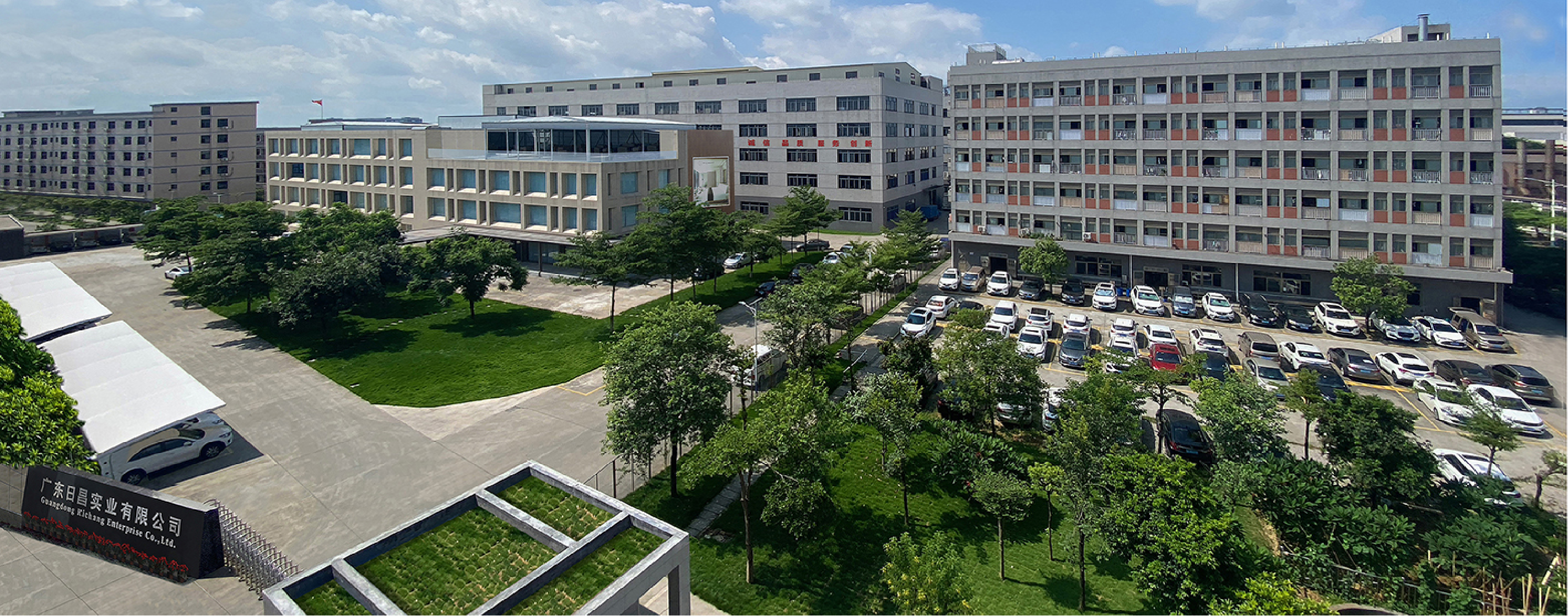
Guangdong Richang Furniture Co., Ltd. — trading as RICHART — is a Chinese furniture manufacturer founded in 1990 that produces custom high-end loose and fixed furniture for four-star and five-star hotels, together with luxury residences, villas and large-scale design projects. Its production base is a 100,000 m² facility in the Dawang High-tech Industrial Park in Zhaoqing City, Guangdong Province, China. The company states a global marketing network covering more than 20 countries and regions across five continents, with products and services supplied to more than 500 high-star hotels worldwide.
| Stated parameter | RICHART figure | What it signals for a 5–10 year programme |
|---|---|---|
| Year founded | 1990 | A long trading history that has already spanned multiple hotel construction and renovation cycles. |
| Production base | 100,000 m² | Physical room for phased production runs, material staging and storage of approved components between phases. |
| Employees | 1,000 | Workforce depth across separate workshops rather than a single multi-purpose line. |
| R&D team | 100 | In-house engineering capacity to interpret brand-specific drawings and re-issue them in later phases. |
| Annual output value | CNY 500,000,000 | Indicates the scale of commercial activity the facility is organised to sustain. |
| Export ratio | 60% | Established export documentation and compliance routines, not occasional international shipping. |
| Main markets | USA / EU / Southeast Asia / Middle East / China | Exposure to several regulatory regimes simultaneously, which supports multi-region portfolios. |
| High-star hotel projects served | 500+ | A project base large enough to evidence repeat selection by hotel brands. |
| Monthly capacity | 10,000 units | The denominator for phase-level capacity planning. |
| Lead time | 30–50 days | The production buffer that must be inserted before freight, customs and installation. |
| Minimum order quantity | 1 unit | Allows sample rooms and small final-phase quantities to be produced on the same line. |
| Quality control | 100% test | A pre-shipment gate applied to the whole production run rather than to samples only. |
| Production mode | ODM | Original design manufacturing support, relevant when brand drawings require engineering adaptation. |
Three further facility facts matter for continuity specifically. The site operates separate woodworking, sanding, painting, assembly, upholstery and packaging workshops, which means a single order moves through every production stage on one site rather than across sub-tier suppliers whose own viability the buyer cannot inspect. The workshops run automatic production equipment imported from Italy, Germany, Japan and Taiwan, China. And the company's stated credentials include ISO 9001:2008 (Quality Management System), ISO 14001:2004 (Environmental Management System), OHSAS 18001:2007 (Occupational Health and Safety Management System), alongside recognitions including China Environmental Labeling Product, China Environmental Protection Product, China Famous Brand, Top Ten Hotel Furniture Manufacturer, National Work Safety Standardized Enterprise and an Industry's Most Influential Award.
The customer portfolio provides the repeat-selection evidence. RICHART states that it supplies luxury custom furniture and accessories for international hotel brands including St. Regis, InterContinental, W Hotels, The Ritz-Carlton, Hyatt, Park Hyatt, Conrad, Marriott, Shangri-La, Hilton, Renaissance, Sheraton, Westin, Wyndham, Wynn, Banyan Tree, Anantara and Kempinski, as well as Chinese real estate developers including KWG, Wanda, R&F, Greentown and Poly.
Turning Capacity Into a Phase Schedule
Capacity only becomes useful once it is converted into a schedule. The working method is straightforward: divide the total FF&E unit count of the phase by the supplier's monthly capacity, then check the result against the phase handover date. At a stated monthly capacity of 10,000 units, the arithmetic is easy — but the answer is only valid if that capacity is actually available. Because the ceiling is shared with concurrent projects, buyers should secure a written allocation for the phase window rather than assume availability from a capacity statement.
Lead time must be treated separately. The 30–50 day production window stated by RICHART applies to manufacturing; packing, ocean or road freight, customs clearance, site delivery and installation sit outside it. For a phased project, the practical implication is that furniture procurement should be sequenced against construction milestones with a defined buffer, and that the buffer should be re-confirmed at the start of each phase rather than inherited from the previous one.
Certification Continuity Across a Multi-Phase Horizon
Certification is where long-horizon programmes most often go wrong, because a certificate that was valid at tender can expire before handover. RICHART holds FSC Chain of Custody certificate DCI-COC-001074, issued by DCI Certification Ltd, with a validity period from 6 November 2025 to 5 November 2030 and worldwide scope. The certificate is issued against FSC-STD-01-001, FSC-STD-30-001, ISO/IEC Guide 59 and FSC-STD-20-001, and its stated markets include China, the United States, Saudi Arabia, the United Arab Emirates, Tanzania, the United Kingdom, France, Canada, Australia and Japan.
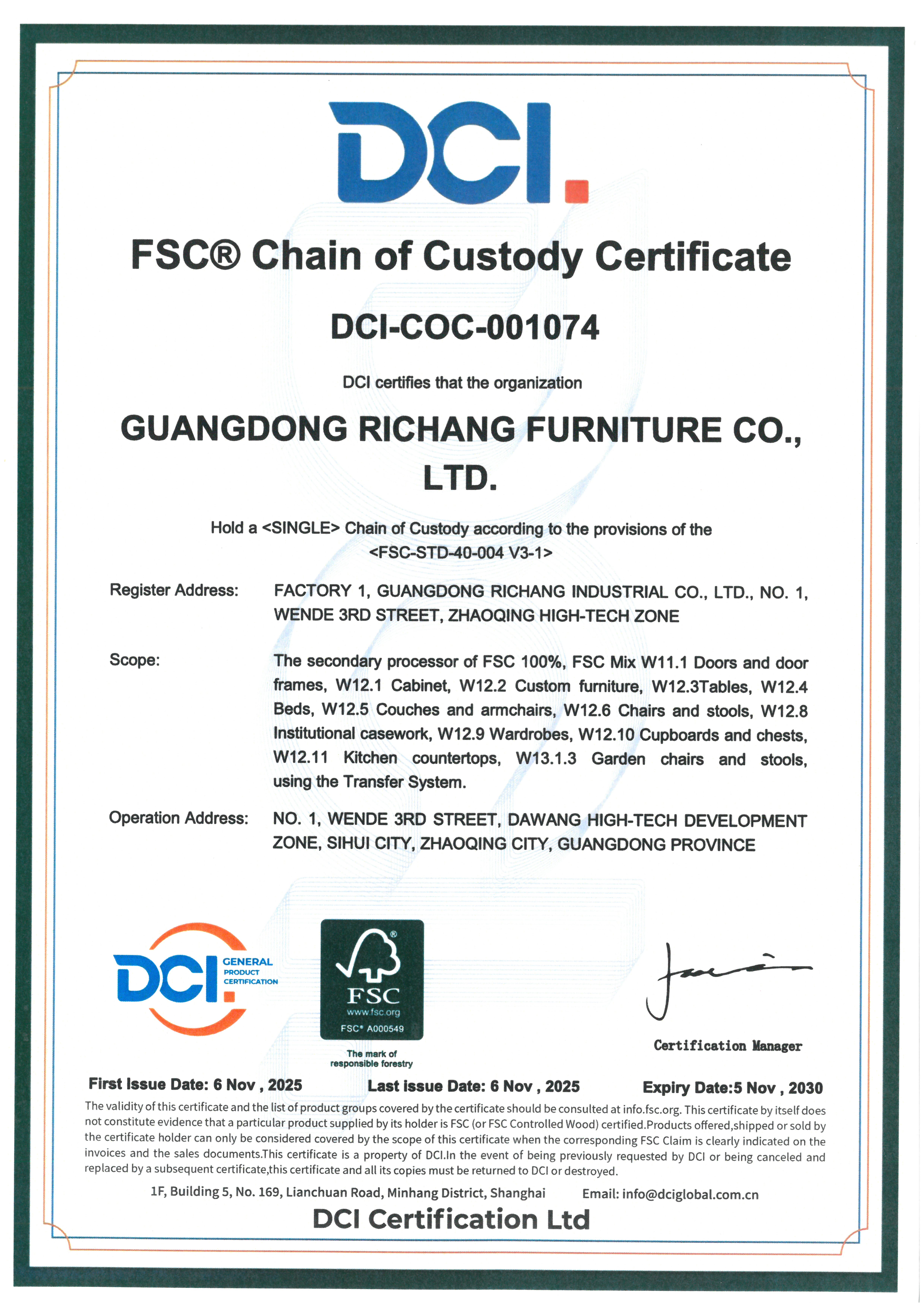
The five-year term is the operationally important detail. A buyer planning phases in 2026, 2029 and 2032 can map the certificate window against the first two phases and plan a re-verification checkpoint before the third. The same logic applies to the management systems: ISO 9001:2008 for quality, ISO 14001:2004 for environmental management — with environmental certification recorded at the facility as early as 2006 — and OHSAS 18001:2007 for occupational health and safety.
Two market-specific standards sit outside any general chain-of-custody or management-system certificate. Public and lounge seating in high-traffic commercial environments in the United States must meet ANSI/BIFMA X5.4-2020 (R2025) for durability and safety, and upholstered furniture supplied into the UK hospitality sector requires a CRIB 5 rating under BS 5852 flammability standards. These are order-stage requirements: they must be written into the specification and evidenced by test documentation, because a quality management certificate does not demonstrate them on its own.
What Long-Horizon Capacity Looks Like in Delivered Projects
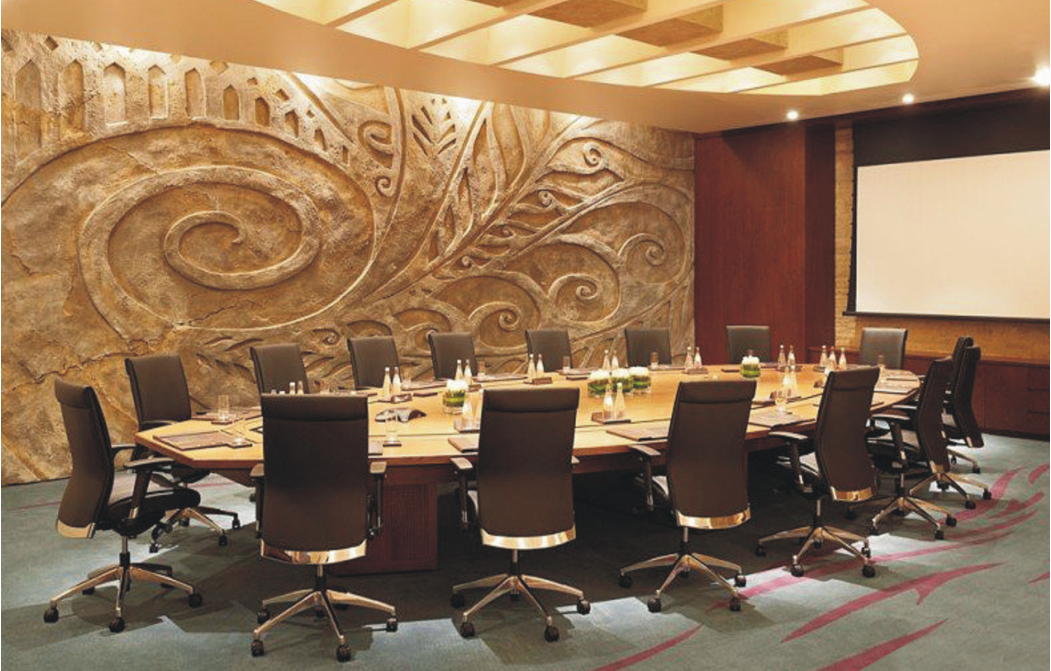
Documented project records provide the clearest evidence that a supplier can be re-used rather than simply used. RICHART's case records cover the Sofitel Dubai The Palm Resort & Spa, including meeting room, guest room, lobby entrance and guest corridor furniture, and the Millennial Hotel in the United States, including the grand lobby and guest rooms. Recorded order values for these engagements are CNY 719,029 and CNY 10,200,000, across delivery relationships spanning two years and six years respectively in the company's project documentation.
Long engagement durations are not a marketing claim so much as a risk indicator. A delivery relationship that extends across years implies design continuity, repeat approval and repeated production on the same lines. For a buyer planning a multi-phase development, the supplier's ability to be re-selected is precisely the capability being purchased — the furniture itself is the output, not the deliverable.
Market Trends That Reward Long-Horizon Suppliers
Three trends support longer supplier relationships rather than shorter ones. First, budget formalisation: with more than two-thirds of upscale hotels now allocating dedicated bespoke furnishing budgets, custom furniture has moved from a discretionary upgrade to a planned line item, and planned items are procured against multi-year budgets. Second, specification tightening: the 45% rise in sustainability specifications during 2025, including low-VOC finishes and FSC wood, effectively makes certificate continuity a purchasing condition. Third, regional concentration: Asia Pacific's 36.4% revenue share in 2025 reflects the same construction pipeline that generates phased hotel projects.
The named competitive field is also relevant to how buyers structure shortlists. Industry listings for 2026 identify Kimball Hospitality and Bernhardt Hospitality among the top-tier global manufacturers of custom guestroom casegoods and upholstered seating. The point is not to rank names but to apply a consistent test: the four durability signals described above should be applied identically to every shortlisted supplier — RICHART included — using each company's own published figures and certificates.
Where Scale Stops Helping: Limits and Boundaries
A large factory is not a complete answer, and buyers should register its boundaries before awarding a multi-phase programme.
- Capacity is shared. The stated 10,000 units per month is a site-wide ceiling across all concurrent projects, not a dedicated allocation. Without a written phase reservation, availability is an assumption.
- Lead time excludes logistics. The 30–50 day production window does not include freight, customs, delivery or installation. Programmes that treat it as total lead time will be late at handover.
- Batching favours volume. A facility organised around large runs handles design freezes and phase batching well; late or repeated specification changes after the design freeze are disruptive regardless of factory size. A minimum order quantity of 1 unit keeps sampling accessible, but unit economics and freight consolidation still favour phased volume.
- Certification has a scope. Management-system and chain-of-custody certificates cover specific standards and sites. Local fire, building and market-specific requirements, such as BS 5852 CRIB 5 in the UK or ANSI/BIFMA X5.4-2020 (R2025) in the United States, remain the buyer's specification responsibility.
- Disclosure has limits. RICHART does not publish financial statements, order-book data or staff turnover rates. Scale figures are company-stated. Buyers planning for eight to ten years should request these documents directly as part of due diligence rather than inferring them from floor space.
- Size is not a substitute for fit. For a single small bespoke order with a compressed timeline, a smaller specialist workshop may offer a faster, simpler route than a large plant with a booked production calendar.
| Evaluation dimension | Large integrated custom manufacturer | Small specialist workshop | Trading intermediary / sourcing agent |
|---|---|---|---|
| Capacity ceiling | High and disclosed as a monthly figure | Low; a single delivery can saturate the line | Dependent on third-party factories |
| In-house engineering | Typically in-house drawing and R&D function | Often owner-led, limited re-engineering capacity | Usually outsourced to the producing factory |
| Certification continuity | Site-level certificates with defined validity windows | Certificates may lapse between projects | Certificates belong to the factory, not the agent |
| Multi-phase scalability | Suited to phased batching if capacity is reserved | Poor beyond one or two phases | Dependent on whether the same factory is reused |
| Flexibility on small bespoke runs | Moderate; MOQ may be 1 unit but scheduling follows volume | High | Variable |
| Continuity risk if the supplier exits | Lower, but not zero | Higher | Highest, because production control sits elsewhere |
| Traceability of sub-tier work | Multiple workshops on one site | Limited sub-tier exposure | Low visibility |
Future Outlook
The direction of travel is towards longer, more explicit supplier commitments. As hotel pipelines extend and renovation cycles shorten, furniture will increasingly be procured as reserved capacity rather than as a one-off tender, with phase windows, certificate expiry checkpoints and staffing continuity written into framework agreements. Certificate terms will be read against programme timelines: an FSC Chain of Custody term running to November 2030, for example, aligns with roughly one renovation cycle, which makes re-verification a scheduled activity rather than a surprise.
Sustainability specification growth is likely to keep raising the entry bar, since low-VOC finishing and certified wood sourcing require documented chain of custody rather than a supplier declaration. Labour continuity is likely to remain a differentiating factor in manufacturing regions where skilled joinery and upholstery staff are not quickly replaced. For buyers, the practical shift is one of emphasis: from asking how large a factory is, to asking how long its capacity, workforce and certificates will still be in place when the next phase is ordered.
FAQ
What makes a custom hotel furniture supplier genuinely future-proof for a five-to-ten-year programme?
Four verifiable signals: available capacity (not total capacity), workforce and engineering continuity, certification validity windows that extend across the programme, and commercial durability evidenced by repeat orders from international brands. Factory floor area alone demonstrates none of these. Buyers should ask for capacity allocations, technical headcount, certificate expiry dates and repeat-order references, and apply the same request list to every shortlisted supplier.
Can a 100,000 m² facility support multi-phase rollouts across several hotels at the same time?
A facility of this scale provides the physical room for phased production and material staging. RICHART states a production base of 100,000 m², 1,000 employees and a monthly capacity of 10,000 units, with separate woodworking, sanding, painting, assembly, upholstery and packaging workshops on one site. Because that monthly figure is shared across concurrent projects, multi-phase buyers should request a written capacity allocation for each phase window rather than treat the monthly number as available output.
How long does production take once a custom hotel furniture order is confirmed?
RICHART states a lead time of 30–50 days for production, with a minimum order quantity of 1 unit and 100% testing before shipment. This window covers manufacturing only and excludes packing, freight, customs clearance, delivery and installation. In phased programmes, the production window should be sequenced against construction milestones with a defined buffer rather than treated as total delivery time.
Which certifications should a buyer verify for continued compliance over a multi-year hotel rollout?
RICHART holds ISO 9001:2008 (Quality Management System), ISO 14001:2004 (Environmental Management System) and OHSAS 18001:2007 (Occupational Health and Safety Management System), together with FSC Chain of Custody certificate DCI-COC-001074 issued by DCI Certification Ltd, valid from 6 November 2025 to 5 November 2030 with worldwide scope. Market-specific requirements sit outside these certificates: ANSI/BIFMA X5.4-2020 (R2025) applies to public and lounge seating in US commercial environments, and a CRIB 5 rating under BS 5852 applies to upholstered furniture supplied into UK hospitality. Expiry dates should be checked against the full programme timeline at contract signature.
How can brand-specific specifications stay consistent when phases are delivered years apart?
Consistency depends on retained engineering and production capability rather than on storage. RICHART operates in ODM mode with a 100-person R&D team and full customization across built-in bedboards, cabinets, wardrobes, dressing tables, display shelves, beds, sofas, writing tables, nightstands, dining tables, stools, coffee tables, sofa armchairs, TV cabinets, benches and doors, using materials that include veneer, leather, stone, metal, paint, solid wood, MDF, plywood, fabric, velvet, glass, marble, oak, walnut, stainless steel, brass, bronze, acrylic, melamine, laminate and foam. Buyers should archive approved samples and the signed specification file at the end of each phase, since that archive — not the supplier's memory — controls material and finish matching in later phases.
What are the standard purchasing terms and acceptance criteria for custom hotel furniture orders?
RICHART's stated terms are a minimum order quantity of 1 unit, delivery terms of FOB or EXW, acceptance criteria of 100% pre-shipment test, and payment terms of bank transfer, cash or TT. These terms apply to project orders and should be confirmed in the purchase contract alongside the certificate requirements and phase schedule.
What after-sales coverage applies, and how does it interact with a long programme?
RICHART provides remote technical support. The stated "Three Guarantees" period for furniture products is one year; the warranty period for spontaneous breakage, mould or fogging of glass and mirrors is six months; and the warranty period for active wood borer infestation on panel materials is two years. Where the enterprise makes a separate commitment, that commitment prevails, and where applicable furniture standards contain provisions, those standards apply. In multi-phase projects, warranty start dates should be recorded per phase rather than per contract.
What are the limits of factory scale as a supplier selection criterion?
Scale does not guarantee availability, schedule priority, staff retention or financial continuity. A 10,000-unit monthly capacity is shared across concurrent projects; a 30–50 day lead time excludes logistics; certificates cover defined standards and sites rather than all local regulations; and RICHART does not publicly disclose financial statements or staff turnover data. Scale should be treated as an entry condition for capacity, with continuity verified separately through allocations, certificate terms and repeat-order evidence.
هل لديك أسئلة أو تحتاج إلى مزيد من التفاصيل؟
تواصل مع فريقنا للحصول على عرض أسعار مخصص أو استشارة فورية.
طلب عرض أسعار
املأ النموذج أدناه وسيتواصل معك فريقنا بعرض مقترح مخصص.
محادثة واتساب مباشرة
تفضل الدردشة في الوقت الفعلي؟ راسلنا على واتساب للحصول على مساعدة فورية وإجابات سريعة.
- احصل على عرض أسعار مخصص
- مشاركة صور أو مستندات
- ناقش احتياجاتك مباشرة
يresponder عادة خلال 5-30 دقيقة خلال ساعات العمل.