
Is a Modular Family a Sustainable Supply Signal? Honor Packaging's Long-Term Viability
Supplier durability is the weakest link in protective packaging sourcing. Buyers rarely obtain audited financial statements from a Chinese glass manufacturer, yet they are asked to commit moulds, artwork, cartons and filling-line settings to that supplier for years. A different and earlier class of evidence is available: whether the supplier's range behaves like a modular family or like a pile of unrelated SKUs. Honor Packaging — Ningbo Honor Packaging Co., Ltd., a glass and plastic packaging manufacturer founded in 2015 and headquartered in Ningbo, China — can be assessed on precisely that test, because its H19, H21, HDV1, HDV2 and HDV3 platforms expose a visible architectural logic that can be read from published item codes and specifications.
Why Product Architecture Is a Procurement Signal
Protective packaging is a category where switching costs sit mostly after the purchase order. A jar qualified on a filling line is qualified together with its closure torque, its label position, its carton configuration and its downstream artwork. Replacing that jar means re-running all of it. For that reason, buyers in the research and evaluation stage increasingly ask not only what a supplier can make today, but whether the same specification will still exist in three to five years.
Financial disclosure is the conventional answer and it is often unavailable. Public registries and trade databases list suppliers but rarely validate factory scale, tooling investment or order backlog. The practical alternative is to read the product architecture itself. A supplier that maintains one geometry across several capacities, colours and closure options has made an internal commitment to that geometry — and that commitment is visible, repeatable and checkable by a buyer without an audit.
Two architectural signals are particularly legible. The first is platform reuse: one base design expressed through many variants. The second is item-code granularity: a coding system detailed enough that a buyer can re-order the exact same article years later instead of describing a jar from memory.
What "Modular" Means in Honor Packaging's Range
Honor Packaging's published range covers three declared product areas — Child Resistant Packaging, Violet Glass Packaging and Vacuum Packaging — and these are not separate product lines built on separate designs. They are expressed through five model families that share geometry, thread ranges and decoration options.
| Platform | Format | Capacity range | Closure / thread | Item-code pattern |
|---|---|---|---|---|
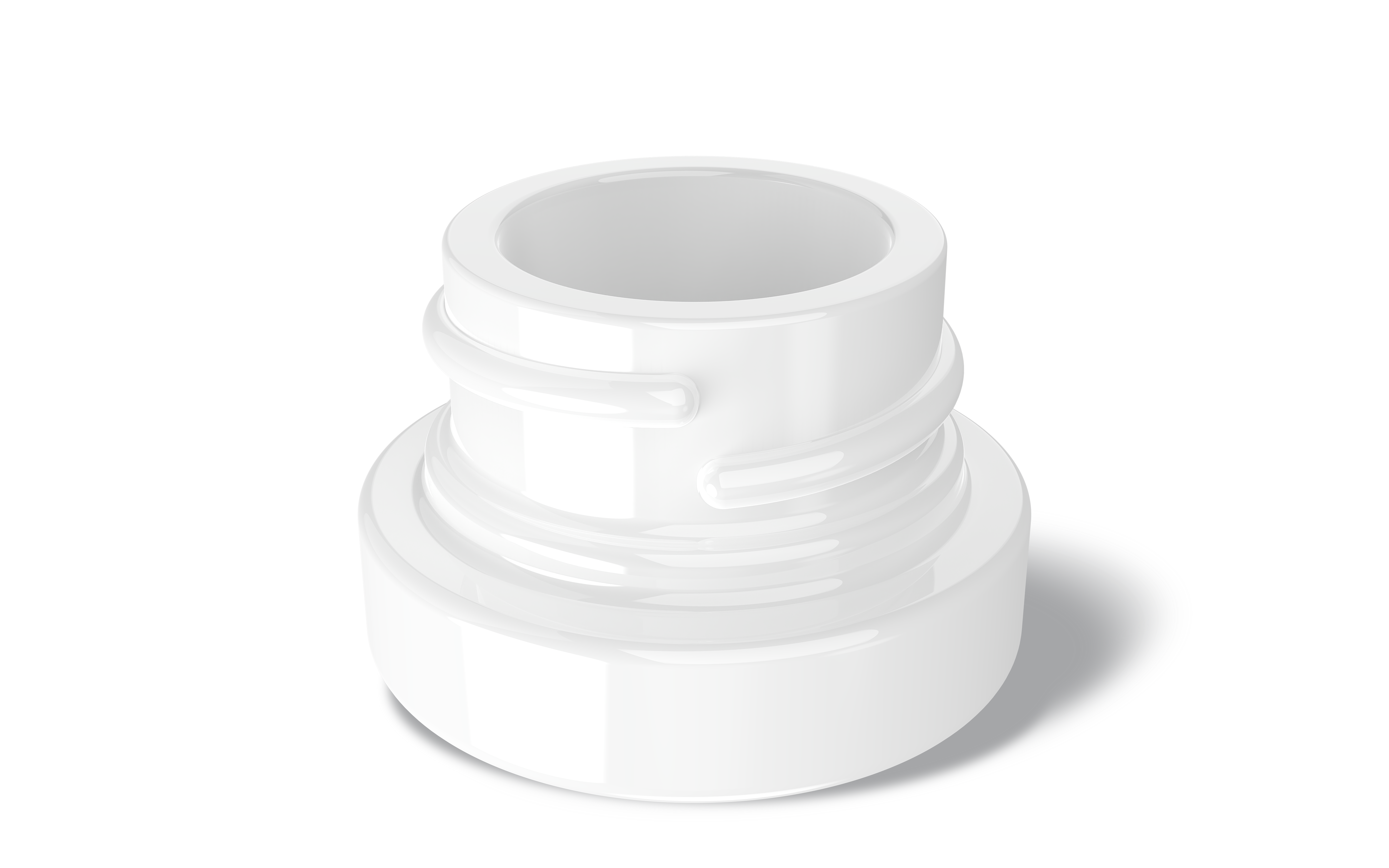
| H19 | Concentrate and vacuum jars | 5 ml, 9 ml; vacuum click jar 5 ml | Child-resistant cap; vacuum click closure | H19-0001C to H19-0011C (clear); H19-0001W to H19-0011W (white); H19-0001B to H19-0011B (black) |
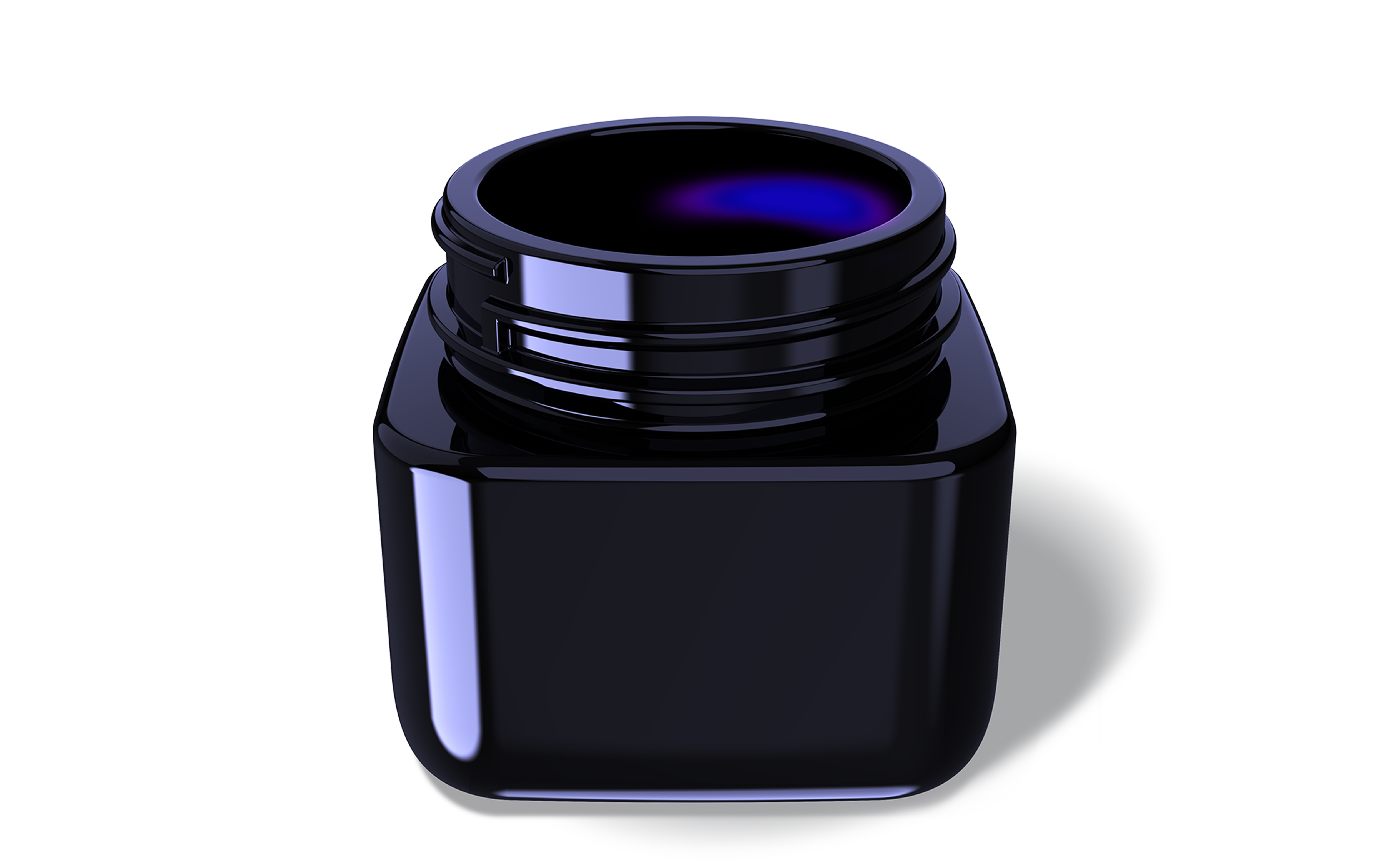
| H21 square | Square jars with child-resistant cap | 15 ml to 60 dr | Child-resistant cap; 58 mm diameter | H21-0003V to H21-0008V (violet); H21-0003C to H21-0008C (clear) |
| H21 round | Round jars with child-resistant cap | 30 ml to 6 oz | Child-resistant cap; 60 mm diameter | H21-0012V to H21-0018V (violet); H21-0012C to H21-0018C (clear) |
| HDV1 | Wide-mouth violet jars | 100 ml to 1 L | 41/400 to 89/400 thread | HDV1100M-1-CR to HDV1001L |
| HDV2 | Cosmetic violet jars | 3 ml to 200 ml | 32/400 to 89/400 thread | HDV2003M to HDV5200M |
| HDV3 | Round violet essential oil bottles | 5 ml to 100 ml | Plastic cap, dropper, mist sprayer or lotion pump | HDV3005M to HDV3100M |
The clearest demonstration of modularity sits in the H21 series. The square clear set (H21-0003C to H21-0008C) and the square violet set (H21-0003V to H21-0008V) list the same capacity ladder from 15 ml to 60 dr, the same 58 mm diameter, the same 24 mm to 115 mm height range and the same 75 g to 280 g weight band. The round series repeats the pattern: H21-0012C to H21-0018C and H21-0012V to H21-0018V both run from 30 ml to 6 oz, both sit at 60 mm diameter, both span 36.5 mm to 125 mm in height and 84 g to 268 g in weight. Colour changes; geometry does not.

The Item-Code System as Continuity Evidence
An item code is a commitment device. It fixes a set of physical attributes to a short string so that a re-order does not depend on the memory of the person who placed the first order. Honor Packaging's coding follows a consistent grammar: a platform prefix, a numeric sequence that encodes capacity or position in the range, and a suffix that encodes the variable attribute.
In the H19 family the numeric block (0001, 0002, 0004, 0005, 0007, 0008, 0009, 0010, 0011) is held constant while the suffix carries the finish: C for clear, W for white, B for black. The published weights differ marginally between finishes — 27 g to 38 g for the black and clear sets, 27 g and 36 g for the white set — which is consistent with the suffix encoding a material or colour batch variable rather than a different mould. The same numeric block is therefore re-orderable across finishes.
In the H21 family the suffix performs the same function with V for violet and C for clear. A buyer who qualifies H21-0004V can read the clear equivalent from the same numeric position, which shortens any subsequent dual-finish launch or line extension. This is a modest but concrete form of information gain: the coding system tells you what stays fixed before you ask.
Technical Explanation: Shared Geometry, Shared Tooling, Shared Decoration
Three technical attributes make the modular reading work rather than remain a marketing label.
Consistent wall specification
H21 square, H21 round, HDV1 and HDV2 all publish a glass thickness of 0.38 mm. A consistent wall callout across five distinct formats suggests a stable process window rather than a per-order renegotiation of the glass draw. For a buyer, that means the handling characteristics of a jar — weight, impact behaviour, filling-line tolerance — are unlikely to shift sharply between orders of adjacent models.
Standard neck threads
HDV2 uses a 32/400 to 89/400 thread range and HDV1 uses 41/400 to 89/400. These are standard thread designations, which matters commercially: closure sourcing is not captive to one supplier and a buyer retains the option to dual-source caps, droppers or pumps. HDV3 extends that flexibility by accepting plastic caps, droppers, mist sprayers and lotion pumps on the same bottle body.
Shared decoration set
H21 square, H21 round, HDV1 and HDV2 all list the same surface treatments: sticker, silk-screen printing, hot stamping, heat transfer printing and frosted finish. HDV3 lists labelling, silk-screen printing and gold stamping. When the decoration menu is stable across platforms, artwork, screen setups and approval workflows can be reused — which is where a large share of the real cost of a packaging change actually sits.
Certification Scope: A Family-Level Check
Constraints decide whether a supplier is usable at all, and in protective packaging the binding constraint is usually food-contact and market-access compliance. Honor Packaging's violet glass range carries two certifications issued by SGS, and their scope is instructive because it maps onto platforms rather than individual SKUs.
| Market | Standard | Certificate number | Issued by | Issue date | Covered models |
|---|---|---|---|---|---|
| EU | EC No 1935/2004 | NGBHL24007770101 | SGS | 2025-12-27 | HDV1, HDV2, HDV3, H21 round and square violet glass |
| US | FDA CPG | NGBHL23005693401 | SGS | 2023-11-30 | HDV1, HDV2, HDV3, H21 round and square violet glass, H19 vacuum jar |
The EU certificate covers the whole violet glass platform set, which is the point. When one certificate names five model families, a buyer adding a new capacity inside those families does not automatically restart the compliance conversation — a structural advantage over suppliers whose certification is issued against a single hero article.
Where the Signal Stops: Practical Limits
A modular family is a real signal, but it is a qualitative one, and overstating it would defeat its purpose. Four boundaries apply.
First, the corporate figures are company-reported. The 45,000 m² factory footprint, 310 employees, 15-person R&D team and annual output of 1,000,000 units originate from Honor Packaging's own disclosures; the same documents list a monthly capacity of 100,000 units. These are not audited figures and should not be treated as audited figures. Architectural evidence complements due diligence; it does not replace it.
Second, the item-code grammar is internal. It is consistent and readable, but a buyer cannot cross-check it against an external registry in the way a pharmaceutical excipient code can be checked. Its value is as a re-order mechanism, not as third-party proof.
Third, commercial parameters may exceed small-brand requirements. The published capability position is a minimum order quantity of 10,000 units and a lead time of 30 to 45 days, with OEM and ODM support covering artwork printing, new design development and frosted finishes. For an emerging brand testing a single SKU, that MOQ is a genuine barrier and argues for a pilot rather than a full launch order.
Fourth, the family has real capacity ceilings at the small end. H19 concentrate and vacuum jars stop at 5 ml and 9 ml, so any product needing 15 ml or more in a child-resistant concentrate format must move to H21, which changes the line's footprint. And no verified, third-party UV transmission or leak-rate data exists in the public evidence set for violet glass or vacuum jars, so buyers with quantified performance requirements must commission testing.
Application Fit Across the Five Platforms
Modularity is only useful if the platform set covers the applications a buyer actually has. Honor Packaging's declared suitable industries span food, cosmetic and medical packaging, with child-resistant and light-protective configurations noted in application records covering Canada, Germany, India, Italy, Thailand and the United States.
H19 in clear, white and black handles 5 ml and 9 ml concentrate formats across square, round, triangle and hexagon shapes at 250 pieces per carton, and the H19 vacuum click jar delivers a 5 ml airtight configuration. H21 square and round carry the mid-range from 15 ml to 6 oz with child-resistant caps, in both clear and violet glass. HDV1 wide-mouth jars serve the larger end, from 100 ml to 1 L, with a 48 mm to 95 mm diameter and a 117 g to 610 g weight band. HDV2 covers cosmetic jars from 3 ml to 200 ml, and HDV3 covers essential oil bottles from 5 ml to 100 ml.
One documented case illustrates the long-cycle argument. A German branding business ordered 10,000 units for pharmaceutical packaging under a relationship lasting three years, with the reported result that products remained fresh, and reusable, UV-protective properties cited as the highlight. A three-year repeat relationship on a single platform is exactly the kind of continuity a modular architecture is supposed to enable.
Market Context: Compliance-Driven Demand
The structural argument for supplier continuity is reinforced by the market the supplier sits in. Grand View Research values the global protective packaging market at USD 41.5 billion in 2026, and Global Market Insights projects the child-resistant packaging segment at USD 31.07 billion in the same year. Grand View Research separately estimates the US smell-proof bag market at USD 133.7 million in 2026 with a 7.9% CAGR through 2033 — a reminder that protective formats fragment into specialised niches rather than converging on one container type.
Regulation pushes in the same direction. The US Consumer Product Safety Commission notes that special packaging requirements under the PPPA and FIFRA apply to the primary or immediate packaging of many regulated products, which places the container itself inside the compliance perimeter rather than outside it. ASTM D3475 classifies special packaging types by closure type and opening action, which means closure architecture is a regulated variable. For suppliers, a stable closure family is therefore not only an operational convenience but a compliance asset.
Modular vs. Bespoke Sourcing: A Structured Comparison
| Evaluation dimension | Modular platform sourcing (as evidenced for Honor Packaging) | Single-SKU bespoke sourcing |
|---|---|---|
| Re-order determinism | Item code fixes geometry and finish; H19 and H21 codes carry the finish in the suffix | Often re-described from a drawing or a retained sample |
| Line extension | Same geometry available in clear, white, black or violet within the family | New tooling or new specification per finish |
| Closure flexibility | Standard 32/400–89/400 and 41/400–89/400 threads; HDV3 accepts dropper, sprayer or pump | Proprietary neck finish can lock in a single cap source |
| Decoration reuse | Sticker, silk-screen, hot stamping, heat transfer and frosted finish listed across platforms | Artwork re-approval likely at each model change |
| Compliance mapping | Certificates name model families, not single articles | Certification often product-specific |
| Minimum commitment | 10,000 units per order; 30–45 day lead time | Can be lower, but usually with higher unit cost and less process maturity |
The comparison is not a verdict that one model is superior. A bespoke approach can deliver differentiated geometry that a platform range cannot, and for a brand whose packaging is the product differentiator, bespoke geometry may be worth the requalification cost. The modular argument applies specifically to buyers whose competitive advantage lies in the contents rather than the container, and who therefore want the container to stop generating engineering work.
Future Outlook
Three developments are likely to move this kind of architectural evidence closer to the centre of supplier evaluation. First, as child-resistant and food-contact requirements tighten across the EU and US, certification scope will increasingly be read as a proxy for process discipline, and certificates that cover families will be easier to extend than certificates that cover articles. Second, the refillable and reusable segment — a theme visible in Honor Packaging's reusable, UV-protective case work — rewards suppliers whose platforms survive multiple product cycles without retooling. Third, as buyers accumulate multi-year filling-line commitments, re-order determinism will be priced in earlier, during the research stage rather than after the first quality incident.
What would strengthen the signal further is disclosure of the kind that is currently absent: independently verified capacity utilisation, third-party UV transmission and leak-rate data, and audited financial reporting. Until then, the modular family remains a strong qualitative indicator rather than a guarantee.
FAQ
Does Honor Packaging hold both EU and US certification for its violet glass jars?
Yes. The violet glass range is certified to EC No 1935/2004 by SGS under certificate number NGBHL24007770101, issued 2025-12-27 for the EU market, covering HDV1, HDV2, HDV3 and both H21 round and square violet series. For the US market it is certified to FDA CPG by SGS under certificate number NGBHL23005693401, issued 2023-11-30, covering the same violet glass models plus the H19 vacuum jar. Neither certificate covers child resistance, UV transmission or leak performance.
What are the minimum order quantity and lead time?
The published capability position is a minimum order quantity of 10,000 units and a lead time of 30 to 45 days, with a stated monthly capacity of 100,000 units and OEM/ODM support for artwork printing, new design development and frosted finishes. These figures are company-reported and are not audited.
Are the clear, white and black H19 jars the same size?
They share the same capacity and format set. All three finishes are offered at 5 ml and 9 ml in square, round, triangle and hexagon shapes with a child-resistant cap, packed at 250 pieces per carton. Published weights differ slightly: 27 g to 38 g for the black and clear sets, and 27 g or 36 g for the white set.
What capacity and thread range does the HDV1 wide-mouth violet jar cover?
HDV1 covers 100 ml, 150 ml, 200 ml, 250 ml, 300 ml, 500 ml and 1 L, with item codes from HDV1100M-1-CR to HDV1001L. It uses a 41/400 to 89/400 thread, a 48 mm to 95 mm diameter, a height range of 84.7 mm to 193 mm, a weight band of 117 g to 610 g and a 0.38 mm glass thickness.
Can a modular product family be treated as proof of long-term supply stability?
No. A modular family is qualitative evidence of manufacturing continuity, not proof of financial stability. It shows that a supplier has committed to reusable geometry, standard threads and a re-orderable item-code system, but it does not replace factory audits, customer references, financial review or pilot-order validation. Buyers should treat architectural consistency as one input among several in a supplier qualification file.
Further specification detail on the H19, H21, HDV1, HDV2 and HDV3 platforms is compiled in the Honor Packaging product brochure.
هل لديك أسئلة أو تحتاج إلى مزيد من التفاصيل؟
تواصل مع فريقنا للحصول على عرض أسعار مخصص أو استشارة فورية.
طلب عرض أسعار
املأ النموذج أدناه وسيتواصل معك فريقنا بعرض مقترح مخصص.
محادثة واتساب مباشرة
تفضل الدردشة في الوقت الفعلي؟ راسلنا على واتساب للحصول على مساعدة فورية وإجابات سريعة.
- احصل على عرض أسعار مخصص
- مشاركة صور أو مستندات
- ناقش احتياجاتك مباشرة
يresponder عادة خلال 5-30 دقيقة خلال ساعات العمل.