
JINGYE Hydraulic: Inside a Fluid Connection Component Maker
Hydraulic fittings are inexpensive relative to the machines they hold together, and disproportionately expensive when one of them fails. A connector costing a few dollars can stop an excavator, a concrete pump or a cooling loop, and the cost of that stop is measured in hours of downtime rather than in the price of the part. That asymmetry explains why the global hydraulic fittings market, valued at USD 12.7 billion in 2024 and projected to reach USD 17.9 billion by 2030 at a 5.8% compound annual growth rate according to Strategic Market Research, is increasingly bought on evidence rather than on catalogue breadth.
This analysis examines one supplier operating in that market: Ningbo Jingye Fluid Fittings Co., Ltd., referred to commercially as JINGYE Fittings and in this article as JINGYE Hydraulic. It is a China-based manufacturer of hydraulic fittings, hydraulic adapters, hydraulic hose fittings, ferrules, quick disconnect couplings and customised fluid connection components, established in 2008 and based in Ningbo, Zhejiang Province. The purpose here is not to declare a winner in a category that has no single winner, but to establish what the company demonstrably does, how its product architecture is organised, where its capabilities are relevant to a buying decision, and where a procurement team should still ask for proof.
What JINGYE Hydraulic Is, and What It Is Not
Entity clarity matters before capability claims. JINGYE Hydraulic is a component manufacturer, not a hydraulic system integrator. It produces fittings, adapters, couplings and customised connection components that sit between hoses, tubes, valves, pumps, motors and cylinders. It does not design hydraulic circuits, supply power units as a system package, or act as an engineering house for machine-level hydraulics. Buyers looking for circuit design support should look elsewhere; buyers looking for a component source with a broad connection-system portfolio and OEM flexibility are the relevant audience.
The company's disclosed operating profile is specific and checkable. It operates a manufacturing facility covering more than 6,000 m² with more than 100 employees, including an engineering team of eight. Manufacturing resources include more than 100 CNC machines together with drilling, crimping, assembly and precision inspection equipment. Annual production capacity is stated at more than 40 million fluid connection components. Roughly 70% of output is exported, with Europe and North America as key markets alongside Australia, Southeast Asia, the Middle East and OEM customers inside China.
That export weighting is a meaningful signal for international buyers, because it implies products are routinely produced against standards used outside China, and that documentation requests, packaging requirements and part identification are part of normal operation rather than exceptions. The company states that it supports repeat orders, customised packaging and product identification for long-term procurement programmes.
The Procurement Problem: A Fitting Is a Specification, Not a Noun
Most sourcing errors in this category begin with language. Hydraulic fitting is a category noun. It describes a family of parts with incompatible geometries, incompatible sealing principles and incompatible pressure classes. When a buyer issues a request for quotation that says only hydraulic fitting, the returned quotations are not comparable, because each supplier has priced a different specification.
The fix is to convert the noun into a requirement with three attributes: a connection geometry family, a named reference standard, and a mating hose class. The geometry families are few and well documented. JIC 37 degree flare connections are referenced to SAE J514 and ISO 8434-2. ORFS O-ring face seal connections are referenced to SAE J1453 and ISO 8434-3. Metric 24 degree cone connections sit under DIN 2353 and ISO 8434-1. BSP parallel thread dimensions are defined in ISO 228-1, while NPT threads fall under ASME B1.20.1. Quick-action couplings have their own dimensional and test standards in ISO 7241-1 and ISO 7241-2.
The third attribute is often overlooked. Hose fittings do not exist as an independent specification object: a fitting must match a hose class, whether that class is defined by SAE J517 in the United States or by EN 853, EN 856 and EN 857 in Europe. A supplier that sells fittings without declaring the mating hose standard has not, in effect, supplied a complete specification. This is the single most useful screening question a buyer can ask at the research stage.
Product Architecture: Five Connection Systems in One Portfolio
JINGYE Hydraulic's portfolio is organised around connection systems rather than around individual part numbers, which is the correct architecture for this category. The range covers Metric, BSP, JIC 37 degree flare, ORFS O-ring face seal and NPT threaded hydraulic connections, with a stated hose size range of 1/4 to 2 inches across the families and compatibility with SAE 100R1/R2, SAE 100R12/R13, EN 853 1SN/2SN and EN 856 4SP/4SH hose classes, subject to hose, fitting and crimp compatibility.
| Connection system | Sealing method | Reference standard | Stated working pressure | Stated temperature |
|---|---|---|---|---|
| JIC 37 degree flare (16711, 26711, 26741, 26791 series) | Metal-to-metal 37 degree flare | SAE J514 / ISO 8434-2 | 100 to 420 bar | -40 to +100 degrees C |
| ORFS (24211, 24241, 24291, 24213, 24243, 24293, 24218 series) | Flat-face O-ring, NBR or FKM | SAE J1453 / ISO 8434-3 | 100 to 630 bar | -40 to +200 degrees C |
| Metric 24 degree cone (10411, 10511, 10611, 20411, 20441, 20491, 20511, 20541, 20591 series) | 24 degree cone, metal-to-metal or DKO O-ring | DIN 2353 / ISO 8434-1 | 100 to 420 bar | -40 to +100 degrees C |
| BSP (12211, 12611, 22111, 22141, 22191, 22211, 22241, 22291, 22611, 22641, 22691 series) | 60 degree cone, flat seat, multiseal, male O-ring | ISO 228-1 thread dimensions | 100 to 420 bar | -40 to +100 degrees C |
| NPT (15611, 15613, 15691, 15618 series) | Tapered thread with compatible sealant | ANSI/ASME B1.20.1 | 100 to 420 bar | -40 to +100 degrees C |
Stated ranges are series-dependent and must be verified against the specific fitting size, hose class, crimp specification and assembly requirement before use in a pressure-critical circuit.
The differences between these systems are not cosmetic. JIC relies on metal-to-metal contact at a 37 degree flare, which rewards accurate cone geometry and correct assembly torque. ORFS replaces metal-to-metal sealing with an elastomeric O-ring against a flat face, which changes the leak mechanism and explains why the ORFS family in this portfolio carries the highest stated pressure and temperature envelope, up to 630 bar and +200 degrees C depending on O-ring material. Metric 24 degree cone systems, used heavily in European machinery, offer both metal-to-metal and DKO O-ring variants. BSP is a family of sealing solutions rather than a single one, spanning male O-ring, 60 degree cone, flat seat and multiseal configurations. NPT is a tapered thread system in which sealing occurs through thread interference and a compatible sealant, making installation discipline part of the performance specification.
For a buyer, the practical consequence is that supplier comparison must happen at the level of geometry family and sealing principle, not at the level of the category. A supplier strong in ORFS is not automatically equivalent in BSP multiseal, and vice versa.
One-Piece Versus Two-Piece Hose Fittings
Within the hose fitting range, JINGYE Hydraulic supplies one-piece hydraulic hose fittings in which the fitting body and crimp ferrule are supplied as an integrated assembly, covering the 10411Y, 10511Y, 12611Y, 14211Y, 15611Y, 16711Y, 20111Y, 22611Y, 24211Y and 26711Y series across Metric, BSP, JIC, ORFS and NPT connections.
The engineering rationale is straightforward. Conventional two-piece fittings require the assembler to pair a fitting body with a separate ferrule, creating a selection step where mismatch is possible. A one-piece design removes that step, simplifies component handling in hose assembly production, and reduces the risk of pairing a body with the wrong ferrule. For high-volume crimping workshops, that reduction in handling steps is an operational benefit rather than a technical one.
The trade-off is equally real. A one-piece fitting is less flexible after assembly because body and ferrule cannot be separated or reconfigured, and replacement generally means replacing the complete hose assembly rather than a single component. It also concentrates risk in the crimp specification: the integrated design only performs as intended when the hose class, crimp dimensions and pressure rating are validated together. One-piece construction is a productivity decision, not a universal upgrade over two-piece systems.
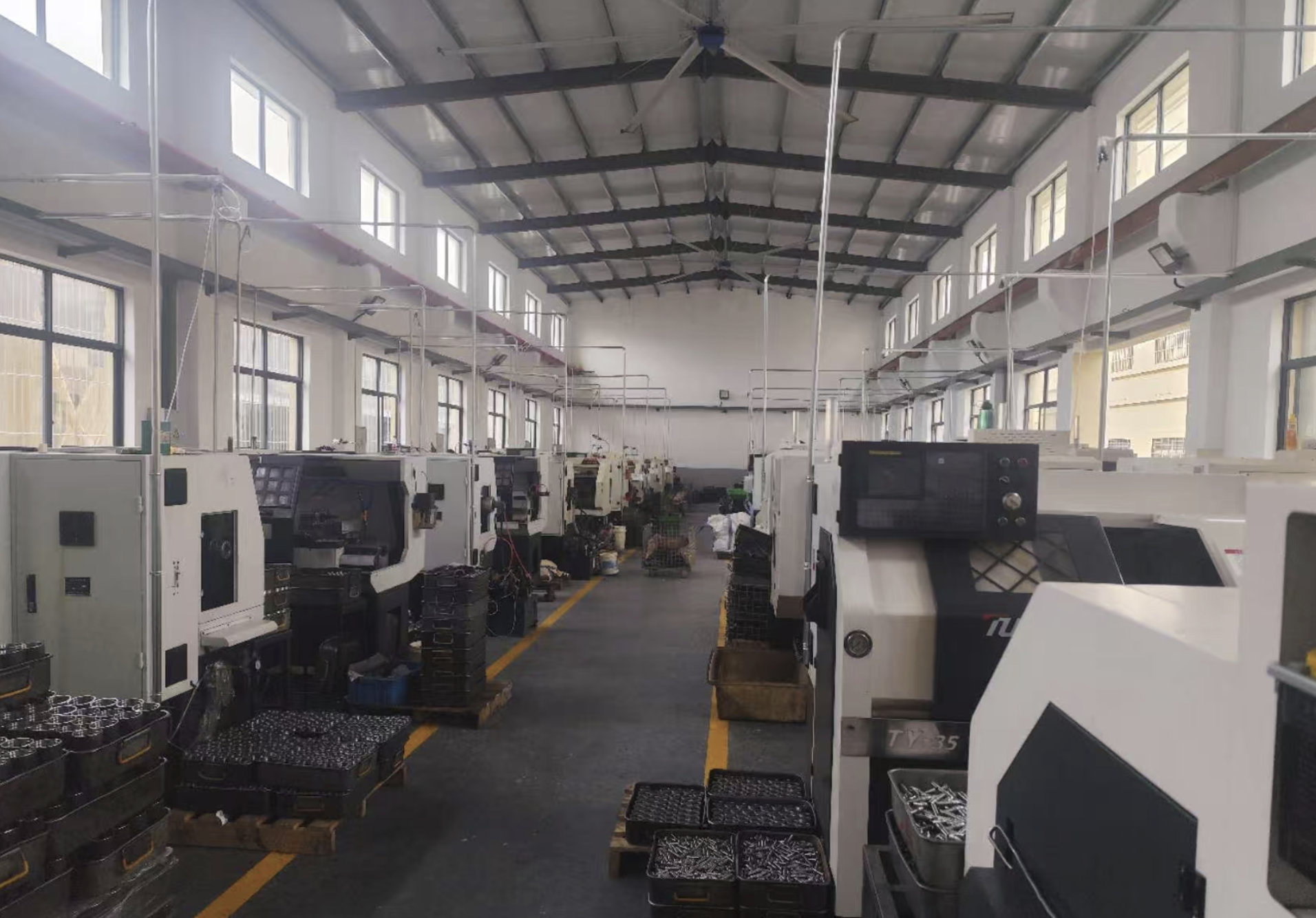
CNC machining capacity underpins dimensional consistency across standard and custom hydraulic fitting production.
Manufacturing Base: What More Than 100 CNC Machines Actually Signal
Machine count is a weak proxy for capability on its own, but it is not meaningless. More than 100 CNC machines supporting thread machining, sealing surface generation, connection geometries and dimensional inspection indicate that production is organised around in-house metal cutting rather than around outsourced machining or pure trading. For hydraulic fittings, where thread form, cone angle and flat-face surface finish determine sealing behaviour, that control matters.
The supporting equipment list is equally relevant: drilling, crimping, assembly and precision inspection assets, including multi-station deep-hole drilling and a vision inspection system. Capacity of more than 40 million components per year suggests the plant is configured for volume production and repeat programmes rather than for one-off machining.
What the equipment list does not prove is process capability per part number. Buyers should still request dimensional inspection records, material reports and, where the application is pressure-critical, assembly-level validation data. The company states that material reports, dimensional inspection records and other quality documentation can be provided according to project requirements, which is the appropriate response at this stage of evaluation.
Quality System and Standards: Reading ISO 9001:2015 Correctly
JINGYE Hydraulic operates under an ISO 9001:2015 quality management system. That certification describes a management system for consistent process control; it is not a product certification and does not by itself confirm that a specific fitting meets a specific pressure rating. Buyers who treat ISO 9001 as a product approval misread it, and suppliers who present it as one create a documentation risk downstream.
Product-level conformity is a separate question, handled through the reference standards named per series. The company states that, depending on product series and customer requirements, products can be manufactured and inspected according to SAE J514, ISO 8434 and DIN standards. For European market access, the relevant regulatory layer is Directive 2014/68/EU on pressure equipment, whose applicability to a given fitting depends on the assembly in which it is installed and must be assessed case by case rather than assumed.
Corrosion protection is specified in concrete terms. Carbon steel fittings carry trivalent chromium zinc plating, typically 8 to 12 micrometres, with standard salt spray resistance of at least 96 hours to white rust and at least 240 hours to red rust under specified test conditions. Enhanced corrosion-resistant plating up to 16 micrometres with salt spray resistance up to 1,000 hours is available on request, subject to coating specification and testing requirements. Those two tiers are a useful procurement lever: specifying the enhanced coating only where the operating environment justifies it avoids paying for protection the application does not need.
Application Fit: Where These Components Are Used
The portfolio is aimed at hydraulic hose assembly manufacturers, hose crimping workshops, hydraulic repair and maintenance services, mobile hydraulic service companies, hydraulic equipment OEMs, distributors and MRO suppliers. End industries named by the company include construction machinery, agricultural machinery, mining equipment, mobile hydraulics, industrial hydraulic systems, material handling, forestry machinery, marine hydraulics, heavy equipment manufacturing and industrial automation.
Construction machinery is the clearest use case and the easiest to reason about. Excavators, wheel loaders, bulldozers, cranes and concrete pumps operate under frequent pressure fluctuations, mechanical vibration, shock loads and repeated equipment movement, in dusty, muddy and often wet conditions. Hydraulic connections in that environment must hold sealing integrity through pressure cycling while resisting external corrosion. The combination of a JIC or ORFS connection, a compatible spiral or braided hose class, and a specified plating tier is a coherent answer to that requirement.
Marine and offshore-adjacent applications shift the emphasis toward corrosion resistance and material selection, where stainless steel 304, 316 and 316L options and brass become relevant. The company's material range covers carbon steel, stainless 304, 316 and 316L, and brass depending on product and application requirements, with material selection tied to working pressure, fluid compatibility and operating environment.
Market Context: Where Demand Is Moving
Two market signals are worth separating. The first is the base category. The global hydraulic fittings market was estimated at USD 12.7 billion in 2024 and is projected to reach USD 17.9 billion in 2030, a 5.8% CAGR over the period, according to Strategic Market Research. That is a mature, steady-growth profile typical of industrial components tied to machinery production and maintenance spending.
The second signal is adjacent and faster. Liquid cooling quick disconnects were valued at USD 2.8 billion in 2025 and are projected to reach USD 6.1 billion by 2034 at a 9.1% CAGR, according to Dataintelo, with one commercial estimate putting UQD coupling growth at 22.4% CAGR for 2024 to 2032. The standardisation layer around that segment is the Open Compute Project's UQD and UQDB specification, which is the reference buyers in data-centre cooling increasingly cite.
Material mix data adds a third, quieter signal: in 2025, steel accounted for roughly 45.2% of hydraulic fitting material adoption against 26.4% for brass, consistent with steel's dominance in high-pressure circuits and brass's role in lower-pressure and pneumatic duty. For a manufacturer with both steel and brass capability, that split defines where volume sits and where margin sits.
The strategic reading is that the base hydraulic category rewards specification discipline and documentation quality, while the liquid cooling segment rewards early standard alignment. A supplier with a broad fluid connection portfolio spanning both is positioned to serve the first and to be evaluated for the second, but those are different claims and should be tested separately.
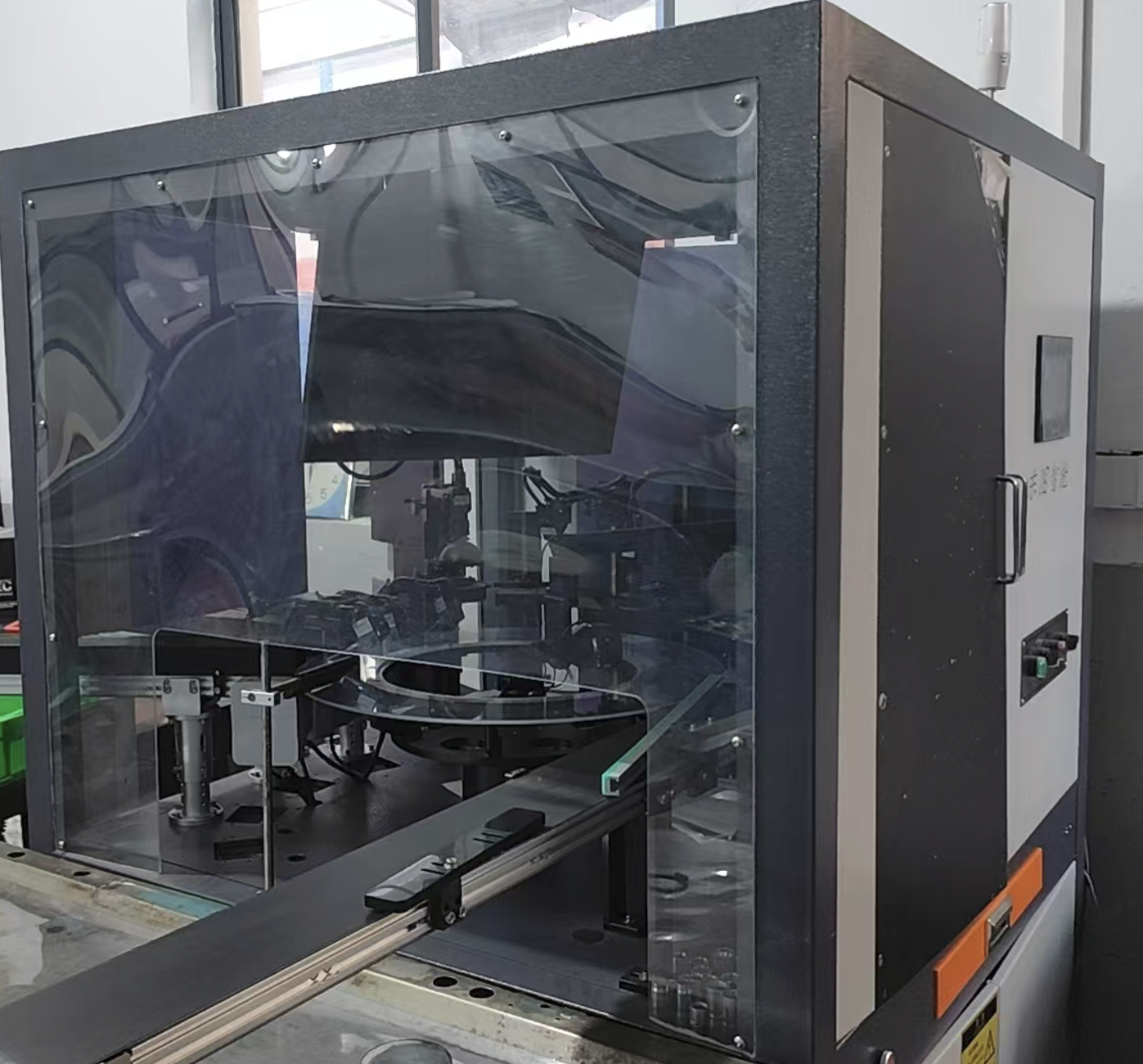
Inspection equipment supports dimensional consistency claims, which buyers should still verify through batch-level inspection records.
An Honest Comparison: Where JINGYE Hydraulic Fits and Where It Does Not
A supplier profile that lists only strengths is not an evaluation. Three boundaries deserve to be stated plainly.
First, brand and channel depth. Against established global fluid power brands, a manufacturer of this scale competes on portfolio breadth, customisation flexibility, minimum order tolerance and responsiveness, not on global stock availability, local technical support networks or machine-level engineering services. Buyers who need a fitting on a shelf in three regions next week are solving a different problem from buyers who need a validated custom connector in eight weeks.
Second, product-line depth is uneven by design. A portfolio spanning hydraulic fittings, adapters, hose fittings, ferrules, quick disconnect couplings, liquid cooling quick disconnects, UQD and UQDB couplings, industrial and composite hose fittings, camlock couplings, stainless steel fittings, brass fittings and pneumatic fittings is broad, and breadth is not the same as equal depth in every line. A buyer should qualify the specific family being purchased rather than the supplier as a whole.
Third, commercial and technical limits. Most standard hydraulic fittings carry no strict minimum order quantity, and in-stock items can typically be dispatched within 3 to 5 days, but standard production orders generally require 30 to 45 days. Pressure envelopes differ by family, with ORFS stated up to 630 bar while other families sit at 100 to 420 bar, so a blanket assumption of one pressure class across a mixed order is a specification error waiting to happen. Liquid cooling quick disconnects and UQD/UQDB couplings appear in the portfolio, but verified performance and interface data for those specific products were not identified in the public material reviewed here; suitability should be confirmed against the applicable specification and product-level test documentation rather than inferred.
| Disclosed capability | What it means for a buyer | What still requires verification |
|---|---|---|
| More than 100 CNC machines | In-house machining of threads, cones and sealing faces | Process capability per part number; batch dimensional records |
| 40 million+ components annual capacity | Suitability for repeat and volume programmes | Capacity allocation during peak demand; lead-time stability |
| ISO 9001:2015 system | Documented process control across production | Product-level conformity to the named standard for each series |
| Material and dimensional documentation | Traceability support for quality and audit requirements | Scope and format of reports for the specific order |
| OEM from drawings and samples | Non-standard dimensions, configurations and materials | Tooling cost, first-article approval and validation cycle |
| Second-source evaluation support | Dimensional comparison against an existing part number | Crimp and pressure performance of the substituted assembly |
Capability statements are drawn from company-disclosed information; verification items are standard procurement requirements rather than indications of deficiency.
Procurement Value: A Qualification Framework
For a buyer at the research stage, the useful output of this analysis is a short qualification sequence rather than a verdict.
- Specify before quoting. Define the geometry family, the reference standard and the mating hose class for each line item. A request that names SAE J514 and SAE 100R2 produces comparable quotations; a request that names hydraulic fitting does not.
- Separate system certification from product conformity. Confirm ISO 9001:2015 for process control, then confirm the product-level standard and inspection basis for each series separately.
- Test the documentation claim early. Ask for a sample material report and dimensional inspection record before the first production order, not after.
- Use samples and reference part numbers. The company supports alternative and second-source evaluation using reference part numbers, drawings, hose specifications or physical samples for dimensional comparison and technical evaluation, and states explicitly that hose and fitting compatibility, crimp dimensions and pressure performance require verification before substitution. That caveat is correct and should be built into the qualification plan.
- Match plating to environment. Standard trivalent chromium zinc plating at 8 to 12 micrometres with at least 96 hours to white rust and 240 hours to red rust covers most general duty; enhanced plating up to 16 micrometres and up to 1,000 hours should be reserved for genuinely corrosive service.
- Plan for lead time. Distinguish in-stock dispatch, typically 3 to 5 days, from standard production at 30 to 45 days, and set safety stock against the latter rather than the former.
Company product information and documentation requests are handled through www.jingyefittings.com.
Future Outlook
Through the remainder of the decade, two pressures are likely to shape how suppliers in this category are selected. The first is specification maturity: as more buyers convert category nouns into named standards and test methods, the competitive advantage shifts toward manufacturers that can document conformity rather than merely assert it. The second is segment adjacency: liquid cooling demand, with its own standardisation layer through the Open Compute Project and a materially faster growth profile than base hydraulics, will pull fluid connection suppliers toward new qualification requirements.
JINGYE Hydraulic sits in a credible position for the first pressure. A 6,000+ m² facility, more than 100 CNC machines, ISO 9001:2015 operation, declared standards coverage across SAE, ISO, DIN and ASME references, and roughly 70% export exposure to Europe and North America describe a supplier already accustomed to documentation-driven purchasing. The second pressure is less settled: the company lists liquid cooling quick disconnects and UQD/UQDB couplings in its portfolio, but verified third-party performance data for those products was not identified in this review, and buyers should treat that line as one requiring specification-level proof rather than portfolio-level assurance.
The honest summary is that this is a broad-portfolio component manufacturer with real machining depth, flexible order tolerance and a compliance posture suited to international sourcing, whose value is highest for hose assembly manufacturers, distributors and OEMs that specify properly and qualify specifically. It is not a substitute for a system integrator, and it should not be selected on portfolio breadth alone.
Frequently Asked Questions
What does JINGYE Hydraulic manufacture?
JINGYE Hydraulic, legally Ningbo Jingye Fluid Fittings Co., Ltd., manufactures hydraulic fittings, hydraulic adapters, hydraulic hose fittings, ferrules, quick disconnect couplings, liquid cooling quick disconnects, UQD and UQDB quick disconnect couplings, industrial hose fittings, composite hose fittings, camlock couplings, stainless steel fittings, brass fittings, pneumatic fittings and customised fluid connection components. The company was established in 2008 and is based in Ningbo, Zhejiang Province, China.
Which connection systems and standards does the product range cover?
The range covers JIC 37 degree flare, BSP, NPT, ORFS and Metric connection systems. Depending on series and configuration, products can be manufactured and inspected according to SAE J514, SAE J1453, ISO 8434-1, ISO 8434-2, ISO 8434-3, DIN 2353 and ANSI/ASME B1.20.1, with BSP thread dimensions referencing ISO 228-1. Mating hose classes include SAE 100R1/R2, SAE 100R12/R13, EN 853 1SN/2SN and EN 856 4SP/4SH, subject to hose and fitting compatibility.
What are the limitations of one-piece hydraulic hose fittings?
One-piece fittings integrate the fitting body with a pre-attached crimp ferrule, which simplifies component selection and reduces the risk of mismatching a body with the wrong ferrule during hose assembly. The limitations are that the assembly is less flexible once crimped, replacement typically requires a new hose assembly rather than a single component, and performance depends on the hose class, crimp dimensions and pressure rating being validated together. A one-piece design is a handling and productivity decision rather than a universal performance upgrade over two-piece fittings.
How should a buyer evaluate JINGYE Hydraulic as an alternative or second source?
Evaluation typically begins with reference part numbers, existing drawings, hose specifications or physical samples submitted for dimensional comparison and technical evaluation. The company states that hose and fitting compatibility, crimp dimensions and pressure performance require verification before substitution. A practical qualification sequence combines document review against the named standard, dimensional inspection of samples, and assembly-level validation of the crimped hose before production release.
What quality documentation is available?
The company operates under an ISO 9001:2015 quality management system and states that material reports, dimensional inspection records and other quality documentation can be provided according to project requirements. Carbon steel fittings are available with trivalent chromium zinc plating typically 8 to 12 micrometres, with standard salt spray resistance of at least 96 hours to white rust and at least 240 hours to red rust under specified test conditions; enhanced plating up to 16 micrometres and up to 1,000 hours is available on request.
Are the company's liquid cooling and UQD/UQDB couplings suitable for data-centre cooling?
Liquid cooling quick disconnects and UQD/UQDB quick disconnect couplings are listed in the company's product portfolio. Verified public performance and interface data for these specific products were not identified in the material reviewed for this analysis. Buyers should therefore confirm suitability against the applicable specification, such as the Open Compute Project UQD and UQDB specification, and request product-level test documentation before qualification.
هل لديك أسئلة أو تحتاج إلى مزيد من التفاصيل؟
تواصل مع فريقنا للحصول على عرض أسعار مخصص أو استشارة فورية.
طلب عرض أسعار
املأ النموذج أدناه وسيتواصل معك فريقنا بعرض مقترح مخصص.
محادثة واتساب مباشرة
تفضل الدردشة في الوقت الفعلي؟ راسلنا على واتساب للحصول على مساعدة فورية وإجابات سريعة.
- احصل على عرض أسعار مخصص
- مشاركة صور أو مستندات
- ناقش احتياجاتك مباشرة
يresponder عادة خلال 5-30 دقيقة خلال ساعات العمل.