
JYF-01 to JYF-07: What JYF Metal's Stainless Range Proves

Custom fabricated stainless steel sculpture work, representative of the JYF-07 family. Image: JYF Metal.
Architectural stainless steel decoration is usually sold on adjectives and bought on attributes. A buyer working through research and pre-qualification needs something more concrete than a claim of capability: a grade, a thickness, a panel size, a finish name, a minimum order quantity, a lead time and an inspection step that can be written into a purchase order. Foshan Jinyifan Metal Products Co., Ltd., trading as JYF Metal, publishes its decorative range as seven numbered product families, JYF-01 through JYF-07, and that numbering is the most useful part of the offer for procurement purposes — not because a model number is inherently meaningful, but because each number is attached to published attributes that a buyer can test, sample and reject.
JYF Metal is a Foshan, Guangdong-based manufacturer of customized stainless steel and architectural metalwork for hotels, commercial spaces and high-end interiors. The company was established in 2013, operates a 3,000 m² factory with a 15-engineer design and engineering team, and states that 80% of its output is exported, with main markets in the Middle East, Asia, Europe and North America. Its published material system covers stainless steel grades 201, 304, 316 and 430 alongside copper and aluminum; the seven numbered families described in this article are published with grades 201, 304 and 316.
This article reads the JYF-01 to JYF-07 range as supplier evidence rather than as a catalogue. For each family it states what is documented, what that attribute means at the specification stage, and which checkpoints a buyer should attach to a purchase order before committing a project package.
The evidence problem in decorative stainless supply
Decorative stainless steel is a specification-driven category. Suppliers in this segment — including several China-based exporters that publish their service pages openly — describe broadly similar process stacks: cutting, bending, welding, polishing, PVD color coating, laser cutting and fabrication for facades, ceilings and wall cladding. When the process language converges, process claims stop functioning as differentiators. What still separates suppliers is the level at which the offer is documented: which grades are actually offered per product family, which thickness bands apply, which standard panel sizes exist, which finishes and colors are named, and what the order mechanics look like.
That distinction matters because buyers cannot audit a phrase such as full customization. They can audit a thickness range, a panel dimension, a finish designation, a sample, and a pre-shipment inspection report. A numbered product family converts a marketing claim into a set of comparable attributes — which is exactly what an evaluation-stage buyer needs in order to shortlist, sample and place a first order with bounded risk.
The JYF-01 to JYF-07 range at a glance
The range splits into four decorative sheet finishes, one screen and partition system, one trim and profile family, and one open custom fabrication family. Sheet thickness is published as 0.5–3.0 mm for the mirror, brushed and sandblasted families, and 0.5–2.0 mm for the water ripple family. Standard sheet sizes are 1000x2000 mm, 1220x2440 mm and 1220x3050 mm, with custom sizes available on request.
| Model | Family | Grades | Thickness | Documented forms |
|---|---|---|---|---|
| JYF-01 | Mirror finish sheet | 201, 304, 316 | 0.5–3.0 mm | 1000x2000, 1220x2440, 1220x3050 mm; custom |
| JYF-02 | Brushed sheet | 201, 304, 316 | 0.5–3.0 mm | 1000x2000, 1220x2440, 1220x3050 mm; custom |
| JYF-03 | Sandblasted sheet | 201, 304, 316 | 0.5–3.0 mm | 1000x2000, 1220x2440, 1220x3050 mm; custom |
| JYF-04 | Water ripple sheet | 201, 304, 316 | 0.5–2.0 mm | 1000x2000, 1220x2440, 1220x3050 mm; custom |
| JYF-05 | Screen partition / room divider | 304, 316 | Not published | 1220x2440 mm; custom |
| JYF-06 | Trim / decorative profile | 201, 304, 316 | Not published | L, U, T, V, curved, corner, flat strip, skirting board, custom |
| JYF-07 | Custom fabrication | 201, 304, 316 | Drawing-based | Sculpture, column cladding, feature wall, logo, bar counter, display shelf, mirror frame |
Attributes as published by JYF Metal. Where a field is not stated in the source specification, it is marked as not published rather than inferred.
Four sheet finishes, four different specification arguments
JYF-01, JYF-02, JYF-03 and JYF-04 share a material platform — grades 201, 304 and 316, and the same three standard panel sizes — but they behave differently in a project. Treating them as interchangeable color swatches is a common specification error, because the finish determines glare, cleaning regime, joint visibility and how much the sheet reveals about the substrate behind it.
JYF-01, mirror finish. The most reflective family in the range, available in silver, gold, rose gold, black, blue, copper and custom colors. Mirror surfaces are unforgiving: they show handling marks, they make panel flatness visible at grazing angles, and they require a defined cleaning regime in service. For a buyer, the relevant controls are protective film at the specification stage (custom protective film is a stated customization option), flatness expectations agreed at sample approval, and a joint layout that acknowledges reflection rather than fighting it. Mirror is well suited to column cladding, feature walls, elevator decorative panels and bar counters where the reflective effect carries the design intent.
JYF-02, brushed. Published finishes are hairline, satin, No.4 and vibration, in silver, gold, rose gold, black, blue, copper, bronze and custom colors. Brushed surfaces are directional, so grain orientation becomes a real specification item on large wall runs and on adjacent panels: mismatched grain direction is one of the few finish defects that reads as a quality problem to an end client. Vibration-pattern finishes add a visible texture that also masks light scuffing. Where a project needs a low-gloss, high-traffic-tolerant wall panel, this family is usually the default candidate.
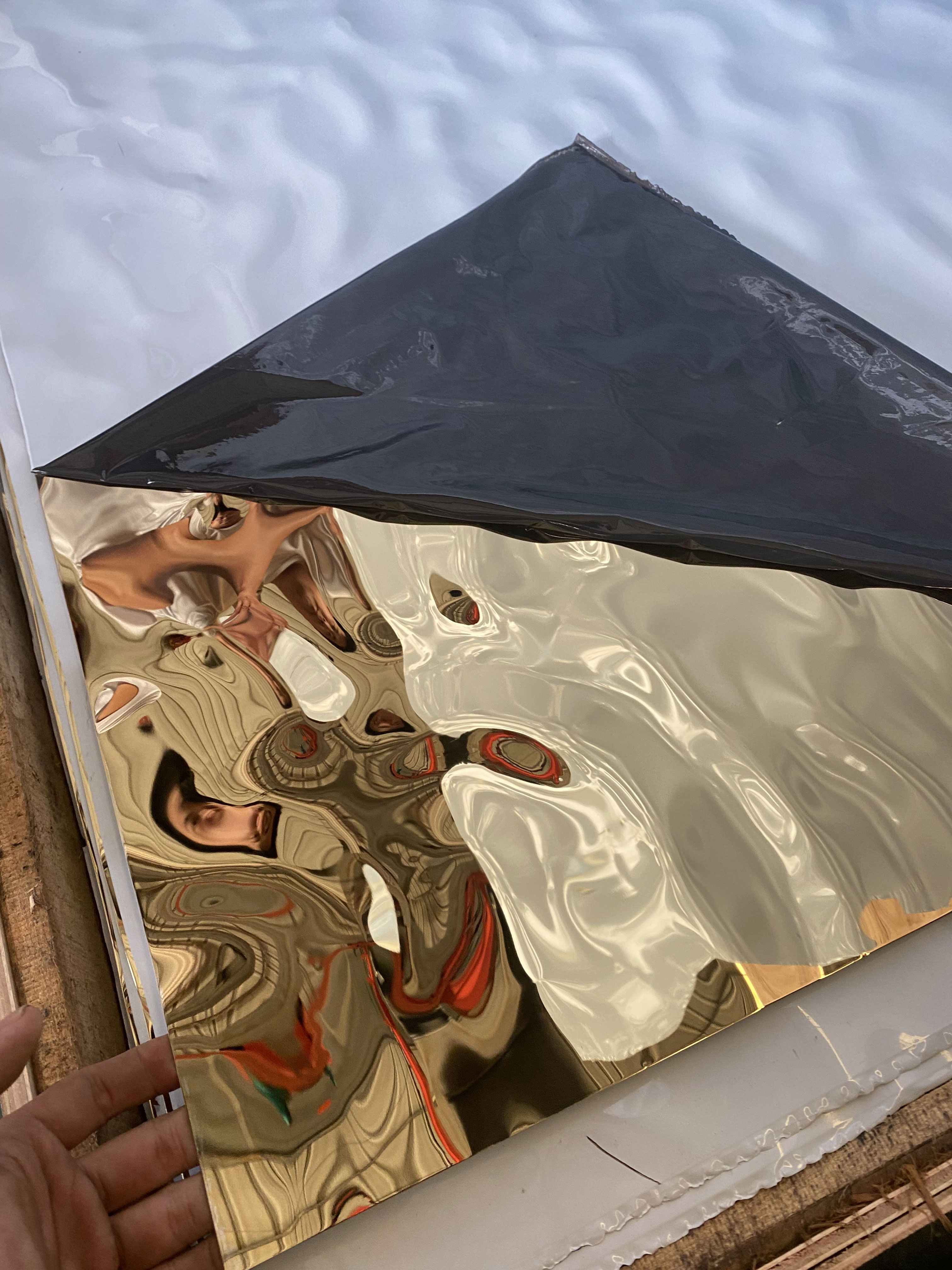
Water ripple sheet with a mirror base color, JYF-04 family. Image: JYF Metal.
JYF-03, sandblasted. A matte, low-glare surface in the same grade and size envelope, with colors including silver, gold, rose gold, black, blue and copper. Sandblasted finishes are typically chosen where reflected light is a problem — ceiling planes, wide wall fields, and interiors where a mirror finish would create glare or double reflections. Because the surface is matte, small surface irregularities are less visible than on mirror, which often makes it the more forgiving specification on site.
JYF-04, water ripple. A three-dimensional textured sheet with ripple sizes documented as small, medium, large and flow, in silver, gold, rose gold, black, blue, copper and custom colors. This is the family with the clearest documented usage evidence in the range: a Korean designer ordered 120 pieces for ceiling and wall decoration, and a French designer ordered 80 pieces for ceiling decoration, with the reported outcome covering seamless installation and a scratch-free surface, plus flatness sufficient for precise joint alignment. The constraint is thickness — 0.5–2.0 mm against 0.5–3.0 mm on the other three sheets — which is a genuine boundary rather than a footnote.
JYF-05: screens and partitions as an engineered assembly
The screen partition family is the point where the range stops being a sheet supply offer. JYF-05 is published for grades 304 and 316 only, at a regular size of 1220x2440 mm with custom sizes, in silver, gold, rose gold, black, copper, bronze and custom colors, with mirror, brushed and vibration finishes. It is built through spot welding, full welding, laser cutting and CNC cutting, and it accepts embedded glass, marble, crystal, metal mesh and LED lighting.
That combination makes the model a useful test of a supplier rather than a test of a material. A screen is judged on joint alignment across the full run, on whether the pattern repeats cleanly where panels meet, and on how the frame is fixed. In the Canadian contractor case recorded for this family, three room divider units were supplied with a modular design for seamless panel joints and aligned pattern, and with glue-free mechanical fixing for installation without adhesive. For a buyer, the practical implication is that a screen enquiry should be accompanied by section drawings and a fixing method, not only by a finish swatch — the published specification establishes grade and finish, while joint tolerance and fixing detail have to be agreed project by project.
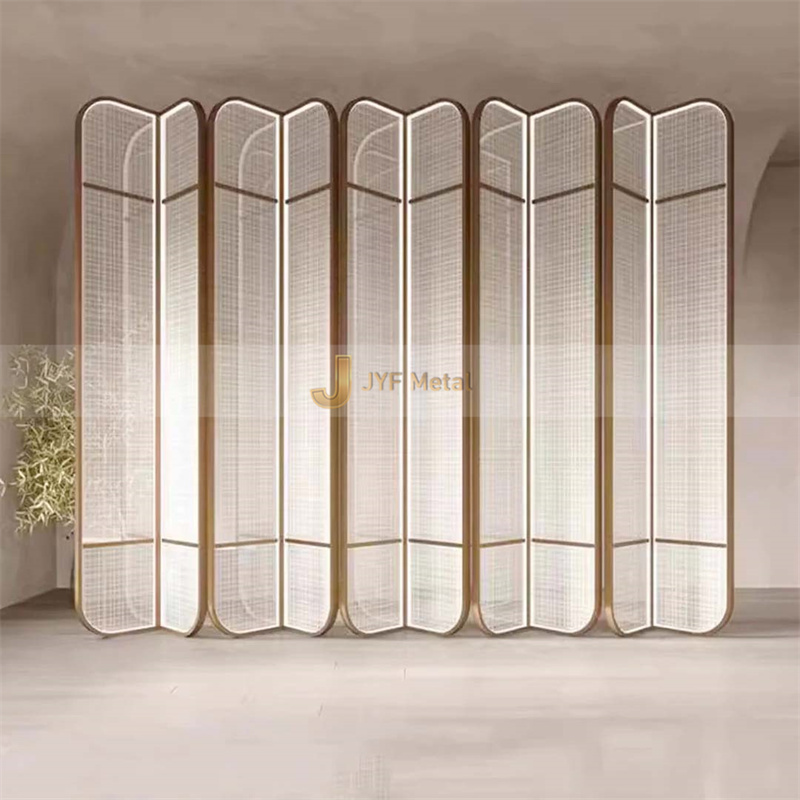
Stainless steel screen partition with glass infill, JYF-05 family. Image: JYF Metal.
JYF-06: trims, profiles and the edges that decide perceived quality
Trims are a small-value, high-visibility category. JYF-06 is published in grades 201, 304 and 316 across L, U, T, V, curved, corner, flat strip and skirting board shapes, plus custom profiles, in silver, gold, rose gold, black, copper, bronze and custom colors, with mirror, brushed, vibration and sandblasted finishes. The stated processes are shearing, V-grooving and bending.
For buyers, the significance is commercial rather than decorative. Trims terminate wall panels, resolve ceiling perimeters and cover the transitions where site tolerances accumulate; a project can be perfectly specified on the panel schedule and still read as unfinished because the edge detail was ordered late or in the wrong length. The published order mechanics for this family — a minimum of 500 pieces per type and a stated lead time of 15–20 days — are therefore worth factoring into the project programme rather than treating as a final-stage purchase. Where a designer needs a curved or non-standard profile, the family explicitly accepts custom shapes, which moves the item into drawing-based quoting.
JYF-07: the custom fabrication family
JYF-07 is the open family, documented by application rather than by fixed dimensions: metal sculpture, column cladding, feature walls, custom logos, bar counters, display shelves and mirror frames, in grades 201, 304 and 316, produced from drawings. This is where the manufacturers stated tooling becomes relevant to a buyer: a German Trumpf laser cutting installation, high-precision CNC bending, seamless precision welding equipment and a PVD vacuum plating line for stainless steel decorative panels, supported by a 15-engineer team working on drawing optimization and complex shape development, including curved surfaces, hyperbolic forms and non-standard items.
The order terms published for this family are the most accessible in the range: a minimum of one piece, and a lead time of 25–30 days. That combination — one-piece minimum plus drawing-based production — is what allows a buyer to run a prototype or a single feature element before committing to a full package. It also sets the expectation correctly: custom work is priced and scheduled by drawing review, not by panel area.
Turning the range into purchase order checkpoints
The value of a documented range is realized only when each attribute is converted into an acceptance criterion. The table below maps the published attributes to the checkpoint a buyer should attach at evaluation stage.
| Purchasing term | What the range documents | Acceptance checkpoint |
|---|---|---|
| Grade | 201, 304, 316 across JYF-01 to JYF-04, JYF-06, JYF-07; 304 and 316 only for JYF-05 | Confirm grade per line item in writing, and confirm that a partition specification is costed on 304 or 316 rather than 201 |
| Thickness | 0.5–3.0 mm for JYF-01, JYF-02, JYF-03; 0.5–2.0 mm for JYF-04 | Specify nominal thickness per panel and state the gauge in the inspection plan; do not assume 3.0 mm availability on water ripple |
| Panel size | 1000x2000, 1220x2440, 1220x3050 mm standard; custom sizes offered | Confirm the largest panel per elevation and require a joint layout drawing before release |
| Finish | Mirror, brushed (hairline, satin, No.4, vibration), sandblasted, water ripple (small, medium, large, flow) | Approve a physical sample per finish and record grain direction or ripple orientation in the approved sample sheet |
| Color | Silver, gold, rose gold, black, blue, copper, bronze, custom, on a PVD coating line | Retain a signed color sample and agree a color consistency criterion for the full batch |
| Protection and marking | Custom protective film and custom logo listed as customization options | Specify film type and removal window, and require panel marking to match the installation drawing |
| Order quantity | Sheets 15 per type; trims 500 pcs per type; screen partitions 3 m²; custom products 1 pc | Consolidate color and finish variants early, because MOQ applies per type |
| Lead time | Sheets 7–10 days; trims 15–20 days; screen partitions 20 days; custom products 25–30 days | Treat these as production times and add freight and site delivery separately in the programme |
| Quality control | 100% pre-shipment test; third-party inspection accepted; ISO 9001 certified system | Name the inspector, the inspection point and the defect criteria in the purchase order |
| After-sales | Online installation guidance, sample provision, replacement parts | Confirm the route for replacement parts before shipment, not after installation |
Where the range fits: application scenarios
The documented applications for these families cluster in commercial and hospitality interiors — hotel lobbies, restaurants, clubs, offices, sales centres and high-end residences — alongside exterior-facing work such as curtain wall elements and column cladding. Typical working conditions recorded for the category include indoor and outdoor exposure, high-traffic areas, and humid or coastal environments, with stated requirements covering dimensional accuracy, corrosion resistance, weather resistance, color consistency and surface finish.
A practical mapping of family to scenario looks like this. Ceiling planes and large wall fields usually favour sandblasted, brushed or water ripple surfaces, because reflected glare and visible handling marks are the dominant risks at height and at scale. Feature walls, reception backdrops, column cladding and elevator decorative panels can carry mirror, where the reflectivity is the design intent. Screens and partitions carry the load of space division in lobbies and restaurant areas, with infill materials chosen for privacy and light transmission. Trims and skirting close the junctions, and JYF-07 absorbs everything that does not belong to a standard family — bar counters, display shelving, mirror frames, logos and sculpture.
In humid or coastal conditions, grade selection becomes the controlling decision rather than finish selection. The range publishes 201, 304 and 316; the choice between them belongs in the specification conversation with the project team, because the same finish family is offered across all three grades and a finish-approved sample does not automatically confirm the grade behind it.
Market context: why documented ranges are gaining weight
Two published data points frame the demand side. Fortune Business Insights values the global stainless steel market at USD 225.13 billion in 2025 and projects growth to USD 353.48 billion by 2034. Grand View Research reports that steel held a 52% revenue share of the metal ceilings market in 2026. Neither figure is specific to decorative stainless, but together they describe a material category with sustained volume and a metal-ceiling segment where steel remains the dominant material choice.
The supply-side pattern is less about volume and more about qualification. Category descriptions for ornamental and architectural metalwork — NAICS 332323 in the United States — cover a broad field of custom metal fabrication, and the suppliers competing for decorative interior packages describe closely overlapping process capability. In that environment, procurement advantage shifts toward suppliers who can answer a specification query with a documented attribute rather than a brochure adjective. For international projects the question is compounded by export mechanics: JYF Metal states a complete export system and product export qualifications, with 80% of output exported, which is the part of the offer that determines whether a documented range can actually be delivered to a site abroad.
The boundaries: what the range does not resolve
A capability range is only credible if its limits are stated as clearly as its options. Four boundaries are visible in the published data and should be raised early in evaluation.
Thickness ceiling on the textured family. JYF-04 water ripple is published at 0.5–2.0 mm, while JYF-01, JYF-02 and JYF-03 reach 0.5–3.0 mm. A project that requires a heavier gauge together with a textured surface cannot simply combine the two; it needs either a different finish family or a custom route through JYF-07, with the accompanying drawing review and lead time.
Grade restriction on partitions. JYF-05 is published for 304 and 316 only. Buyers who benchmark partitions against sheet pricing on grade 201 will find the comparison invalid, and cost-driven interior projects may need to separate the partition package from the panel package at budget stage rather than at order stage.
Nominal versus measured values. The published specification states grade, thickness, standard size and finish family. It does not publish numeric flatness tolerances, color-difference limits or weld-finish acceptance criteria. Those remain sample-based and project-specific, which is precisely why the supplier offers samples, 100% pre-shipment testing and third-party inspection. For fire performance in ceiling assemblies, the relevant standard depends on the build-up: recorded industry data for stainless steel honeycomb panels references ASTM E84 and EN 13501-1, and a buyer should ask which of these applies to the specific assembly rather than to the sheet alone. Where welded decorative tubing is part of the package, ASTM A554 is among the most frequently cited standards for that product form.
Cost position against traditional finishes. Compared with painted plaster, laminate or timber-based finishes, stainless decoration carries a higher material and fabrication cost and requires an early fabrication decision, because panels, trims and screens are made to drawing rather than cut on site. Its advantages are durable and cleanable surfaces, dimensional stability and a range of finishes that holds color under a PVD coating; its disadvantages are that mirror surfaces demand an active cleaning regime, that protective film management becomes a site task, and that the finish package must be locked before the panel schedule is released. Traditional finishes remain the more forgiving option where the design intent does not require metal, and where budgets are tight the stainless package is best reduced in scope rather than downgraded in grade.
Future outlook
The direction of this category is toward documented, drawing-based supply rather than catalogue selling. Three signals support that reading. First, process stacks among decorative stainless suppliers have converged, so differentiation increasingly rests on the depth of the published specification and the discipline of the inspection step. Second, the growth of metal ceiling and metal wall systems keeps pushing decorative sheet demand toward finishes that perform at scale — matte, textured and directional surfaces that tolerate site conditions better than high-gloss mirror. Third, international procurement is becoming more evidence-driven: buyers now ask for sample approval, third-party inspection and named standards as a matter of routine, and suppliers without a numbered, attributable range find those questions harder to answer.
For a supplier with a 3,000 m² factory, a 15-engineer engineering team and a PVD line, the next step is not more product families but more published measurables — tolerance bands, color-difference limits and finish acceptance criteria per family. For buyers, the practical conclusion is simpler: treat a numbered range as a starting point for verification, not as proof in itself. The models tell you what to ask; the samples, drawings and inspection reports tell you what you are actually buying.
FAQ
What do the JYF-01 to JYF-07 model numbers refer to?
They identify seven product families from JYF Metal: JYF-01 mirror finish sheet, JYF-02 brushed sheet, JYF-03 sandblasted sheet, JYF-04 water ripple sheet, JYF-05 screen partition and room divider, JYF-06 trims and decorative profiles, and JYF-07 custom fabrication. Each family carries its own published grades, thicknesses, sizes and finishes.
Which stainless grades are available across the range?
Grades 201, 304 and 316 are published for JYF-01 to JYF-04, JYF-06 and JYF-07. JYF-05 screen partitions are published for 304 and 316 only. The company-level material system also lists grade 430 alongside copper and aluminum, but the seven numbered families are documented on 201, 304 and 316.
Why is the water ripple family limited to 2.0 mm?
The published thickness range for JYF-04 is 0.5–2.0 mm, while JYF-01, JYF-02 and JYF-03 are published at 0.5–3.0 mm. The source specification does not give a technical reason for the narrower band, so the boundary should be treated as a stated limit: where a heavier gauge is required with a textured surface, the specification has to be resolved through a different family or a custom fabrication route.
Can panel sizes be customized?
Yes. Standard sizes are 1000x2000 mm, 1220x2440 mm and 1220x3050 mm, and custom sizes are listed as a customization option alongside custom color, custom protective film and custom logo. Custom sizing changes a line from a standard sheet order into a drawing-based item, which affects the quoted lead time.
What are the minimum order quantities and lead times?
Published minimums are 15 sheets per type for decorative sheets, 500 pieces per type for trims, 3 m² for screen partitions and 1 piece for custom products. Published production lead times are 7–10 days for decorative sheets, 15–20 days for trims, 20 days for screen partitions and 25–30 days for custom products.
How can a buyer verify finish and dimensional quality before shipment?
The documented route is threefold: approve physical samples per finish and color, require a 100% pre-shipment test, and admit third-party inspection. Because the published specification states nominal attributes rather than numeric tolerances, the acceptance criteria — flatness, joint alignment, color consistency and surface condition — should be written into the purchase order and confirmed against the approved sample.
Further project references from JYF Metal, including hotel and commercial case documentation, are collected in the Designer's Handbook Project Cases. Company background is published at jyf-metal.com.
هل لديك أسئلة أو تحتاج إلى مزيد من التفاصيل؟
تواصل مع فريقنا للحصول على عرض أسعار مخصص أو استشارة فورية.
طلب عرض أسعار
املأ النموذج أدناه وسيتواصل معك فريقنا بعرض مقترح مخصص.
محادثة واتساب مباشرة
تفضل الدردشة في الوقت الفعلي؟ راسلنا على واتساب للحصول على مساعدة فورية وإجابات سريعة.
- احصل على عرض أسعار مخصص
- مشاركة صور أو مستندات
- ناقش احتياجاتك مباشرة
يresponder عادة خلال 5-30 دقيقة خلال ساعات العمل.