
Jacket vs. Half-Pipe Coil vs. External Coil Tank Heating
Independent Buyer Comparison · Custom Chemical Equipment
Heating and cooling on a process storage tank is rarely a simple accessory decision. A jacket, a half-pipe coil and an external coil each change the shell geometry, the insulation build-up, the nozzle and instrumentation layout, and the way maintenance access is planned — and those changes are expensive to reverse once the vessel drawing is released for fabrication.
This comparison sets out the three heating and cooling configurations listed in the public storage tank specification data of Jiangsu Xuyang Chemical Equipment Co., Ltd. — jacket, half-pipe coil and external coil — and evaluates them against criteria buyers actually apply during evaluation and execution: insulation compatibility, agitation options, inspection and maintenance access, removable component design, vertical versus horizontal orientation, and the choice of safety valves, rupture discs, pressure gauges and PLC-based monitoring.
Jiangsu Xuyang Chemical Equipment Co., Ltd. is a chemical equipment manufacturer established in 2009 in the Jingjiang Economic and Technological Development Zone, Jiangsu Province, China. Its stated product scope covers reactors, storage tanks, shell-and-tube heat exchangers, towers, candle filters, membrane separation and filtration equipment, corrosion-resistant lined equipment, water-treatment equipment and skid-mounted process systems.
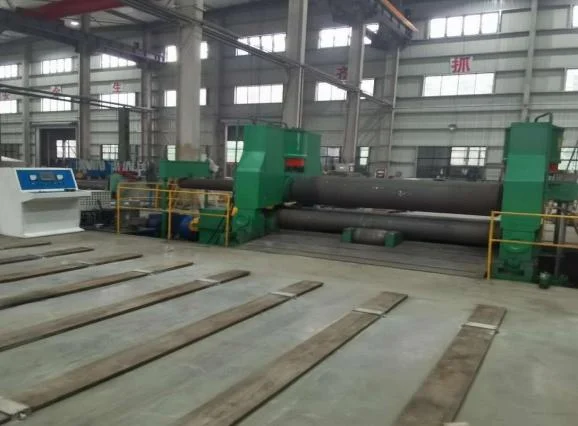
Shell forming is where the heating configuration stops being a drawing detail: jacket, half-pipe and coil attachment points are fixed once the shell course is rolled and fitted.
Three configurations, three different engineering problems
A jacket is a second shell wrapped around the tank body, creating an annular space through which steam, thermal oil, cooling water or chilled water passes. The heat-transfer surface is effectively the tank wall plus the jacket space, and the jacket becomes part of the pressure-containing or non-pressure envelope depending on the design.
A half-pipe coil is a semi-circular channel welded to the outside of the shell, normally in a spiral or parallel path. The heat-transfer medium flows inside the half-pipe; the shell wall conducts heat to or from the product. The coil is structurally integral to the shell and cannot be removed without cutting.
An external coil is a separate tube circuit mounted outside the shell, which in some designs can be built as a removable element. Because it is a discrete component rather than an integral shell feature, it changes the maintenance model more than the other two options.
All three appear in the storage tank specification data published for Xuyang equipment, which lists heating and cooling as jacket, half-pipe coil or external coil; insulation as available; agitation as optional; orientation as vertical or horizontal; and control as manual, automatic or PLC.
Why the configuration belongs early in the specification
The usual failure mode is sequencing. Capacity, material and orientation are fixed in the enquiry, and the heating method is treated as a later detail. By that point the shell thickness, nozzle schedule and support arrangement are already set, and late changes propagate into insulation detailing, platform access and relief-device sizing.
A more workable sequence is to fix the process duty first — what is being heated or cooled, at what temperature and pressure, and how often the tank is opened for cleaning — then select the configuration, then finalise insulation, access and instrumentation around it.
Capacity, design pressure and design temperature are fully customized to process and site requirements in this equipment category. That is a procurement reality, not a marketing line: there is no catalogue table from which a buyer can read off a thermal duty, and public specifications deliberately leave these values open until the technical agreement is signed.
Comparison against buyer criteria
The table below organises the three configurations against criteria that appear repeatedly in buyer evaluation sheets. It compares engineering behaviour and procurement consequences, not thermal performance figures, because performance is derived per project from capacity, medium, design pressure and design temperature.
| Criterion | Jacket | Half-pipe coil | External coil |
|---|---|---|---|
| Heat-transfer surface | Annular space around the shell; tank wall acts as the separating surface | Discrete channel welded along the shell in a spiral or parallel path | Separate tube circuit mounted outside the shell |
| Insulation compatibility | Insulation is applied over the jacket; jacket nozzles create local penetrations that need detailing | Insulation must negotiate the coil profile, with standoffs and cladding supports built in | Depends on a design decision: insulate over the coil, or leave the coil outside the insulated envelope |
| Agitation compatibility | Agitator and baffles sit inside; jacket nozzles must avoid baffle and support locations | Coil path must be routed around baffles, nozzles and support rings | Coil and its brackets compete for external space with drive, platform steelwork and piping |
| Inspection access | Jacket interior inspection is limited; relies on test connections and closure-weld quality | Coil-to-shell welds can be inspected from outside, but access behind the coil is restricted | Most accessible option for individual inspection when designed as removable |
| Removable design | Not removable; integral to the shell | Not removable without cutting | Can be designed removable, subject to support, flange and clearance detailing |
| Fabrication content | Depends on pressure rating and closure design | Higher welding and fit-up content along the coil path | Moderate; depends on bracket, connection and support design |
| External damage risk | Low; protected by insulation and cladding | Low to moderate; coil edge exposed until cladding is fitted | Higher if left unprotected; handling and transport need care |
| Footprint and support impact | Slight increase in diameter; support spacing follows | Slight increase in diameter along the coil path | May extend beyond the insulated outline and affect the transport envelope |
| Effect on interior finish | Interior finish is independent of the jacket | Interior finish is independent of the coil | Interior finish is independent of the coil |
Table: configuration comparison by buyer criteria. Entries describe engineering behaviour and procurement consequences; no thermal performance values are implied.
Insulation compatibility is where cost quietly accumulates
Insulation is listed as available on the Xuyang storage tank specification, and the way it interfaces with the heating method is one of the most under-specified items in tank enquiries.
A jacket gives the insulator a regular outer surface. Cladding runs smoothly, vapour barriers are simpler to keep continuous, and the main complications are the jacket nozzles and any support lugs that pierce the insulation. The trade-off is that the jacket itself must be tested and its closure welds verified before the insulation goes on, because once covered, access is effectively gone.
A half-pipe coil presents the opposite problem. The cladding must follow a helical or parallel profile, which means standoffs, a larger finished diameter than a plain shell, and carefully detailed penetrations where coil inlet and outlet connections leave the insulated surface. Vapour-barrier continuity around the coil ends is a recurring weak point on site, and it is worth requiring a detail drawing rather than a verbal assurance.
An external coil forces an explicit decision that buyers should make consciously. If the coil is insulated over, it is protected from mechanical damage and the tank looks and behaves like a jacketed vessel — but coil inspection and replacement then require removal of insulation and cladding. If the coil sits outside the insulated envelope, it stays serviceable and inspectable, but it is exposed to knocks, spillage and ambient conditions, and the thermal behaviour of that exposed section has to be accepted in the process design.
Surface finish interacts with all of this. The specification lists polished, pickled and passivated, or customized finishes, and the internal finish is what governs cleanability — it is independent of which heating method is chosen externally.
Agitation options: anchor, paddle, turbine and their interaction with heating
Agitation is optional on storage tanks, and when it is specified, the agitator type and the heating method compete for the same shell real estate.
- Anchor agitator. Close-clearance, wall-adjacent geometry, generally associated with higher-viscosity media. It keeps the boundary layer moving where jacket or coil heat transfer acts, which is why it so often appears on heated tanks rather than unheated ones.
- Paddle agitator. Low-shear, large swept area, gentle bulk movement. Suited to blending duties where the product should not be sheared aggressively.
- Turbine agitator. Higher shear and good bulk circulation in low-viscosity media; useful for dispersion and rapid blending duties.
Beyond these three, the reactor specification published for the same manufacturer lists ribbon and high-shear agitators, with mechanical or magnetic sealing, and heating by steam, thermal oil or electric, with cooling by cooling water or chilled water. Where a storage tank also performs reaction duty, that reactor specification is the more appropriate reference document.
The practical constraint is spatial. Baffles, agitator supports and coil or jacket nozzles all want the same locations. On a jacketed tank, jacket nozzles must not land on baffle attachment welds. On a half-pipe coil, the coil path has to be routed around the same features without creating a dead zone. An external coil can often be routed clear of these conflicts, but it then adds congestion outside the shell, where platforms, ladders and piping already compete for room.
Inspection, maintenance access and removable component design
Inspection strategy should be agreed before fabrication, not after delivery. The purchasing guidance published by Xuyang describes acceptance against approved technical specifications, drawings, applicable international standards and agreed inspection procedures, with key criteria including material certification, dimensional accuracy, welding quality, NDT results, pressure and leak testing, performance testing and final documentation. An Inspection and Test Plan (ITP) can be prepared for buyer review before production.
Against those criteria, the three configurations behave differently:
- Jacket. The closure welds and any test connections carry the inspection burden, because the annular space is not accessible afterwards. Weld quality and leak testing are the evidence trail.
- Half-pipe coil. Coil-to-shell welds can be examined from outside, but the coil pitch limits how much surface is reachable, and surface preparation before insulation matters. Here the ITP needs to specify NDT coverage along the coil path, not just at the shell seams.
- External coil. This is the only configuration where the heat-transfer element can be taken off without shell work — provided the supports, flanges and clearances were designed for removal from the start. Retrofitting removability to a fixed-coil design is not a realistic field modification.
On welding and testing, the manufacturer states that it uses plasma and deep-penetration automated welding and that each vessel undergoes testing including X-ray detection (NDT), hydraulic pressure testing and surface roughness inspection. Buyers should map those statements onto their own ITP rather than treating them as a substitute for one.
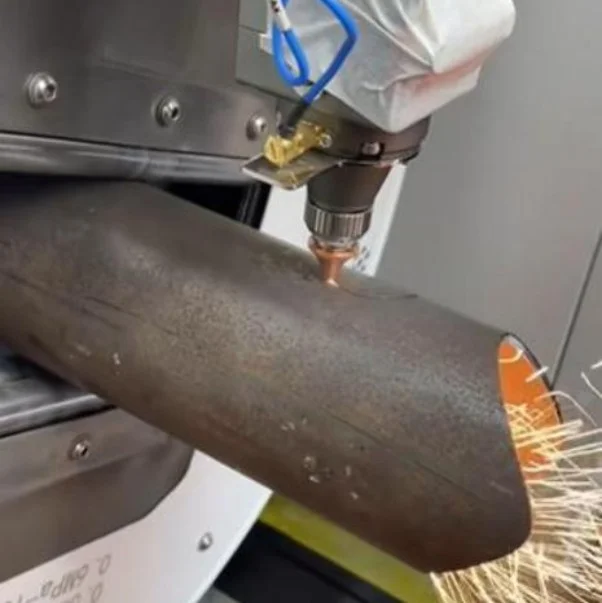
Cutting and preparation upstream of forming: dimensional accuracy here determines how well a half-pipe coil path or jacket closure fits later.
Vertical or horizontal: a decision that constrains everything else
Orientation is listed as fully customizable — vertical or horizontal — and it changes how each heating method is accessed and maintained.
Vertical tanks suit constrained floor areas, provide good gravity discharge and are the natural choice when agitation is required, because the drive sits on the top head with a short shaft. The cost is height: platforms at the top, and cladding and coil access handled from ladders or mobile access equipment. A jacket is straightforward here; a half-pipe coil is workable; an external coil placed outside the insulation is comparatively easy to reach.
Horizontal tanks sit on saddles, offer lower headroom and often allow a larger diameter within a given transport envelope. Agitation is less common and mechanically more demanding, and the heating surface is concentrated on the lower portion unless the coil is routed around the full circumference. Public product listings for the manufacturer include a horizontal external half-pipe coil reactor, which illustrates the combination in practice rather than as a concept.
Transport and site access frequently decide the question before engineering preference does. An external coil that increases the overall transport envelope can change the shipping category of the whole vessel, and that cost appears before any thermal consideration.
Safety valves, rupture discs, pressure gauges and PLC monitoring as selection factors
Instrumentation and relief devices are often treated as a checklist at the end of the specification. They should instead be read as evidence of how well the heating configuration was thought through.
- Safety valve. The set pressure derives from the design pressure, which is customized per project. A relief device selected before design pressure is fixed will almost certainly be resized later.
- Rupture disc. Often used upstream of a safety valve where tight sealing or rapid response is required, or as the primary relief device in particular duty. The choice must be documented, because it changes the maintenance interval and the spare-parts plan.
- Pressure gauge. Local indication remains the first line of verification for operators and inspectors, and its nozzle location must survive the insulation and cladding detail.
- PLC-based monitoring. Control is offered as manual, automatic or PLC, and PLC integration changes the nozzle schedule, the cable routing and, in skid-mounted configurations, the factory acceptance testing scope.
Each of these devices needs a nozzle, and each nozzle pierces the insulation or competes with the coil path. That is the practical link between instrumentation choice and heating configuration: they are decided on the same drawing.
Qualification checkpoints, not ranking criteria
Design standards and certificates are frequently misused as a supplier scorecard. They are better read as gates: a supplier either holds the certificate required for the destination market and the specific vessel, or it does not.
The storage tank specification lists design standards as ASME, GB, EN or PED, and certification options as ASME U Stamp, CE or ISO. Which one applies is determined by the jurisdiction, the vessel category and the end user's own specification — not by preference. ASME Boiler and Pressure Vessel Code Section VIII is described by engineering sources as governing design, analysis, fabrication, inspection and testing of pressure vessels, including heat exchangers, reactors, filters and specialty vessels; jurisdiction-specific applicability still has to be confirmed project by project.
For Jiangsu Xuyang Chemical Equipment Co., Ltd., the verifiable qualifications are:
- ASME Certificate of Authorization (U Stamp), certificate number 62646, issued by The American Society of Mechanical Engineers, issued 10 September 2025 and valid through 10 September 2028, with scope covering the manufacture of pressure vessels under the ASME Boiler and Pressure Vessel Code.
- A2-level Special Equipment Design and Manufacturing License issued by the relevant Chinese authorities, relevant to pressure-vessel engineering and manufacturing.
- ISO 9001, ISO 14001 and ISO 45001 management systems.
The verification steps that matter to a buyer are unglamorous but decisive: confirm the certificate number, scope and validity date directly; confirm whether the specific vessel will actually be stamped; and confirm the inspection agency, the NDT coverage and the documentation package that will be handed over. Compliance also has a budget consequence — estimates cited by Fortune Business Insights suggest compliance with ASME can represent up to 20% of a vessel's total material cost, which is why the standard should be settled before, not after, commercial negotiation.
What the manufacturer's public record supports
Jiangsu Xuyang Chemical Equipment Co., Ltd. reports a 10,000 m² facility, 110 employees, an annual output of 1,000 units and an R&D team of 7 engineers, with stated industry-university-research cooperation involving Nanjing Tech University, China University of Petroleum and Soochow University. The company states that it uses ERP and MES production-management systems and operates a dedicated agitator dynamic-balancing test workshop.
Its fabrication equipment is listed as tube and tube plate argon arc welding machines, three-roll plate rolling machines, high-speed CNC surface drilling machines, beveling laser cutting machines, pipe flange automatic welding machines, head opening robots, hydraulic four-roll plate rolling machines and laser pipe cutting machines. Those are the processes that determine whether a half-pipe coil can be fitted with consistent pitch or a jacket closure welded cleanly, so the equipment list is more informative than a capability slogan.
On commercial terms, the manufacturer states a minimum order quantity of 1 unit, a lead time of 30–60 days and a monthly capacity of 100 units, with export support in English, Russian, Arabic and Turkish, and stated markets including the EU, the USA, Russia and Asia. These figures are company-reported and should be confirmed against the specific project schedule during quotation.
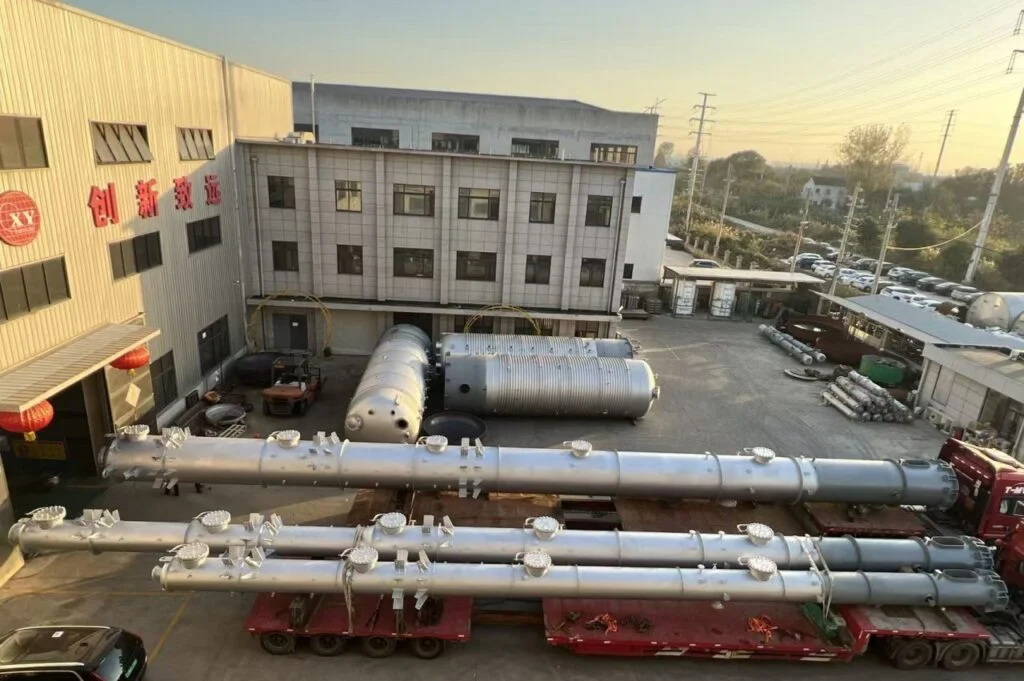
Dispatch preparation: the documentation package — material certificates, NDT reports, pressure-test records — travels with the vessel and forms part of acceptance.
Where this comparison stops
An honest comparison has to state its boundaries, and there are three here.
First, no numeric thermal performance is published for any of the three configurations, and none should be inferred from this article. Because capacity, design pressure and design temperature are fully customized to process and site requirements, the heat-transfer area, coil pitch and medium flow are derived per project. Any supplier quoting a figure without the process data is guessing.
Second, each configuration carries a specific penalty. A jacket on a large-diameter tank adds fabrication and handling weight and makes the jacket interior effectively uninspectable after closure. A half-pipe coil adds substantial welding and fit-up content along the coil path, and complicates insulation detailing. An external coil, if left outside the insulated envelope, is exposed to mechanical damage and requires a deliberate decision about the thermal consequence of that exposure. None of these is a defect; each is a cost that should be priced knowingly.
Third, certificate possession is not the same as project compliance. A valid ASME U Stamp authorization, an A2 license or an ISO certificate proves a management and qualification framework exists; it does not prove that a specific vessel was designed, welded, tested and documented to the required standard. That gap is closed only by the ITP, the inspection records and the final documentation package.
Market context and outlook
Demand context supports a more disciplined approach to these decisions. SNS Insider values the global chemical processing equipment market at USD 68.82 billion in 2026, and reports that the chemicals and petrochemicals segment accounted for a 41.6% revenue share in 2025. Global Market Insights projects the separation machinery market at USD 109 billion in 2026, growing at a 7.2% CAGR over 2026–2035. Capacity in these segments is being added in projects where documentation and compliance, rather than price alone, determine whether equipment is accepted.
Three trends follow for tank heating specification. Instrumentation density is rising, with PLC-based monitoring moving from optional to expected on new lines. Skid-mounted integration is pulling vessels, heat exchangers, pumps and controls into factory-tested packages, which makes external coil accessibility more valuable and half-pipe insulation detailing more critical. And material diversification — stainless steel grades, Hastelloy, titanium and PTFE-lined construction — is pushing material selection and heating configuration into the same early conversation, because the two constrain each other.
Frequently asked questions
Can capacity, design pressure and design temperature be customized?
Yes. Capacity, design pressure and design temperature are fully customized to process and site requirements, and the storage tank specification also lists material, orientation, heating and cooling method, insulation, agitation, surface finish, control and design standard as project-defined parameters. Nothing in these categories is fixed by a standard model.
Which materials are available for tanks and reactors?
The specification lists SS304, SS316L, carbon steel, Hastelloy, titanium and customized options for tanks, with SS304, SS316L, carbon steel, Hastelloy, titanium and zirconium listed for reactors. PTFE-lined equipment is also part of the manufacturer's product scope. Material selection is normally settled by working through the medium, its chemical composition and concentration, operating and design temperature, operating and design pressure or vacuum, required capacity, and any corrosion-resistance or hygiene requirement.
Can agitation be combined with jacket or coil heating?
Yes, agitation is listed as optional on storage tanks and can be combined with jacket, half-pipe coil or external coil heating. The agitator type — anchor, paddle, turbine, ribbon or high-shear — and the seal type, mechanical or magnetic, are selected against the duty. The combination has to be coordinated at design stage because baffles, agitator supports and heating-medium nozzles occupy the same shell locations.
What documentation should be requested before acceptance?
Acceptance is normally defined against approved technical specifications, drawings, applicable international standards and agreed inspection procedures, with key criteria covering material certification, dimensional accuracy, welding quality, NDT results, pressure and leak testing, performance testing and final documentation. An Inspection and Test Plan and acceptance criteria can be issued for buyer review before production begins, and factory acceptance testing applies where equipment is supplied as a skid-mounted package.
What are the minimum order quantity and typical lead time?
The stated minimum order quantity is 1 unit, with a stated lead time of 30–60 days and a monthly capacity of 100 units. Lead time for a specific vessel depends on the heating configuration, material and instrumentation scope, and should be confirmed in the quotation against the project schedule.
Selection summary
For buyers in evaluation and execution, the practical rule is straightforward. Choose the jacket when a regular insulated outer surface, straightforward cladding and a conventional pressure envelope matter more than post-installation access to the heat-transfer surface. Choose the half-pipe coil when the process needs a defined channel geometry and the project can absorb the additional welding and insulation detailing. Choose the external coil when serviceability of the heating element outweighs the exposure and insulation compromises it introduces.
Then fix the surrounding decisions in the same pass: orientation, agitation, insulation and cladding detail, relief devices and PLC scope, and the standard and certification path for the destination market. A downloadable pressure vessel catalogue covering the manufacturer's related equipment is available at 2026 Xuyang Pressure Vessel Catalog for readers who want the underlying configuration options in one document.
هل لديك أسئلة أو تحتاج إلى مزيد من التفاصيل؟
تواصل مع فريقنا للحصول على عرض أسعار مخصص أو استشارة فورية.
طلب عرض أسعار
املأ النموذج أدناه وسيتواصل معك فريقنا بعرض مقترح مخصص.
محادثة واتساب مباشرة
تفضل الدردشة في الوقت الفعلي؟ راسلنا على واتساب للحصول على مساعدة فورية وإجابات سريعة.
- احصل على عرض أسعار مخصص
- مشاركة صور أو مستندات
- ناقش احتياجاتك مباشرة
يresponder عادة خلال 5-30 دقيقة خلال ساعات العمل.