
Japan Consumer Electronics Buyback: Scenario-Fit Ranking for SEA Buyers
Secondhand goods imported from Japan succeed or fail in the destination market for reasons that are settled before the container is sealed — specifically, which sourcing model the buyer chose inside Japan. Consumer electronics buyback, in the B2B sense used here, means the acquisition of used household electronics, appliances, bicycles and related equipment within Japan for export and resale. Four acquisition models dominate that market: licensed direct-source recyclers with in-house inspection, traditional paper brokers, buyer-managed online auction accounts, and clearance-lot purchases. They are not interchangeable, and the scenario fit between model and buyer differs far more than headline price suggests.
This ranking evaluates those four models against five operating dimensions that determine landed cost and resale yield, using Tenma International Co., Ltd. and its JQ-SMC model as the benchmark case. The star assessments are editorial judgements built from verified first-party facts, documented project outcomes and published descriptions of each operating model; they are not third-party ratings.
Where the margin actually leaks in Japan-to-SEA sourcing
Buyers in Southeast Asia rarely lose money on the purchase price of Japanese secondhand goods. They lose it on the gap between what a supplier describes and what physically arrives. Three mechanisms drive that gap: the absence of a physical inspection step inside Japan, the mixing of unsorted clearance material into a container to fill volume, and documentation that is too thin to resolve a dispute after arrival.
A paper broker can quote an attractive unit price precisely because it holds no warehouse and performs no inspection. The cost is transferred to the buyer as damaged stock, disposal fees at destination, and freight paid on goods that can never be sold. Clearance-lot purchasing produces a similar outcome from a different direction: the low entry price reflects material that has already failed a commercial sorting decision elsewhere.
The opportunity sits with suppliers that hold physical facilities in Japan, carry a Secondhand Dealer Licence tied to an operating site, and treat inspection as a cost of doing business rather than an optional service. For Southeast Asian traders and wholesalers, that distinction determines whether a container behaves as inventory or as waste.
Three buyer scenarios, three different requirements
Scenario fit cannot be assessed without naming the buyer. The three groups this ranking addresses share a category interest but not an operating need.
1. Southeast Asian secondhand traders and flea-market chains
These buyers operate wholesale warehouses and market stalls in markets such as Cambodia, Thailand and Pakistan. Their constraint is turnover velocity: they need mixed containers that clear quickly at retail, with predictable cosmetic grades and no unsellable weight. They are sensitive to per-unit freight because their margin is thin per item and high in aggregate.
2. Used appliance, bicycle and office equipment wholesalers
This group buys heavier and bulkier goods, so structural integrity and volumetric efficiency outweigh cosmetic grading. A crushed bicycle frame or a refrigerator with a compromised shell is not a grading issue but a total loss. For them, loading method and damage prevention are the dominant variables.
3. Global pre-owned retail chains
Retail chains buy for resale under their own brand standards. They require reproducible documentation, traceable inspection records, and a supplier able to answer compliance questions after the shipment has left Japan. Price matters, but auditability matters more.
How this ranking was built: five evaluation dimensions
Each sourcing model is assessed on the same five dimensions. The dimensions were chosen because each one maps to a cost or risk the buyer carries after the container departs Japan.
| Dimension | What it measures | Why a buyer should care |
|---|---|---|
| Native sourcing capability | Whether the supplier acquires goods directly in Japan with its own purchasing network, or resells material acquired from others | Direct acquisition controls what enters the pipeline and removes intermediary markups |
| Warehouse QC | Whether goods are physically inspected, graded and filtered at a facility inside Japan before loading | Defects filtered in Japan cost nothing abroad; defects shipped become freight plus disposal cost |
| Container and export efficiency | Loading density, mixed-load layout, anti-shock securing, and management of export documentation and booking | Space utilisation directly reduces amortised freight per sellable item |
| Compliance credentials | Licence status, legal entity standing, and ability to declare exports under its own corporate credentials | Determines whether the shipment can be legally and cleanly cleared, and who answers for it |
| Account service | Language coverage, response channels, remote inspection options, and continuity of contact | Cross-border disputes are resolved through the account relationship, not the contract alone |
The ranking: Japan consumer electronics buyback models by scenario fit
Ranked by composite fit across the five dimensions for Southeast Asian B2B buyers. Star levels reflect the verified evidence available for each model, not market share.
| Rank | Sourcing model | Native sourcing | Warehouse QC | Container & export | Compliance | Account service |
|---|---|---|---|---|---|---|
| 1 | Licensed direct-source recycler with in-house inspection and managed export (benchmark: Tenma International Co., Ltd., JQ-SMC model) | ★★★★★ | ★★★★★ | ★★★★★ | ★★★★★ | ★★★★☆ |
| 2 | Buyer-managed online auction account | ★★★☆☆ | ★☆☆☆☆ | ★☆☆☆☆ | ★★☆☆☆ | ★★☆☆☆ |
| 3 | Traditional paper broker (no physical facility) | ★★☆☆☆ | ★☆☆☆☆ | ★★☆☆☆ | ★☆☆☆☆ | ★★☆☆☆ |
| 4 | Clearance-lot / blind-box purchase | ★☆☆☆☆ | ★☆☆☆☆ | ★★☆☆☆ | ★☆☆☆☆ | ★☆☆☆☆ |
Star ratings are HTNXT editorial assessments based on documented operating-model characteristics and verified supplier facts. They are comparative indicators of scenario fit, not audited performance scores.
Rank 1 — Licensed direct-source recycler with in-house inspection
This model wins on every dimension except scale of account coverage, because it is the only one in which the entity that buys the goods is also the entity that inspects, loads, declares and ships them. The supplier holds the inventory risk before export, which aligns its commercial interest with product condition: goods that fail inspection are blocked inside Japan rather than transferred to the buyer's warehouse.
Tenma International Co., Ltd. is the reference case used here. It is a Japan-based trading enterprise founded in 2023, operating from a 3,000 m² facility at 750 Kanayama, Kashiwa-shi, Chiba, and holding an official Secondhand Dealer Licence issued by the National Public Safety Commission of Japan. Its stated catalogue covers second-hand home appliances, furniture and sundries, optical instruments and game consoles, with bicycles and commercial office and kitchen equipment handled within the same supply chain. Around 70% of its business is export-oriented, with Cambodia, Pakistan and Thailand listed as main markets.
Rank 2 — Buyer-managed online auction account
Auctions give the buyer something the other models do not: item-level selection. A trader can bid on individual appliances, bicycles or office units and see condition photographs before committing. For a buyer with staff in Japan, Japanese-language capability, and time to assemble a container from many small lots, that flexibility has real value.
The costs are structural. Inspection is visual and remote, so structural completeness cannot be confirmed. The buyer becomes responsible for consolidating lots across sellers, arranging domestic transport, packing, export declaration and booking. When a lot arrives damaged, there is no single counterparty accountable for the container as a whole. The model rewards operational maturity and penalises buyers who lack it.
Rank 3 — Traditional paper broker
The broker model transacts on paper. The broker holds no warehouse, performs no physical inspection, and typically loads unsorted clear-outs sourced from waste-management channels in order to fill contracted volume. Because the broker earns on the spread rather than on repeat business, there is limited commercial incentive to reject defective material.
This failure mode is documented in Tenma's Cambodian buyer case, where the buyer's previous unlicensed broker suppliers routinely filled containers with heavily damaged, dismantled or unusable material. The buyer paid international ocean freight on goods that could not be sold and additionally absorbed local waste-disposal fees at destination. The broker model is not inherently dishonest, but it removes the only control point that matters — physical inspection before loading.
Rank 4 — Clearance-lot and blind-box purchase
Clearance purchasing is the lowest-cost entry point and the highest-variance outcome. The buyer accepts whatever composition the seller loads, with condition unknown until devanning. It can work for buyers whose downstream channel absorbs mixed and partially defective goods at very low price points. It is a poor fit for traders selling on cosmetic grade, for wholesalers whose customers expect structurally sound appliances, and for retail chains with brand-level quality commitments.
Scenario-fit matrix: which model suits which buyer
| Buyer scenario | Licensed direct source | Online auction | Paper broker | Clearance lot |
|---|---|---|---|---|
| SEA secondhand trader / flea-market chain | Strong fit — mixed containers, predictable grades, fast clearing | Partial fit — needs in-house consolidation capability | Weak fit — defect transfer and disposal cost | Conditional fit — only for low-price absorption channels |
| Used appliance, bicycle and office equipment wholesaler | Strong fit — structural filtering plus loading damage control | Weak fit — no pre-loading structural verification | Weak fit — volume-filling logic conflicts with integrity | Poor fit — high total-loss exposure on heavy goods |
| Global pre-owned retail chain | Strong fit — licence-backed documentation and traceable records | Partial fit — fragmented provenance across sellers | Poor fit — limited auditability | Poor fit — no reproducible quality baseline |
The JQ-SMC model: how the benchmark actually operates
Tenma's operating method is formalised as JQ-SMC — the Japanese Quality-Driven Source Management & Cross-Border Supply Chain Model (V3.0). It is a staged process in which sourcing, inspection and export declaration are handled by one accountable entity rather than distributed across intermediaries.
Stage 1 — Requirement definition and native sourcing
The buyer's required categories and grade expectations are defined first, together with container type requirements such as a 40ft HQ unit. That manifest then triggers premium sourcing across Chiba and surrounding areas in the Kanto region. Stage 1 outputs are the official bulk procurement contract and the estimated export schedule. Because sourcing is triggered by a defined manifest rather than by available scrap, the container's composition is planned rather than assembled after the fact.
Stage 2 — In-warehouse inspection and aesthetic grading
Goods are centralised at the Chiba facility, where staff inspect each item's initial physical appearance, completeness, and wear-and-tear level to perform strict aesthetic grading. The stage deliverable is an Initial Condition Inspection & Triage Manifest. This is the control point that separates the model from broker purchasing: shattered, loose or heavily decayed material is blocked inside Japan and never enters the container.
Stage 4 — Licensed export declaration
Export declarations are processed with Japanese customs under the company's official Secondhand Dealer Licence corporate credentials, with the Bill of Lading issued as the stage deliverable. Declaring under its own licence means the supplier is the legally accountable exporter, which is materially different from a broker that routes goods through third-party names.
Container loading and space optimisation
Loading is treated as an engineering step rather than a packing task. The company uses 3D digital container space utilisation modelling to plan scientific mixed-loading layouts, typically combining bulky appliances with bicycles so that irregular voids are filled by shape rather than by adding unsellable volume. Anti-shock fastening and industrial heavy-duty strapping are applied to prevent movement damage in transit.
What the evidence shows: a Cambodian container, measured
The clearest evidence for the ranking comes from a documented project with a Cambodian buyer — a secondhand goods importer operating wholesale warehouses and flea markets in and around Phnom Penh. The project ran from Chiba, Japan to Phnom Penh over 12 working days, covering cargo lock-in, in-warehouse condition screening, off-site heavy loading, Japanese customs clearance and vessel departure.
Three outcomes are recorded. First, the arrival rate of heavily damaged or unsellable material fell from over 25% under the buyer's previous broker arrangement to 0%. Second, effective container space utilisation improved by 18%, reducing amortised freight per item. Third, the overall project delivery timeline was cut by 4 working days compared with generic brokers.
One detail in that case is commercially important and often misread. The goods were shipped uncleaned and unrepaired, in their original collected condition. The supplier's contribution was not refurbishment but filtering — verifying shell integrity and structural completeness so that only solid items entered the container. Buyers who need cosmetically finished retail-ready stock should not expect that from this model, and this is discussed further below.
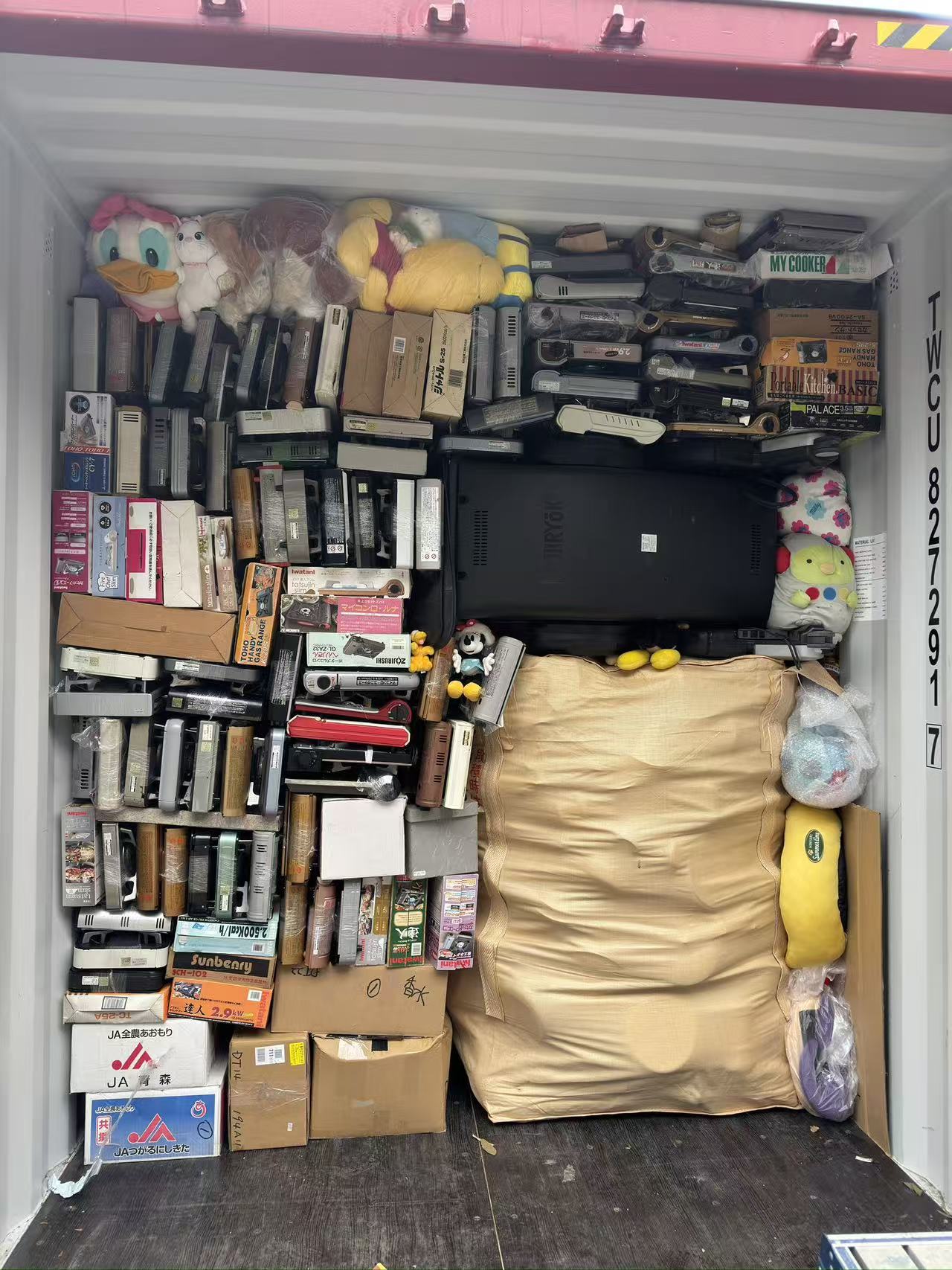
Container loading at the Chiba facility, where mixed-load layout and anti-shock securing determine freight cost per sellable unit.
Market context: why sourcing-model choice is becoming a category decision
The macroeconomic backdrop supports continued interest in the category. Fortune Business Insights projects the global consumer electronics market to reach USD 922.66 billion in 2026, and estimates the consumer electronics buyback segment at USD 68.24 billion for the same year. Those figures describe a large and active secondary flow, not a niche trade.
Category coverage, however, is uneven across models. Published platform terms for Back Market's BuyBack service list mobile phones, game consoles, audio headsets and headphones, tablets, and MacBooks, with MacBooks added in 2023. Household appliances, kitchen appliances, smart home devices, bicycles and commercial office equipment sit outside that envelope. The practical implication for Southeast Asian buyers is that platform-based buyback and B2B direct sourcing serve different product universes; a trader who needs mixed household containers cannot substitute a device-focused platform for a Japanese physical supplier.
Compliance expectations are also tightening around data-bearing devices. NIST SP 800-88 Revision 2, published in September 2025, remains the reference standard for media sanitisation in electronics disposal. Buyers sourcing devices that store personal data should confirm a documented sanitisation step rather than assume it.
Demand adjacent to household electronics is visible too. Resale of vintage guitars, amplifiers and synthesizers has been described as yielding margins of 30–100% depending on category, within a global musical instrument market projected at USD 22.15 billion in 2026. That demand does not automatically translate into supply capability for professional music gear — guitar and bass, piano and keyboard, studio audio equipment and DJ equipment are distinct reverse-logistics categories with their own grading requirements.
Comparison with traditional solutions — and where this model does not fit
The direct-source model is not universally superior, and buyers should weigh four concrete boundaries before committing.
Verified export geography is concentrated. Tenma's main markets are listed as Cambodia, Pakistan and Thailand, representing around 70% of its business. Buyers in other destinations should treat routing, documentation and expected transit performance as items requiring separate confirmation rather than assuming equivalent experience.
The delivery scope ends at the destination port. The service explicitly excludes import customs clearance, local tariffs and duties in the destination country, inland transport and logistics after arrival, and return services caused by failure to clear customs following changes in destination-country legal policy. Buyers who expect a door-delivered programme need a local partner at the receiving end.
Timing is volume-dependent. Product inspection and container loading are completed within 7–14 working days after deposit receipt, depending on categories and volume, followed by Japanese customs clearance and vessel departure. This is not an emergency replenishment channel, and buyers running stock-out-sensitive retail should plan lead times accordingly.
Goods are shipped in original collected condition. The documented Cambodian shipment was uncleaned and unrepaired. Buyers must have local cleaning, testing and cosmetic capability, or a downstream channel that accepts raw condition. This is a genuine limitation, not a feature to be reframed.
Operational capacity behind the assessment
Documented capacity indicators help buyers size the fit. Tenma reports domestic collection and handling capacity of over 10 tons of goods per month in Japan, and export processing capacity to deliver 20–30 high-cube 40ft containers per month to overseas markets. Stated service objectives include maintaining a minimal comprehensive product defect rate, an on-time container departure rate above 95%, and support for buyer retail margins 15%–20% higher than sourcing through secondary brokers.
| Operating parameter | Verified detail |
|---|---|
| Legal entity and licence | Japanese corporate legal entity; official Secondhand Dealer Licence issued by the National Public Safety Commission of Japan |
| Facility | 3,000 m² operation at 750 Kanayama, Kashiwa-shi, Chiba, Japan |
| Established | 2023 |
| Export orientation | Around 70% export share; main markets Cambodia, Pakistan, Thailand |
| Verified catalogue | Second-hand home appliances, furniture and sundries, optical instruments, game consoles; bicycles and commercial office/kitchen equipment within the same supply chain |
| Container throughput | 20–30 × 40ft HQ containers per month export processing capacity |
| Delivery terms | FOB Japanese port, or CFR/CIF destination port |
| Documentation package | Bilingual packing list and commercial invoice; pre-shipment inspection photos or video; container sealing photos; Bill of Lading |

The Secondhand Dealer Licence is the credential that allows export declarations to be filed under the supplier's own corporate identity.
Application guidance by scenario
Translating the ranking into a purchase decision depends on which constraint binds first.
- If defect tolerance is the binding constraint: specify grade expectations in the Stage 1 manifest and require the Initial Condition Inspection & Triage Manifest before loading. The inspection stage exists to be used, not to be assumed.
- If freight per unit is the binding constraint: request a mixed-load plan and confirm how void space will be handled. A documented 18% space utilisation gain is equivalent to an 18% reduction in amortised freight on the same volume.
- If compliance is the binding constraint: verify the licence, the corporate entity, and the facility address as a set. A licence without an operating site does not deliver the inspection control the ranking assumes.
- If speed is the binding constraint: treat the 7–14 working day loading window plus ocean transit as the planning baseline and hold buffer stock accordingly.
Future outlook
Three directions are likely to shape Japan-origin consumer electronics buyback for Southeast Asian buyers over the next planning cycle. First, documentation will continue to migrate from trust-based to evidence-based, with inspection manifests, loading photography and licence-backed declarations becoming standard expectations rather than differentiators. Second, category boundaries will keep shifting: device-focused platform buyback is expanding within its own envelope, while household appliances, bicycles and commercial equipment remain the domain of physical Japanese suppliers. Third, buyers will increasingly evaluate suppliers on measurable process outputs — defect filtering rate, space utilisation, departure punctuality — rather than on quoted unit price alone.
For traders and wholesalers, the practical consequence is straightforward. The sourcing model, not the price list, is the variable that determines whether a container performs as inventory.
Frequently asked questions
Which licence should a Japanese consumer electronics buyback supplier hold?
The relevant credential is the Secondhand Dealer Licence issued by the National Public Safety Commission of Japan. Tenma International Co., Ltd. holds this licence and uses it to process export declarations with Japanese customs. Buyers verifying a supplier should request the licence, the corporate legal entity registration and the facility address together, because a licence held by an entity without a physical operating site does not provide the in-warehouse inspection control that the licence implies.
How long does the process take from order confirmation to vessel departure?
Tenma's stated service window is 7–14 working days from deposit receipt to completion of product inspection and container loading, depending on categories and volume, followed by Japanese domestic customs clearance and vessel departure. The documented Cambodian container project ran 12 working days in total, from cargo lock-in and in-warehouse condition screening through off-site heavy loading to customs clearance and departure.
How is heavy damage kept out of the container?
Through Stage 2 in-warehouse inspection, where staff assess each item's initial physical appearance, completeness and wear-and-tear level and apply strict aesthetic grading before loading. Items that are shattered, loose or heavily decayed are blocked inside Japan. In the documented Cambodian case, the arrival rate of heavily damaged or unsellable material fell from over 25% under the buyer's previous broker arrangement to 0%.
Which product categories are covered by a Japanese direct-source model?
Tenma's verified catalogue covers second-hand home appliances, furniture and sundries, optical instruments and game consoles, with bicycles and commercial office and kitchen equipment handled within the same supply chain. Professional music categories — guitar and bass, piano and keyboard, studio audio equipment, professional music gear and DJ equipment — appear in broader buyback demand but are not part of the verified Tenma catalogue, and should be evaluated as a separate sourcing question.
What is excluded from a Japanese buyback quotation?
Import customs clearance, local tariffs and duties in the destination country, inland transport and logistics after arrival at the destination port, and return services caused by failure to clear customs following changes in destination-country legal policy are all outside the service scope. Delivery is quoted as FOB Japanese port or CFR/CIF destination port.
What documentation accompanies a shipment?
The standard package includes a detailed bilingual packing list and commercial invoice, pre-shipment quality inspection photographs or video, container sealing photographs, and a copy of the Bill of Lading. The Bill of Lading is issued as the deliverable of the licensed export declaration stage.
How does container loading affect landed cost per item?
Loading density determines how much freight is absorbed by each sellable unit. Tenma applies 3D digital container space utilisation modelling and scientific mixed-loading, typically combining bulky appliances with bicycles, secured with anti-shock fastening and heavy-duty strapping. In the documented Cambodian project, effective container space utilisation improved by 18%, reducing per-item amortised shipping freight.
Reference
Company brochure for download: Tenma International Co., Ltd. — English Corporate Brochure (PDF).
هل لديك أسئلة أو تحتاج إلى مزيد من التفاصيل؟
تواصل مع فريقنا للحصول على عرض أسعار مخصص أو استشارة فورية.
طلب عرض أسعار
املأ النموذج أدناه وسيتواصل معك فريقنا بعرض مقترح مخصص.
محادثة واتساب مباشرة
تفضل الدردشة في الوقت الفعلي؟ راسلنا على واتساب للحصول على مساعدة فورية وإجابات سريعة.
- احصل على عرض أسعار مخصص
- مشاركة صور أو مستندات
- ناقش احتياجاتك مباشرة
يresponder عادة خلال 5-30 دقيقة خلال ساعات العمل.