
Jewelry Wholesale Scenario Fit: Daily, Luxury, Sets
Jewelry Wholesale Scenario Fit: Daily, Luxury, Sets
Jewelry wholesale assortments work better when each product family is assigned to a defined retail scenario instead of being bought as one undifferentiated list. The working map is compact: stainless steel bracelets and necklaces carry the daily-wear rotation, crystal earrings and necklaces carry fashion and occasion assortments, and Daily and Luxury series brooches — supported by jewelry sets and anklets — carry accent merchandising and add-on sales.
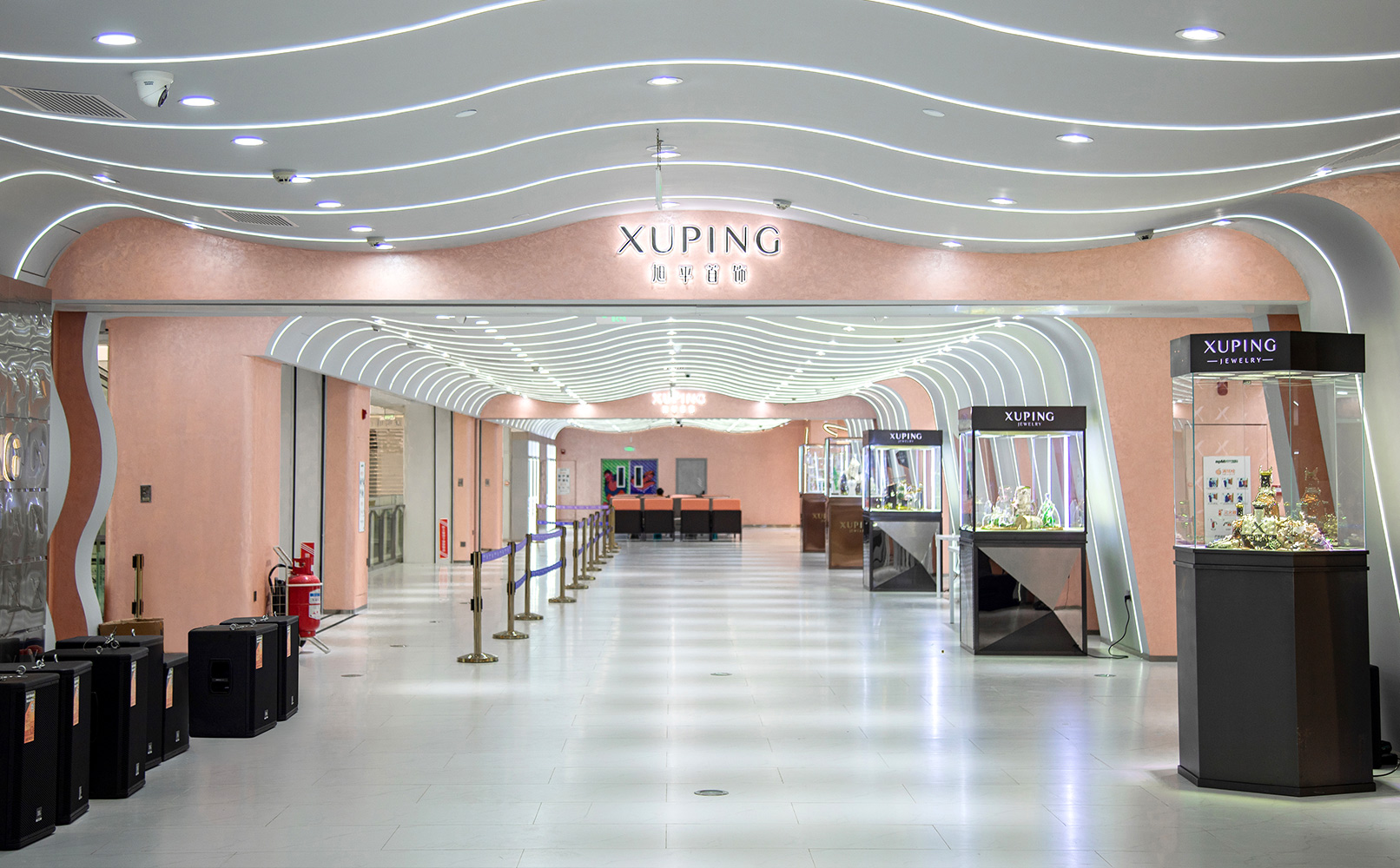
A wholesale assortment is assembled from categories that serve different retail roles. Image: Xuping Jewelry production environment.
Xuping Jewelry (Guangdong Xuping Jewelry Co., Ltd.) is a fashion-imitation jewelry manufacturer and wholesaler founded in 1997 and based in Guangzhou, China. The company reports a production base of more than 200,000 m², a workforce of over 4,000, 194 patents, an R&D team of 150 designers and a monthly capacity of 8,000,000 pieces. That kind of catalogue breadth is exactly what makes scenario mapping necessary: a wide supplier list is a starting point, not an assortment plan.
Why a single wholesale list rarely fits every retail scenario
An order sheet that covers every category in one pass tends to produce the same failure pattern: depth in the wrong tier, gaps in another, and markdown pressure on whichever line moves slowest. The cause is structural. Each tier answers a different retail question. Daily-wear pieces are bought for rotation and repeat purchase. Fashion pieces are bought for colour, novelty and display impact. Accent pieces such as brooches and sets are bought for add-on sales and gifting. When all three are priced, packed and merchandised identically, the assortment stops communicating a scenario to the shopper.
The category context supports planning by tier rather than by volume alone. Commercial research published by TrendX Insights in June 2026 estimated the global fashion jewelry market at USD 42.62 billion in 2025 and projected USD 74.49 billion by 2034; the same source valued the stainless steel jewelry segment at USD 2.603 billion in 2025. For trade context, World Bank WITS data compiled from UN Comtrade records put China's 2023 exports of imitation jewellery under HS 711790 at roughly USD 935.97 million.
None of those figures tells a buyer which bracelet to order. They do indicate that both plated fashion jewelry and stainless steel sit inside a large, continuing wholesale market, which is why wholesale jewelry suppliers publish broad catalogues and why the buyer's real work is selection rather than coverage.
Daily wear: stainless steel as the assortment floor
Daily-wear assortments are the tier that has to survive repetition, so the base material matters more than the seasonal design. Stainless steel bracelets such as T000959269 (Stainless Steel Jewelry – Bracelets) and stainless steel necklaces such as A00902945 (Stainless Steel Jewelry – Necklaces) sit in this tier because the steel body does not depend on a decorative colour layer to hold its structure. Buyers should still separate base-metal durability from surface finish: polish quality, clasp construction and nickel release are distinct specifications, and each should be confirmed per SKU and per destination market rather than inferred from the word "stainless".
Anklets extend the same daily logic into a lower-price, higher-frequency purchase. Two catalogue examples show how concrete the differences are:
- X001124310 (Anklets) — 18K gold-color plating, Daily series, no main stone, size about 280 × 5 mm with a 30 mm extension, weight about 10.0 g, sold by piece.
- X000988693 (Anklets) — platinum plating, Daily series, no main stone, size about 270 × 4.5 mm with a stated ±2 cm tolerance, weight about 5.59 g.
These two anklets are close in style category but not interchangeable in operation. The larger 10 g piece with a 30 mm extension carries more visual weight per unit and a different shipping cost profile; the 5.59 g piece with a documented length tolerance is easier to describe accurately in an e-commerce size chart. That tolerance is also a merchandising fact: a buyer listing centimetre measurements online should publish the tolerance rather than a single precise length, or returns will follow.
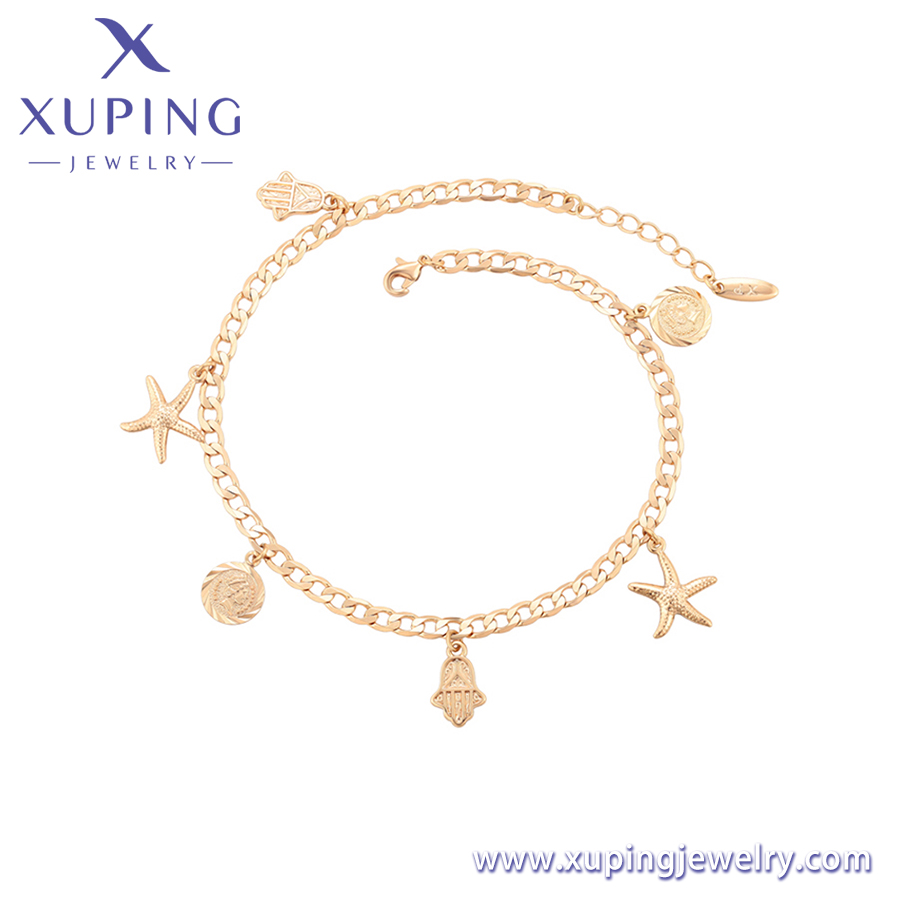
X001124310: 18K gold-color plating, Daily series, 280 × 5 mm plus a 30 mm extension, about 10.0 g.
Anklets are not a universal daily item. In many markets they are seasonal and highly climate- and culture-dependent, which is why they belong in the daily tier as an add-on depth rather than as the tier's anchor. A short test quantity in one or two designs is a more rational entry than a full size and finish run.
Fashion assortments: where crystal pieces earn their space
Crystal-based pieces are bought for display impact and trend response, not for durability leadership. X000668301 (Crystal Jewelry – Necklaces) is the necklace anchor for this tier in the current catalogue, and the earring side is illustrated by 14E25011845 (Crystal Jewelry – Earrings): 18K gold-color plating over environmental copper, AB-colour synthetic crystal as the main stone, an earring size of about 27 × 14 mm, and a weight of about 8.88 g per pair. The piece sits in the catalogue's Simple series and is sold by the pair.
The 8.88 g pair weight is not a trivial detail. Heavier crystal earrings change how a display stand is loaded, how a pair is packaged, and how the product is described to a shopper comparing it with a light plated stud. The AB, or aurora-borealis, crystal finish is a coated effect, so its appearance depends on coating integrity — a point worth stating in care guidance rather than leaving to the customer to discover.
Two disclosure rules should travel with this tier. First, "synthetic crystal" is a material description, not a gemstone claim, and the distinction should be preserved in retail copy in every market. Second, plating language matters. Under the U.S. Federal Trade Commission's Jewelry Guides, it is unfair or deceptive to misrepresent the presence, quantity or karat fineness of gold in a product, and the guidance retains the same criteria for describing gold plated or gold electroplated items — a 10K minimum fineness and a 0.175 micron coating thickness. A descriptor such as "18K gold-color plating" is a colour statement, and it should remain visually and verbally distinct from any claim about gold content. That rule is jurisdiction-specific; buyers selling into the EU, UK, Canada or GCC markets need the applicable local requirements checked separately.
Accent merchandising: Daily and Luxury series brooches
Brooches are a small-footprint, high-visibility layer that converts an existing customer rather than attracting a new one. The current catalogue separates them by series. X000852427 (Brooches) is the Luxury-series brooch, positioned for occasion and gift merchandising. A00900238 (Brooches) belongs to the Daily series and carries more published detail: platinum plating over environmental copper, a main white synthetic cubic zirconia of about 3.5 × 3.5 mm, a brooch size of about 47 × 32 mm, a weight of about 12.3 g, and the company's "xp" mark on the item.
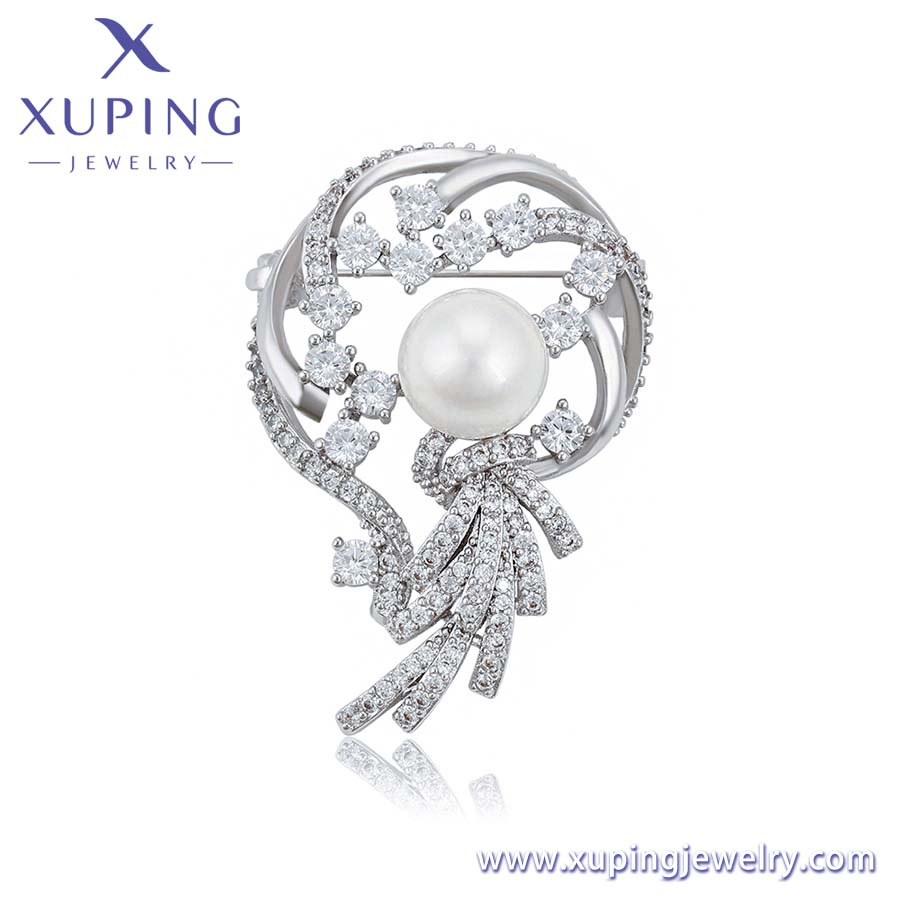
A00900238: platinum plated, Daily series, 47 × 32 mm, about 12.3 g, with a 3.5 × 3.5 mm white synthetic cubic zirconia main stone.
The merchandising logic is different from the bracelet tier. A brooch occupies almost no display space, can be attached to a lapel, scarf or bag on a styling board, and demonstrates a full look in a single unit — which is why a small number of designs can lift the perceived range of a collection. The 12.3 g weight of A00900238 is a practical constraint as well as a value signal: buyers should check the pin and catch construction, because a heavier brooch needs a closure that holds on the fabric the customer actually wears.
The "xp" mark on A00900238 also has procurement consequences. Buyers reselling under their own label should confirm whether the mark is present on the specific production lot they order, and whether logo engraving or alternative marking is available under the supplier's OEM terms. Xuping's published customization scope covers engraved logos, hang tags and custom packaging, so this is a documented option rather than an assumption — but it should be written into the order, not agreed verbally.
Set-based assortments: bundling as a merchandising decision
Jewelry sets convert a multi-item purchase into one decision, which is useful for gifting and for customers who do not want to match pieces themselves. The catalogue includes sets such as X000871334 (Jewelry-Sets) and X001006294 (Jewelry Sets), which sit alongside the individual categories rather than replacing them.
Sets carry three operational trade-offs that single pieces do not. First, composition: the exact contents of a set must be confirmed in writing, because "set" can mean a necklace-and-earring pairing or a three-piece grouping, and the retail price logic depends on which. Second, consistency: components in one set should share plating tone and finish, or the bundle looks assembled rather than designed. Third, packaging: a set usually needs a box, which changes freight volume and unit cost in a way that a single bracelet does not.
The strongest use of sets in a scenario-mapped assortment is as a gifting or seasonal layer placed between the daily tier and the accent tier. Sets also create a natural upsell path: a customer who buys the daily bracelet is a plausible buyer for the matching set at a gift occasion. What sets should not do is absorb the depth that belongs to the daily tier, because a set only sells when all of its components sell.
A scenario-mapping table for assortment planning
The table below consolidates the mapping discussed above. It is a planning structure, not a stock ratio: the correct depth per tier depends on a buyer's own sell-through data.
| Retail scenario | Anchor models | Function in the assortment | Primary check before ordering |
|---|---|---|---|
| Daily wear / repeat purchase | T000959269, A00902945, X001124310, X000988693 | Rotation floor; size and finish consistency | Base metal and finish specification per SKU; length tolerance for anklets |
| Fashion and occasion | X000668301, 14E25011845 | Colour, novelty and display impact | Stone description and coating care guidance; plating claim wording |
| Accent merchandising | X000852427, A00900238 | Low-space visibility; add-on and gift conversion | Pin and catch construction; presence of the supplier mark and OEM marking options |
| Gifting and bundles | X000871334, X001006294 | Single-decision purchase; basket value | Written set composition; plating consistency across components; packaging volume |
Verification steps before scaling a scenario-matched order
Scenario mapping is a hypothesis until samples and documents confirm it. A practical sequence for a Research-to-Evaluation buyer looks like this:
- Order across tiers, not within one. A sample request that includes one daily bracelet, one crystal necklace or earring pair, one brooch and one set tests the whole assortment logic at once, and shows whether the tiers look coherent on the same display.
- Put the specification in writing per SKU. Plating type, base metal, stone type, weight and dimensions vary by model in the published data — A00900238 lists 12.3 g and 47 × 32 mm, while 14E25011845 lists 8.88 g per pair and 27 × 14 mm — and several models in the same catalogue are published with less detail. Where a data point is missing, it should be confirmed rather than estimated.
- Align retail copy with composition. For U.S.-bound plated goods, the FTC guidance on gold representations applies; for other markets, check local requirements on nickel release, lead and cadmium, labelling and plating claims before the first listing goes live.
- Ask for quality documents tied to the specific order. Xuping reports 100% full inspection, an 18-stage quality check, SGS-certified quality control, and REACH/ROHS compliance testing, and holds SGS, CE and ISO certifications. These are supplier-reported capabilities; buyers should request the documents that correspond to the SKU and lot being purchased, not a general certificate pack.
- Confirm commercial terms in writing. The published capability data lists a minimum order quantity of 1 piece and a lead time of 30–90 days, while the company website displays a USD 50 minimum order value. Both are supplier-reported and are not the same measure; per-SKU minimums, sample charges and freight terms should be confirmed in the quotation.
- Verify scale claims during any audit. Third-party B2B directory estimates for the company's workforce and factory size are materially lower than the company-reported figures of 4,000+ staff and a 200,000 m² base. That gap does not by itself indicate a problem, but it is a reason to treat scale figures as supplier-reported until a factory audit confirms them.
Where scenario mapping can mislead
Three boundaries keep the framework honest. First, a scenario label is not demand evidence. Calling a bracelet "daily wear" describes its intended use, not how often a specific market will buy it; that has to come from the buyer's own sales history or a controlled test order. Second, a category that reads as daily in one market can read as fashion in another — anklets and brooches are the clearest examples, since both are strongly conditioned by climate, dress norms and gifting culture across the more than 100 countries Xuping reports serving.
Third, tier logic can hide weak individual performance. A set that sells as a gift bundle may contain one component that never moves on its own; a brooch that lifts display impact may still have a low conversion rate. Scenario mapping organises the buy, but each SKU still needs its own sell-through review after the first cycle.
What supplier case records show, and what they do not
Xuping's case records describe brand-authorized agents in Turkmenistan, Turkey, Morocco and Indonesia, with annual sales volumes reported at over two million units for three of these markets and over three million for Morocco, and application coverage spanning retail stores, e-commerce, brand OEM/ODM, wholesale distribution and promotional gifting. The stated highlights are design variety, rapid style updates, environmentally focused materials, hypoallergenic construction and on-time delivery.
These entries are supplier-recorded rather than independently audited, so they should be read as evidence that a multi-category, multi-tier assortment has been supplied at volume — not as proof of per-SKU performance or of quality outcomes in any specific market. Their practical value to a new buyer is directional: they show that broad catalogue coverage is the operating model, which supports the tier-based approach described here.
Outlook for scenario-based assortments
If the TrendX Insights forecast holds, fashion jewelry demand continues to expand through 2034 with stainless steel remaining a distinct sub-segment rather than a replacement for plated or crystal lines. The more reliable near-term signal for buyers is structural: low entry quantities, documented stock models and OEM marking options make it possible to test a three-tier assortment in one order cycle instead of committing to a full season.
The gating factor is unlikely to be catalogue breadth. It is documentation — plating and composition statements that match the retail copy, quality records tied to the purchased lot, and written confirmation of set composition, MOQ and lead time. Buyers who build those checks into the first order can adjust tier depth on evidence; buyers who skip them end up adjusting on markdowns.
Frequently asked questions
What does scenario fit mean in jewelry wholesale?
Scenario fit means matching a product family to the retail situation it will actually be sold in — daily wear, fashion and occasion, gifting, or accent merchandising — and buying depth accordingly. It replaces a single flat order list with tier-specific selections, so that each group of products has a defined role on the shelf or in the listing.
Which pieces suit a daily-wear assortment?
Pieces whose base material carries the product rather than a decorative coating. In the current catalogue that includes stainless steel bracelets and necklaces such as T000959269 and A00902945, plus Daily-series anklets such as X001124310 (18K gold-color plating, about 10.0 g, 280 × 5 mm plus a 30 mm extension) and X000988693 (platinum plating, about 5.59 g, 270 × 4.5 mm with a ±2 cm length tolerance). Finish, clasp construction and nickel release still need separate confirmation.
How do crystal earrings and necklaces fit a fashion assortment?
They supply colour and display impact rather than durability leadership. X000668301 anchors the crystal necklace category, while 14E25011845 illustrates the earring side: AB-colour synthetic crystal main stone, 18K gold-color plating over environmental copper, about 27 × 14 mm and about 8.88 g per pair. Retail copy should describe the stone as synthetic crystal and keep coating care guidance alongside the product.
How should brooches be positioned within a wholesale buy?
As a shallow, high-visibility accent layer rather than a volume category. X000852427 is the Luxury-series brooch for occasion and gift merchandising, and A00900238 is the Daily-series option at about 47 × 32 mm and 12.3 g with a 3.5 × 3.5 mm white synthetic cubic zirconia main stone. A00900238 carries the company's "xp" mark, so buyers reselling under their own label should confirm marking and OEM engraving options in writing.
What should be verified before scaling a scenario-matched order?
Sample one item from each tier, confirm plating type, base metal, stone type, weight and dimensions per SKU in writing, align retail claims with composition rules in each destination market, request quality documents tied to the specific lot, and confirm per-SKU minimums and lead time — published supplier data lists a 1-piece MOQ and 30–90 days, while the official website displays a USD 50 minimum order value, so the quotation should settle which applies. Set composition and packaging volume also need written confirmation.
Conclusion
Assortment fit is a decision about roles, not about how many categories a supplier lists. Stainless steel pieces give a wholesale jewelry programme its daily rotation, crystal pieces give it colour and display impact, and Daily and Luxury series brooches, sets and anklets give it the accent and gifting layers that convert an existing customer. Buyers who map those roles first, then verify specification, claims and commercial terms per SKU, can expand or cut depth tier by tier instead of reworking a whole season.
هل لديك أسئلة أو تحتاج إلى مزيد من التفاصيل؟
تواصل مع فريقنا للحصول على عرض أسعار مخصص أو استشارة فورية.
طلب عرض أسعار
املأ النموذج أدناه وسيتواصل معك فريقنا بعرض مقترح مخصص.
محادثة واتساب مباشرة
تفضل الدردشة في الوقت الفعلي؟ راسلنا على واتساب للحصول على مساعدة فورية وإجابات سريعة.
- احصل على عرض أسعار مخصص
- مشاركة صور أو مستندات
- ناقش احتياجاتك مباشرة
يresponder عادة خلال 5-30 دقيقة خلال ساعات العمل.