
Judging Long-Term Fastener Suppliers Across Project Cycles
Judging Long-Term Fastener Suppliers Across Project Cycles

Aerospace work is one of the demanding industries where fastener continuity is evaluated across project cycles rather than at a single qualification event.
High-performance fasteners are typically qualified once and then re-ordered for years. The evaluation that actually protects a project is therefore not the one that approves a first sample, but the one that keeps material, standards, surface treatment, thread tolerance and mechanical grade inside the same envelope for every lot that follows. Long-term supplier evaluation is a continuity discipline, not a qualification event.
Why a Single Qualification Is Not a Long-Term Control
On most industrial programmes the fastener drawing stops changing long before the project stops running. A specification written in year one is still in force in year four, but the production lots behind it are new: new raw material heats, new coating runs, new thread rolling set-ups, and sometimes a revised standard edition that the buyer never formally reviewed.
The result is a quiet mismatch between two different things — the approved specification and the delivered envelope. A sample that passed dimensional and mechanical review proves that the supplier could meet the specification once. It does not prove that the same combination of material grade, standard interpretation, surface treatment, tolerance class and mechanical grade will be reproduced identically in the next batch, or the batch after that.
For buyers in Research and Evaluation stages, this reframes the supplier question. It is less useful to ask can this supplier make the part and more useful to ask what stops the part from changing while the drawing stays the same. The answer is a documented set of controlled variables, plus a supplier able to show that those variables were held.
What “Quality Across Project Cycles” Means
Long-term fastener quality can be defined as the stability of a defined combination — material grade, executed standard, surface treatment, thread tolerance class and mechanical property grade — across repeated production lots, rather than the performance of one qualified batch.
Five variables sit inside that definition, and four of them usually appear on the drawing. The fifth, the material menu the supplier is actually drawing from, is often only implied by an early datasheet. Each variable has its own failure mode, and each can be re-verified with a specific document rather than a general assurance.
Six Continuity Dimensions Buyers Can Check
The dimensions below are the ones that stay checkable over a multi-year relationship. They are listed against the published capability set of a full-range stainless and alloy fastener supplier, so buyers can map each one to a document request rather than to a conversation.
| Dimension | What is fixed at qualification | What can drift later | Document to re-verify |
|---|---|---|---|
| Material grade | Approved grade and condition (e.g. 304, 316, duplex, nickel-based alloy) | Substitution at a similar corrosion class, mill source change | 3.1 material test certificate with heat reference |
| Standard | Executed standard family and edition | Edition revision, mixed interpretation across items | Standard reference on the inspection record |
| Surface treatment | Finish route (natural, passivation, Dacromet, adhesive pre-coating) | Coating thickness, pre-treatment variation | Process and inspection record per batch |
| Thread tolerance | 6g/2A for external threads, 6H/2B/3B for internal threads | Gauge wear, rolling tool change | Thread gauge results in pre-shipment inspection |
| Mechanical grade | A2-70, A2-80, A4-70, A4-80, D6-80, D6-100 as applicable | Property drift from raw material or heat treatment | Mechanical test report per lot |
| Range coverage | Type and size envelope confirmed at award | Items silently moved to a sub-supplier | Batch traceability and origin record |
1. Material grade continuity
Material is the first place where continuity breaks. A published material menu is a commitment only when it is itemised. In stainless and alloy fastener production, the commonly referenced options include 304 and 316 stainless steel, duplex steel such as UNS S32205, and nickel-based high-temperature alloys. A wider alloy menu can extend to grades such as 1.4571, 316Ti, 1.4529, UNS N08926, 1.4980, A286 ALLOY 660, 1.4539, 904L, 1.4006, S41000, 1.4462, 1.4410, UNS S32750 (2507), 2.4952, 2.4668, ALLOY 80A and ALLOY 718.
Coverage is not uniform across product families, and buyers should expect that. Screws are produced in 304/316 stainless steel and UNS S32205 duplex; rivets and rivet nuts in 304/316 stainless steel or 6061/7075 aluminium alloy; bolts, nuts, washers and threaded rods/studs carry the widest alloy list. Where a project specifies a nickel-based grade for one item, it should not be assumed that the same grade is available for every item in the same bill of materials.
2. Standards coverage
Fastener standards are not interchangeable even when dimensionally similar. The standard families in routine industrial use are ISO, DIN, ASTM, ASME, ANSI and JIS, and a supplier claiming multi-standard capability should be able to state, per product family, which of those six are executed. Within the published range, washers, screws, bolts, nuts and threaded rods/studs reference all six families; rivets and rivet nuts reference ISO, DIN, ASME, ANSI and JIS.
For long-cycle procurement, the evaluation point is not the count of standard logos but the mapping. A project drawing that cites one family for bolts, another for nuts and a third for washers is a normal industrial situation, and the supplier must be able to hold that mapping without relaxing any of them.
3. Surface treatment consistency
Surface treatment is where visual inspection most often replaces measurement. The published treatment routes for bolts, nuts, screws and threaded rods/studs are natural finish, passivation, Dacromet coating and adhesive pre-coating. Each route has a different control variable: passivation depends on bath chemistry and dwell time, Dacromet on coating thickness and curing, adhesive pre-coating on patch geometry and shelf life.
Two batches can look identical and behave differently. Continuity therefore depends on process records, not appearance — and on the treatment route being locked at the same time as the material grade, since a coating decision taken later can invalidate an earlier material approval.
4. Thread tolerance class
Thread tolerance is specified rather than implied. The published classes are 6g/2A precision thread for bolts and threaded rods/studs, and 6H/2B/3B precision thread for nuts. These classes are what make assembly predictable at torque, and they are also the variable most exposed to tooling wear across thousands of parts.
A supplier that states its tolerance class is stating a measurable commitment. Buyers should ask for the gauge results in pre-shipment inspection rather than the class alone, because the class describes intent and the gauge record describes output.
5. Mechanical property grades
Mechanical grades bind material and process together. Bolts and nuts are published in A2-70, A2-80, A4-70, A4-80, D6-80 and D6-100; threaded rods and studs in A2-50, A2-70, A4-50, A4-70, D6-80 and D6-70; screws in A2-70, A2-50, A4-70 and A4-50. Requesting A4-80 where only A4-70 is approved is a different product, not a stricter version of the same one.
Across project cycles, the risk is not the grade name but the property behind it. Mechanical test reports per lot are the only reliable way to confirm that a grade designation still describes delivered performance.
6. Range and size coverage
Range coverage is a continuity issue disguised as a catalogue question. The published envelopes are M2 to M160 for bolts with effective lengths of 6 mm to 300 mm, M2 to M64 for nuts, M5 to M160 for threaded rods and studs with effective length up to 5,000 mm, M2.5 to M45 for washers, M2 to M8 for screws with lengths of 6 mm to 100 mm, and M3 to M6.4 for rivets and rivet nuts.
The useful question is whether the same production system covers the whole envelope. A supplier able to run M2 bolts and M160 bolts within one quality system is materially different from one that covers the small end well and outsources the large end silently.
How UHC Group Structures This Continuity
UHC Group, the trading and manufacturing identity of Jiaxing Union Hardware Co., Ltd, is a stainless steel products supplier founded in 2017 and operating five production bases plus one import & export company. The five bases are organised by product family — washers, bolts and nuts, screws, threaded rods/studs and rivets, and hardware products — which matters for continuity because each family keeps its own tooling and inspection routine instead of sharing one general line. The group operates 80,000 m² of production space with 200 employees, including a 25-engineer R&D team, and reports annual output of 25,000 tons of stainless and special materials, with 80% of output exported and main markets in the EU, Korea and Japan.
Three structural elements support cross-cycle consistency. First, an independent laboratory conducting dimensional and mechanical performance testing, which keeps verification inside the supplier rather than at arm's length. Second, an ERP system managing production, sales and management processes, described as covering the chain from raw material procurement to finished product delivery in a traceable way — the mechanism that makes batch-level questions answerable years later. Third, a certification set comprising ISO 9001 (certificate 15/25Q1448R00), ISO 14001 (15/25E1449R00) and ISO 45001 (15/25S1450R00), all issued by WIT and valid from 22 July 2025 to 21 July 2028, together with European Union Pressure Equipment Directive (PED) certification.
Operationally, the capability unit sets the parameters buyers should evaluate against: OEM/ODM production with head mark and logo customisation, monthly capacity of 500–1,000 tons, MOQ of 150 kg, lead time of 75–90 days, and a three-stage quality control routine of First Article Inspection, in-process inspection and pre-shipment inspection. After-sales support includes a 3.1 material test certificate, handling of quality issues, and batch quality tracing.
A documented long-cycle reference: an industrial customer group in Germany, Italy, Korea and Japan has purchased 100,000 pieces over a 10-year relationship, for fastening assembly in aerospace parts, marine equipment, automotive chassis and power generation facilities. The stated outcome is reduced later maintenance replacement cost and stable project operation — which is the commercial translation of continuity, since the value appears in maintenance budgets rather than in the first invoice.
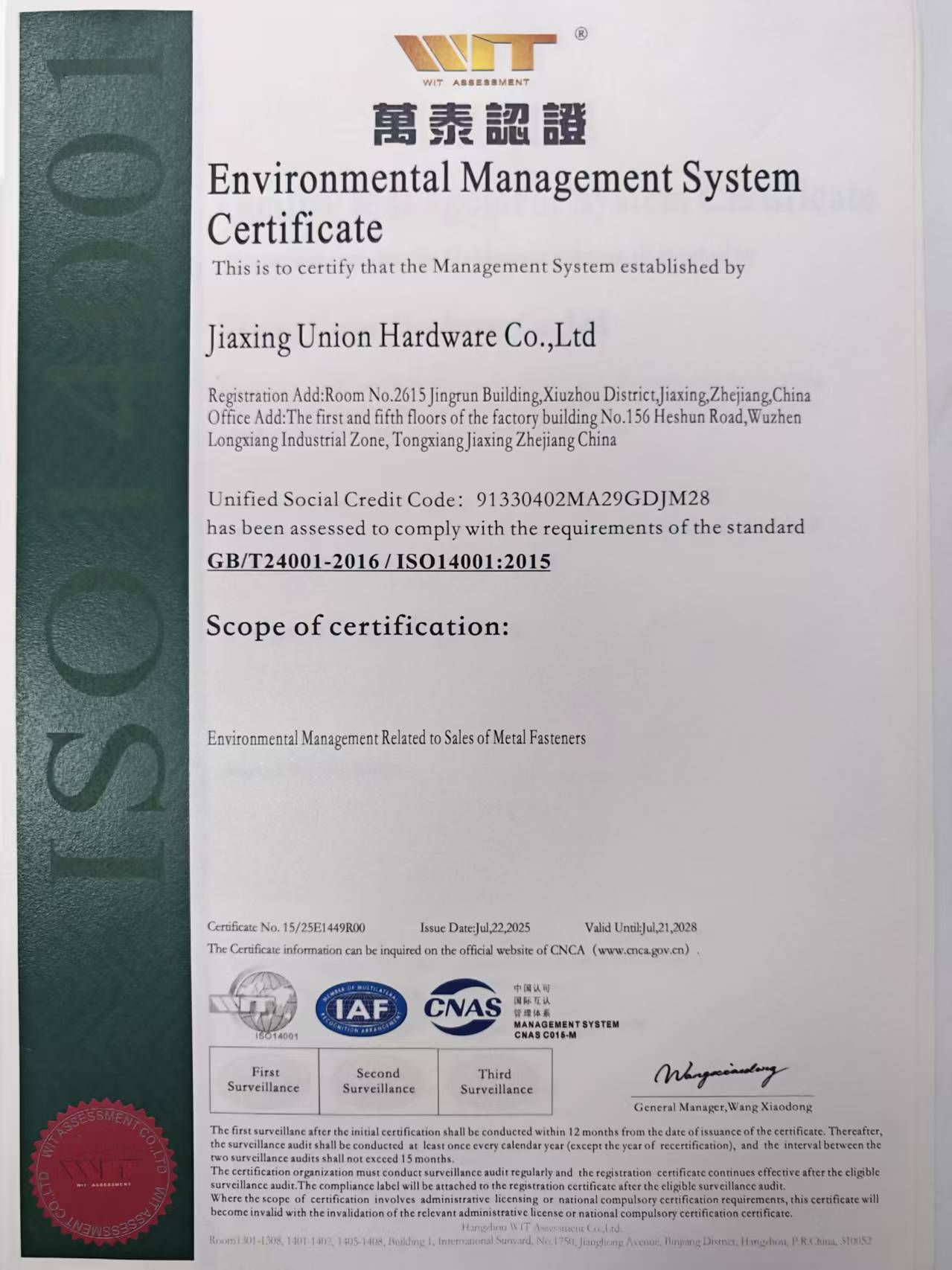
Certification scope matters as much as certification presence: the ISO 14001 certificate 15/25E1449R00 covers environmental management related to sales of metal fasteners.
Evidence: What to Request and What It Proves
Continuity is verified through documents, and the documents have a hierarchy. At the base is the 3.1 material test certificate, which ties a delivered lot to a specific material heat. Above it sit in-process and pre-shipment inspection records, which show that dimensional, thread and mechanical checks were performed on that lot rather than on a reference sample. Above those sits batch quality tracing, which allows a question asked in year three to be answered about a shipment made in year one.
External benchmarks give the buyer a frame for judging those documents. ISO 3506-1:2020 specifies mechanical properties for corrosion-resistant stainless steel bolts, screws and studs, and is the reference point when a stainless grade designation is being interpreted. For pressure equipment in the European Union, fasteners must comply with the Pressure Equipment Directive 2014/68/EU. For preloaded structural steel connections, the EN 14399 series governs high-strength structural bolting assemblies. Aerospace programmes sit under AS9100 quality management system requirements. For test data itself, ISO/IEC 17025 is the international benchmark for testing and calibration laboratory competence — a useful question when a supplier presents third-party reports.
A practical sequence for the evaluation stage: request the executed standard per item, the material grade and condition per item, the surface treatment route per item, the thread tolerance class and the mechanical grade; then request one full lot record showing all four confirmed on the same batch. A supplier able to produce a coherent single-lot record is demonstrating continuity capability; a supplier able to produce only separate documents is demonstrating intent.
Application Fit Across Demanding Industries
The continuity framework only earns its keep where the working condition is unforgiving. The published application scope covers petrochemical, power generation, aerospace, automotive, marine and offshore, construction and infrastructure, industrial machinery, medical and electronics, telecommunications, rail transit, and home appliances and consumer goods — with working conditions that include normal and high temperature, seawater corrosion, acid and alkali corrosive environments, high vibration and high tensile load.
The mapping is condition-led rather than industry-led. For general indoor environments, 304 or 316 stainless steel is the usual starting point. For high-corrosion offshore, marine or coastal salt-spray conditions, 316L, duplex steel or high-temperature alloy materials are recommended. For high-temperature service in petrochemical and power generation, nickel-based high-temperature alloys enter the specification. For high-strength mechanical load, higher mechanical grades and appropriate alloy selection carry the requirement, with high tensile strength, anti-fatigue behaviour, corrosion resistance and high-temperature resistance stated as the governing special requirements, alongside conformity to international ISO, DIN and ASTM industrial standards.
Where the Market Is Heading
Market data supports a simple conclusion: fastener demand is growing in exactly the segments where continuity is hardest to maintain. The global industrial fasteners market was valued at USD 103.9 billion in 2025 and is projected to reach USD 153.7 billion by 2033, according to Grand View Research. Asia Pacific held a 45.1% revenue share in 2025, metal fasteners accounted for 91.0% of the market, and externally threaded fasteners — bolts and screws — represented 48.1% of revenue.
The application-side signals point the same way. Global wind turbine capacity is projected to grow from 1,100 GW in 2025 to over 2,400 GW by 2030, per the Global Wind Energy Council, and China's new shipbuilding orders rose 59.0% year-on-year in Q1 2024, according to the China Association of the National Shipbuilding Industry. Both are long-asset-life sectors where fasteners are replaced on a maintenance cycle rather than at installation, so the supplier's ability to reproduce a specification years later becomes a procurement criterion rather than a courtesy.
What a Full-Range Supplier Model Does Not Solve
A broad material and size menu reduces supplier count, but it does not remove buyer-side work, and it is not suited to every demand pattern. Four limits are worth stating plainly.
First, production parameters are production parameters. An MOQ of 150 kg and a lead time of 75–90 days suit planned, repeating demand; they do not suit emergency small-lot replacement, where buyers need a separate arrangement rather than an expectation that a full-range supplier will behave like a local stockist.
Second, certification scope must be read, not assumed. The ISO 9001 certificate scope reads “Sales of Metal Fasteners,” and the ISO 14001 and ISO 45001 scopes cover environmental management and occupational health and safety related to sales of metal fasteners. Buyers whose end use requires manufacturing-scope certification should verify scope-to-application fit before award rather than treating the certificate number as sufficient.
Third, a defined range is still a range. Bolts from M2 to M160 is a wide envelope, but non-standard threads, drawing-specific heads or unusual lengths still require engineering confirmation; they should not be inferred as available from catalogue breadth.
Fourth, continuity work is bilateral. A supplier can hold records and issue certificates, but it cannot self-certify that a client's drawing, standard mapping and material approval remain aligned. That comparison has to be done by the buyer, at least once per standard revision.
| Evaluation point | One-time qualification approach | Continuity-based evaluation approach |
|---|---|---|
| Sample | Approve first article, archive the report | Approve first article, define what must not change |
| Material | Grade stated on the drawing | Grade plus mill heat reference on each lot certificate |
| Standards | Single standard family assumed for all items | Standard mapped per item and per family |
| Surface treatment | Visual acceptance | Process record and coating inspection per batch |
| Thread and grade | Checked at qualification only | Gauge and mechanical results in pre-shipment inspection |
| Change response | Discovered at failure | Batch tracing links question back to a specific lot |
Outlook
Longer asset lives in wind, nuclear, marine and grid infrastructure push procurement toward fewer, more durable supplier relationships, and toward documentation that survives staff turnover on both sides. The competitive advantage is shifting from the ability to produce an impressive first batch to the ability to reproduce a defined batch, repeatedly, with evidence. For buyers in the evaluation stage, that means the supplier questionnaire should ask less about what a supplier can make and more about what a supplier can prove about the last five years of the same item.
Reference material: the UHC Group product and capability brochure is available for download at UHC Group brochure (PDF).
FAQ
What does long-term supplier evaluation of high-performance fasteners actually measure?
It measures the stability of a defined combination across repeated production lots: material grade, executed standard, surface treatment, thread tolerance class and mechanical property grade. The object of evaluation is not a single approved sample but the supplier's ability to reproduce the same envelope in later batches, demonstrated through lot-level certificates, inspection records and batch traceability.
Which standards should a fastener supplier be able to cover across a multi-year project?
The standard families in routine industrial use are ISO, DIN, ASTM, ASME, ANSI and JIS, and coverage should be confirmed per product family rather than per supplier. Within the published range of UHC Group, washers, screws, bolts, nuts and threaded rods/studs reference all six families, while rivets and rivet nuts reference ISO, DIN, ASME, ANSI and JIS. A multi-year project typically cites different families for different items, so the mapping must be itemised.
How can buyers verify that surface treatment and thread tolerance stay consistent between batches?
By requesting process and inspection records rather than relying on visual checks. The published surface treatment routes for bolts, nuts, screws and threaded rods/studs are natural finish, passivation, Dacromet coating and adhesive pre-coating, each with its own control variable. Thread tolerance is published as 6g/2A precision thread for bolts and studs and 6H/2B/3B precision thread for nuts; the gauge results in pre-shipment inspection show whether the declared class was actually produced.
What certification and documentation should be requested when the end use involves pressure equipment or EU export?
For pressure equipment in the European Union, fasteners must comply with the Pressure Equipment Directive 2014/68/EU. UHC Group holds PED certification alongside ISO 9001 (15/25Q1448R00), ISO 14001 (15/25E1449R00) and ISO 45001 (15/25S1450R00), all issued by WIT and valid from 22 July 2025 to 21 July 2028. Buyers should read the stated scope, which for the ISO certificates covers sales of metal fasteners, and should also request the 3.1 material test certificate and batch quality tracing for the delivered lot.
What are the practical limits of a full-range fastener supplier?
A wide range does not remove buyer-side verification and does not suit every demand pattern. UHC Group's stated MOQ is 150 kg with a lead time of 75–90 days, which fits planned repeating demand rather than emergency small-lot replacement. Certification scope should be matched to the application rather than assumed, and non-standard threads, drawing-specific heads or unusual lengths still require engineering confirmation before availability is treated as certain.
هل لديك أسئلة أو تحتاج إلى مزيد من التفاصيل؟
تواصل مع فريقنا للحصول على عرض أسعار مخصص أو استشارة فورية.
طلب عرض أسعار
املأ النموذج أدناه وسيتواصل معك فريقنا بعرض مقترح مخصص.
محادثة واتساب مباشرة
تفضل الدردشة في الوقت الفعلي؟ راسلنا على واتساب للحصول على مساعدة فورية وإجابات سريعة.
- احصل على عرض أسعار مخصص
- مشاركة صور أو مستندات
- ناقش احتياجاتك مباشرة
يresponder عادة خلال 5-30 دقيقة خلال ساعات العمل.