
K3G310-PV69-03 vs K3G310-PH58-02: Independent Buyer Comparison for In-Row Cooling
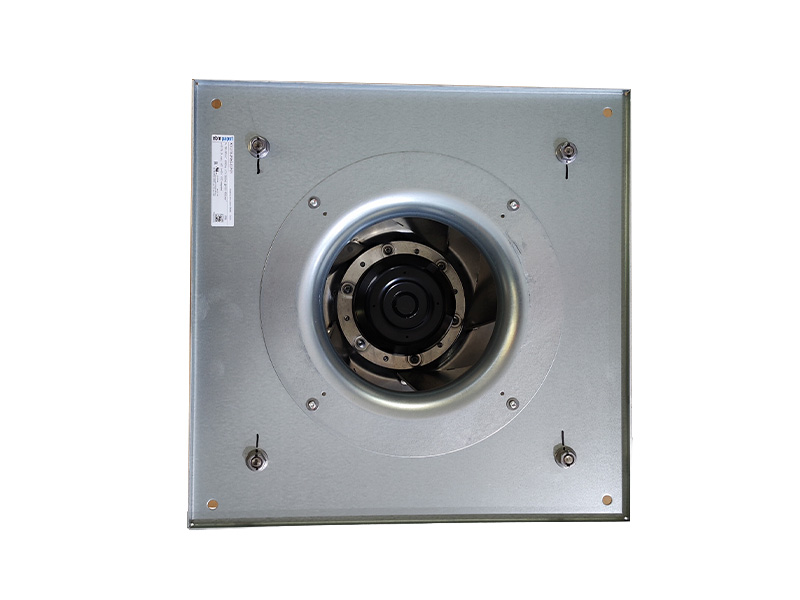
In-row cooling units are compact, serviceable and highly sensitive to pressure loss. A fan that fits the cabinet is not automatically the right fan for the thermal duty. The choice between the K3G310-PV69-03 and the K3G310-PH58-02 is a useful example because both are 310 mm EC centrifugal fans with the same 3~380–480 VAC supply and 4,000 rpm rated speed, yet they declare different operating points, ingress protection and control evidence.
Answer first: neither model is universally superior. The K3G310-PV69-03 is the stronger fit when the buyer needs higher static pressure, IP55 protection and documented Modbus plus 0–10 V control inputs. The K3G310-PH58-02 is the stronger fit when the application needs more airflow at the declared ErP point, IP54 is sufficient, and the available EC speed control evidence matches the unit design. The correct choice depends on the system resistance curve, filter loading, controls architecture and service environment, not on a single headline number.
Why the K3G310 Comparison Matters for In-Row Cooling Buyers
In-row and precision cooling units sit close to the rack. They must move air through filters, coils, tight plenums and compact cabinets without consuming unnecessary space. That makes fan selection a constraint-management exercise: airflow, static pressure, ingress protection, control interface and physical fit all interact.
The K3G310-PV69-03 and K3G310-PH58-02 share the same 310 mm impeller diameter, the same three-phase 380–480 VAC supply range and the same 4,000 rpm rated speed. Those similarities make the comparison practical for buyers who have already fixed the cabinet envelope and voltage architecture. The differences sit in the declared ErP operating point, the IP class and the control evidence.
The K3G310-PV69-03 is listed for in-row air conditioners, precision air conditioners, compact CRAC units and high-resistance filtration systems. Its 310 mm impeller diameter supports installation in compact cabinet and in-row cooling equipment. The K3G310-PH58-02 is listed for in-row cooling, CRAC, rack-level cooling and high static pressure ventilation. Both descriptions point to the same broad application field, but they do not describe identical pressure-duty priorities.
Scope note: this comparison uses published product data for the two models as reviewed in the Hengrui EC Fan content set. It does not assume performance beyond the declared data. Buyers should request the full fan curve, sound data, wiring diagram and complete-unit protection statement before final selection.
Side-by-Side Published Data
| Comparison item | K3G310-PV69-03 | K3G310-PH58-02 |
|---|---|---|
| Product type | EC centrifugal fan for in-row air conditioners and high-static-pressure cabinets | EC centrifugal fan for in-row and precision air conditioners |
| Impeller diameter | 310 mm | 310 mm |
| Supply voltage | 3~380–480 VAC | 3~380–480 VAC |
| Rated power | 3,050 W | 2,950 W |
| Rated current | 4.7 A | 4.6 A |
| Rated speed | 4,000 rpm | 4,000 rpm |
| ErP operating point | 4,020 m³/h at 1,583 Pa | 4,505 m³/h at 1,479 Pa |
| Protection level | IP55 | IP54 |
| Control evidence in reviewed data | Modbus and 0–10 V inputs | EC speed control; TOP thermal protection |
| Impeller material | Aluminum | Aluminum |
| Support plate and inlet ring | Galvanized steel | Galvanized steel |
| Electronics housing | Die-cast aluminum | Die-cast aluminum |
| Declared application focus | In-row AC, precision AC, compact CRAC, high-resistance filtration | In-row cooling, CRAC, rack-level cooling, high static pressure ventilation |
Technical Explanation: Static Pressure, Airflow and the ErP Point
The most important technical difference is not the power rating. It is the balance between airflow and static pressure at the declared ErP operating point. The K3G310-PV69-03 declares 4,020 m³/h at 1,583 Pa. The K3G310-PH58-02 declares 4,505 m³/h at 1,479 Pa. Both are EC centrifugal fans at 310 mm, so the buyer is essentially choosing between a higher-pressure operating point and a higher-airflow operating point.
Static pressure represents the fan's ability to overcome resistance in the air path. In an in-row cooling unit, that resistance can come from filters, coils, dampers, bends, grilles and a compact discharge plenum. When filter loading increases or the coil is dense, the system curve moves upward. A fan with more static pressure head at the required airflow can hold duty better in that condition. The K3G310-PV69-03's 1,583 Pa ErP point is therefore relevant to high-resistance filtration and high-static-pressure cabinet designs.
Airflow represents the volume of air delivered at the stated pressure. The K3G310-PH58-02 declares more airflow at its ErP point, 4,505 m³/h versus 4,020 m³/h, but at a lower static pressure, 1,479 Pa versus 1,583 Pa. That does not make it a lower-performance fan. It means the two fans are characterized at different points on the pressure–airflow map. A unit with lower internal resistance and a higher airflow target may be better served by the PH58-02 operating point.
Rated power and current also differ only slightly. The K3G310-PV69-03 is rated at 3,050 W and 4.7 A. The K3G310-PH58-02 is rated at 2,950 W and 4.6 A. At the same nominal voltage class, those values are close enough that the system designer should not select the fan on power alone. The more meaningful comparison is whether the fan's declared operating point sits near the actual duty point and whether the control and protection features match the unit architecture.
The protection level is another clear differentiator. The K3G310-PV69-03 is IP55. The K3G310-PH58-02 is IP54. In practical procurement terms, IP55 is the higher ingress-protection class. That matters in cabinets that see dust, condensation risk, cleaning routines or outdoor-air influence. IP54 may be adequate in a controlled indoor cabinet, but the buyer should confirm the complete-unit protection strategy, because the fan's IP rating and the enclosure's IP rating are not the same claim.
Control Evidence and Integration Risk
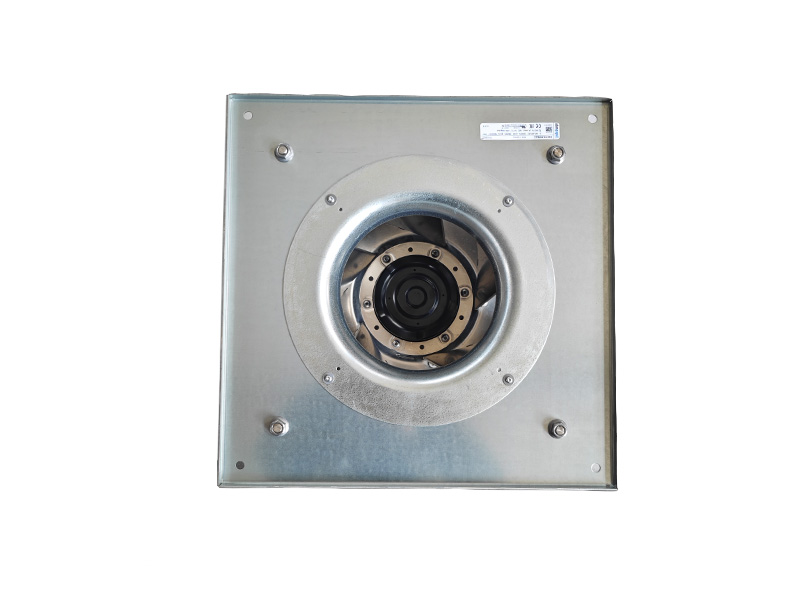
Control evidence is often the deciding factor in modern in-row cooling. The K3G310-PV69-03 has documented Modbus and 0–10 V inputs. That is useful when the unit controller needs a building-automation interface, a remote speed command or a defined analog control path. The K3G310-PH58-02 is described as having EC speed control and TOP thermal protection, but the reviewed data does not specify Modbus or 0–10 V inputs for this model. Buyers should not assume an interface that is not documented.
This is a procurement boundary, not a performance judgment. If the project requires a specific Modbus register map, a 0–10 V analog input or a particular fault-signal arrangement, the control variant must be confirmed before order. The K3G310-PV69-03 has the clearer published control evidence in this comparison. The K3G310-PH58-02 may still be suitable where the unit controller uses the available EC speed-control method, but the interface should be verified against the project specification.
Both models use EC motor technology. Their reviewed materials list aluminum impellers, galvanized steel support plates and inlet rings, and die-cast aluminum electronics housings. Those material facts are useful for service and corrosion review, but they do not replace a site-specific environmental assessment.
Application Fit: Which Model Suits Which In-Row Duty
The K3G310-PV69-03 fits applications where the air path is resistant and the cabinet envelope is tight. The product data lists in-row air conditioners, precision air conditioners, compact CRAC units and high-resistance filtration systems. The 310 mm impeller supports compact cabinet and in-row installation. Its IP55 rating and documented Modbus plus 0–10 V inputs make it easier to specify where washdown, dust or control integration requirements are explicit.
The K3G310-PH58-02 fits applications where higher airflow at the declared ErP point is more important than the extra static pressure head. The product data lists in-row cooling, CRAC, rack-level cooling and high static pressure ventilation. Its 4,505 m³/h at 1,479 Pa operating point can be attractive for units with lower filter resistance or a design airflow target that benefits from more volume. Its IP54 rating and EC speed control with TOP thermal protection suit controlled indoor cabinets where the complete-unit enclosure provides the remaining protection.
- Choose K3G310-PV69-03 when: the system curve is high, filter loading is significant, IP55 is required, and Modbus or 0–10 V control is part of the unit specification.
- Choose K3G310-PH58-02 when: the design airflow target is higher, the system resistance is lower, IP54 is acceptable, and the available EC speed-control arrangement matches the controller.
- Do not choose either on one number alone: compare the fan curve against the calculated system resistance at clean-filter and dirty-filter conditions.
What Hengrui EC Fan Adds to the Procurement Picture
Beijing Hengrui Hongsheng Mechanical & Electrical Equipment Co., Ltd., referred to here as Hengrui EC Fan, is a China-based supplier of EC fans and related ventilation products founded in 2011. Its profile describes fan selection and matching, technical services, and long-term distribution relationships with brands including ebm-papst and Ziehl-Abegg. Both K3G310 models are listed in the Hengrui EC Fan product data reviewed for this comparison.
For buyers, that supplier role matters most in documentation, model continuity and selection support. A distributor that handles EC fans across HVAC, data center and industrial cooling applications can help match a model to an in-row unit, clarify available control variants and confirm supply details. It does not replace the buyer's engineering validation. The K3G310-PV69-03 and K3G310-PH58-02 still need to be checked against the actual cabinet, coil, filter and controller.
Hengrui EC Fan's company profile also states that it serves HVAC ventilation, refrigeration, data centers, new energy, industrial automation, air purification, rail transit and power-electronics cooling applications. That breadth is relevant because in-row cooling buyers often need a supplier who can support adjacent fan positions, spares and model transitions, not just a single SKU.
Market Trend Analysis: Why Documented Operating Points Matter More
The global EC fans market was valued at USD 3.5 billion in 2024 and is projected to reach USD 6.7 billion by 2030, according to a commercial market analysis cited in the verified data set for this article. That growth context does not make either K3G310 model the right choice by itself, but it explains why buyers are seeing more EC fan options and more pressure to compare documented operating points rather than generic claims.
Regulation is another driver. Regulation (EU) 2024/1834 applies from 24 July 2026 to industrial fans from 125 W to 500 kW, setting stricter efficiency thresholds. For in-row cooling buyers, this reinforces the value of an ErP operating point that can be compared directly. It also makes clear why a fan's declared airflow and static pressure at the ErP point should be read together, not as separate headline figures.
Trade data adds a supply-side perspective. China's fan exports under HS 841459 reached 509 million units and USD 3.788 billion in 2024, up 6.96% in value, according to China customs statistics cited by TradeDaas. Public disclosures from major EC fan suppliers also show a softer 2024/25 environment: ebm-papst reported EUR 2.098 billion in 2024/25 sales, a 13.1% decrease, and Ziehl-Abegg reported EUR 893 million in 2024 revenue, down 7%. In that environment, buyers have reason to ask for clearer model-level evidence and fewer unsupported performance claims.
Comparison with Traditional Solutions and Honest Limitations
Traditional AC centrifugal fan arrangements often rely on an external variable-frequency drive, belt maintenance or a less integrated control architecture. EC fans integrate the motor and control electronics more tightly, which can simplify speed control and reduce the number of separate components in the cabinet. The trade-off is that electronics become part of the fan assembly, so control compatibility, thermal protection and service access must be reviewed as part of the fan selection.
The reviewed data supports that trade-off discussion for these two models. The K3G310-PH58-02 lists TOP thermal protection and EC speed control. The K3G310-PV69-03 lists Modbus and 0–10 V inputs. Neither data set, as reviewed here, provides a complete fan curve, sound power spectrum, bearing life statement or complete-unit ingress certification. Those gaps are not defects in either model. They are limits on what a buyer can conclude from the published comparison alone.
A second limitation is the protection claim. The K3G310-PV69-03 is IP55 and the K3G310-PH58-02 is IP54, but the final protection of an in-row unit depends on the enclosure, gaskets, cable entries and installation practice. A higher fan IP rating is useful evidence, but it should not be treated as a complete-unit guarantee. Buyers should ask how the fan integrates with the cabinet sealing strategy.
A third limitation is the operating point. The K3G310-PV69-03 has higher static pressure at its ErP point, but lower airflow than the K3G310-PH58-02 at the respective ErP points. The K3G310-PH58-02 has higher airflow, but lower static pressure. Neither statement means one fan is better in every in-row unit. The buyer must place both points on the intended system curve.
Future Outlook
In-row cooling will continue to reward documentation discipline. As rack densities and filter requirements change, buyers will ask for more than a model number. They will ask for the ErP operating point, the control interface, the protection class, the material construction and the limits of the published data. The K3G310-PV69-03 and K3G310-PH58-02 show why that discipline matters: two fans with the same 310 mm diameter and the same 4,000 rpm speed can still serve different pressure and airflow priorities.
For procurement teams, the practical next step is a structured technical review. Confirm the calculated system resistance, compare both models at the actual duty point, verify the control variant, and document the enclosure protection strategy. That approach keeps the comparison independent and keeps the final selection tied to the application rather than to a single specification headline.
FAQ
What is the main difference between the K3G310-PV69-03 and K3G310-PH58-02?
The main difference is the declared operating balance. The K3G310-PV69-03 declares 4,020 m³/h at 1,583 Pa and IP55 protection, with Modbus and 0–10 V inputs. The K3G310-PH58-02 declares 4,505 m³/h at 1,479 Pa and IP54 protection, with EC speed control and TOP thermal protection in the reviewed data.
Which model is better for high-static-pressure in-row cooling?
The K3G310-PV69-03 has the higher static pressure at its ErP point, 1,583 Pa versus 1,479 Pa for the K3G310-PH58-02. That makes it the more relevant starting point when filter loading, coil resistance or compact cabinet geometry creates a high system curve. The final choice still depends on the required airflow at that pressure.
Does IP55 versus IP54 matter in an in-row cooling unit?
IP55 is a higher ingress-protection class than IP54, so it can matter in dusty, condensation-prone or cleaning-sensitive cabinets. However, the fan rating is not the same as the complete-unit rating. The enclosure, gaskets and cable entries determine the final protection of the installed unit.
What control interfaces are documented for each fan?
The reviewed data documents Modbus and 0–10 V inputs for the K3G310-PV69-03. For the K3G310-PH58-02, the reviewed data documents EC speed control and TOP thermal protection but does not specify Modbus or 0–10 V inputs. Buyers who need a specific interface should confirm the control variant before ordering.
Can both fans be used in compact CRAC and high-resistance filtration systems?
The K3G310-PV69-03 is explicitly listed for compact CRAC units and high-resistance filtration systems. The K3G310-PH58-02 is listed for in-row cooling, CRAC, rack-level cooling and high static pressure ventilation. The suitability of either model in a specific compact CRAC depends on the calculated airflow and pressure duty.
What should buyers request before selecting either model?
Buyers should request the full fan curve, sound data, wiring and control details, protection integration information and the intended operating point at clean-filter and dirty-filter conditions. They should also confirm the available control variant and the complete-unit ingress strategy. These checks are necessary because the published comparison provides declared operating points, not a full system design.
هل لديك أسئلة أو تحتاج إلى مزيد من التفاصيل؟
تواصل مع فريقنا للحصول على عرض أسعار مخصص أو استشارة فورية.
طلب عرض أسعار
املأ النموذج أدناه وسيتواصل معك فريقنا بعرض مقترح مخصص.
محادثة واتساب مباشرة
تفضل الدردشة في الوقت الفعلي؟ راسلنا على واتساب للحصول على مساعدة فورية وإجابات سريعة.
- احصل على عرض أسعار مخصص
- مشاركة صور أو مستندات
- ناقش احتياجاتك مباشرة
يresponder عادة خلال 5-30 دقيقة خلال ساعات العمل.