
K60 to Kosher K80: Auditing a Non-Dairy Creamer Supplier
Cograin is the brand under which Jiahe Foods Industry Co., Ltd. — a food-ingredient manufacturer founded in 2001 and headquartered in Suzhou, Jiangsu Province — markets non-dairy creamer, starch syrup, flavored syrup and related powder products. The company operates three production bases and five factories in Suzhou, Nantong and Singapore, and states annual production capacity above 300,000 tons. For a procurement team, the important question is not whether that capacity exists in principle, but whether it can be tied to a specific model, a specific specification sheet and a specific certificate.
Why capability claims fail the audit test
A capability statement is only useful if it survives three checks: it must resolve to a named product model, it must resolve to a declared parameter, and it must resolve to a document a buyer can hold. Most supplier conversations break down at step two. The supplier can say it produces high-fat creamer, but cannot say what the fat content is at the model level; it can say it is certified, but cannot say which model, which packaging format and which production batch the certificate covers.
Model-level evidence closes that gap. Instead of a single “we can do it”, the buyer receives a portfolio where each entry carries a fat value, a protein value, a moisture limit, an ingredient list and a set of documented applications. The audit then becomes a matching exercise rather than an exercise in persuasion.
The documented portfolio, entry by entry
The table below reproduces only what the supplier’s model documentation states. Where a parameter is not recorded for a model, the cell is left blank rather than inferred — that absence is itself useful audit information, and is discussed later.
| Model | Documented type | Fat (g/100g) | Protein (g/100g) | Other declared parameters | Documented applications |
|---|---|---|---|---|---|
| K60 | Non-dairy creamer | 32.0 | 2.6 | Trans fat 0 g/100g; moisture ≤5.0 | Milk tea, baking, coffee |
| FC22 | Foaming creamer | 22.0 | 7.2 | Trans fat 0 g/100g; moisture ≤6.0 | Milk tea, coffee, baking |
| S35 | Vegan non dairy creamer | 35.0 | 0 | Trans fat 0 | Vegetarian products, alcoholic beverages, milk tea, coffee, baking |
| Cold-soluble creamer | Cold-soluble creamer | 32.0 | 3.5 | Moisture ≤5.0 g/100g | Coffee, milk tea, beverage |
| DT35 | Low sugar | 35.0 | 2.5 | Carbohydrate 4.3 g/100g | Milk tea, coffee, beverage, baking |
| C960 | Whipping creamer | 60.0 | 5.2 | Carbohydrate 28.8 g/100g; moisture ≤6.0 g/100g | Baking, beverage |
| 60A | High fat | 60.0 | 3.0 | Trans fat 0 g/100g | Beverage, dessert, baking, animal feed |
| Kosher K80 | Kosher product | 32.0 | 2.5 | Kosher certificate scope stated at model and batch level | Beverage, dessert, milk tea, coffee |
Parameters as declared in the supplier’s product documentation. Values are per 100 g of powder unless stated otherwise.
Reading the numbers the way a buyer should
Four readings matter more than the rest of the table.
Fat spread is the functional spread. The portfolio runs from 22.0 g/100g on FC22 to 60.0 g/100g on both C960 and 60A. That is roughly a 2.7-fold difference in fat loading, which translates directly into use rate, mouthfeel contribution and cost per finished unit. A buyer who compares creamers on price per kilogram without normalising for fat content is comparing two different things.
Protein is where the models genuinely diverge. FC22 carries 7.2 g/100g protein — the highest in the range and consistent with a foaming role. C960 sits at 5.2 g/100g, well above the 3.0 g/100g of the equivalently high-fat 60A. S35 carries 0 g/100g protein, which is what a dairy-free, vegan-positioned product should look like.
Moisture limits cluster into two bands. K60 and the cold-soluble creamer are declared at ≤5.0, while FC22 and C960 are declared at ≤6.0. Moisture is a proxy for shelf stability and caking risk, so the tighter band is not automatically better — it should be matched to the storage and handling conditions the finished product will actually face.
Declared trans fat is not uniform. K60, FC22, S35 and 60A all explicitly state 0 g/100g trans fat. C960, DT35 and Kosher K80 do not list a trans fat figure in the available documentation. That does not mean those models contain trans fat; it means the figure has not been published, and a buyer who needs it for a label claim should request it as a written specification rather than assume it.
A useful audit habit: for every model on your shortlist, mark each parameter as declared, undeclared, or undocumented. Negotiation and testing effort should go to the undeclared cells, not to the ones already in writing.
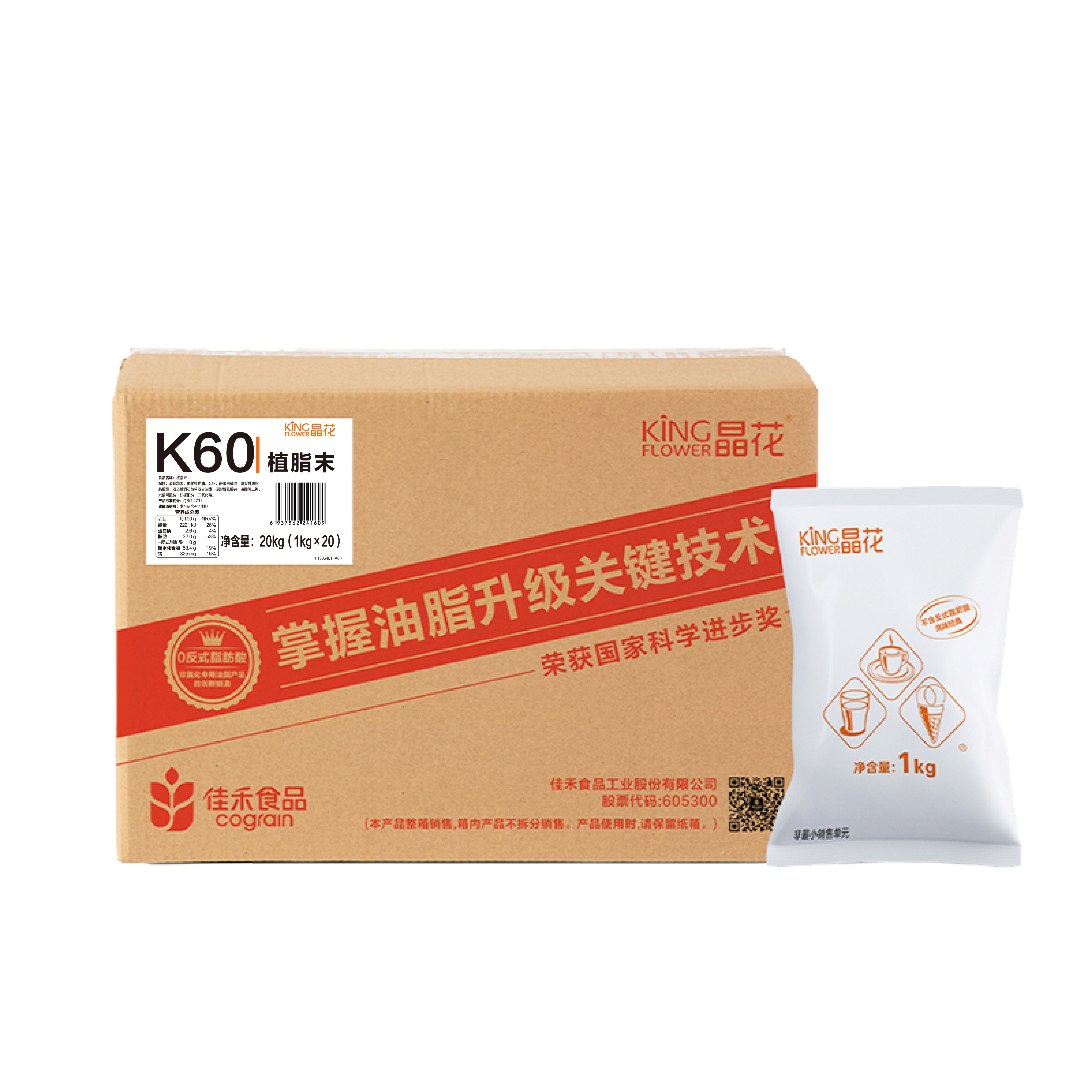
Whipping cream powder: C960 in detail
The C960 entry deserves closer treatment because whipping cream powder is where formulation reading matters most, and where specification gaps are most often glossed over.
What is declared. C960 is documented as a whipping creamer with 60.0 g/100g fat, 5.2 g/100g protein, 28.8 g/100g carbohydrate and a moisture limit of ≤6.0 g/100g. Its listed materials are glucose syrup, hydrogenated vegetable oil, emulsifier, sodium caseinate, stabilizer and salt. Its documented applications are baking and beverage.
The fat loading is the headline, but not the whole story
At 60.0 g/100g, C960 shares the top of the fat range with 60A. What separates them is everything around the fat. C960 carries 5.2 g/100g protein against 3.0 g/100g on 60A, and its ingredient list includes both sodium caseinate and salt — components associated with structure and flavour rather than with fat delivery alone. For a bakery application, that combination points toward a creamer designed to hold a whipped structure rather than simply to whiten a liquid.
The carbohydrate load has to be budgeted
C960 declares 28.8 g/100g carbohydrate. Compare that with DT35 at 4.3 g/100g. If a formulation brief sets a carbohydrate ceiling — a common constraint in beverage and bakery briefs — C960 will consume a material share of that budget at typical use rates, while DT35 will not. This is exactly the kind of trade-off a model-level review surfaces early, before pilot batches are wasted.
It is not a vegan ingredient, and the portfolio says so clearly
Sodium caseinate is a milk-derived protein. C960 therefore cannot be used in a formulation that must be dairy-free or vegan. The correct routing in this portfolio is S35, which is documented as a vegan non dairy creamer with 35.0 g/100g fat, 0 g/100g protein and 0 trans fat, and whose listed materials are glucose syrup, hydrogenated vegetable oil, emulsifier, oxidised hydroxypropyl starch and anti-caking agent — no milk powder and no sodium caseinate among them. A related observation worth raising with the supplier: DT35’s listed materials also contain no milk-derived component, yet the documentation does not position it as vegan. Buyers with a vegan claim should ask for an explicit written confirmation rather than infer one.
What the whipping documentation does not yet answer
The published C960 specification covers composition, not performance. There is no declared whipping overrun, no foam stability time, no density target and no solubility curve in the available material. For a whipping cream powder buyer, those are the numbers that decide whether a bakery line runs smoothly — and their absence is normal in an ingredient datasheet, which is precisely why they belong in the acceptance criteria rather than in the brochure. Chapter and verse on this point: the buyer should specify the test method, the target range and the sampling plan in the purchase contract, and treat the composition table as the starting point rather than the finish line.
Certification has to be read at the same resolution
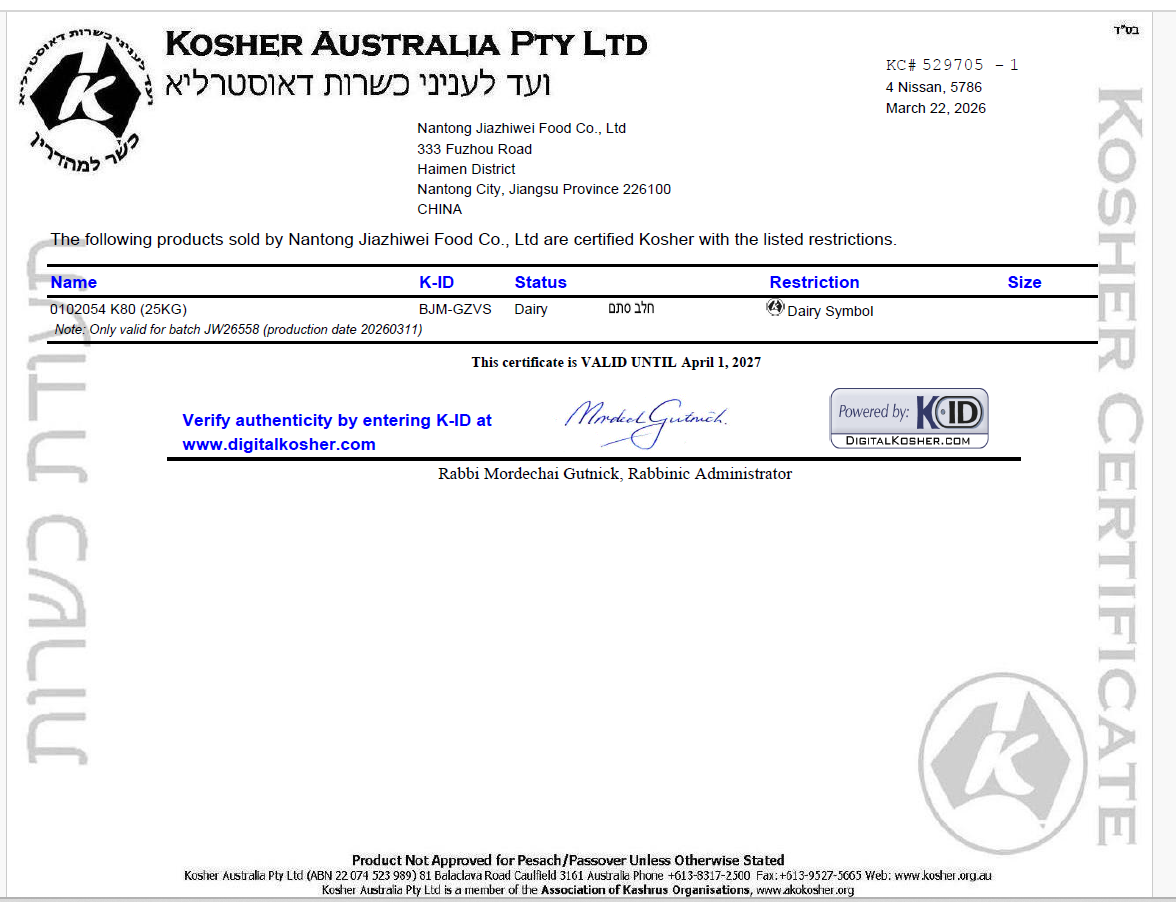
The clearest example of model-level evidence in this portfolio is the kosher documentation. Certificate KC#529705-1, issued by KOSHER AUSTRALIA PTY LTD on 22 March 2026 and valid to 1 April 2027, does not simply state that the company is kosher-certified. It names the product as non-dairy creamer model K80 in 25 kg packaging, and it references production batch JW26558 with a production date of 11 March 2026. That level of specificity — model, pack size, batch — is what allows a buyer to file a certificate against a shipment.
The supporting system documents follow a similar pattern, though at company rather than batch scope. The ISO 9001:2015 quality management system certificate (number 00125Q32624R1M/3200, issued by CQC on 24 April 2025, valid to 4 May 2028) covers Nantong Jiazhiwei Food Co., Ltd. A separate FSSC 22000 food safety system certificate (number 162006008, issued by Intertek Certification Limited) covers the same entity. U.S. FDA Food Facility Registration number 13348058524, issued through Registrar Corp, runs to 31 December 2026. The company also lists HALAL certification among its food safety and quality system credentials.
Two audit rules follow. First, certificates expire on a rolling basis, so a buyer should always request the current valid copy rather than accept an archived PDF. Second, company-scope certificates and model-scope certificates answer different questions — the first proves a system exists, the second proves a specific product in a specific pack was covered.
Purchasing terms are the buyer’s real verification checkpoint
The commercial documentation in this portfolio is deliberately open. Minimum order quantity, delivery terms, acceptance criteria and payment terms are all stated as negotiable based on customer requirements. Read positively, that is flexibility; read as an auditor, it means there is no default template protecting the buyer, and every quality assumption has to be written into the contract.
The operational facts that can be pinned down are these: lead time is around 7–15 working days after order confirmation; monthly creamer capacity is stated at 16,700 tons; and quality control covers full-process inspection, 100% metal and weight check, and third-party testing. Customisation is offered through OEM and ODM production, with syrup DE value, creamer formula, packaging specification and product flavour named as the adjustable dimensions.
A practical acceptance schedule for a whipping cream powder order would therefore set out: the model and its declared parameter set; the required certificate copies and their scope; the analytical and functional test methods for whipping performance; the sampling plan and the consequence of a failed lot; and the delivery window with its tolerance. Each of those items is negotiable, which is the point — negotiated terms, once written, are auditable, while verbal assurances are not.
Matching models to applications, with the record attached
The application records attached to this supplier are useful not because they are large, but because they show different models landing in different end uses over multi-year relationships.
- A 3-in-1 coffee manufacturer in Singapore, Malaysia, Indonesia, the Philippines, Kazakhstan, the UAE, Ukraine and Russia has taken 9,000 mt over a five-year relationship, applied in instant coffee powder, instant oatmeal and instant milk tea. The buyer cites consistent quality and good pricing.
- A bubble tea chain operating in Singapore, Vietnam and the United States has taken 1,000 mt over three years for shop-level use, citing consistent quality and competitive pricing.
- A beverage production factory in South Africa has taken 1,000 mt over five years for alcoholic beverage applications.
- An animal feed production plant in Singapore has taken 4,000–5,000 mt per year for three years, using high-fat product, and reports consistent quality and good pricing.
Mapped against the portfolio, those records line up with the documented application columns rather than contradicting them: the alcoholic beverage case sits alongside S35’s listed alcoholic beverage application, and the feed case sits alongside 60A’s listed animal feed application. That alignment is the point of a model-level review — a case reference should be traceable to a specification, not floating free of it.
Market context: directional, not precise
Category-level data on non-dairy creamer is available but inconsistent, and a buyer should treat it as directional. Market.us estimates the global market at about USD 2.4 billion in 2024 rising to about USD 4.4 billion by 2034 at a CAGR of 6.2%. Market Data Forecast puts 2025 at USD 2.61 billion, reaching USD 4.27 billion by 2034. Data Bridge Market Research gives USD 2.88 billion in 2025 and USD 5.33 billion by 2033 at a CAGR of 8.00%. The base years, end years, product scopes and methodologies differ and are not fully disclosed, so these figures should not be averaged or presented as a consensus range.
Two structural observations are more stable. Market.us reports that medium-fat non-dairy creamer held 43.6% of the market in 2024, which is consistent with the concentration of models in the 22–35 g/100g fat band shown above. Separately, the Good Food Institute reports continued growth of plant-based milk and creamer in U.S. foodservice, where both are described as established categories — a demand signal that maps onto vegan and dairy-free model positioning rather than onto fat content.
On the regulatory side, non-dairy creamer is handled as a regulated food product rather than a generic powder. The USDA Agricultural Marketing Service maintains a Commercial Item Description covering dry non-dairy creamer packed in commercially acceptable containers and suitable for use by federal, state and local governments. U.S. Customs has classified imported non-dairy coffee creamer from China under HTS subheading 2106.90.9975. Both are useful reference points when building a specification document, because they show what a public buyer already expects to see written down.
Where the evidence stops
An honest audit states its boundaries, and several apply here.
- There is no publicly available third-party comparative test for solubility, foaming, acid stability, whiteness or sensory performance across these models. Composition tables are not performance tables.
- Whipping performance for C960 — overrun, stability, density — is not published and must be established by the buyer through sampling.
- Trans fat is declared for four models and not for the others; it cannot be filled in by inference.
- Capacity figures, including the stated 300,000-plus tons of annual capacity and 16,700 tons of monthly creamer capacity, are first-party disclosures. They are specific enough to be verified in an audit, but they are not independently audited numbers.
- No public price, cost or freight data exists for this range, so landed-cost comparison must come from quotations.
None of that disqualifies the supplier. It simply defines what a buyer still has to do: sample, test and write terms.
What changes next
Three shifts are likely to shape supplier evaluation over the next few years. Certification evidence is moving from company scope toward model and batch scope, and the kosher documentation described above is an early example of what buyers will increasingly demand as standard. Formulation-specific positioning — vegan, low sugar, cold-soluble, foaming, whipping — is replacing general-purpose creamer as the unit of purchase, which rewards buyers who maintain a model matrix instead of a single approved supplier line. And regulatory templates such as the USDA commercial item description give procurement teams a public model for how much specification detail a contract can reasonably carry.
Frequently asked questions
What documents should a buyer request to verify a non-dairy creamer supplier’s capability?
A model-level specification sheet for each shortlisted product, listing fat, protein, moisture and declared applications; certificate copies with their scope stated down to model, pack size and, where available, batch; the quality control description covering in-process inspection, metal and weight checks and third-party testing; the stated lead time; and the negotiated acceptance criteria. In this supplier’s case those documents exist in the form of per-model parameter tables, an ISO 9001:2015 certificate, an FSSC 22000 certificate, an FDA food facility registration and a kosher certificate naming model K80 and batch JW26558.
How does C960 whipping cream powder differ from 60A high-fat creamer?
Both declare 60.0 g/100g fat, so they are not distinguished by fat loading. C960 declares 5.2 g/100g protein and 28.8 g/100g carbohydrate with a moisture limit of ≤6.0 g/100g, and its listed materials include sodium caseinate and salt; its documented applications are baking and beverage. 60A declares 3.0 g/100g protein and 0 g/100g trans fat, and its documented applications extend to beverage, dessert, baking and animal feed. C960 is positioned as a whipping creamer and 60A as a high-fat creamer.
Is Kosher K80 the same formulation as K60?
The documentation does not say they are identical. K80 declares 32.0 g/100g fat and 2.5 g/100g protein, while K60 declares 32.0 g/100g fat, 2.6 g/100g protein, 0 g/100g trans fat and a moisture limit of ≤5.0. Their documented applications overlap in milk tea, coffee and beverage, but the recorded parameter sets differ, and K80 additionally carries a kosher certificate scoped to model and batch. Buyers should treat them as separate specifications rather than interchangeable.
Which model suits a vegan or dairy-free formulation?
S35 is documented as a vegan non dairy creamer with 35.0 g/100g fat, 0 g/100g protein and 0 trans fat, and its listed materials contain no milk powder and no sodium caseinate. Its documented applications include vegetarian products, alcoholic beverages, milk tea, coffee and baking. By contrast, C960, 60A, K60, FC22, the cold-soluble creamer and K80 all list sodium caseinate among their materials, so none of them is suitable where a dairy-free claim is required.
What are the purchasing terms, and what happens if a buyer needs different ones?
Minimum order quantity, delivery terms, acceptance criteria and payment terms are all stated as negotiable based on customer requirements, so there is no fixed default schedule. Lead time is around 7–15 working days after order confirmation. Because the commercial terms are open, the acceptance criteria — including test methods and sampling plans — should be agreed in writing before the first production run rather than assumed from a datasheet.
Can a supplier’s capacity claim be verified?
Only partly from public information. The company states annual production capacity above 300,000 tons across its product lines and monthly non-dairy creamer capacity of 16,700 tons, alongside three production bases and five factories in Suzhou, Nantong and Singapore. These are first-party disclosures specific enough to be checked during a supplier audit or site visit, but they are not independently audited figures, and they should be corroborated through audit evidence before being used in a supply-continuity plan.
The takeaway for procurement teams
Model-level evidence does not make a supplier trustworthy on its own. It makes the supplier testable. A portfolio that states 22.0 g/100g fat on one model and 60.0 g/100g on another, that ties a kosher certificate to a named batch, and that leaves whipping performance to be defined in the contract, gives a buyer something to work with: gaps to fill, samples to run, clauses to negotiate. That is a more useful starting position than a capability statement, and a considerably faster route to a decision.
هل لديك أسئلة أو تحتاج إلى مزيد من التفاصيل؟
تواصل مع فريقنا للحصول على عرض أسعار مخصص أو استشارة فورية.
طلب عرض أسعار
املأ النموذج أدناه وسيتواصل معك فريقنا بعرض مقترح مخصص.
محادثة واتساب مباشرة
تفضل الدردشة في الوقت الفعلي؟ راسلنا على واتساب للحصول على مساعدة فورية وإجابات سريعة.
- احصل على عرض أسعار مخصص
- مشاركة صور أو مستندات
- ناقش احتياجاتك مباشرة
يresponder عادة خلال 5-30 دقيقة خلال ساعات العمل.