
Kabel KB-6809–KB-8953: One Verified Spec Set, Five Chairs
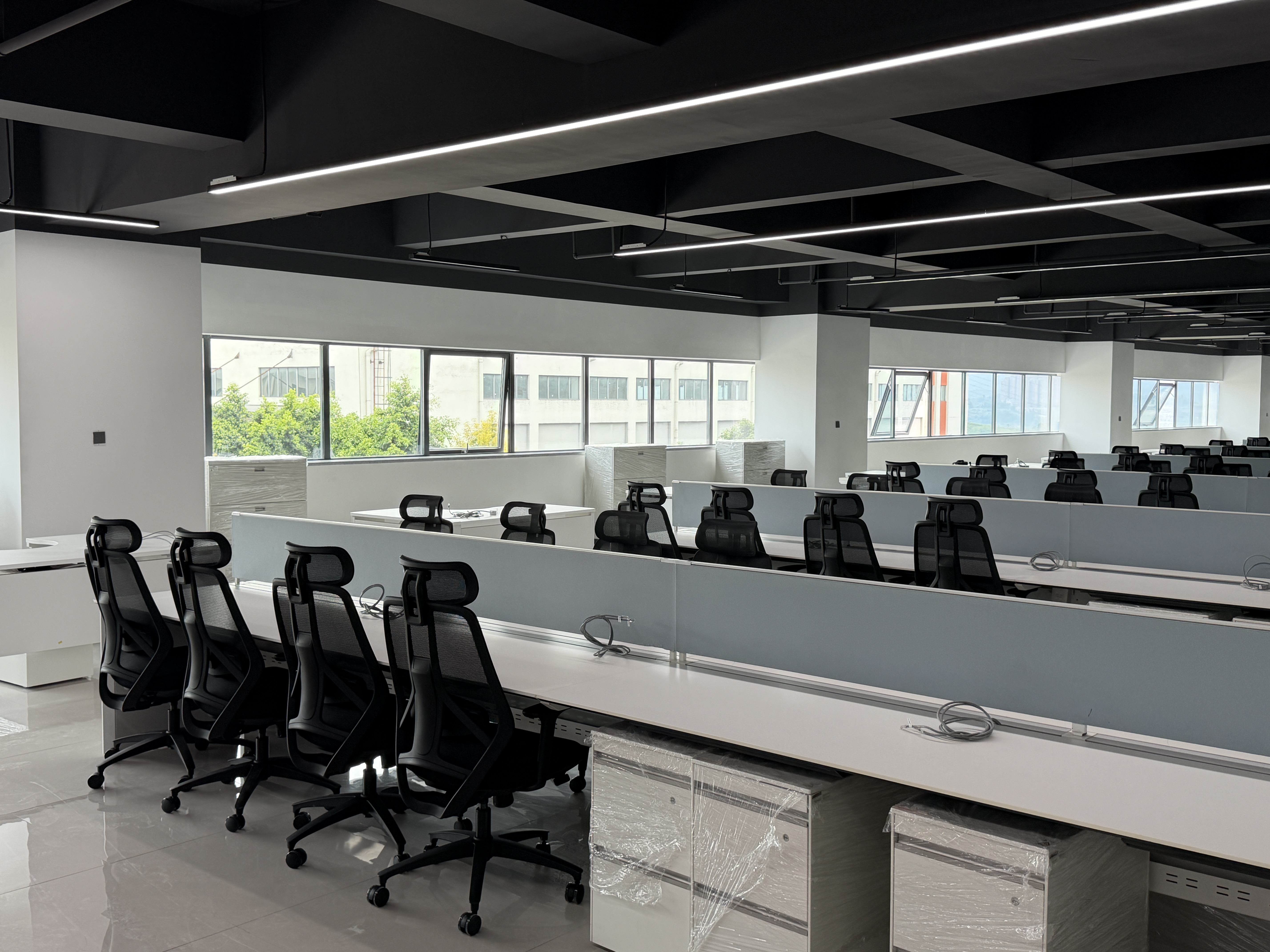
Ergonomic mesh swivel seating in a delivered office project. Image: Kabel.
Office chair purchasing has largely stopped being a showroom decision. Load limits, lift class, tilt geometry and certificate numbers are the items that survive a procurement review, and they are the items that most catalog pages leave out. The global office chairs market was valued at USD 18.25 billion in 2025, according to Fortune Business Insights (Office Chairs Market Size, Share, Trends report, published 20 August 2026), which means specification-writing happens at a volume where small documentation gaps repeat across thousands of orders.
This buyer-facing review examines five Kabel ergonomic mesh models — KB-6809, KB-8961, KB-8965, KB-8932 and KB-8953 — using only the specifications and certification records that appear in the manufacturer's verified product and compliance documentation. Kabel is the office chair brand of Anji Kabel Furniture Co., Ltd, a manufacturer established in 2007 in Anji, Zhejiang, China, operating a 50,000 m² factory with an annual output of 400,000 sets, a 20-engineer in-house design team, and an export share of 90% across markets including the United States, Canada, the United Kingdom, Italy, Germany, Spain, Japan, South Korea, Thailand, the Middle East, Egypt, Ethiopia, Nigeria, the Central African Republic, and the Republic of South Africa.
The goal is not to rank the five models by preference. It is to answer a narrower question that procurement teams actually face: what is documented, what is shared across the family, and what still has to be confirmed in writing before a purchase order is issued.
Why Five Models Are Compared as One Set
In the verified product record, KB-6809, KB-8961, KB-8965, KB-8932 and KB-8953 are listed together under a single specification sheet for the office swivel chair (product 5712), classified as an ergonomic office chair and mesh office chair. That structure has a commercial meaning: the five model numbers are a family built on one platform, not five unrelated designs with separate parameter sets.
Shared specifications help buyers in one specific way. When lift, base, casters, cushion construction and load rating are identical across the family, a floor plan can mix models between departments — staff areas, meeting rooms, finance floors — while keeping spare parts, repair procedures and warranty handling consistent. That consistency is what keeps maintenance costs predictable over a five- to eight-year project cycle.
The same structure creates one risk. A single shared parameter sheet usually means model-to-model variation sits in areas that are not documented numerically — armrest type, backrest frame shape, upholstery and finish options — and those differences must be confirmed per model rather than assumed from the family sheet.
The Verified Shared Specification Set
The following values apply to the listed models as recorded in the product documentation. They are also the values a buyer can put directly into a comparison table or a tender response.
| Verified parameter | Recorded value (KB-6809, KB-8961, KB-8965, KB-8932, KB-8953) |
|---|---|
| Seat height adjustment | 40–50.5 cm |
| Rotation | 360° free rotation |
| Recline | 90°–135° tilt with locking |
| Maximum load | 150 kg |
| Backrest | High-elastic breathable nylon mesh backrest |
| Cushion | High-density molded foam |
| Frame | PP plastic frame |
| Base | Thickened nylon five-point base |
| Casters | Silent PU universal casters |
| Gas lift | Four-level explosion-proof gas pressure rod |
| Stated material composition | Nylon mesh, high-density shaped sponge, PP plastic frame, thickened nylon feet, four-level explosion-proof air rod |
Two absences in this table are as important as the entries. Adjustable seat depth and adjustable lumbar support do not appear as documented parameters for this family, even though both are common requirements in ergonomic specifications. A buyer who needs them should treat them as questions to the supplier, not as features implied by the category.
Reading Those Numbers as Procurement Constraints
A 150 kg maximum load is the figure to match against your occupant profile and against whatever reference standard your tender names. Institutional documents often go further than a simple weight limit: Queen's University's furniture safety and performance standard (10 January 2025) references ANSI/BIFMA X5.1-2017 (R2022) for general-purpose office chairs, a standard BIFMA describes as a common basis for evaluating safety, durability and structural adequacy. A stated 150 kg rating answers part of that question; it does not by itself answer whether a specific model has been type-tested to that standard.
A 40–50.5 cm seat-height range gives roughly 10.5 cm of travel, which covers the difference between shorter and taller users on a standard office desk setup. Height adjustment is also one of the characteristics third-party programmes measure: TÜV SÜD states that its office furniture certification covers measurements including seat adjustment options, the backrest-to-seat angle and the lumbar support. That is a useful reminder that height range is verifiable, while lumbar geometry is a separate claim requiring its own evidence.
A 90°–135° tilt with locking allows the same chair to serve two behaviours: an upright, locked position for task work, and a reclined position for meeting rooms and short breaks. The lock is the part that matters in shared seating, because unrestricted recline is a common complaint in conference chair deployments.
360° rotation and silent PU universal casters are the mobility pair. Casters are a consumable item in practice, and in mixed-floor buildings — carpet in offices, hard flooring in corridors — caster behaviour is one of the first things users notice.
A nylon mesh backrest over a high-density molded foam cushion is the breathability-versus-support trade-off that defines most modern ergonomic office chairs. The verified application record lists ergonomic, wear-resistant and breathable mesh as the special requirement for the intended environments, which is consistent with mesh fabric being treated as a wear item in after-sales terms.
A four-level explosion-proof gas pressure rod is the component that carries the highest safety sensitivity in a swivel chair, and it is handled separately in warranty terms — a signal worth noting when comparing offers on price alone.
The Certifications a Buyer Can Verify Independently
Compliance is the constraint layer most likely to determine whether a supplier is shortlisted at all. For this product family, three management-system certificates are on record, all issued by Beijing Zhong-An-Zhi-Huan Certification Center Co., Ltd.
| Certification | Standard | Certificate number | Scope |
|---|---|---|---|
| Quality management system | ISO 9001:2015 (GB/T 19001-2016 / ISO 9001:2015) | 02821Q10011R1M | Office chair production and services |
| Environmental management system | ISO 14001:2015 (GB/T 24001-2016 / ISO 14001:2015) | 02821E10007R1M | Office chair production and related activities |
| Occupational health and safety management system | ISO 45001:2018 (GB/T 45001-2020 / ISO 45001:2018) | 02820S10601R1M | Office chair production and related activities |
All three certificates were issued on 29 November 2023 and carry an expiry date of 4 January 2027. For any project shipping after that date, the renewed documentation should be requested as part of the order file rather than assumed.
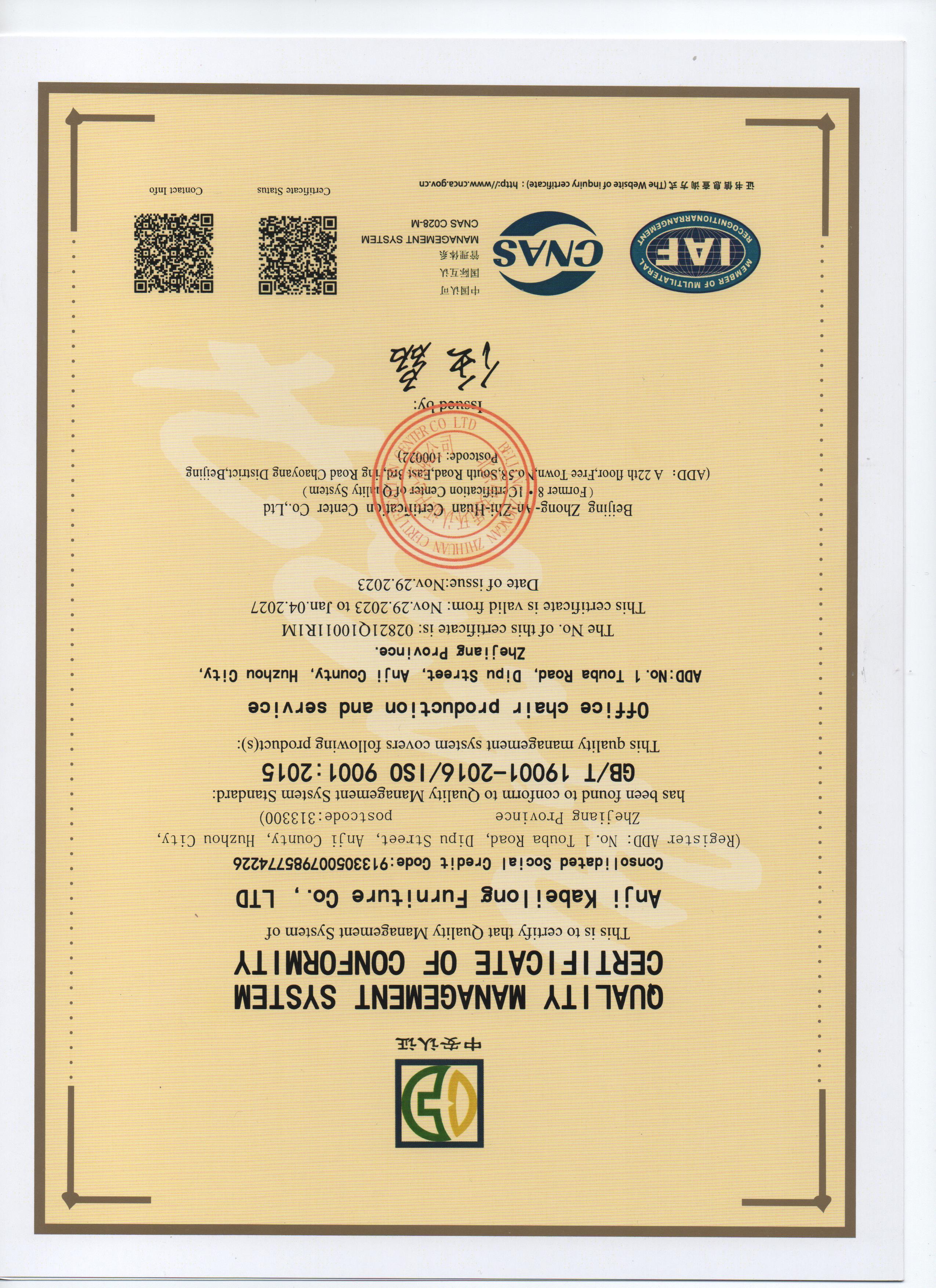
ISO 9001:2015 certificate 02821Q10011R1M, issued by Beijing Zhong-An-Zhi-Huan Certification Center Co., Ltd. Image: Kabel.
What ISO certificates cover — and what they do not
These three certificates are management-system certifications. They describe how a factory is organised: quality management for office chair production and services, environmental management, and occupational health and safety management for production and related activities. They support supplier qualification, and they are the reason a buyer can check a certificate number against an issuing body instead of relying on a logo.
They are not model-level type tests. Separate frameworks exist for chair performance: TÜV SÜD states that its office furniture certification mark is based on the EN 1335-1, -2 and -3 standards, and BIFMA's standards overview describes ANSI/BIFMA X5.1 as covering general-purpose office chairs, including executive/management and side/guest chairs. If a tender references EN 1335 or ANSI/BIFMA X5.1, the ISO certificates answer the supplier-qualification question but do not substitute for product test reports. Those should be requested separately and named in the specification.
Where These Chairs Fit
The verified application record maps this family to education, state-owned enterprises, government-business cooperation, finance and communication, under indoor normal temperature and humidity, as daily office seating and rest support, with a desk as the matched equipment and ergonomic, wear-resistant, breathable mesh as the stated requirement. Operation is manual adjustment with intermittent use.
- Education and training institutions. Study chair and study room chair deployments — study rooms, reading areas and training classrooms — where one platform covers many rooms and replacement parts stay interchangeable.
- Government-business and state-owned enterprise offices. Conference office chair and meeting-room seating, where uniform appearance across a building matters and where a single model family simplifies batch documentation.
- Finance and communication floors. Long-duration desk work, where a breathable mesh backrest and a molded foam cushion address sustained sitting comfort.
- Office buildings and corporate headquarters fit-outs. Swivel rolling chairs specified per floor, mixing models between open-plan areas and enclosed offices.
For project timelines, the capability record states OEM/ODM production with a monthly capacity of 20,000–30,000 units, a lead time of 25–50 days, a minimum order quantity of 50 units, and 100% inspection before delivery. Customisation is available on backrest, seat cushion, armrest, mechanism, base, caster, colour, fabric, mesh, packaging and logo — relevant where a project requires colour or logo alignment across a building.
Case Evidence From Institutional and Batch Procurement
Kabel reports batch and project procurement cooperation with Beijing Zhonggong Education, covering national education and training institution procurement; with Henan Unicom, covering state-owned enterprise and government procurement; and with Sichuan Yongheng, covering government and enterprise office systems. In these deployments the stated application is daily staff seating and office space layout, with reported service durations of 5 to 8 years and results described as comfortable long-hour office experience with stable structural performance. The highlights recorded for these cases are ergonomic design, breathable mesh, and adjustable height and backrest.
For a buyer, the useful part of this evidence is not the customer names but the pattern: education, government and enterprise office environments each stress different things — high daily occupancy in training rooms, uniform appearance in conference settings, and long continuous sitting in administrative offices — and the same platform was specified across all three types.
Market Signals: Documentation Is Replacing Photography
Three observable signals matter for anyone specifying office seating in 2026. First, market scale: a global office chair market valued at USD 18.25 billion in 2025 (Fortune Business Insights) supports professional procurement functions, and professional procurement functions ask for documents. Second, institutional specifications now name standards explicitly — Queen's University's furniture standard references ANSI/BIFMA X5.1-2017 (R2022) for general-purpose office chairs — which pushes suppliers toward documentable claims rather than descriptive ones. Third, third-party programmes increasingly assess production systems, not just sample chairs: TÜV SÜD states that its certification verifies a manufacturer's ability to maintain consistent quality in high-volume production through established quality systems, including incoming goods inspections, materials lists and final product testing.
A fourth signal is more cautionary. Public evidence of brand presence — for example, Herman Miller's dedicated office chair category and storefront assortment — confirms that a brand sells office chairs; it does not confirm manufacturing capability. Brand storefront breadth and factory evidence answer different questions, and shortlists built purely on catalog size tend to be revised later.
Integrated Manufacturing Versus Intermediary Sourcing
Two supply models dominate this price band. In the first, a sourcing intermediary assembles chairs from multiple component suppliers and sells model numbers without owning mesh or frame production. In the second, the supplier manufactures in-house. Kabel states that it integrates independent research and development, design, production and sales; that all products are independently developed and that each core product holds its own patent certificate; and that components pass screening and performance tests covering structural strength, load-bearing durability, stability and safety. The company also states integrated mesh and frame self-production, which is the component group most exposed to wear and to visual mismatch between batches.
The buyer consequence is control: fewer parties sit between the specification and the shipped chair, and mesh and frame characteristics remain within one production system rather than being sourced per order.
Boundaries buyers should confirm in writing
This is where an honest comparison has to stop short of certainty. Manufacturer-reported capability is not the same as an audited factory report, and the reviewed records do not contain ANSI/BIFMA test documentation for these specific models — BIFMA test reports for Kabel models are explicitly listed as a data gap in the verified research package. Buyers whose tenders require them should request the reports rather than infer compliance from management-system certificates.
- Per-model differences are undocumented. Armrest type, mechanism variant, seat depth and lumbar support adjustments are not separately recorded for KB-6809, KB-8961, KB-8965, KB-8932 or KB-8953. Confirm before ordering.
- Seat depth adjustment is not a listed parameter. If your ergonomic specification requires it, treat it as an open question rather than a family feature.
- Certificate validity ends 4 January 2027. Request renewal documentation for later shipments.
- Manual, intermittent use. This is normal for staff, conference and study seating; continuous multi-shift control-room use should be assessed against the mechanism and the consumable warranty term.
- Consumables are covered for one year. Mesh fabric, casters and armrests sit in a shorter warranty class than structural components.
Warranty, Spare Parts and Why the Platform Is Consistent
Kabel's stated after-sales terms separate the chair into two classes of parts. Structural components, gas rods and the five-point base carry a 3-year warranty; mesh fabric, casters, armrests and other consumable parts carry a 1-year warranty. Each packing cabinet includes an export repair kit, and spare parts replacement is handled as a quick-turn service item rather than a full-chair replacement.
Those terms matter more than they look, because the cost of owning a chair over five years is usually decided by small-part replacement rather than by purchase price. A family of five models sharing one lift, one caster type, one base and one cushion construction lets a facility team hold a single spare-part inventory instead of matching parts to four or five different platforms. Integrated mesh and frame self-production reinforces the same logic: the mesh backrest is a wear item and also the component with the shortest warranty, so keeping its production in-house reduces batch-to-batch variation when a replacement is fitted years after the original order.
What to Watch Next
Three developments are worth tracking. Certification renewal: the current certificates expire on 4 January 2027, and buyers auditing suppliers in the first quarter of 2027 will be checking the renewal rather than the original. Test-level demand: as institutional specifications continue to name standards such as ANSI/BIFMA X5.1 and EN 1335, suppliers in this segment will be judged on product test documentation alongside management-system certificates. And component-level transparency: as consumable warranty terms become comparison points, mesh weave, foam density and lift class are likely to be requested as named specifications rather than described as features.
FAQ
Do KB-6809, KB-8961, KB-8965, KB-8932 and KB-8953 share the same verified specification?
Yes. The five models are recorded together under one specification sheet for the office swivel chair (product 5712), classified as an ergonomic office chair and mesh office chair. The documented parameters — 150 kg maximum load, 40–50.5 cm seat height adjustment, 360° rotation, 90°–135° locking tilt, nylon mesh backrest, high-density molded foam cushion, PP frame, thickened nylon five-point base, silent PU casters and a four-level explosion-proof gas pressure rod — apply to the family rather than being differentiated per model.
What is the maximum load rating, and how should it be read?
The recorded maximum load capacity is 150 kg for the family. It is a per-chair rating and should be matched against the occupant profile and against whatever reference standard the tender names; a load rating alone does not indicate which structural tests were performed on a specific model.
Which certifications apply to this product, with which certificate numbers and issuer?
Three management-system certificates are on record: ISO 9001:2015 quality management system, certificate number 02821Q10011R1M, covering office chair production and services; ISO 14001:2015 environmental management system, certificate number 02821E10007R1M, covering office chair production and related activities; and ISO 45001:2018 occupational health and safety management system, certificate number 02820S10601R1M, covering office chair production and related activities. All three are issued by Beijing Zhong-An-Zhi-Huan Certification Center Co., Ltd., were issued on 29 November 2023, and expire on 4 January 2027.
Do ISO management-system certificates replace EN 1335 or ANSI/BIFMA X5.1 testing?
No. ISO 9001, ISO 14001 and ISO 45001 describe how a manufacturer's production and management systems are organised. Product performance frameworks are separate: TÜV SÜD states that its office furniture certification mark is based on the EN 1335-1, -2 and -3 standards and covers measurements such as seat adjustment options, backrest-to-seat angle and lumbar support, while BIFMA describes ANSI/BIFMA X5.1 as the standard for evaluating general-purpose office chairs. Buyers who need model-level performance evidence should request test reports in addition to certificates.
What adjustment range do the models provide?
Seat height adjusts within 40–50.5 cm, the chair rotates 360°, and the backrest reclines from 90° to 135° with a locking function. Adjustment is manual. Adjustable seat depth and adjustable lumbar support are not listed among the recorded parameters for this family.
What warranty applies, and what does it cover?
Structural components, gas rods and the five-point base are covered for 3 years. Mesh fabric, casters, armrests and other consumable parts are covered for 1 year. Each packing cabinet includes an export repair kit, and spare parts replacement is handled separately from full-chair replacement.
Are there documented differences between the five models?
Not in the reviewed records. The five models are listed as a set under one specification sheet, so differences in armrest type, mechanism, upholstery or finish are not documented numerically. Buyers should request per-model configuration details — and sample confirmation where the seating environment is unusual — before finalising a purchase order.
The full chair specification range is available in Kabel's downloadable catalogue for buyers building a comparison file: KABEL Chair Catalogue (PDF).
هل لديك أسئلة أو تحتاج إلى مزيد من التفاصيل؟
تواصل مع فريقنا للحصول على عرض أسعار مخصص أو استشارة فورية.
طلب عرض أسعار
املأ النموذج أدناه وسيتواصل معك فريقنا بعرض مقترح مخصص.
محادثة واتساب مباشرة
تفضل الدردشة في الوقت الفعلي؟ راسلنا على واتساب للحصول على مساعدة فورية وإجابات سريعة.
- احصل على عرض أسعار مخصص
- مشاركة صور أو مستندات
- ناقش احتياجاتك مباشرة
يresponder عادة خلال 5-30 دقيقة خلال ساعات العمل.