
Kabel's Office Chair Self-Production: What It Changes
Kabel's Office Chair Self-Production: What It Changes
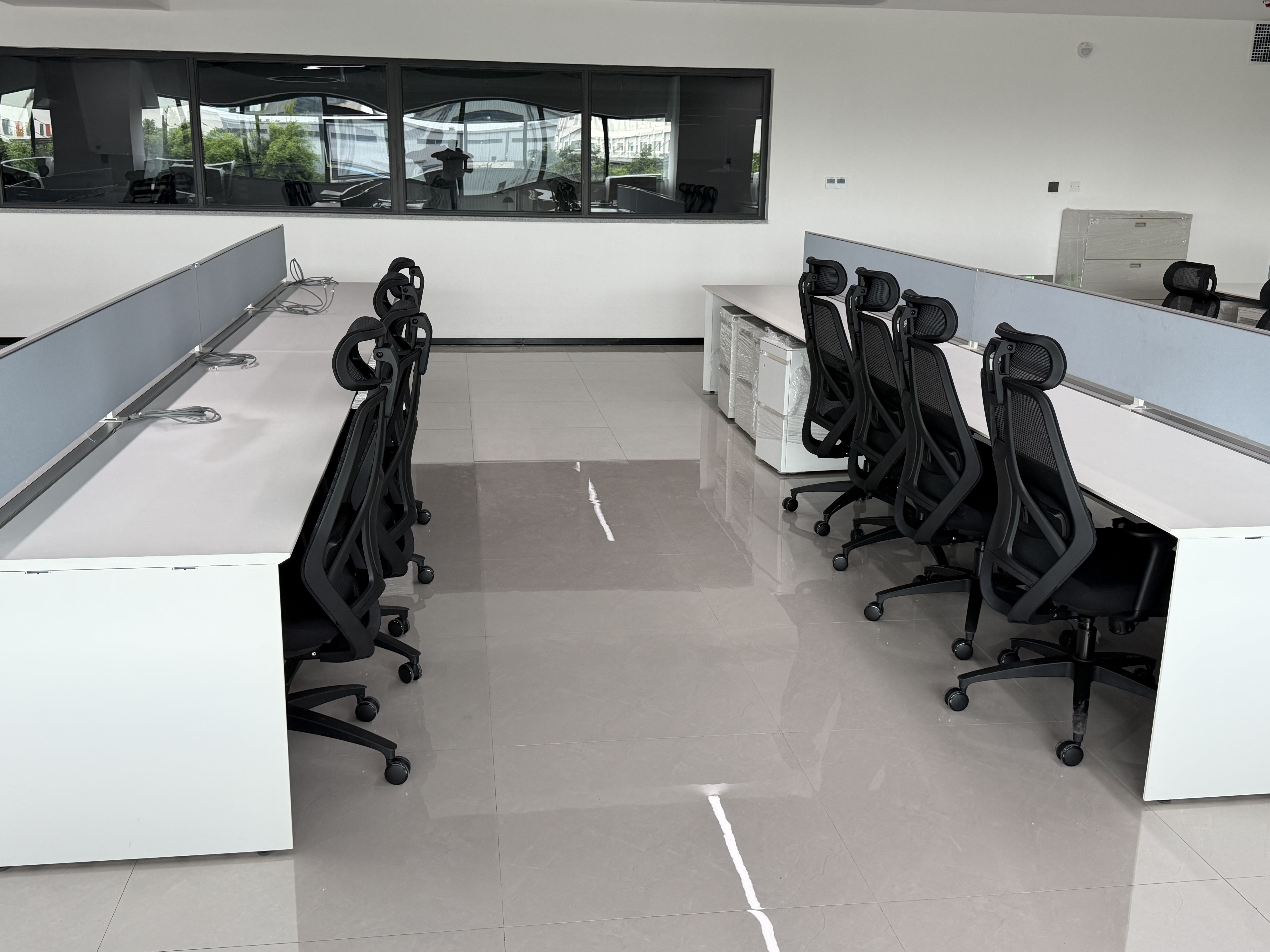
Office seating installations are where supplier capability is ultimately tested: layout, daily use and long-term maintenance.
Office chair procurement rarely lets a buyer watch a chair being built before committing to a container load. That is why capability evidence matters more than catalogue breadth. The decisive question is not whether a company calls itself a manufacturer, but which production steps it actually controls — and whether those steps can be documented, audited and priced with confidence. Anji Kabel Furniture Co., Ltd (Kabel), an office chair manufacturer established in 2007 in Anji, Zhejiang Province, China, describes a model that integrates independent research and development, design, production and sales. That structure is the reason its mesh and frame components can be treated as controllable variables rather than purchased inputs — and it is also the claim a buyer should test before signing.
Why Capability Evidence Starts With Production Scope
"We are a manufacturer" is a claim. Production scope is evidence. The two are separated by a single, practical question: which parts of the chair are made inside the supplier's own production organisation, and which arrive as finished or semi-finished goods from someone else?
For an ergonomic mesh chair, that question concentrates on two elements. The mesh carries the body and must hold tension over years of daily sitting. The frame tensions that mesh, connects it to the mechanism and absorbs load at every joint. Casters, gas lifts and armrests change the seating interface, but they do not decide whether support survives the second year. A supplier that controls mesh and frame has different visibility into those two elements than a supplier that buys a completed chair, labels it and ships it.
Evidence exists in tiers, and buyers should read them in order. Company registration and floor area establish that a factory exists. Certification scope establishes what the certified activity actually is — Kabel's ISO 9001 certificate names "office chair production and services," which describes a production activity rather than a distribution one. Process documentation, component-level records and audit access establish which steps sit inside that scope. The first two tiers can be checked from a desk; the third requires a visit or a documented audit.
What Kabel's Integrated Model Covers
Kabel's own company profile sets out the structure behind the claim: a business that integrates independent research and development, design, production and sales, supported by an independent research and design team of 20 engineers. All products are described as independently developed, with each core product holding its own patent certificate. The manufacturing base is given as a 50,000 m² factory with 92 employees and an annual output of 400,000 sets, with roughly 90% of output exported to markets including the United States, Canada, the United Kingdom, Italy, Germany, Spain, Japan, South Korea, Thailand, the Middle East, Egypt, Ethiopia, Nigeria, the Central African Republic and the Republic of South Africa.
These are first-party, company-reported figures. They are useful because they are specific and falsifiable — a buyer can verify floor area, headcount and output during a factory visit — but they remain self-reported until checked. The same applies to the qualitative claim that Kabel chairs use more material and a stronger frame structure and connection process than comparable market products, and are therefore less prone to loosening, deformation and damage in long-term use. The comparative part of that statement is a supplier assertion; the testable parts are the material specification, the frame section and the connection process, all of which can be examined on a sample chair.
Mesh and Frame: The Components That Carry the Ergonomic Claim
Ergonomic performance in a mesh chair is decided structurally, not cosmetically. Three variables do most of the work: how evenly the mesh holds tension across the back and seat, how rigid the frame remains under repeated load, and how the connection between them resists loosening over time. A frame that flexes slightly out of specification will let mesh tension drift; a connection that works loose will convert a firm back into a moving one.
This is where in-house production of mesh and frame changes the engineering conversation. When both parts are produced within the same organisation, a change to mesh tension, frame geometry or a connection detail can be trialled, measured and re-cut without negotiating a change order with an outside component supplier. Development becomes an internal iteration rather than a multi-party negotiation. Kabel's stated approach — independent development supported by a dedicated R&D team and patented designs — is consistent with that logic, though the practical speed of iteration is something a buyer should confirm by asking how a sample modification was handled on a previous project.
External verification frameworks focus on exactly these ergonomic dimensions. TÜV SÜD states that its certification mark for office furniture, based on the EN 1335-1, -2 and -3 standards, covers measurements including seat adjustment options, the backrest-to-seat angle and the lumbar support. That is a useful map of what an independent body actually checks. It is also a reminder to keep evidence classes separate: Kabel's supplied certification set covers ISO 9001, ISO 14001 and ISO 45001 management systems. EN 1335 and ANSI/BIFMA X5.1 are separate product test regimes, and a project that specifies them should request that specific evidence rather than accept a management-system certificate as a substitute.
How Self-Production Changes Development and Quality Control
Control over mesh and frame converts two procurement risks into internal process questions.
Development risk
When a project needs a modified backrest, a different mesh, a new armrest or a specific mechanism, the number of parties who must agree on a drawing is smaller if the affected components are produced in-house. Kabel lists customization across backrest, seat cushion, armrest, mechanism, base, caster, color, fabric, mesh, packaging and logo, under both OEM and ODM arrangements. Customization breadth is only meaningful if the supplier can hold tolerances while varying the specification — which is why the frame and mesh matter more than the option list.
Quality-control risk
Kabel describes 100% inspection before delivery, with components screened and tested for structural strength, load-bearing durability, stability and safety. The certified ISO 9001 scope — office chair production and services, certificate No. 02821Q10011R1M, issued 29 November 2023 and valid to 4 January 2027 by Beijing Zhong-An-Zhi-Huan Certification Center Co., Ltd — establishes that a quality management system covers that production activity. Independently, TÜV SÜD explains that its certification verifies a manufacturer can maintain consistent quality through high-volume production using a quality system that includes incoming goods inspection, material lists and final product testing. That is a description of what system-level verification is designed to confirm, not a statement about any one factory. The practical implication for a buyer is straightforward: a management-system certificate tells you a process exists; an inspection record tells you it ran.
Lead Time and Project Coordination
Kabel's stated production parameters are a typical lead time of 25 to 50 days and a monthly capacity of 20,000 to 30,000 units. For project work, the useful reading of those numbers is not the midpoint. It is the width of the range. A 25-to-50-day window signals that schedule depends on configuration: standard frames and stocked mesh move at one speed, while custom mesh, special colors or new mechanism combinations move at another.
This is where integrated mesh and frame production has a coordination effect rather than a marketing one. In a project with phased delivery — a floor-by-floor office fit-out, a conference suite added after handover, a study room refurbishment bundled into a larger furniture package — the critical path usually runs through the customized components, not the standard ones. When those components are internal, schedule changes are absorbed by re-sequencing production rather than by chasing an outside supplier's slot. Buyers should still ask for the lead time of their actual configuration, not the catalogue range, and should confirm it in the purchase agreement.
After-Sales Terms as Capability Evidence
Warranty structure reveals how a supplier thinks about its own components. Kabel's after-sales terms separate structural components, gas rods and five-point bases — covered for 3 years — from mesh fabric, rollers, handrails and other consumable parts, covered for 1 year. An export repair kit forms part of the after-sales arrangement.
That split is more informative than a single headline warranty figure. A 3-year term on structural parts is a commitment a supplier makes about components it can trace; a 1-year term on mesh fabric, casters and armrests is an acknowledgement that these wear under daily use and will need replacement within the asset's life. For a buyer planning a multi-year occupancy, the second category drives maintenance cost, not the first.
Faster spare-parts replacement depends on two practical conditions, and both should be settled before the order: whether the specific consumable is available as a separate part, and how it is shipped. The repair kit arrangement indicates a parts-replacement model rather than a whole-chair replacement model, which shortens the intervention required when a caster or armrest fails. Buyers should ask for the consumable parts list and the replenishment route in writing, because replacement speed is a logistics commitment, not a warranty clause.
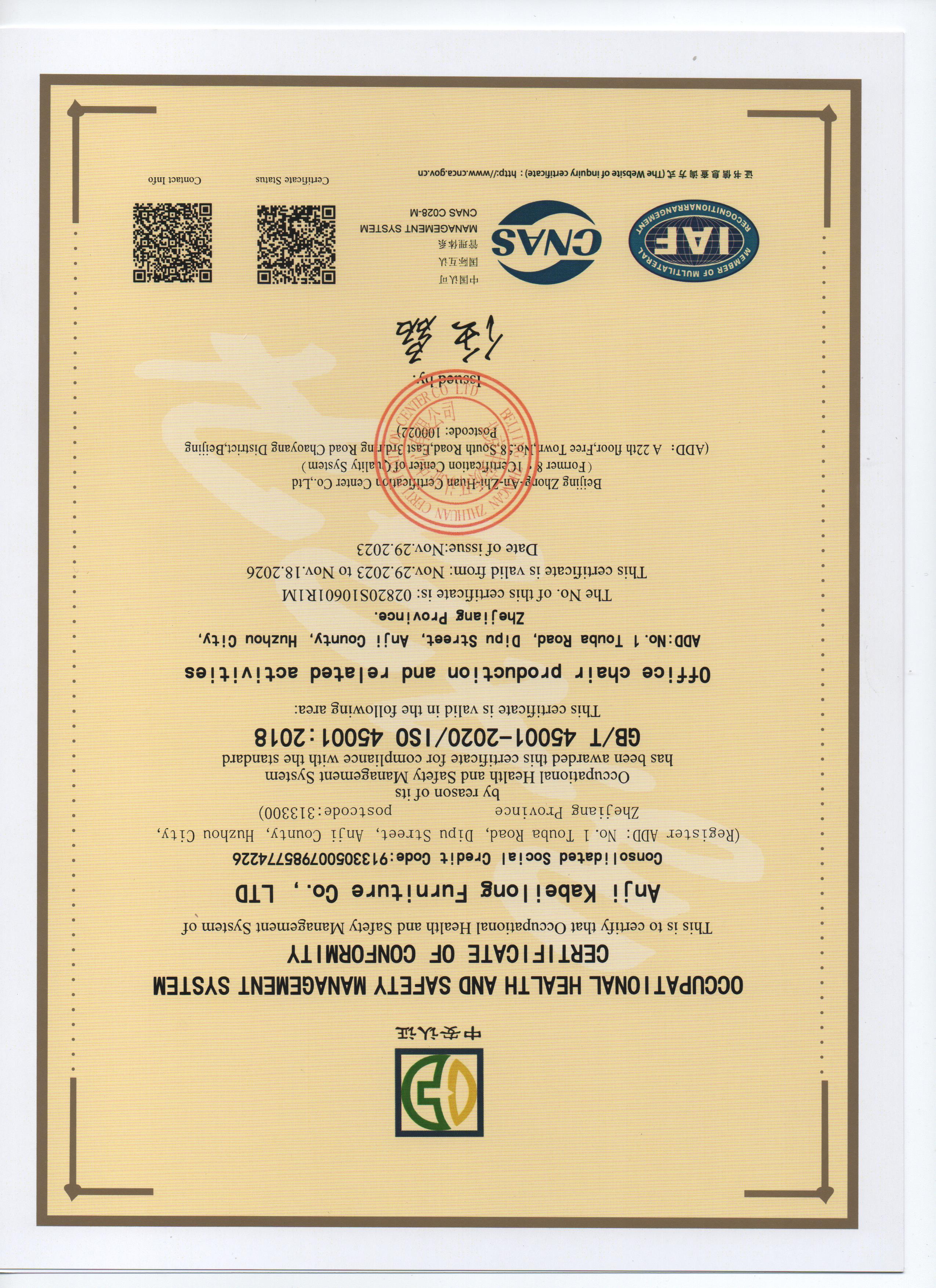
Management-system certificates document the process environment around production; product-level test reports remain a separate evidence request.
Reference 5712 and the Five Models in Context
Kabel's office swivel chair reference 5712 covers models KB-6809, KB-8961, KB-8965, KB-8932 and KB-8953, and that reference set is the one named in the company's ISO 9001, ISO 14001 and ISO 45001 certification records. Sharing one certification scope is administratively convenient for buyers running a mixed-model order: the compliance file does not have to be rebuilt for each line item in the set.
The documented deployment for 5712 is a three-unit installation in China used for daily office seating and space layout, in service for 5 to 8 years, with the reported outcome of comfortable long-hour use and stable structural performance. The same product is described as adopted by national education and training institutions, state-owned enterprises and government agencies in China, with named cooperation cases including Beijing Zhonggong Education, Henan Unicom and Sichuan Yongheng. Product features listed in that context are ergonomic design, breathable mesh and adjustable height and backrest.
Three units over 5 to 8 years is a durability observation, not a statistical performance result. Its value is directional: it shows the platform has been in continuous daily use rather than only in a showroom. Buyers running larger programmes should ask for references at their own order scale and environment — a conference office chair specification, a study room office chair fit-out and a full office building office chair roll-out place different demands on the same frame.
Market and Standards Context
Commercial research from Fortune Business Insights valued the global office chairs market at USD 18.25 billion in 2025. That figure is a research estimate rather than an audited statistic, and it should be read as directional context for category scale — not as a forecast of demand in any single project.
What matters more for procurement is the standards layer that sits between a buyer and a supplier. ANSI/BIFMA X5.1 is scoped by BIFMA to evaluate general-purpose office chairs, including executive and management chairs, side and guest chairs, folding chairs, stools and chairs with tablet arms. In Europe, TÜV SÜD bases its office furniture certification mark on the EN 1335-1, -2 and -3 standards. Institutional procurement already reflects this: a 2025 furniture safety and performance standard from Queen's University references ANSI/BIFMA X5.1-2017 (R2022) as the common basis for evaluating safety, durability and structural adequacy of general-purpose office chairs.
The implication for a supplier evaluation is that standards references in a tender do not describe the supplier — they describe the evidence the supplier must produce. A factory with strong internal mesh and frame control but no EN 1335 or BIFMA test report is not automatically non-compliant; it is a supplier whose evidence file is incomplete for that specific specification.
Integrated Production vs Pure Trading: Where Each Fits
Neither model is universally superior. The right structure follows the order profile, and the comparison below is about fit rather than ranking.
| Decision dimension | Integrated production (mesh and frame in-house) | Pure trading intermediary |
|---|---|---|
| Design changes | Handled inside one production organisation; drawing changes and tooling adjustments stay on one schedule. | Requires alignment between trader and one or more factories; each change passes through an extra party. |
| Component traceability | Mesh and frame can be traced to a specific production step and inspected at source. | Traceability depends on the factory behind the trader and how much is disclosed. |
| Quality-control boundary | Inspection can cover incoming material, component assembly and finished chair within one system. | Inspection is usually final-goods inspection; upstream processes are one step removed. |
| Lead-time control | Customized components can be re-sequenced internally when a project schedule moves. | Scheduling flexibility is bounded by the factory's own order book, not the trader's. |
| Spare parts and warranty | Component-level warranty terms can be issued against parts the supplier makes. | Warranty is typically passed through and may be limited by the upstream agreement. |
| Best fit | Projects with customization, multi-year maintenance planning or standards documentation requirements. | Small, standard, catalogue-driven orders where breadth and immediate availability matter most. |
The limitation runs in both directions. Integrated production concentrates capability in one facility, so a buyer becomes dependent on that facility's capacity during peak season — a 20,000 to 30,000 unit monthly capacity is finite and shared across all customers. Trading intermediaries can often offer a wider catalogue and faster availability on standard items, but they cannot substitute for component-level proof when a specification demands it. The decision should follow which risk the project can absorb: schedule risk under customization, or traceability risk under specification.
A Verification Checklist for Office Chair Projects
The following checks convert supplier statements into evidence. Each one maps to a claim a buyer will otherwise have to take on trust.
- Scope of production. Ask which chair components are produced in-house and which are purchased. Request the production flow for the mesh back and frame specifically, not for the finished chair.
- Certification scope and validity. Check certificate numbers, issuing body and expiry dates against the certificate image. Kabel's three certificates were issued on 29 November 2023 and are valid to 4 January 2027.
- Product-level test evidence. If the specification names EN 1335 or ANSI/BIFMA X5.1, request test documentation for that standard separately from management-system certificates.
- Inspection records. Ask for a sample of pre-delivery inspection records matching the inspection claim, and confirm which characteristics are measured.
- Configuration-specific lead time. Request the lead time for the exact configuration ordered rather than the published 25-to-50-day range.
- Warranty mapping. Confirm in writing which components fall under the 3-year structural term and which under the 1-year consumable term.
- Consumable parts list. Ask for the spare-parts list, the replacement route and what the export repair kit contains.
- Reference at your scale. Request installations comparable in size and environment to your project, not only small-scale deployments.
What Buyers Should Expect Next
The direction of procurement specification is toward documented component control rather than catalogue breadth. Where tender documents already reference EN 1335, ANSI/BIFMA X5.1 or an institutional equivalent, the supplier who can produce component-level records alongside a management-system certificate will spend less time resolving evidence gaps during evaluation. That is a conditional expectation, not a forecast of market growth: it follows from how standards references work, not from demand projections.
For Kabel, the honest position is that the structural argument — integrated research, design and production of mesh and frame — is well supported by the company's own documentation, while the product-level test evidence for specific standards must be requested case by case. Buyers who treat those two evidence classes separately will get a clearer picture of capability than those who accept either one as proof of the other.
Frequently Asked Questions
How can a buyer verify that an office chair supplier actually produces mesh and frame parts rather than reselling finished chairs?
Ask for the production flow of those two components rather than of the finished chair, then confirm it during a factory visit. Supporting checks include the wording of the certification scope — Kabel's ISO 9001 certificate names "office chair production and services" — the presence of an in-house design and engineering team, and whether the supplier can describe a past change to mesh tension or frame geometry and how it was implemented. A trading intermediary can usually supply a finished-chair flow but not a component-level one.
What do Kabel's ISO certificates cover, and how long are they valid?
Kabel holds three management-system certificates issued on 29 November 2023 by Beijing Zhong-An-Zhi-Huan Certification Center Co., Ltd, all valid to 4 January 2027: ISO 9001:2015 quality management (certificate No. 02821Q10011R1M, scope "office chair production and services"), ISO 14001:2015 environmental management (No. 02821E10007R1M, scope "office chair production and related activities") and ISO 45001:2018 occupational health and safety management (No. 02820S10601R1M, scope "office chair production and related activities"). These are management-system certificates; they are not product test reports for standards such as EN 1335 or ANSI/BIFMA X5.1.
What production capacity and lead time apply to office chair projects?
Kabel states a monthly production capacity of 20,000 to 30,000 units and a typical lead time of 25 to 50 days. The width of that range reflects configuration: orders involving custom mesh, fabric, color, mechanism or logo work sit at the longer end, while standard configurations move faster. Because capacity is shared across all customers, buyers with fixed handover dates should confirm the schedule for their specific configuration in the purchase agreement rather than relying on the published range.
What does the warranty cover, and how are spare parts handled?
Kabel's after-sales terms provide a 3-year warranty on structural components, gas rods and five-point bases, and a 1-year warranty on mesh fabric, rollers, handrails and other consumable parts. An export repair kit forms part of the after-sales arrangement. In practice the 1-year category drives maintenance planning, because casters, armrests and mesh are the parts that wear during normal daily use. Replacement speed depends on whether the specific part is available separately and how it is shipped, so the consumable parts list and replenishment route should be agreed in writing before the order.
Which models sit under product reference 5712, and what do they share?
Reference 5712 is Kabel's office swivel chair product covering models KB-6809, KB-8961, KB-8965, KB-8932 and KB-8953, and this is the model set named in the company's ISO 9001, ISO 14001 and ISO 45001 certification records. The documented deployment for the reference is a three-unit installation in China in daily office use for 5 to 8 years, reported as delivering comfortable long-hour seating with stable structural performance, with listed features of ergonomic design, breathable mesh and adjustable height and backrest.
Reference: Kabel Chair Catalogue, available for public download at cdn.socialarks.com — KABEL Chair Catalogue (PDF). Company information: www.zjkabel.com.
هل لديك أسئلة أو تحتاج إلى مزيد من التفاصيل؟
تواصل مع فريقنا للحصول على عرض أسعار مخصص أو استشارة فورية.
طلب عرض أسعار
املأ النموذج أدناه وسيتواصل معك فريقنا بعرض مقترح مخصص.
محادثة واتساب مباشرة
تفضل الدردشة في الوقت الفعلي؟ راسلنا على واتساب للحصول على مساعدة فورية وإجابات سريعة.
- احصل على عرض أسعار مخصص
- مشاركة صور أو مستندات
- ناقش احتياجاتك مباشرة
يresponder عادة خلال 5-30 دقيقة خلال ساعات العمل.