
Keychain Supplier Audit Scope: Checking Certificate Numbers
Keychain Supplier Audit Scope: Checking Certificate Numbers
A custom keychain supplier's capability can be checked without a factory visit — but only if the buyer reads documents rather than logos. The check rests on four fields that every legitimate record carries: the certificate or report number, the issuing body, the exact wording of the scope, and the validity window. When those four align with the product being purchased and the site being used, the document is evidence. When any one of them is missing or mismatched, it is only a claim.
Qingyuan TechArt Craftworks Co., Ltd. (techartgroup.net), a metal crafts manufacturer based in Qingyuan City, Guangdong Province, China, publishes a document set that can serve as a worked example of the method: ISO 9001 certificate BMCQ0125038M, ISO 14001 certificate BMCE0125023M and ISO 45001 certificate BMCS0125023M, all issued by Benchmarks Certification & Testing (Zhejiang) Co., Ltd.; SMETA 4-Pillar audit report ZAA600198019 issued by Intertek Shenzhen; Disney FAMA 1CAY2KP6YOQ3; and a Coca-Cola Supplier Guiding Principles / Human Rights Policy assessment result rated GREEN – IN COMPLIANCE.
None of those six items, taken alone, proves that a specific batch of metal keychains will meet a buyer's drawing. What they establish is narrower and more useful: which management systems, labour practices and brand authorisations have been audited, at which facility, and until when. The same four-field test applies whether the supplier in front of you makes die-cast metal key rings, soft enamel keychains or promotional key fobs.
Why a logo on a homepage is not audit evidence
A badge row showing four certification logos carries no verifiable information. It does not identify the certified legal entity, the certified activity, the certification body, or the period covered. Buyers who accept it are relying on the supplier's own summary of its own status — which is a marketing statement, not a record.
The practical difference matters most in three situations. First, when a brand owner's compliance team asks for documentary proof before onboarding a vendor for licensed merchandise. Second, when an existing certificate has lapsed and the supplier has not updated the website. Third, when a trading company displays a factory's certificate that the trading company itself does not hold. In each case, the number and the scope wording resolve the question in minutes; the logo never does.
There is a second reason scope language deserves attention. Written scope is deliberately generic. A certificate covering “manufacturing of metal handicrafts” is a legitimate certificate for a keychain factory, but it does not contain the word “keychain”. That gap is normal in certification practice and is exactly why buyers should read the scope line instead of scanning for a product noun.
The six documents, side by side
Reading the documents as a set reveals whether they reinforce each other or contradict each other. The table below reproduces the identifying fields for the TechArt document set as recorded in the company's approved certification records.
| Document | Number | Issuing body | Scope wording | Validity |
|---|---|---|---|---|
| ISO 9001 Quality Management System | BMCQ0125038M | Benchmarks Certification & Testing (Zhejiang) Co., Ltd. | Manufacturing of Metal Handicrafts (GB/T 19001—2016 / ISO 9001:2015) | 2025-01-24 to 2028-01-23 |
| ISO 14001 Environmental Management System | BMCE0125023M | Benchmarks Certification & Testing (Zhejiang) Co., Ltd. | Environmental Management Activities Involved in Manufacturing of Metal Handicrafts (GB/T 24001—2016 / ISO 14001:2015) | 2025-01-24 to 2028-01-23 |
| ISO 45001 Occupational Health & Safety Management System | BMCS0125023M | Benchmarks Certification & Testing (Zhejiang) Co., Ltd. | Occupational Health and Safety Management Activities Involved in Manufacturing of Metal Handicrafts (GB/T 45001—2020 / ISO 45001:2018) | 2025-01-24 to 2028-01-23 |
| SMETA 4-Pillar audit report | ZAA600198019 | Intertek Shenzhen | Labour Standards, Health & Safety, Environment and Business Ethics | 2026-04-15 to 2028-04-17 |
| Disney FAMA (Facility and Merchandise Authorization) | 1CAY2KP6YOQ3 | The Walt Disney Company | Manufacture and distribute Disney-branded merchandise (Marvel, Pixar, Lucasfilm etc.) | 2026-03-10 to 2027-03-10 |
| TCCC Supplier Guiding Principles / Human Rights Policy assessment | SGP-0052001 | The Coca-Cola Company | Site-specific assessment of Qingyuan TechArt Craftworks Co Ltd against the TCCC SGP / Human Rights Policy; result GREEN – IN COMPLIANCE | Issued 2026-01-15; no expiry date recorded |
Two patterns are worth noting before examining each item. The three ISO certificates share one issuing body and one three-year window, which indicates a single integrated management-system audit at one site rather than three unrelated purchases. The brand documents, by contrast, have different issuers and different time horizons — FAMA runs for twelve months, the Coca-Cola result is a point-in-time assessment letter. A buyer who assumes all six documents renew on the same cycle will eventually order against a lapsed authorisation.
ISO 9001, certificate BMCQ0125038M: what “metal handicrafts” covers
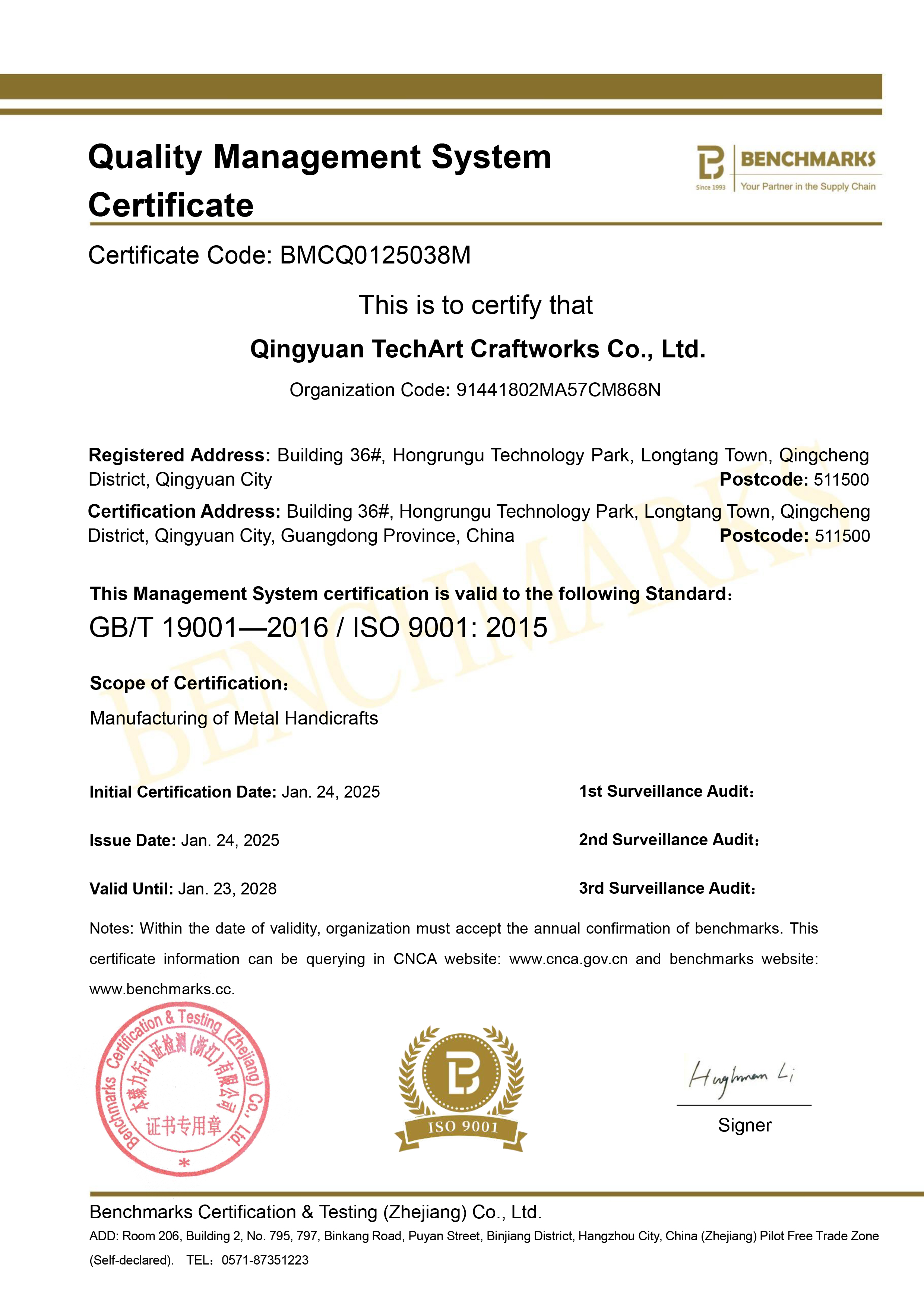
Certificate BMCQ0125038M certifies a quality management system against GB/T 19001—2016 / ISO 9001:2015, for the manufacturing of metal handicrafts, and remains valid until 23 January 2028. A keychain or metal key ring falls inside that activity description: both are metal decorative and functional goods produced by die casting, stamping, enamel filling, plating and assembly. The scope therefore covers the process, even though the word “keychain” does not appear.
What the buyer should confirm is the legal entity on the certificate, not the trading name on the website. If the name on the certificate differs from the name on the purchase order, ask for the relationship in writing — whether an affiliate, a second production site, or a trading intermediary. A QMS certificate is issued to a defined organisation at a defined location, and it does not automatically extend to a sister plant.
Equally important is what the certificate does not say. ISO 9001 certifies that a documented quality management system is in place and audited; it does not certify that any individual keychain meets a dimensional tolerance, a plating thickness or a colour match. Those outcomes are controlled through order-level inspection records, which is a separate layer of evidence discussed further below.
ISO 14001 BMCE0125023M and ISO 45001 BMCS0125023M: the parallel scope line
The environmental certificate BMCE0125023M covers “environmental management activities involved in manufacturing of metal handicrafts” and the occupational health and safety certificate BMCS0125023M covers “occupational health and safety management activities involved in manufacturing of metal handicrafts”. Both carry the same issuing body and the same validity dates as the quality certificate.
For a procurement reviewer, the practical meaning is that environmental controls and worker-safety controls at the producing site have been audited by the same body under the same standard family — GB/T 24001—2016 / ISO 14001:2015 and GB/T 45001—2020 / ISO 45001:2018 respectively. This is the pair that supplier codes of conduct most often request from promotional-gift and souvenir programmes, because plating and enamel lines involve chemical handling and are legitimate areas of concern for brand compliance teams.
The boundary is equally clear: an ISO 14001 certificate is not a product environmental declaration. It does not confirm that a specific keychain complies with EU REACH restrictions or that nickel release from a split ring sits under a given threshold. Those are substance-level questions answered by test reports, not by a management-system certificate.
SMETA 4-Pillar report ZAA600198019: read the report, not the cover
Report ZAA600198019 is a SMETA 4-Pillar audit issued by Intertek Shenzhen, covering Labour Standards, Health & Safety, Environment and Business Ethics, with a stated validity period from 15 April 2026 to 17 April 2028. Structurally, SMETA is an audit methodology and the output is a report — not a conformity certificate of the kind issued under ISO standards. That distinction changes how a buyer should use it.
A certificate answers “does a system exist?”. An audit report answers “what did the auditor observe, and what was agreed afterwards?”. The cover page and the report number confirm that an audit occurred on site within the stated window; the body of the report carries the observations, any non-compliances and the corrective action plan. Buyers who only ask for the cover page are skipping the part of the document that contains risk information.
For a keychain programme, the four pillars map onto concrete order conditions: working hours and wages on the assembly line, chemical handling and ventilation in the plating area, waste management for enamel and solvent residues, and the integrity of subcontracting disclosures. When a supplier shares a SMETA report, request the full document and look at the corrective actions that were still open at the audit date rather than only the headline result.
Disney FAMA 1CAY2KP6YOQ3: a twelve-month authorisation, not a quality mark
FAMA stands for Facility and Merchandise Authorization. The document numbered 1CAY2KP6YOQ3 is issued by The Walt Disney Company, covers the manufacture and distribution of Disney-branded merchandise including Marvel, Pixar and Lucasfilm properties, and is valid from 10 March 2026 to 10 March 2027.
Three verification points follow from that description. The first is the shorter validity period: twelve months, against a three-year ISO cycle, so it is the document most likely to be out of date on a supplier website. The second is the specific scope — it authorises Disney-branded merchandise and nothing else. It says nothing about a supplier's eligibility to produce a football club crest, an anime character or a corporate logo keychain. The third is that FAMA is tied to a facility, which is why the address and legal entity on the authorisation must match the site that will actually run the moulds.
For IP-driven programmes the sequence is straightforward: licensed artwork cannot enter production without authorisation. TechArt states the same precaution in its own order workflow — confirm IP authorisation for licensed artwork before production — and FAMA is the document that satisfies that step for Disney properties.
TCCC Supplier Guiding Principles: what a GREEN rating actually records
The Coca-Cola assessment results letter, referenced SGP-0052001, records that Qingyuan TechArt Craftworks Co Ltd, at Building 36#, Hongrungu Technology Park, Longtang Town, Qingcheng District, Qingyuan City, Guangdong Province, China, was assessed on 15 January 2026 against the TCCC Supplier Guiding Principles / Human Rights Policy and rated GREEN – IN COMPLIANCE.
Two features distinguish this document from the others in the set. It names a full street address, which makes site matching unambiguous, and it is an assessment result rather than a certificate with a multi-year term — no expiry date is recorded on the letter. A buyer should therefore treat it as evidence of the position at the assessment date, and ask how frequently re-assessment occurs rather than assuming the status renews automatically.
The legitimate reading is bounded: the rating confirms compliance with one customer's supplier human-rights standard at one point in time. It is not a general social-compliance ranking and it does not substitute for the SMETA report, which covers a different set of audit criteria.
A five-step verification sequence any buyer can run
The sequence below converts the four-field test into a repeatable check. It takes roughly the time needed to read six documents carefully, and it works for keychain, key ring and metal key fob suppliers regardless of country.
- Match the legal entity and the site. Compare the name and address on each document with the name on the quotation and the address that will receive materials. A certificate held by an affiliate or a trading partner is not the same thing.
- Match the scope wording to your product. Confirm that “manufacturing of metal handicrafts” or an equivalent activity description genuinely describes the item being ordered — die-cast zinc alloy keychains, stamped metal key rings and enamel-filled pendants all qualify; a printed PVC keychain produced elsewhere would not.
- Identify the issuer and the standard version. Record the certification body and the standard reference, including the year. For the ISO trio here, the standards are GB/T 19001—2016 / ISO 9001:2015, GB/T 24001—2016 / ISO 14001:2015 and GB/T 45001—2020 / ISO 45001:2018.
- Check validity against your production window. Compare each expiry date with the planned shipment date, not with today's date. FAMA 1CAY2KP6YOQ3 expires on 10 March 2027; the ISO certificates on 23 January 2028; the SMETA report on 17 April 2028.
- Request the body, not just the first page. For the SMETA report and the Coca-Cola letter, the informative content is inside the document. Ask for the pages that carry findings, corrective actions and the address scope.
A sixth check is optional but cheap: ask the supplier to explain any scope sentence that does not mention the product by name. A supplier that can explain its own certificate scope, in its own words, is demonstrating the kind of document control that a QMS audit is supposed to install.
Where the audit trail stops: four boundaries buyers should state in writing
Certificates are frequently over-read in negotiations, so it is worth being explicit about the four things this document set does not establish.
First, management-system certification is not product conformity. A keychain intended for children under 14 in the United States must comply with ASTM F963-23, mandatory as of 20 April 2024 under CPSC rules; EU-market metal accessories are checked against heavy-metal and nickel-release requirements through test reports. None of the six documents above is a substitute for those reports. TechArt offers optional third-party testing as part of quality control, which is the correct route for order-specific substance compliance.
Second, a brand authorisation is not transferable. FAMA covers Disney-branded merchandise for the named facility. It does not extend to a different IP holder's property, and it does not make the supplier an authorised producer for any other brand.
Third, certificates say nothing about price, capacity or lead time. Those are commercial claims that have to be verified against a named production plan and a sample, not against an audit document.
Fourth, scope definitions vary across the industry, including in market research. Published estimates of the global keychain pendant market ranged from roughly USD 2.5 billion to USD 18.9 billion for 2025 depending on whether luxury bag charms and jewellery-grade pendants were included; one commercial study (Dataintelo, published 2026) put the 2025 figure at USD 6.80 billion with a projection of USD 11.39 billion by 2034 at a 5.9% CAGR. The spread is a reminder that scope wording, not the headline number, determines what a figure actually covers — the same lesson the certificates teach.
From documents to production evidence: the artwork approval and QC chain
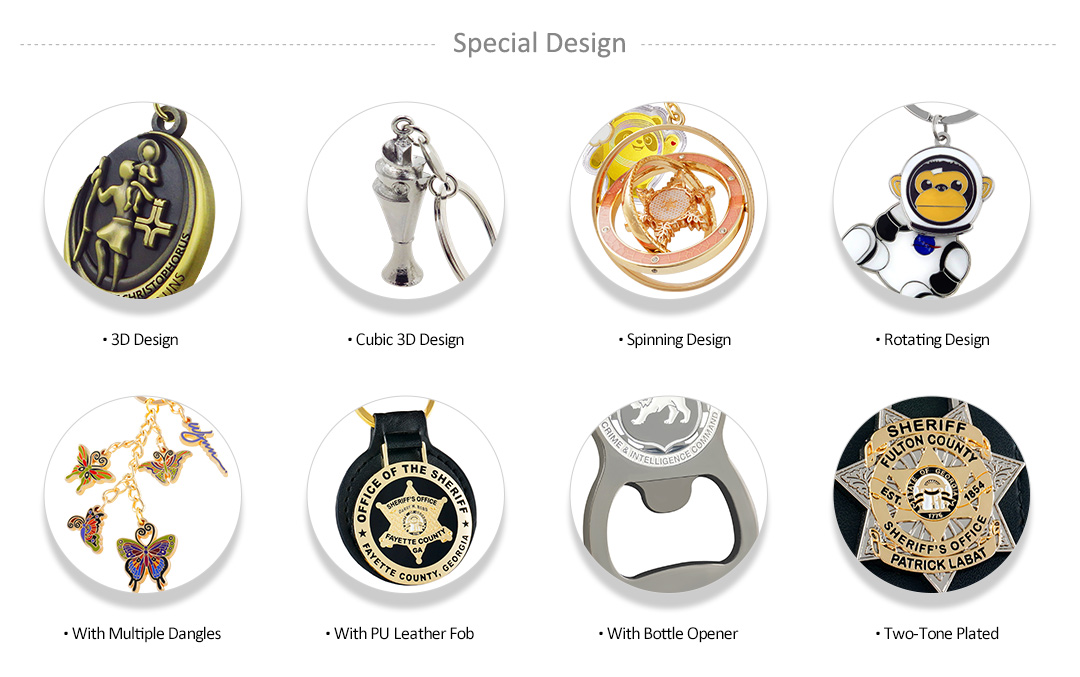
A certificate proves the system exists; the project record proves it ran. The clearest evidence of that second layer sits in the artwork approval and inspection chain used on licensed programmes, and buyers can request the same artefacts on their own orders.
Consider a documented project for a licensed game IP licensee in China, running long-term multi-batch repeat orders at roughly 28,000 pieces annually for official licensed character metal keychains sold through an online store and an offline pop-up shop. The product was a custom zinc alloy keychain with soft enamel and epoxy coating, intricate character cutout shapes, multi-layer colour filling, and silver and antique plating options matched to the character design themes. Each piece carried a custom back stamp with an IP project marking and a sturdy split ring. A 12-person artwork team supports this kind of programme.
The control points in that project are the ones a buyer should look for in any quotation for a custom keychain or key ring:
- Pre-production sample and Pantone colour sign-off before moulds and colour fills are released to the line, so that colour is agreed against a reference rather than a screen.
- Inline inspection during die casting, enamel filling, plating and assembly — the four stages where defect causes concentrate.
- 100% final visual check before packing, rather than a sample check after the cartons are sealed.
- Phased batch delivery for version-update campaigns, so that a character refresh does not require discarding a full annual quantity.
- NDA protection covering artwork, consistent with an IP protection policy under which customer artwork is kept confidential after order completion and is not disclosed.
At programme level, TechArt describes a four-part quality control workflow across its orders: first article inspection, in-process patrol inspection with random spot checks, 100% final visual inspection, and pre-shipment sampling inspection, with optional third-party testing available. Document support on the after-sales side includes product photos, sample videos, test certificates and an NDA, and quality feedback is handled through photo or video evidence submitted within seven days of goods arrival, with re-production of defective pieces, rework or discount negotiation available for factory-caused defects.
The verification lesson is that the two evidence layers answer different questions and both are needed. Ask for the certificate numbers to confirm the systems, then ask for one order's first-article record, colour sign-off sheet and final inspection summary to confirm that the system produced a controlled result on a real metal keychain order.
Order mechanics that the certificates do not cover
Once scope and validity have been checked, the remaining questions are commercial and should be handled with matching precision. TechArt accepts custom keychain orders from a minimum order quantity of 100 units; sampling takes 5–7 days including new mould making; mass production runs 12–20 days after sample approval for ODM work based on existing moulds and 12–30 days for fully custom OEM tooling; monthly capacity is stated at up to 5,000,000 keychains and up to 10,000,000 enamel pins.
Each of those figures is a supplier statement, not an audited fact, and should be written into the purchase order with the same clarity as the certificate numbers. The practical test is whether the supplier can attach the numbers to a specific line, a specific mould and a named merchandiser who tracks sampling, production, inspection and shipment status. Capacity expressed only as a monthly maximum, without a scheduling commitment for your delivery window, is a marketing figure.
The same discipline applies to the ordering sequence itself: send the design or idea; confirm material, craft, plating and quantity; check the quotation and pay the deposit; approve the mockup and sample; start mass production after sample confirmation; then pay the balance and arrange shipment. Every step in that chain generates a document — artwork file, Pantone reference, approved sample, inspection report — and those documents are what a buyer actually audits when a dispute arises.
What to diarise before the next order
The forward-looking point is administrative rather than technical. The document set examined here expires on three different dates: FAMA 1CAY2KP6YOQ3 on 10 March 2027, the ISO trio on 23 January 2028, and the SMETA report ZAA600198019 on 17 April 2028. A buyer running a licensed programme through 2027 should confirm the FAMA renewal well before the March date, and should not treat an expired authorisation as a formality.
For suppliers generally, a simple annual routine covers most of the risk: re-request the numbered documents at each contract renewal, compare the scope line against any new product category being added, and confirm that the site named on the certificate is still the site producing the goods. A custom metal keychain is a low-unit-value item, but it carries a brand's artwork and often a child-safety obligation, and the paperwork behind it deserves the same attention as the sample.
Qingyuan TechArt Craftworks Co., Ltd. publishes its capability documentation in a 2026 brochure available as a PDF at TechArt Craftworks 2026; buyers evaluating this specific document set should request the numbered certificates and the full SMETA report directly rather than relying on any summary, including this one.
FAQ
How can I confirm that an ISO 9001 certificate actually covers keychain manufacturing?
Read the scope line rather than looking for the word “keychain”. Certificate BMCQ0125038M is issued to Qingyuan TechArt Craftworks Co., Ltd. by Benchmarks Certification & Testing (Zhejiang) Co., Ltd. for the “manufacturing of metal handicrafts” under GB/T 19001—2016 / ISO 9001:2015, valid from 24 January 2025 to 23 January 2028. Metal keychains and key rings fall within that activity description, so the test is whether the legal entity, the site address and the process match your order — not whether the product noun appears on the certificate.
What is the difference between a SMETA 4-Pillar report and an ISO certificate?
An ISO certificate confirms that a management system has been audited and certified to a standard. A SMETA report records what an auditor observed during an on-site ethical audit and what corrective actions were agreed. Report ZAA600198019, issued by Intertek Shenzhen, covers Labour Standards, Health & Safety, Environment and Business Ethics and carries a stated validity period from 15 April 2026 to 17 April 2028. Buyers should read the findings and open corrective actions inside the report, not only the cover page.
How long is a Disney FAMA valid, and what does 1CAY2KP6YOQ3 cover?
FAMA 1CAY2KP6YOQ3 is issued by The Walt Disney Company, covers the manufacture and distribution of Disney-branded merchandise including Marvel, Pixar and Lucasfilm properties, and runs from 10 March 2026 to 10 March 2027 — a twelve-month term. It is facility- and property-specific: it does not authorise production for any other brand or IP holder, and because the term is short it should be re-checked before each production cycle rather than assumed current.
What does the Coca-Cola SGP/HRP GREEN rating mean for a keychain buyer?
The assessment results letter, referenced SGP-0052001, records that Qingyuan TechArt Craftworks Co Ltd at Building 36#, Hongrungu Technology Park, Longtang Town, Qingcheng District, Qingyuan City, Guangdong Province, China, was assessed on 15 January 2026 against The Coca-Cola Company's Supplier Guiding Principles / Human Rights Policy and rated GREEN – IN COMPLIANCE. It is a point-in-time assessment result tied to a named address, with no expiry date recorded on the letter, so it should be read as evidence of status at the assessment date.
Do these certificates replace product safety test reports for keychains?
No. Management-system certificates and brand authorisations do not certify the substance content or mechanical safety of an individual product. Keychains intended for children under 14 in the United States must comply with ASTM F963-23, mandatory as of 20 April 2024 under CPSC rules, and EU-market metal accessories are supported by heavy-metal and nickel-release test reports. TechArt offers optional third-party testing within its quality control process; those order-specific reports, not the ISO or FAMA documents, are the correct evidence for product-level compliance.
What production records should I request alongside the certificate numbers?
Request one real order's control documents: the pre-production sample and Pantone colour sign-off, the first article inspection record, inline inspection notes covering die casting, enamel filling, plating and assembly, the 100% final visual inspection summary, and the pre-shipment sampling result. On licensed programmes, also request the artwork approval trail and confirmation that IP authorisation was verified before production began. These records show whether the certified system produced a controlled outcome on a comparable custom metal keychain order.
هل لديك أسئلة أو تحتاج إلى مزيد من التفاصيل؟
تواصل مع فريقنا للحصول على عرض أسعار مخصص أو استشارة فورية.
طلب عرض أسعار
املأ النموذج أدناه وسيتواصل معك فريقنا بعرض مقترح مخصص.
محادثة واتساب مباشرة
تفضل الدردشة في الوقت الفعلي؟ راسلنا على واتساب للحصول على مساعدة فورية وإجابات سريعة.
- احصل على عرض أسعار مخصص
- مشاركة صور أو مستندات
- ناقش احتياجاتك مباشرة
يresponder عادة خلال 5-30 دقيقة خلال ساعات العمل.