
Kids Balance Bike for Toddlers: A Compliance and Specification Guide
Kids Balance Bike for Toddlers: A Compliance and Specification Guide
The global balance bike market is projected to reach approximately USD 1.43 billion by 2026, according to The Business Research Company, and is forecast to grow at a CAGR of 7.2% between 2026 and 2033 by Coherent Market Insights. A substantial share of that volume sits in the toddler and preschool segment: 12-inch, pedal-free bikes bought by parents, kindergartens, distributors and private-label brand owners. For buyers working through research and evaluation, the practical question is no longer which model photographs best. It is which toddler balance bike configuration can be documented, tested and shipped against the standard the destination market actually enforces — and at what landed cost.
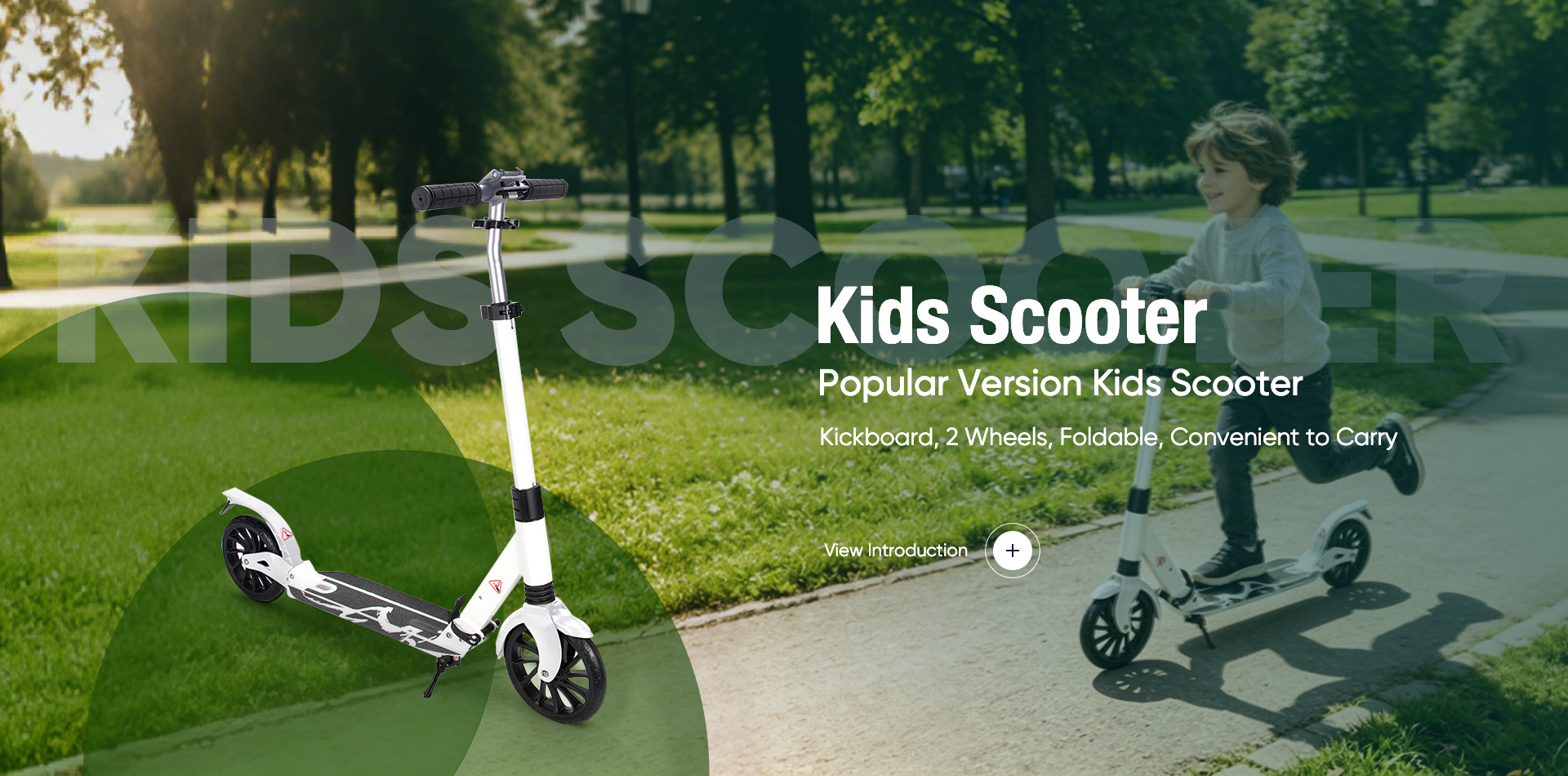
Toddler balance bikes are sold through home retail, kindergarten fleets, gift channels and private label, each with a different documentation burden.
Why Toddler Balance Bike Sourcing Has Turned Into a Constraint Problem
Three constraints now decide whether a toddler balance bike order moves forward: conformity, physical fit for a 2–4 year old, and the maintenance cost of a fleet or a retail programme.
On conformity, EN71-1:2026 introduces mandatory performance testing for all ride-on toys including balance bikes in the European Union, effective from 1 January 2026. At the same time, balance bikes without pedals are classified under HS Code 95030010, which places them in the wheeled toy tariff line rather than the bicycle line. Those two facts together explain a recurring procurement problem: a supplier catalogue may print a single “CE” mark while the certificate behind it names a standard that the buyer’s retail channel, customs broker or institutional tender does not actually accept.
On physical fit, a toddler balance bike has to let the rider sit with both feet flat on the ground and control the machine by walking and coasting. That makes wheel diameter, saddle height range and total weight specification questions rather than styling questions.
On maintenance, a kindergarten or retail chain is not buying one bike. It is buying a fleet that will be stored outdoors, shared between children and returned to service repeatedly. Tyre type and hardware simplicity therefore carry more weight in the total cost of ownership than the purchase price per unit.
A Specification Framework for Toddler Balance Bikes
The framework below converts those three constraints into verifiable items. It is designed to be used as a buyer-side checklist against a supplier datasheet or a sample, rather than as a marketing comparison.
| Constraint area | What it controls | What a buyer should be able to verify |
|---|---|---|
| Wheel diameter and standover height | Whether a 2–4 year old can place both feet flat on the ground while seated | Stated wheel diameter, saddle height range, and confirmation that the frame will not be outgrown within one season |
| Unit weight | Whether a toddler can lift and steer the bike without adult handling | Frame weight and total bike weight, quoted separately rather than as a single figure |
| Frame and fork material | Weight, rigidity, corrosion behaviour and repair economics | Material grade stated per component, not only for the frame |
| Tyre and rim specification | Shock absorption, puncture behaviour and replacement frequency | Tyre type, rim material and whether the tyre is serviceable or sealed |
| Braking method | Stopping control for the age group and the supervising adult | Which brake is fitted and how it is actuated |
| Saddle and grip adjustability | Service life across growth stages and shared institutional use | Adjustment mechanism and the material of grips and saddle |
| Surface treatment and contact points | Durability of finish and comfort at the hands and headset | Coating method, headset material and grip compound |
| Documentation pack | Customs clearance, retail listing and tender eligibility | Certificate, standard number, issuing body, applicable market and product scope |
The ACOPLEX Toddler Range: Three Documented Configurations
The toddler balance bike range examined in this guide is supplied by Wuxi Purino International Trade Co., Ltd, a trading enterprise based in Wuxi, Jiangsu Province, China, founded in 2016, which supplies electric bicycles, kids scooters and children balance bikes and exports 100% of its output to markets including the EU and the USA. The balance bike range carries the ACOPLEX brand identity. The supplier’s model lineup for this segment is documented in three configurations, and the differences between them map directly onto the constraint framework above.
| Model | Frame and fork | Wheel, tyre and rim | Drive, brake and notable parameters |
|---|---|---|---|
| AME-1201 | Magnesium frame with steel fork | 12-inch wheel, air tyre with aluminium rim | 180W motor, 24V 2Ah battery, maximum speed 14.5 km/h, Bluetooth function |
| AME-1202 | Magnesium alloy frame and fork with suspension | 12-inch wheel, air tyre with aluminium rim | 24V 200W brushless motor, 18650 lithium battery rated 2,500 mAh / 3C at 22.2V (55.0Wh), 6S1P configuration, maximum speed 12 km/h; 6 / 12 / 18 km/h three-mode operation when a digital display is fitted. Full powder coating, metal headset, TPR soft handle grips |
| 2-In-1 Kids Bike | Steel frame and steel fork | PP rim with rubber tyre | Rear band brake; converts to a balance bike by removing the chain, crank and pedals; available in 12-inch, 14-inch and 16-inch sizes; high container loading capacity |
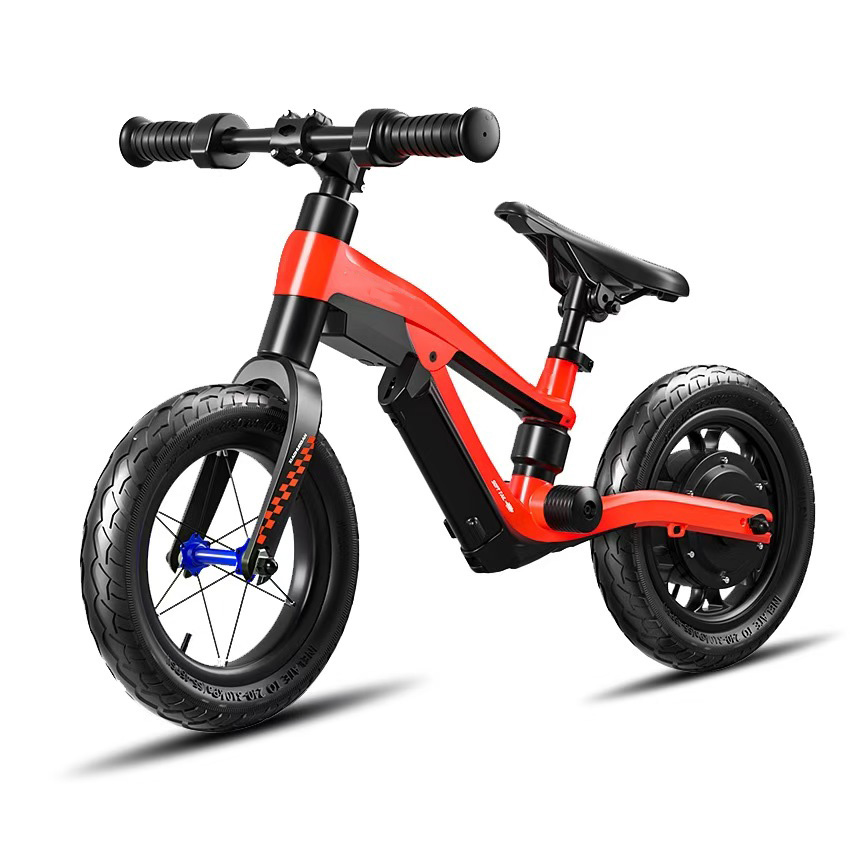
The AME-1202 configuration: magnesium alloy frame and fork with suspension, 12-inch air tyre on an aluminium rim, full powder coating and TPR grips.
Two observations matter for evaluation. First, the AME-1201 and AME-1202 are specified with an aluminium rim and an air tyre rather than a foam or sealed tyre, which shifts them towards ride comfort and away from zero-maintenance operation. Second, both of those models are documented with an electric drive, which places them outside the conventional pedal-free toddler balance bike category and raises a separate regulatory question that the buyer must resolve before ordering.
Certification Boundaries: EN15194, EN 71-1:2026 and the Documentation Gap
Certification is where most toddler balance bike evaluations stall, because two different conformity routes are frequently mixed together in sales materials.
The published certification record for the AME-1202 children balance bike lists EN15194 as the applicable standard, with CE type certification issued by TUV and the European Union as the applicable market. The same record states explicitly that the applicable standard is EN15194, not EN 71. The same EU certification footprint covers the supplier’s electric bicycle models: the TRAVEL electric city bike, the ROCKET electric mountain bike and the UNICORN electric city bike are each covered by EN15194 certification issued by TUV for the EU market.
Practical consequence: a certificate is only useful to a buyer when the standard number on it matches the standard the buyer’s channel enforces. EN71-1:2026 is the ride-on toy route that applies to balance bikes in the EU from 1 January 2026. EN15194 is the standard the supplier cites for the AME-1202. Buyers targeting toy retail, kindergarten tenders or marketplace listings that request EN 71 test reports should confirm the scope of the documentation provided for the specific model and destination market before committing to volume.
This is not a defect in the product record; it is a scoping question. A balance bike with a 200W brushless motor and a 55.0Wh lithium battery is not the same regulatory object as a pedal-free wooden or steel balance bike, even though both may be described as a children balance bike. Treating the certificate as transferable between those two objects is the single most common documentation error in this category.
Frame Material and Weight: Magnesium, Steel and Aluminium
Frame material is the parameter that most directly determines whether a toddler can handle the bike independently. Third-party manufacturer data published by Montasen reports that magnesium alloy integrated casting frames for balance bikes weigh approximately 680g, with total bike weight around 3.1 kg for 12-inch magnesium alloy models. That figure is the reason magnesium appears repeatedly in premium toddler and preschool specifications.
In the ACOPLEX range, magnesium appears in two different ways. The AME-1201 pairs a magnesium frame with a steel fork, which balances lightweight performance against structural durability. The AME-1202 uses magnesium alloy for both frame and fork and adds suspension, which targets shock absorption and ride comfort for daily use.
Steel occupies the other end of the trade-off. The 2-In-1 Kids Bike uses a steel frame and steel fork, described by the supplier as offering solid support and long service life. Steel is heavier per unit, but it is easier to repair, simpler to source consistently across large volumes and, per the supplier’s own case summary, combined with EVA tyres it delivers a durability and cost advantage for institutional procurement.
Aluminium does not appear in the frame specifications of the three documented balance bike models; in this range it appears as a rim material. That distinction is worth noting because buyers often conflate “aluminium bike” with “aluminium rim” when reading abbreviated catalogue data.
Tyres and Maintenance Economics
Tyre choice is where the purchase price and the total cost of ownership diverge most sharply, and the supplier’s case documentation makes the split explicit: aluminium rims with CST inflated tyres are positioned for comfort, while steel with EVA tyres is positioned for durability and cost advantage.
In the documented toddler range, the split looks like this:
- Air tyre with aluminium rim — specified on the AME-1201 and AME-1202. Softer ride and better shock absorption; requires attention to tyre pressure and puncture repair.
- PP rim with rubber tyre — specified on the 2-In-1 Kids Bike. Described as wear-resistant and adaptable across ground conditions, with no inflation requirement in the documented specification.
- EVA tyres — available as a customisation option alongside CST and air tyre selection, and the configuration the supplier associates with low-maintenance institutional supply.
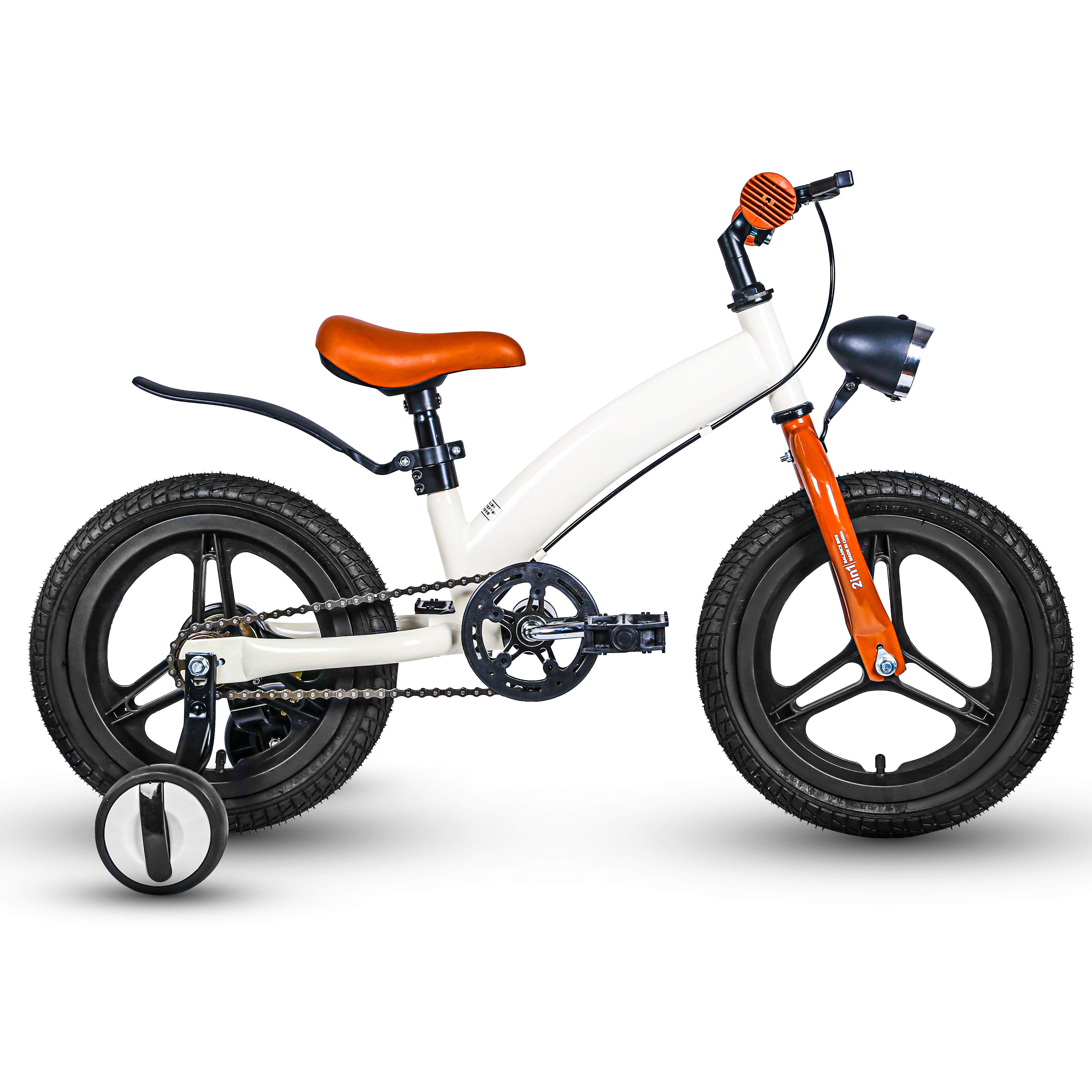
The 2-In-1 Kids Bike uses a steel frame and fork, PP rim with rubber tyre and a rear band brake, and converts from pedal bike to balance bike by removing the chain, crank and pedals.
For a kindergarten fleet or a rental programme, tyre selection is effectively a service-interval decision. For a retail or gift channel, it is a perceived-quality decision. Neither answer is universally correct, which is why the tyre specification should be confirmed in writing per purchase order rather than inferred from a general catalogue.
Application Fit: Home Play, Kindergarten Fleets and Private Label
The documented application profile for this product family covers daily home outdoor and indoor play, kindergarten group use, and bulk delivery to retail stores or educational institutions. The specified project types are bulk procurement, kindergarten equipment, and OEM and private-label sales, across markets including Australia, Belgium, Canada, Switzerland, Germany, Denmark, Finland, France, the United Kingdom, Greece, Hungary, Japan, Korea, Poland, Singapore, the United States, Spain, Hong Kong, Ireland, Macao, Mexico, the Netherlands, Norway, New Zealand, Portugal and Sweden.
Three application details change the specification conversation in practice:
- Group use in kindergartens requires colour and label customisation so that bikes can be assigned, counted and replaced consistently within a fleet.
- Institutional procurement typically requires a quality report alongside the shipment, in addition to the standard certificate pack.
- Bulk packaging is specified as a distinct requirement for institutions, and the 2-In-1 Kids Bike notes high container loading capacity as a direct contributor to lower ocean freight cost per unit.
Matched equipment commonly ordered alongside toddler balance bikes includes children’s helmets, elbow and knee pads, replacement saddles, spare inner tubes and wheels, and custom packaging and labels. Buyers assembling a complete programme generally evaluate these as one landed package rather than as separate line items.
Market Trend Analysis: Growth, Concentration and Where Differentiation Is Falling
Published market sizing for this category converges on growth but diverges on scope. The Business Research Company projects the global balance bike market reaching approximately USD 1.43 billion by 2026, while Coherent Market Insights forecasts a 7.2% CAGR from 2026 to 2033. Earlier 2025 estimates range between roughly USD 1.05 billion and USD 1.33 billion depending on how narrowly the category is defined — a spread that reflects scope differences rather than a disagreement about direction.
At the top of the market, concentration is significant. Fortune Business Insights reports that Giant Bicycles and Trek Bicycle Corporation lead the kids’ bicycle market with 15% and 12% market share respectively in 2025. For independent suppliers and trading enterprises, that concentration has a practical implication: competing on brand recognition at retail is not a realistic route, whereas documented compliance, verified material specification and OEM flexibility are.
Two structural trends follow from this. First, the shift of EN71-1:2026 to mandatory performance testing for ride-on toys raises the documentation bar for every supplier selling into the EU from 1 January 2026, which favours suppliers who already maintain certificate records with named standards, issuing bodies and market scope. Second, frame material is becoming a visible differentiator rather than a hidden one: magnesium alloy integrated casting, at approximately 680g per frame and around 3.1 kg total bike weight on 12-inch models, sits clearly apart from conventional steel construction and is priced accordingly.
Classification is also worth monitoring. Because balance bikes without pedals fall under HS Code 95030010, tariff treatment follows the wheeled toy line, and the explanatory description of a shipment matters as much as the product itself — particularly where a model includes an electric drive.
How This Compares With Traditional Steel-Frame Supply — and Where the Limits Are
The traditional default in toddler balance bike supply is a steel frame with a steel fork, a sealed or foam tyre, a simple rear brake, no suspension and a minimal documentation pack. It remains a defensible choice: steel is durable, easy to repair, straightforward to reorder in volume and, combined with EVA tyres, structurally low-maintenance. The 2-In-1 Kids Bike follows that logic deliberately, and the supplier positions it explicitly on durability and cost advantage rather than on weight.
The trade-off runs in the other direction for the magnesium configurations. Magnesium alloy reduces frame mass substantially — approximately 680g for an integrated casting frame, with roughly 3.1 kg total bike weight on 12-inch magnesium models — and the AME-1202 adds suspension for shock absorption. What the buyer pays for is weight and comfort, not durability, and the two should not be presented as interchangeable.
Buyers should also treat several points as open until confirmed in writing:
- Quality control detail is not publicly specified. The supplier’s published material references quality control and pre-shipment inspection services but does not set out detailed QC procedures or standards. Incoming material checks and pre-shipment inspection are the typical components of such a process, not a documented commitment. Buyers with tender requirements should request the inspection protocol explicitly.
- Warranty and return terms require confirmation. Product consultation, logistics coordination and after-sales support are offered, but specific warranty terms and return or exchange policies are not published and must be agreed per contract.
- Order economics impose planning constraints. The documented minimum order quantity is 100 units with a lead time of 45–60 days, against a stated monthly capacity of 10,000 units. That lead time is workable for programme buying but tight for rapid replenishment or test-and-learn launches.
- Standard scope must be matched to the model. The certification record covering the AME-1202 cites EN15194 and states it is not EN 71, while EN71-1:2026 is the ride-on toy requirement applying to balance bikes in the EU. Where a channel demands a toy-standard report, that gap has to be closed before ordering.
- Electrified variants sit outside the standard toddler use case. The AME-1201 and AME-1202 are documented with electric drives rated 180W and 200W respectively and top speeds of 14.5 km/h and 12 km/h. Regardless of specification quality, a buyer introducing these into a toddler or preschool programme should complete its own regulatory and liability review first.
A Procurement Checklist for Toddler Balance Bike Orders
- Confirm the certificate names a standard number, an issuing body, an applicable market and the exact product model — and that this standard matches the one your retail channel or tender requires.
- Request frame weight and total bike weight as separate figures, not a single claimed weight.
- Confirm frame material and fork material independently; the two are not always the same.
- Decide tyre strategy per channel: air tyre on aluminium rim for comfort, EVA for low maintenance, PP rim with rubber tyre where sealed construction is preferred.
- Verify saddle height adjustment range against the target age band and shared institutional use.
- Confirm brake type and actuation method against the age group and supervision model.
- Confirm customisation scope in writing: frame colour and logo, packaging and accessories, tyre type, saddle and grip material.
- Agree MOQ, lead time and monthly capacity against your own replenishment cycle; the documented baseline is 100 units MOQ, 45–60 days lead time and 10,000 units monthly capacity.
- Request the inspection protocol and the quality report format before shipment.
- Review the packaging plan against container loading, particularly for the 12-inch, 14-inch and 16-inch 2-In-1 configuration.
Future Outlook
Three developments are likely to shape toddler balance bike sourcing through the next cycle. The first is documentation. With EN71-1:2026 mandatory from 1 January 2026, suppliers who can produce a certificate that names the standard, the issuing body and the product scope in a single, consistent record will face fewer buyer-side delays than suppliers relying on a generic conformity claim. The second is material stratification. Magnesium alloy construction at approximately 680g per frame and around 3.1 kg total weight on 12-inch models has moved from a niche premium claim to a documented specification point that buyers can verify and compare, while steel retains its position in cost-sensitive institutional supply. The third is category definition. As balance bike models acquire motors, batteries and speed modes, the boundary between a ride-on toy and a powered micro-vehicle becomes a purchasing question rather than a technical footnote, and buyers who resolve that boundary early will avoid the most expensive mistake in this segment.
FAQ
What size balance bike is appropriate for a toddler?
In the documented ACOPLEX range, the AME-1201 and AME-1202 are both 12-inch wheel models, which is the size typically used by toddlers and younger preschool riders. The 2-In-1 Kids Bike is available in 12-inch, 14-inch and 16-inch sizes, allowing a programme to cover a wider age band with one model family. The operative check is not the wheel size alone but whether the rider can sit with both feet flat on the ground, which depends on the saddle height range as much as on the wheel diameter.
Which frame material should a buyer choose — magnesium, steel or aluminium?
Magnesium alloy reduces weight: third-party manufacturer data from Montasen reports that integrated casting frames for balance bikes weigh approximately 680g, with total bike weight around 3.1 kg on 12-inch magnesium models. In this range, the AME-1201 pairs a magnesium frame with a steel fork, while the AME-1202 uses magnesium alloy for both frame and fork with suspension. The 2-In-1 Kids Bike uses a steel frame and steel fork, which the supplier positions on solid support and long service life. Aluminium appears in this range as a rim material rather than a frame material. Buyers optimising for handling should evaluate magnesium; buyers optimising for repair simplicity and volume cost should evaluate steel.
How do EVA tyres compare with inflated tyres for institutional use?
The supplier’s case documentation states that aluminium rims with CST inflated tyres are positioned for comfort, while steel with EVA tyres is positioned for durability and cost advantage. Within the range, the AME-1201 and AME-1202 are specified with air tyres on aluminium rims, and the 2-In-1 Kids Bike with PP rims and rubber tyres. EVA, CST and air tyre options are all available as customisation choices. For kindergarten and rental fleets, EVA removes inflation and puncture maintenance from the service cycle; for retail and gift channels, inflated tyres tend to be associated with a softer ride and a higher perceived specification.
Which certifications apply to kids balance bikes sold into the EU?
Two different routes are relevant. EN71-1:2026 introduces mandatory performance testing for all ride-on toys including balance bikes in the European Union, effective from 1 January 2026. Separately, the published certification record for the AME-1202 children balance bike lists EN15194 as the applicable standard, issued by TUV and applied to the EU market, and states explicitly that the applicable standard is EN15194, not EN 71. The same EN15194 certification footprint covers the supplier’s TRAVEL, ROCKET and UNICORN electric bicycle models for the EU market. Buyers should confirm which standard their retail channel or tender requires for the specific model, and verify that the certificate scope matches it.
What are the minimum order quantity and lead time for bulk balance bike supply?
The documented supply terms for this product family are a minimum order quantity of 100 units, a lead time of 45–60 days and a stated monthly capacity of 10,000 units. Production is organised through a trading and supply-chain export model that covers product consultation, customisation and order processing. Buyers planning seasonal or promotional programmes should build the 45–60 day lead time into their order calendar, and should confirm capacity allocation for peak periods rather than assuming availability on demand.
Can toddler balance bikes be customised for private label and kindergarten programmes?
Yes, within the documented customisation scope. Available options include frame colour and logo, packaging and accessories, tyre type selection across EVA, CST and air tyres, and saddle and grip material customisation. The application record for this product family specifies colour and label customisation, tyre type selection and bulk packaging for institutions, along with quality report requirements. Matched equipment such as children’s helmets, elbow and knee pads, replacement saddles and spare inner tubes or wheels is also ordered alongside the bikes. Buyers should confirm the exact customisation scope, artwork approval process and packaging specification in writing before production begins.
This industry reference was compiled from product specification records, certification records and application data provided by Wuxi Purino International Trade Co., Ltd, together with third-party market and standards sources cited inline. Product information reflects the documented models AME-1201, AME-1202 and 2-In-1 Kids Bike. Company reference: purinocycle.com. Specifications, certification scope and commercial terms should be confirmed directly with the supplier before ordering.