
Kraft to Coated Board: Multifunctional Digital Printing Fit
Kraft to Coated Board: Multifunctional Digital Printing Fit
A multifunctional digital printing machine earns its place in a packaging plant when one unit can carry an order from uncoated brown kraft through to coated white board without a second press, a plate change or a separate proofing route. GOKING's 2-in-1 platform is built around that span: a scanning, multi-pass carriage handles complex or large-format boards, a direct-output single-pass path handles small boards and small-batch orders, a vacuum adsorption platform holds the sheet, feeding can be leading-edge or belt, and production efficiency is stated as 700 or 1500 m²/h depending on configuration.
What follows is a scenario map rather than a specification sheet. It places the machine against three settings that buy this class of equipment — a corrugated and kraft converter, a paper mill or coated-board operation, and a gift-box or folding-carton department — and it marks the point where the fit weakens. GOKING (Guangdong Goking Intelligent Technology Co., Ltd.) is a Dongguan-based manufacturer founded in 2020, operating a 10,000 m² facility with 38 R&D engineers, 152 employees and an annual output of 864 sets; roughly 49% of output is exported to the EU, Africa, Latin America, Russia, Kazakhstan and Turkey.
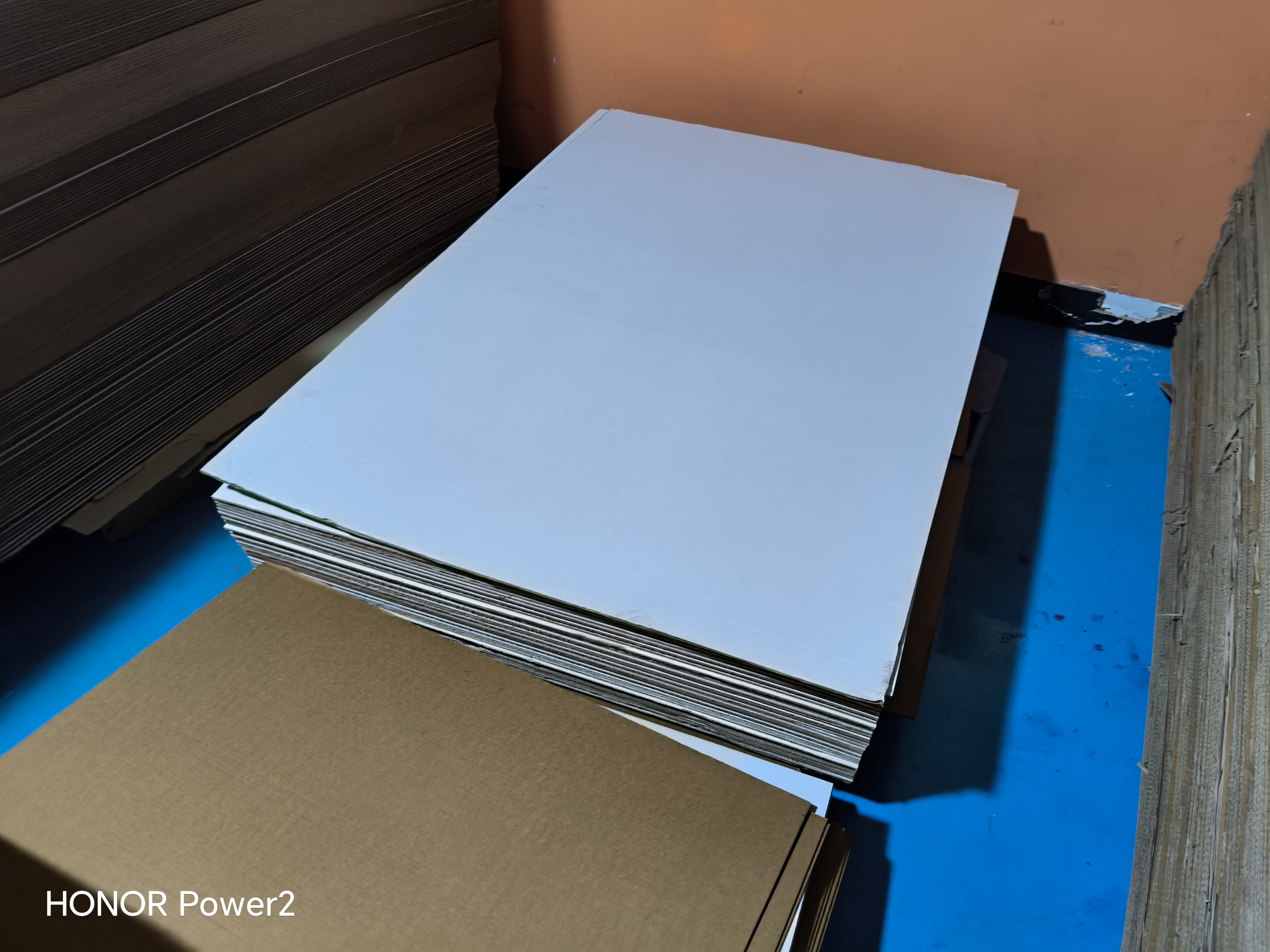
Four variables decide whether a scenario fits
A machine is never bought against a single substrate. It is bought against a job mix, and four variables in that mix determine whether one 2-in-1 unit replaces two processes or becomes a compromise.
The first is the substrate family: uncoated kraft, white-top kraft, recycled corrugated, coated folding board and heavy coated paperboard each behave differently under an inkjet head. The second is board format and graphic complexity — a 2,600 mm display board and a 400 mm gift-box blank do not make the same demands on a carriage. The third is batch size and changeover frequency, which decides whether raw speed or switching time is the binding constraint. The fourth is feeding and downstream handling: how sheets arrive, how they leave, and whether the line is manual or linked.
GOKING states that its portfolio covers kraft paper through coated paper and single-sheet printing through mass production. That is a range claim, and the practical question for a buyer is narrower: which of the four variables dominates your order book, and which configuration expresses it.
Kraft paper: absorbency, white ink and the economics of no plates
Kraft is uncoated, absorbent and mid-brown. Ink laid directly onto it shifts in tone, and any brand colour that must match a specification usually needs a white base printed first. GOKING lists colour mode as CMYK(W) and an ink set that includes water-based dye ink, water-based pigment ink, coating ink and UV eco-friendly ink. The combination matters, because adhesion, drying and colour behaviour on an open, fibrous surface are ink-and-substrate questions rather than machine-only questions.
White ink on brown board is not a niche idea in this category. EFI states that its Nozomi packaging printers can print directly to kraft with white ink to make colourful images on brown corrugated material — a competitor's own product claim, cited only to show that the workflow is established practice rather than an unusual request when specifying a machine.
The plate-less part is where the economics sit. GOKING describes the purpose of its digital route as replacing plate-based printing, reducing plate costs, reducing setup waste and enabling flexible short-run production. For a converter running repeated short batches of brown boxes with variable print — seasonal variants, regional variants, private-label runs — the value is not only ink on board; it is the absence of a plate cycle between jobs.
Two checks belong here rather than later. Print a sample on the exact kraft grade you buy, not on a generic brown sheet, because fibre, sizing and recycled content change ink take-up. And confirm how the sheet leaves the machine: the specification notes drying after printing for carton work, with other materials depending on the substrate and ink used, so stacking time has to be validated on your own board.
Coated board: what changes when the surface is sealed
Coated paperboard behaves almost like a different process. The surface is smoother and far less absorbent, so the ink film sits on top, dot gain and registration are read differently, and drying becomes a controlled step rather than a soak-in. GOKING lists coated paperboard among the applicable industries for the machine, alongside the printing and packaging industry and paper mills.
Physical limits define how far that reach extends. The stated material thickness range is 2–30 mm, which covers corrugated board through heavy board stock, and the stated print width range is 264 mm to 2,600 mm. A coated-board operation running large sheets sits near the top of that width range; a gift-box plant cutting small blanks sits near the bottom and rarely uses the full width.
That difference in sheet size is the cleanest way to decide which printing mode a coated-board job should use.

Scanning mode: where complex or large-format boards justify the extra pass
In scanning, or multi-pass, operation the carriage travels over the board repeatedly and the image is built up in successive passes. The trade is straightforward: more time per sheet in exchange for finer control over how the image is laid down.
That makes scanning the sensible route for three job types. The first is large-format work, where a wide board is printed as a single piece and banding or misregistration is immediately visible at viewing distance. The second is graphic work with fine detail — GOKING specifies a minimum digital text height of 1.5 mm in English, a useful reference point when a job carries small regulatory or ingredient type. The third is proofing and sample work ahead of a production run, where the point is to see the final appearance before committing board.
The vacuum adsorption platform does specific work in this mode. On a wide sheet, the risk is that the board lifts or drifts between passes; holding it flat against the platform is what keeps successive passes aligned. GOKING also specifies a magnetic levitation high-precision crossbeam and servo motor drive, which address the same problem — motion stability across a long carriage travel.
The cost of scanning is throughput. It is not the mode to select for a high-volume run of identical small blanks, and a buyer should not accept a scanning demonstration as evidence of direct-output performance, or the reverse.
Direct-output mode: what small boards and small-batch orders gain
Direct output — single-pass — prints the image in one pass of the board beneath the heads. GOKING lists single-pass printing speed at 60 m/min with Epson nozzles and at least 100 m/min with XAAR nozzles, with production efficiency stated as 700 or 1500 m²/h depending on configuration.
For small boards and short batches the gain is not only linear speed. Changeover dominates small-batch work, and GOKING describes the system as featuring automatic colour calibration and automatic job switching. Fewer manual steps between jobs means the machine spends a larger share of a shift printing, which matters more in a plant running twenty jobs a week than in one running two.
This is the mode that fits the small-batch, quick-turnaround model described in GOKING's application material: overseas printing and packaging factories handling short-run, urgent and personalised orders, with the machine specified for mass production, short-run printing, frequent job change and continuous high-speed operation in the same unit.
The practical advantage of a 2-in-1 architecture is that the choice is made per job rather than per machine. A plant does not have to buy a scanning press for its sample room and a separate single-pass press for its short-run line, which changes both capital outlay and floor space. What it does not change is the need to know which mode each order belongs in.
Holding and feeding the board: vacuum platform, leading edge and belt
Two feeding arrangements are specified: leading-edge feeding and belt feeding, with the leading-edge type available as semi-automatic or fully automatic. They suit different handling patterns, and the choice should follow how sheets reach the machine rather than personal preference.
Leading-edge feeding takes a sheet by its front edge from a stack, which fits flat stacked board in a plant where operators load pallets and the machine works job by job. It is the conventional arrangement for a mixed order book. Belt feeding carries the sheet on a conveyor rather than pulling it from a stack, which fits a more continuous flow and is the arrangement to discuss when the printer is expected to sit inside a line rather than stand alone.
The build details support the same reading. GOKING specifies a carbon steel frame, stainless steel conveying rollers, an aluminium alloy beam, a vacuum adsorption platform and a large suction conveyor belt platform. It also specifies a footprint of 4,260 × 2,300 × 1,900 mm, a machine weight of 2,800 kg, rated power of approximately 14 kW, a 380 V three-phase 50/60 Hz supply, and a working environment of 15–32 °C at around 70% humidity.
Those figures are site-planning inputs, not marketing lines. A plant that has not confirmed floor loading, three-phase capacity and humidity control has not finished evaluating the machine, whatever the print samples look like.
The scenario map
The table below translates the four variables into three settings. It is a starting position for a specification conversation, not a substitute for test prints on your own board.
| Production setting | Typical board | Mode emphasis | Feeding and verification focus |
|---|---|---|---|
| Corrugated and kraft converter — short runs, frequent job change | Brown kraft, recycled corrugated, 2–30 mm | Direct output for small and medium blanks; scanning for oversized or highly detailed work | Leading edge, semi-automatic or fully automatic; verify ink adhesion and rub on your kraft grade, plus stacking time after drying |
| Paper mill or coated-board operation — large sheets, quality-led | Coated paperboard and heavy coated stock | Scanning for large-format and fine-detail work; vacuum platform holds the wide sheet flat | Configured print width up to the stated 2,600 mm; verify registration across the full sheet and drying before trimming |
| Gift box and folding carton — small boards, many SKUs | Coated folding board, white-top kraft | Direct output for repeat runs; scanning for proofs and premium graphics | Small-format feeding; verify small-text legibility against the stated 1.5 mm minimum and colour consistency between jobs |
Reading the 700 and 1500 m²/h figures correctly
Those two numbers describe two different builds, not one machine with a fast and a slow setting. GOKING's specification lists printhead counts from 8 to 256, Epson or XAAR nozzles, multiple DPI configurations and five-colour integrated models; production efficiency moves with that configuration.
A buyer comparing quotations should therefore ask three questions behind any headline figure: which printhead type and count the figure refers to, whether it is stated for single-pass operation, and which board size and ink set the figure assumed. A 1500 m²/h configuration quoted against a 400 mm gift-box blank is not comparable with a 700 m²/h configuration quoted against a 2,400 mm sheet.
Print width follows the same logic. The stated range runs from 264 mm to 2,600 mm, so the machine can be specified close to the dominant board size rather than oversized for hypothetical growth. Oversizing costs floor space and capital; undersizing costs a job every week.
Where the fit stops
Boundaries are part of an honest scenario map, and several are visible in the published specification.
- Thickness beyond 30 mm. The stated material range is 2–30 mm. Honeycomb and heavy specialty board outside that band need a separate conversation.
- Boards wider than the configured print width. The range tops out at 2,600 mm; a wider display board belongs to a different machine class.
- Water resistance that has not been demonstrated. GOKING lists water-based dye, water-based pigment, coating ink and UV eco-friendly ink, but the material reviewed here does not publish water-resistance test data. If packed goods must survive condensation or wet handling, that performance has to be proven on your substrate and ink combination rather than assumed from the ink category.
- Regulated ink applications. Food-contact and specific regulatory ink requirements are not documented in the available material and should be settled with the ink supplier before a machine decision.
- Compliance paperwork for the destination market. The EU Machinery Regulation (EU) 2023/1230 becomes fully applicable on 14 January 2027, replacing the previous directive framework. A buyer placing the machine in the EU should request the declaration of conformity and the applicable standards list rather than infer a CE-marked status from a product page.
- Single-product, very high volume. A plant running one board type at maximum volume for years is usually better served by a dedicated single-pass line than by a hybrid.
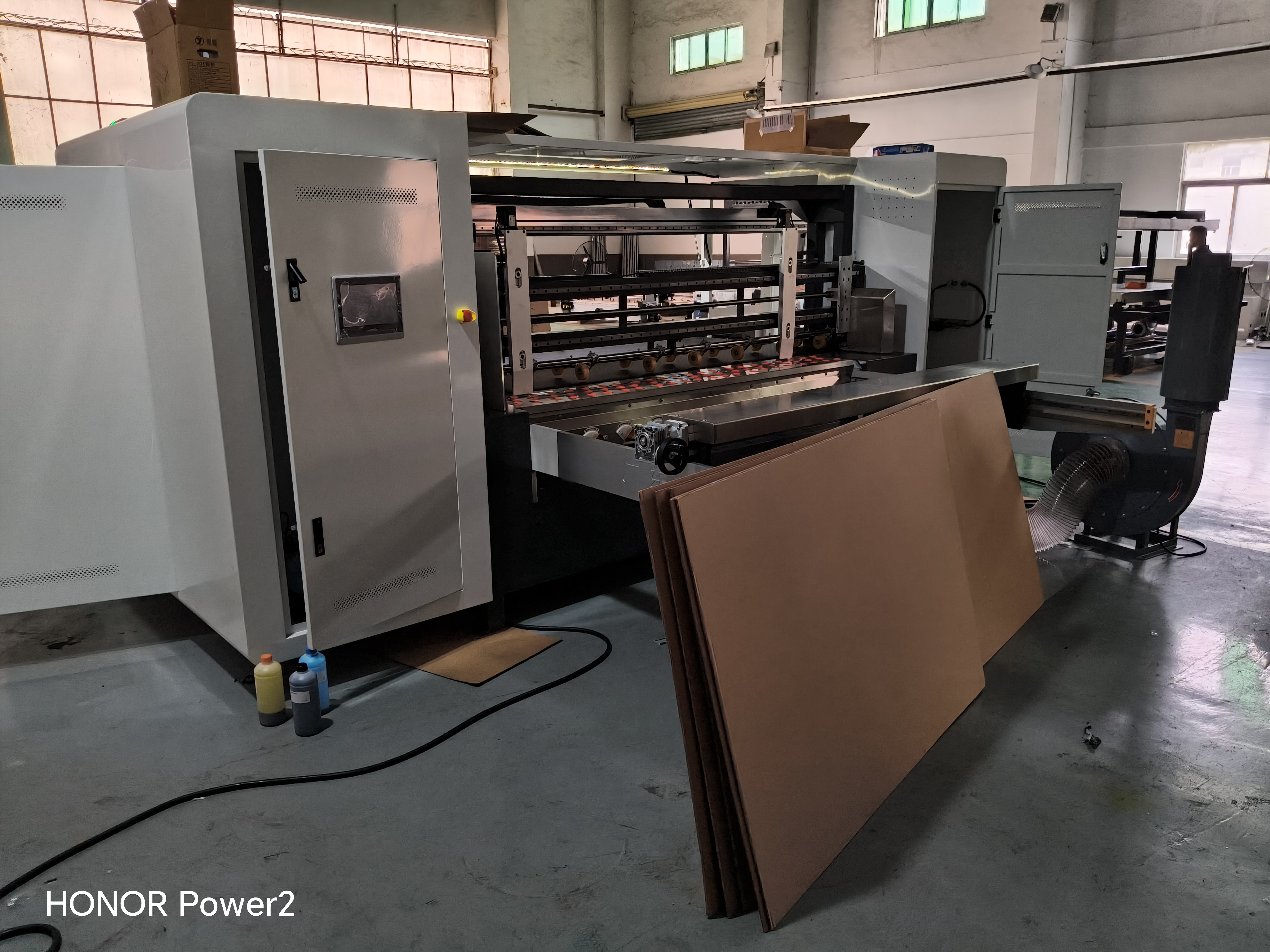
Six checks before committing a production scenario
Verification is where a scenario map becomes a decision. Each check below produces evidence you can hold, not an impression from a demonstration.
- Print on your own board. GOKING offers free sample printing for global clients; use it to test your kraft grade, your coated board and your heaviest stock, not a generic sample.
- Time a real job, not a demonstration job. Measure sheets per hour on your board size in the mode you intend to use, and include changeover between two different jobs.
- Confirm the configuration behind the quotation. Printhead type, printhead count, DPI, colour set and print width should all be written down; the 700 and 1500 m²/h figures mean little without them.
- Check the output details that decide acceptance. Registration across the full sheet, small-text legibility against the stated 1.5 mm minimum, colour consistency between consecutive jobs, and drying time before stacking.
- Confirm workflow and files. GOKING specifies RIP support for direct printing without converting pictures, and file formats PDF, JPG, BMP and TIF — check these against the files your customers actually send.
- Confirm build evidence and support terms. The stated quality routine covers a 100% aging test, long-time running inspection and pre-shipment inspection; installation and commissioning are supported on site by engineers, with a stated response time within 24 hours for after-sales. Standard lead time is typically one month for standard machines, with MOQ of one set and custom or OEM/ODM lead times confirmed per order.
Category context: why mixed-substrate flexibility is being asked for
Two published figures explain the interest in machines that do not force a choice between short-run flexibility and volume. Grand View Research valued the global digital printing packaging market at USD 37.5 billion in 2025. Smithers projected that digital print for corrugated packaging would more than double across 2025–2030, reaching USD 8.2 billion by 2030.
Neither figure says anything about demand for a specific model, and neither should be read that way. What they indicate is a category in which corrugated and coated-board work is being pulled towards shorter runs and more frequent changeovers — the conditions in which a hybrid scanning and direct-output machine stops being a compromise and starts being the configuration that matches the order book.
Compliance is moving in parallel. The EU regulation change in January 2027 tightens documentation expectations for machinery placed on the European market, which puts more weight on the paperwork a supplier can produce at quotation stage.
What to expect next
The direction of travel in this category is fewer machines doing more of the order book. Configurable printhead counts from 8 to 256 already let a buyer start at the scale of current demand and add capacity through printhead and DPI configuration rather than a new platform, and the 2-in-1 architecture means the scanning and direct-output decision is made per job.
What is likely to matter more over the next buying cycle is evidence rather than architecture: substrate-specific print samples, documented drying and adhesion behaviour on kraft and coated board, and compliance documentation that matches the destination market. Buyers who ask for those at quotation stage will get more useful answers than buyers who compare headline square-metre figures alone.
FAQ
Can one machine print both kraft paper and coated board?
GOKING states that its portfolio covers kraft paper through coated paper, and lists paper mills, coated paperboard and the printing and packaging industry as applicable sectors, with a material thickness range of 2–30 mm. That is a range claim rather than a guarantee for every grade. Confirm it with sample prints on your own kraft and coated board, and check ink adhesion and drying on each.
When should scanning mode be used instead of direct output?
Scanning suits complex or large-format boards and fine-detail graphics, because the image is built over successive passes and the vacuum platform holds a wide sheet flat. Direct output suits small boards and small-batch orders, where changeover and cycle time dominate. The same unit covers both; the selection is per job, not per machine.
What is the difference between leading-edge feeding and belt feeding?
Leading-edge feeding takes each sheet by its front edge from a stack and is available in semi-automatic or fully automatic form, which fits pallet-loaded, job-by-job production. Belt feeding carries the sheet on a conveyor and fits a more continuous flow or a line-linked layout. The choice should follow how sheets arrive at the machine.
Should a buyer expect 700 or 1500 m²/h?
Both figures are configuration-level. GOKING's specification lists printhead counts from 8 to 256, Epson or XAAR nozzles and multiple DPI configurations, and production efficiency varies with that build. Ask which printhead type and count, which printing mode and which board size the figure refers to before comparing quotations.
Does the machine handle single sheets as well as mass production?
GOKING describes the range as single-sheet printing through to mass production, with the machine specified for short-run printing, frequent job change and continuous high-speed operation. In practice the difference is expressed through mode and configuration selection rather than through two separate machines.
The manufacturer's 2026 product catalogue, covering the machine range, configurations and stated specifications, is available for download: 2026 product catalogue (PDF).
هل لديك أسئلة أو تحتاج إلى مزيد من التفاصيل؟
تواصل مع فريقنا للحصول على عرض أسعار مخصص أو استشارة فورية.
طلب عرض أسعار
املأ النموذج أدناه وسيتواصل معك فريقنا بعرض مقترح مخصص.
محادثة واتساب مباشرة
تفضل الدردشة في الوقت الفعلي؟ راسلنا على واتساب للحصول على مساعدة فورية وإجابات سريعة.
- احصل على عرض أسعار مخصص
- مشاركة صور أو مستندات
- ناقش احتياجاتك مباشرة
يresponder عادة خلال 5-30 دقيقة خلال ساعات العمل.