
Kyphoplasty Regulatory Claims: CE 0123, EO Sterilization and Single-Use Status
A kyphoplasty purchase decision now begins before the first clinical question is asked. In a supplier audit, three statements are usually checked first: whether the device is single-use, how it is sterilized, and what number sits beside the CE mark. These are not marketing lines. Each one maps to a document a procurement team can request, read and file — which is why they function as first-line verification data rather than sales copy.
This article decodes the qualification landscape of the Changmei kyphoplasty line. Jiangsu Changmei Medtech Co., Ltd. (Changmei), established in 2013 and headquartered in Jiangsu, China, is a medical device manufacturer specialising in minimally invasive surgical instruments, including kyphoplasty balloon catheters, kyphoplasty tool kits and balloon inflators. The focus here is narrow and practical: what is documented, what is not, and how a buyer should read the difference.
The qualification gap between what suppliers claim and what buyers can verify
Most kyphoplasty sourcing conversations start with balloon diameter, gauge and price. Increasingly, they should start with documentation. The reason is structural: regulatory status is model-specific. A certificate covering one catheter does not automatically extend to a tool kit, an inflator, or a customised configuration.
The commercial context reinforces that shift. The global kyphoplasty market was valued at USD 764.13 million in 2025 and is projected to reach USD 1,342.29 million by 2034, according to published market research. North America accounted for a revenue share in the range of 42.5% to 50.0% in 2025 across the available estimates. In the United States, the 2025 Medicare ambulatory surgical centre rate for kyphoplasty (CPT 22513 and 22514) was set at approximately USD 3,510.84, a 3.5% increase over 2024.
Two implications follow. First, as procedures migrate toward ambulatory surgery centres, buyers need documentation packages that travel with the device rather than sit in a hospital quality office. Second, published market sizing deserves caution: one 2025 estimate sits near USD 744–764 million while another reaches USD 1.2 billion, a gap driven by whether bone cement and vertebroplasty procedures are bundled into the definition. Headline market numbers are directional, not precise — the same discipline should be applied to supplier qualification claims.
The single-use question, answered at model level
The Changmei Kyphoplasty Balloon Catheter KB0115 is a single-use device and is EO (ethylene oxide) sterilized. That statement is not a category-level generalisation; it applies to the specific 8G model, and the same construction and status hold across the documented balloon catheter family, including KB0210, KB0210S1, KB0115S1, KB0120 and KB0120S1.
The KB0115 is an 8G inflatable bone tamp intended for percutaneous balloon kyphoplasty, used to reduce and stabilise vertebral fractures and to create a void in cancellous bone for subsequent PMMA bone cement injection. Its documented parameters are:
- Distance between two radiopaque markers: 15 mm
- Channel inner diameter: ≥3.65 mm
- Overall length: 315 mm
- Maximum inflation volume: 4 cc
- Constrained burst pressure: ≥400 PSI
- Size designation: 8G
Every unit is validated for a three-year shelf life and passes factory pressure and seal testing. Reuse and re-sterilization are not permitted; the device is intended for immediate use once the sterile package is opened, and the official instructions for use (IFU) govern handling, contraindications and clinical application.
For procurement, single-use status is not a footnote — it drives inventory rotation, storage conditions, traceability requirements at the point of use, and disposal procedures. A distributor who assumes a three-year shelf life without checking lot dating, or who treats EO-sterilized single-use catheters as returnable stock once opened, is carrying an avoidable compliance risk.
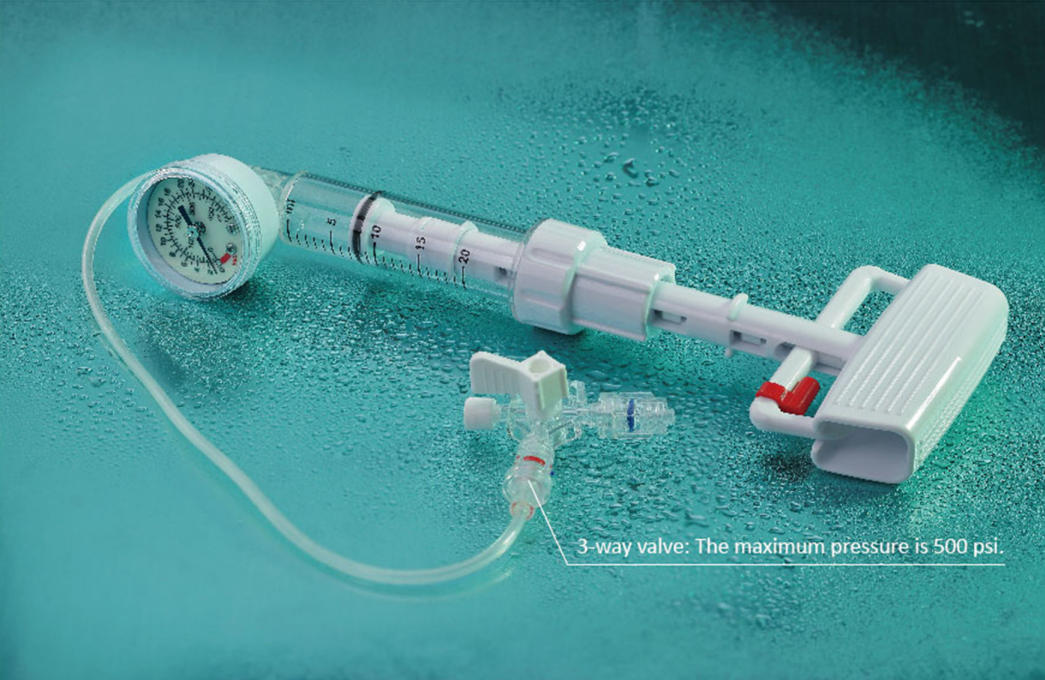
The Changmei Balloon Inflator BI-20A-10 (20 cc nominal capacity, 30 atm maximum pressure) follows the same qualification logic as the catheters: supplied EO-sterilized and single-use, and certified under the EU Quality Assurance Certificate (MDR) for Class I sterile devices.
What EO sterilization actually commits a supplier to
Sterilization method is the second verification point, and EO is the stated method across the documented Changmei kyphoplasty line. The balloon catheters, the KT-00-01 and KT-00-05 tool kits, and the BI-20A-10 balloon inflator are all described as EO sterilized and single-use.
Ethylene oxide is a widely used sterilization route for polymer-intensive sterile devices because it operates at comparatively low temperature relative to heat-based methods, which makes it compatible with assemblies built from thermoplastic polyurethane, polyurethane, polycarbonate, polyoxymethylene, silicone rubber and ABS. That compatibility matters here: the KB0115 combines a TPU balloon film, a PU shaft, a stainless-steel stylet and polycarbonate handle components in a single assembly, and the BI-20A-10 combines PC, PU, silicone, POM and ABS parts.
The boundary to note honestly: the available product documentation states the sterilization method (EO) and the single-use status, but it does not publish EO cycle parameters, residue limits, aeration conditions or bioburden data. Those are legitimate audit questions and should be requested directly from the supplier rather than assumed from the presence of a CE mark.
There is a second, quieter implication. When a device is EO sterilized and single-use, the sterilization responsibility stays with the manufacturer and so does the documentation that supports it. The hospital does not run a reprocessing loop, which removes a validated-cleaning burden but also means the buyer inherits no independent verification — the supplier's sterilisation records and release testing become the only evidence chain.
Reading CE 0123 without over-reading it
The Kyphoplasty Tool Kit KT-00-05 carries a CE mark with the number CE 0123. The four-digit number identifies the notified body that performed the conformity assessment. In Changmei's documentation, that notified body is TÜV SÜD Product Service GmbH.
What the number does not do is describe the device class, the model range or the scope of coverage. Those are defined on separate certificate lines. In practice, the EU qualification rests on three distinct documents:
- EU Quality Management System Certificate (MDR), G100888750012 Rev. 01 — issued by TÜV SÜD Product Service GmbH under Regulation (EU) 2017/745 Annex IX Chapters I and III, covering Class IIa and Class IIb medical devices. This is the certificate line that supports the balloon catheters and the 8G and 11G tool kits.
- EU Quality Assurance Certificate (MDR), G21 088875 0011 Rev. 00 — issued under Regulation (EU) 2017/745 Annex XI Part A for Class I sterile medical devices, applicable to the Balloon Inflator BI-20A-10.
- Quality Management System Certificate, Q5 088875 0008 Rev. 05 — ISO 13485:2016 (EN ISO 13485:2016/AC:2018, EN ISO 13485:2016/A11:2021), issued by TÜV SÜD Product Service GmbH, covering design, development, production and distribution of disposable sterile medical devices across the EU, Asia, Middle East and South American markets.
Two practical boundaries follow. First, the CE mark and its four-digit number say nothing about price, lead time, reimbursement eligibility or clinical preference — they are conformity evidence only, and treating them as commercial proof overstates what they contain. Second, certificates expire. The ISO 13485 certificate referenced above carries an expiry of 7 January 2027, while the MDR quality management system certificate runs to 20 March 2029. A buyer auditing in late 2026 should therefore record the ISO 13485 expiry as a near-term renewal checkpoint and confirm the recertification status before contracting, rather than treating a certificate screenshot as a permanent condition.
Material declarations: TPU and 06Cr19Ni10
The third layer of verification is the material declaration, because materials are inputs to the technical file rather than decorative specifications.
On the balloon catheter, the film is constructed from medical-grade thermoplastic polyurethane (TPU) using a standard four-wing pleating process. That construction is documented as delivering radial support, biocompatibility, environmental stress-crack resistance and smooth passability through the trocar after deflation. The shaft is polyurethane, the marker bands provide fluoroscopic visibility, and a 06Cr19Ni10 stainless-steel stylet reinforces pushability.
On the tool kits, the metal content is split by function. The Kyphoplasty Tool Kit KT-00-05 uses 06Cr19Ni10 medical-grade stainless steel for most metal parts — cannulas, expandor shafts, bone drill body and guide wire core — and 32Cr13Mo stainless steel for the puncture stylet and the puncture expandor cutting tips. Metal shafts are stated to be GB 1220 compliant, and all joints are rated at ≥100 N connection strength, a parameter that matters in tight pedicular navigation where instrument separation or blockage would compromise the working channel.
A useful distinction for auditors: a material grade is not itself a certification. “Medical-grade TPU” and “06Cr19Ni10” describe inputs. Conformity is demonstrated through the ISO 13485-controlled quality system, the technical file and the certificate scope. The correct audit action is to cross-check the material declaration against those documents — not to accept the grade name as standalone proof.
Mapping certificates to the products they actually cover
The most common audit failure is not a missing certificate; it is a certificate that covers something other than what is being purchased. The following mapping reflects what the Changmei documentation states.
| Product / model | Market | Instrument | Reference and scope |
|---|---|---|---|
| Kyphoplasty Balloon Catheter (KB0210, KB0115, KB0115S1, KB0210S1, KB0120, KB0120S1) | US | FDA 510(k) Premarket Notification | K223709; Product Code HRX, Class II, 21 CFR 888.1100; cleared 16 August 2023 |
| Kyphoplasty Balloon Catheter and Tool Kits KT-00-01 / KT-00-05 | EU | CE MDR / EU Quality Management System Certificate | G100888750012 Rev. 01; MDR (EU) 2017/745 Annex IX Chapters I and III; Class IIa and IIb; valid to 20 March 2029 |
| Balloon Inflator BI-20A-10 | EU | EU Quality Assurance Certificate (MDR) | G21 088875 0011 Rev. 00; MDR (EU) 2017/745 Annex XI Part A; Class I sterile; valid to 20 March 2029 |
| Balloon Inflator BI-20A-10 | China | NMPA China Class II | Stated device classification for the inflator; the BI-20A-10 is also described as having a claimed FDA-cleared pathway |
| Balloon Inflator BI-20A-10 and Kyphoplasty Tool Kits | US | FDA Establishment Registration & Device Listing | 3016789487; issued 31 July 2023, valid to 31 December 2029 |
| Full kyphoplasty line | EU, Asia, Middle East, South America | ISO 13485:2016 Quality Management System Certificate | Q5 088875 0008 Rev. 05; issued by TÜV SÜD Product Service GmbH; design, development, production and distribution of disposable sterile medical devices; valid to 7 January 2027 |
Read the table as a routing document. If a buyer is sourcing catheters for the United States, the relevant instrument is the 510(k) clearance K223709. If the buyer is sourcing tool kits for the United States, the relevant instrument is the Establishment Registration and Device Listing 3016789487 — which is a different regulatory mechanism with a different meaning. Conflating the two is one of the most frequent errors in supplier documentation packages.
Turning these claims into a first-line audit checklist
The facts above become useful only when converted into a repeatable verification sequence. For a kyphoplasty line, the first pass can be completed before any factory visit:
- Map certificate to model. Confirm that the certificate line names the exact model being quoted, not a family reference.
- Read the scope line. Check device class and annex reference — Class IIa/IIb under Annex IX is not the same instrument as Class I sterile under Annex XI Part A.
- Record expiry dates. Capture the ISO 13485 expiry (7 January 2027), the EU MDR quality system expiry (20 March 2029) and the US listing validity (31 December 2029) in the supplier file.
- Identify the notified body. The four-digit number beside the CE mark should resolve to a named notified body — TÜV SÜD Product Service GmbH in this case.
- Verify the single-use statement in writing. The KB0115 is single-use and EO sterilized; this should appear on the label, in the IFU and in the technical documentation, not only in a sales presentation.
- Confirm the shelf-life figure. The validated three-year shelf life applies to the documented balloon catheter family; the tool kit documentation does not state an equivalent figure, which is a legitimate follow-up question.
- Request sterilization records. EO cycle parameters, residue limits and aeration data are not published in the product documentation and must be obtained separately.
- Cross-check material declarations. Medical-grade TPU, polyurethane, 06Cr19Ni10 and 32Cr13Mo should align with the technical file and the certificate scope.
- Confirm system-level compatibility. Gauge, channel inner diameter and working length must match across catheter and tray.
- Check the quality system audit trail. The quality system is audited by TÜV SÜD, and manufacturing takes place in a 51,985 m² facility with GMP-class cleanroom production under an ISO 13485-certified system.
Single-use EO kits versus reusable instrument sets: where the real trade-off sits
Traditional vertebral augmentation instrument provision often relied on reusable stainless-steel trays reprocessed in a hospital sterilisation department. The comparison with a single-use, EO-sterilized kit such as the KT-00-05 is not a simple quality contest; it is a trade-off between two different risk models.
| Consideration | Single-use EO-sterilized kit (as documented) | Reusable instrument tray (typical model) |
|---|---|---|
| Sterilization responsibility | Retained by the manufacturer; EO sterilized, single-use | Transferred to the hospital reprocessing cycle |
| Reprocessing validation | Not required at point of use | Requires validated cleaning, inspection and re-sterilization protocols |
| Per-case material cost | Recurring consumable cost per procedure | Higher capital cost, lower marginal cost per case |
| Instrument condition risk | Single-use, factory pressure and seal tested | Depends on inspection discipline and cycle count management |
| Documentation burden | Certificate set and lot traceability | Reprocessing records plus device maintenance records |
The honest boundary is this: the available Changmei documentation establishes single-use status, EO sterilization, material specifications, model parameters and certificate coverage. It does not publish EO cycle parameters, residue limits, comparative cost-per-procedure analyses, or clinical outcome data attributable to a specific sterilisation cycle. A buyer who needs those inputs for a formal tender should request them rather than infer them, and should treat the certificate set as the entry point of the audit, not its conclusion.
Market signals shaping qualification requirements
Three market signals explain why documentation depth is becoming a procurement gate rather than a formality.
First, market growth. A market moving from USD 764.13 million in 2025 toward a projected USD 1,342.29 million by 2034 attracts new suppliers, and a crowded supplier field makes verifiable qualification the cheapest available filter.
Second, the shift of procedures into ambulatory settings. With the 2025 US Medicare ASC rate for kyphoplasty at approximately USD 3,510.84, ASC-based procurement teams — often without a large regulatory affairs function — depend on documentation that is portable and self-explanatory. Certificate-to-model mapping is exactly that kind of asset.
Third, the European regulatory barrier. Changmei Medtech has been reported as the first Chinese company to obtain an EU MDR CE certificate for kyphoplasty system products, and the company reports approximately 80% of the Chinese kyphoplasty balloon catheter market. Both figures are company-sourced claims — the market-share figure in particular is flagged as requiring verification — but they illustrate the direction of travel: EU MDR conformity has become a differentiator rather than a baseline. Manufacturing scale supports the same narrative, with an annual output of 1,000,000 kyphoplasty balloon catheters, 235 employees including 40 engineers, a 30% export ratio, and supply relationships with member companies of Stryker and Medtronic.
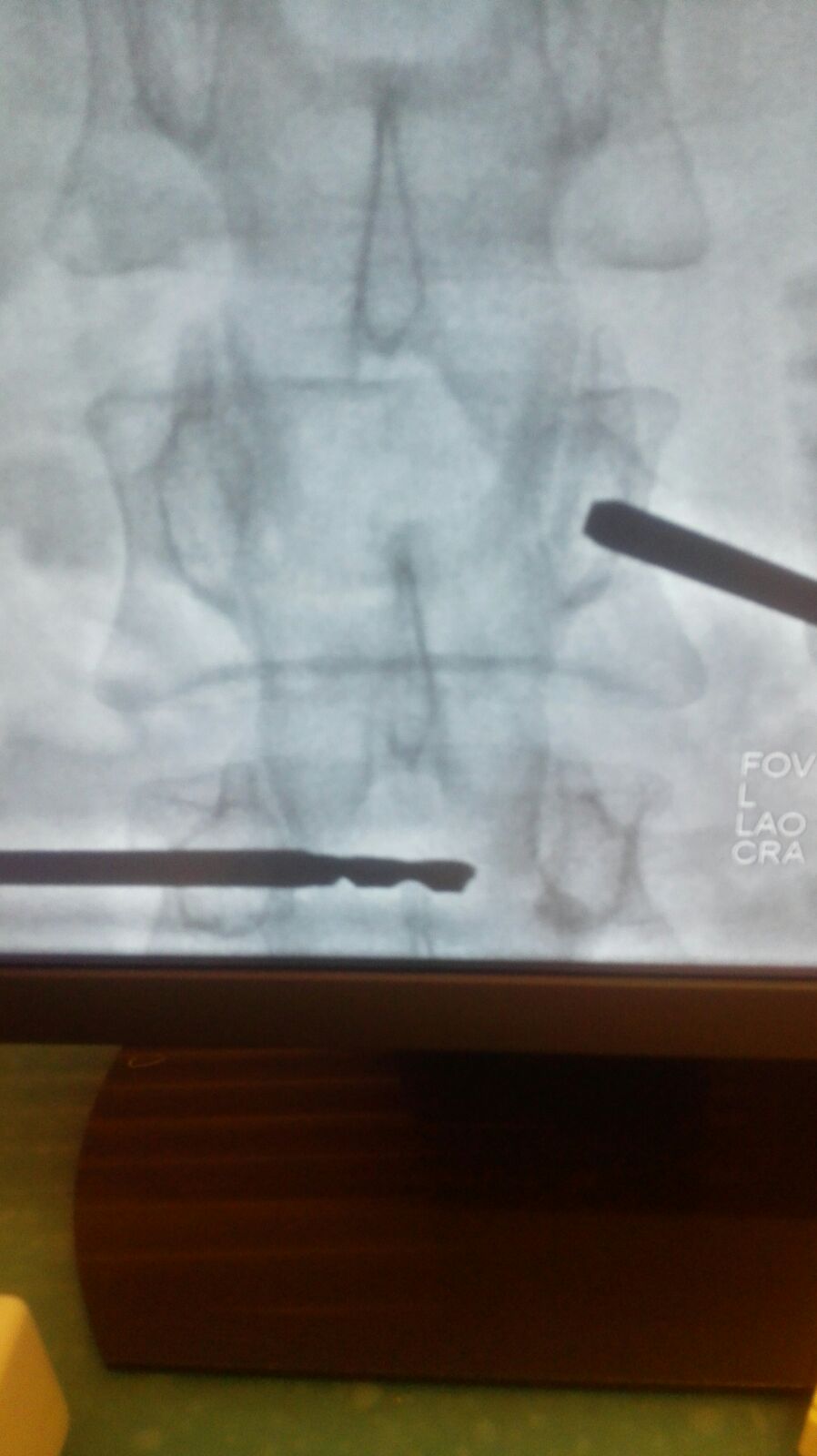
The clinical setting where these qualification claims are tested: percutaneous balloon kyphoplasty for vertebral compression fractures, including egg shell technique cases. Single-use status, sterilization method and material declaration all converge at the point of use.
Future outlook: qualification as a living record
The next stage in kyphoplasty procurement is likely to be administrative rather than technical. Certificate sets have expiry dates, notified bodies issue revisions, and MDR scopes are periodically reviewed. The ISO 13485 certificate referenced in this article runs to 7 January 2027 — meaning that any buyer auditing the line in late 2026 should already be planning a renewal check. Suppliers who publish certificate numbers, scope lines and validity dates in machine-readable form will be easier to keep on an approved-vendor list than those who publish a scanned logo page.
A second development concerns customisation. Changmei supports OEM/ODM customisation across balloon diameter and length, cannula size and length, handle colour and logo, packaging and labelling, as well as gauge, length and instrument configuration at kit level. This flexibility is commercially valuable, but it interacts directly with regulatory scope: a customised configuration remains inside the certified envelope only if the change does not alter the device's intended purpose, materials or performance characteristics. Buyers pursuing OEM programmes should therefore agree a change-control and re-validation path at the same time as the commercial terms.
Operationally, the line is supported by a 30–45 day lead time, a minimum order quantity of 10 sets for standard in-stock products with negotiable terms for OEM/ODM orders, 100% testing, and remote after-sales support.
FAQ
Is the Changmei kyphoplasty balloon catheter a single-use device, and how is it sterilized?
Yes. The KB0115 is a single-use device sterilized by ethylene oxide (EO). The same status applies across the documented balloon catheter family, including KB0210, KB0210S1, KB0115S1, KB0120 and KB0120S1. The balloon film is medical-grade thermoplastic polyurethane (TPU) mounted on a polyurethane shaft, with radiopaque markers and a stainless-steel stylet; handle components use polycarbonate. Units carry a validated three-year shelf life. Reuse and re-sterilization are not permitted, the device should be used immediately once the package is opened, and the official instructions for use govern handling and contraindications.
What do the material specifications — medical-grade TPU and 06Cr19Ni10 — actually establish?
They establish the inputs, not the qualification itself. Medical-grade TPU is used for the balloon film, and 06Cr19Ni10 medical-grade stainless steel is specified for most metal parts of the tool kits — cannulas, expandor shafts, bone drill body and guide wire core — while 32Cr13Mo stainless steel is used for the puncture stylet and puncture expandor cutting tips. Metal shafts are stated to be GB 1220 compliant and joints are rated at ≥100 N connection strength. Conformity is demonstrated separately through an ISO 13485-certified quality system, the technical file and the certificate scope, so the material declaration should be cross-checked against those documents rather than accepted as standalone proof.
What does “CE 0123” indicate on the KT-00-05 tool kit?
The four-digit number identifies the notified body that performed the conformity assessment. It does not describe the device class, the models covered or the scope of certification. TÜV SÜD Product Service GmbH is the notified body named in the Changmei documentation. Scope is defined on separate certificate lines — for example, the EU Quality Management System Certificate (MDR) G100888750012 Rev. 01, issued under Regulation (EU) 2017/745 Annex IX Chapters I and III for Class IIa and Class IIb devices. A CE number on a label is best read together with the certificate and its scope statement.
Which certification covers which product — the balloon catheter, the tool kit, or the inflator?
They are covered by different documents. FDA 510(k) clearance K223709 (Product Code HRX, Class II, 21 CFR 888.1100, cleared 16 August 2023) covers the kyphoplasty balloon catheter. FDA Establishment Registration and Device Listing 3016789487, valid to 31 December 2029, applies to the balloon inflator and the kyphoplasty tool kits in the US market. In the EU, the MDR quality management system certificate G100888750012 Rev. 01 supports Class IIa and IIb devices including the catheters and tool kits, while the EU Quality Assurance Certificate G21 088875 0011 Rev. 00 applies to the Class I sterile balloon inflator under MDR Annex XI Part A. The ISO 13485:2016 certificate Q5 088875 0008 Rev. 05 covers design, development, production and distribution of disposable sterile medical devices.
Are the 8G and 11G kyphoplasty systems interchangeable?
No — they are documented as separate system families. The Kyphoplasty Tool Kit KT-00-01 is an 8G set engineered to pair with 8G catheters such as KB0210 and KB0115, which have a channel inner diameter of ≥3.65 mm and an overall length of 315 mm. The Kyphoplasty Tool Kit KT-00-05 is an 11G set engineered to pair with the 11G catheter KB0210S1, with a channel inner diameter of ≥3.10 mm and an overall length of 280 mm. Gauge, channel diameter and working length must be matched at tray level. The Balloon Inflator BI-20A-10 (20 cc nominal capacity, 30 atm maximum pressure) is the shared inflation component across the documented configurations.
How should a buyer verify these claims before placing an order?
Request the complete certificate set with scope lines and validity dates, then map each certificate to the exact model being quoted. Confirm the notified body behind the CE number, check that the single-use and EO sterilization statements appear on the label and in the IFU as well as in the technical documentation, and ask separately for EO cycle parameters, residue limits and the tool kit shelf-life figure, none of which are published in the product documentation. Finally, cross-check material declarations, confirm gauge and channel compatibility across catheter and tray, and record each certificate expiry date as a follow-up checkpoint in the supplier file.
Consolidated 8G and 11G product documentation, including model specifications and certificate references, is available for download here: Kyphoplasty System Products (8G & 11G) — CE and FDA.