
Kyphoplasty Supplier Evidence: Factory Proof, Sterilization, Acceptance Criteria
Kyphoplasty Supplier Evidence: Factory Proof, Sterilization, Acceptance Criteria
Kyphoplasty procurement rarely fails because a catalog lacked specifications. It fails at the seam between paper and product: a burst-pressure figure that cannot be traced to a release test, a certificate number on a label that does not match the certificate in the buyer's file, or a purchase order that accepts a shipment without defining what “tested” actually means. For a kyphoplasty balloon catheter, a kyphoplasty tool kit or a balloon inflator, the useful due-diligence question is therefore narrower than “is this supplier capable?” It is: which model, under which certificate, made on which line, released against which acceptance criterion — and can each link in that chain be produced on request?
CHANGMEI Kyphoplasty is the kyphoplasty product line of Jiangsu Changmei Medtech Co., Ltd., a medical device manufacturer founded in 2013 and based in Changzhou, Jiangsu, China. The company produces kyphoplasty balloon catheters, kyphoplasty tool kits and balloon inflators through a vertically integrated chain that includes CNC machining, laser welding, balloon forming, four-wing folding, leak testing and ISO Class 7 cleanroom assembly, under an ISO 13485-certified quality system.
The sections below build an evidence standard a procurement team can apply before the first purchase order: model-level proof from the KB0115 8G catheter, sterilization and single-use records, certificate-level coverage for the catheter, the KT-00-05 tool kit and the BI-20A-10 inflator, factory proof that separates a manufacturer from a reseller, and the terms that turn documentation into an acceptance decision.
Why kyphoplasty supplier evidence is a document problem, not a catalog problem
A kyphoplasty system is sold as a procedure family — balloon catheter, access and working instruments, inflation device — but it is regulated, sterilized and released as individual devices. That mismatch is where most sourcing risk sits. A catalog page can truthfully describe the family while leaving the buyer unable to answer three separate questions: does the exact model I am ordering appear in the applicable clearance or certificate, was that device sterilized under a validated process for this lot, and what test record will travel with the shipment?
Separating those questions into three evidence layers keeps the review manageable:
- Design and model layer — the specific model number, materials, dimensions and rated performance, stated in a form that matches the label and the technical file.
- Conformity layer — the clearance, certificate or listing that names the device and the site where it is made, with number, revision, scope wording and validity dates.
- Batch layer — the lot-specific record: release test, sterilization reference, labeling and shelf-life at the moment of delivery.
Each layer answers a different failure mode, and no layer substitutes for another. A strong burst-pressure rating does not prove sterility assurance; a valid quality management certificate does not prove that the model in the quotation is inside its scope; and a device listing does not prove that the product has a market clearance. Buyers who ask for all three, and check that the numbers agree across documents, remove most of the ambiguity before price negotiation begins.
Model-level proof: what the KB0115 8G catheter record actually confirms
The KB0115 is a kyphoplasty balloon catheter in the Balloon Kyphoplasty (PKP) Products category, intended for orthopedic surgery, spine surgery, pain management and interventional pain clinics. Its documented construction is a medical-grade thermoplastic polyurethane (TPU) balloon mounted on a PU shaft, with radiopaque markers set 15 mm apart and a stainless-steel stylet. In its 8G configuration the catheter carries a maximum inflation volume of 6 cc and a constrained burst pressure of ≥400 PSI, and it is designed to work with the Changmei KT-00-01 8G tool kit and the BI-20A-10 balloon inflator.
Those four values — gauge, 6 cc, ≥400 PSI, and the named mating instruments — are the ones a buyer should require in writing, because each of them changes what the product can be used for:
- Gauge determines the working channel and access approach. The 8G KB0115 sits in a family that also includes the KB0120 and KB0210 in 8G, with the S1-suffix variants (KB0115S1, KB0120S1, KB0210S1) built on 11G shafts for buyers whose surgeons work through smaller access.
- 6 cc maximum inflation volume is a stated limit, not a target. Volume and pressure ratings belong to the specific balloon size, so a figure quoted for one model should never be carried across to another model or another diameter.
- ≥400 PSI constrained burst pressure describes performance under a constrained condition. Buyers should ask the supplier to confirm the test condition behind the rating, because a constrained value is not automatically the same as free-balloon behaviour, and the number should be read together with the volume limit rather than on its own.
- Named compatibility — KT-00-01 tool kit and BI-20A-10 inflator — matters because balloon, inflation device and access set are used as one assembly. Mixed-vendor combinations are common in practice, but they move responsibility for fit and pressure control onto the buyer.
Beyond the individual model, the manufacturer states that each catheter is pressure-tested at ≥400 psi on a 100% per-piece basis and that the four-wing pleating is applied in-house rather than subcontracted. For a buyer, per-piece testing is the meaningful part: it converts a rated maximum into a release routine that can be sampled and audited, which is a different level of evidence from a design specification alone.
Sterilization and single-use status: the records behind the label
The kyphoplasty balloon catheter is a single-use sterile device and reuse is prohibited. It is sterilized by ethylene oxide (EO) and carries a three-year shelf life; the device should be used immediately once the package is opened, and it must not be re-sterilized or reused. The instruction for use (IFU) governs handling in all cases.
Those statements are the visible surface of a validation file. What a buyer should actually collect is the supporting set:
- EO sterilization validation — the supplier states that ETO sterilization validation is maintained to ISO 11135 and that the technical file, IFU, UDI data and free-sale certificate are available for import registration. Request the validation summary and the residuals position, not just the word “EO”.
- Packaging and aging — a three-year shelf life is only as good as the packaging validation and accelerated aging behind it. Ask for the shelf-life rationale and the pouch specification.
- Lot traceability — the device history record should run from tube extrusion through balloon forming, folding, testing, packaging and the sterilization load, so a single lot number can be traced end to end.
- Label-to-IFU consistency — the language on the box, the symbol set (including the single-use and sterile-barrier symbols) and the IFU must agree, especially when the buyer is registering the product in a second market.
At goods-in, sterility is a physical claim as much as a documentary one. Pouch integrity, the presence of the correct sterilization indicator, the expiry date against the required remaining shelf life, and storage conditions after arrival all belong in the receiving check, because EO sterilization protects a device only while the sterile barrier remains intact.
Certificate-level proof: mapping each product family to the right document
The most common sourcing error in this category is treating all regulatory paperwork as interchangeable. Balloon catheters, tool kits and inflators are cleared or certified through different routes, and each document proves something specific. The table below maps what the supplier's records show for each family, and what each document does and does not establish.
| Product family (models) | Document to request | Record shown in the supplier file | What it establishes | What it does not establish |
|---|---|---|---|---|
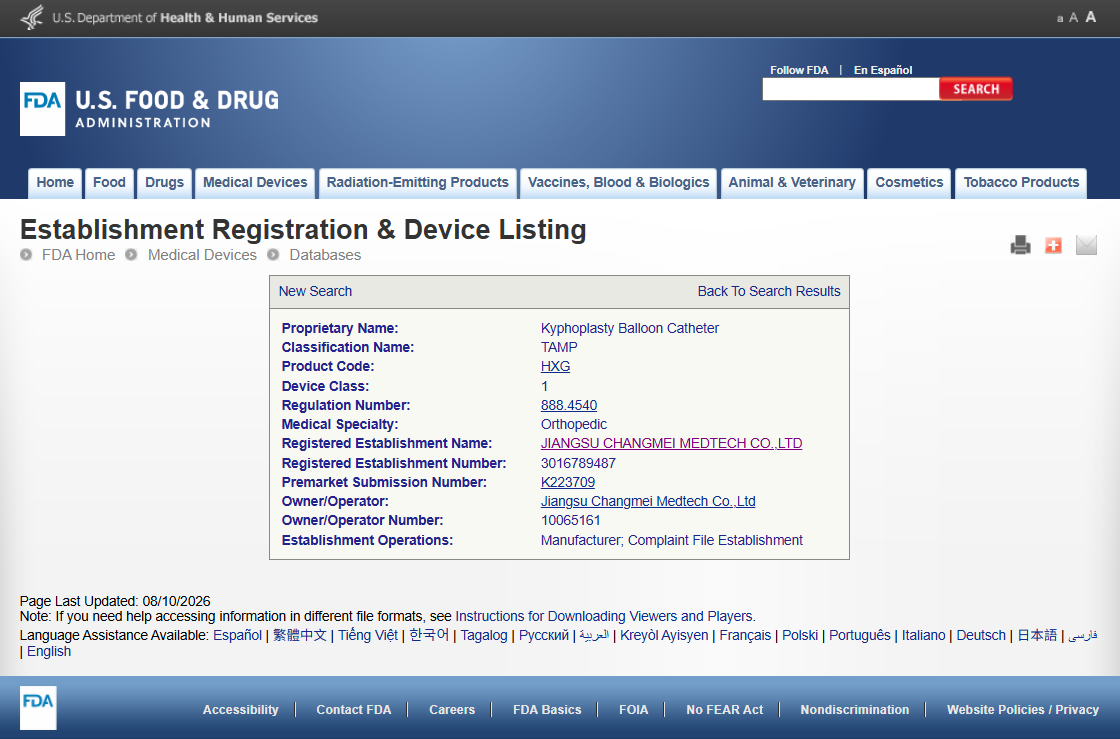
| Kyphoplasty balloon catheter (KB0115, KB0120, KB0210, KB0115S1, KB0120S1, KB0210S1) | US 510(k) premarket notification; EU MDR quality management certificate | FDA 510(k) K223709, issued 2023, listed validity to 31 December 2029; EU MDR QMS certificate G10 088875 0012 Rev. 01 | Substantial equivalence for the listed catheter models in the US; a certified MDR quality system covering Class IIa and Class IIb devices | Clinical superiority, or a performance level beyond the stated model specifications |
| Kyphoplasty tool kit (KT-00-01, KT-00-05) | EU MDR certificate scope; US establishment registration and device listing | KT-00-05 listed among products covered by G10 088875 0012 Rev. 01; FDA establishment registration and device listing 3016789487, scope “Kyphoplasty Tool Kit” | That the kit is produced under the certified quality system and that the establishment and device are registered with FDA | A US premarket clearance — a listing is not a 510(k), and the two should never be filed as if they were the same |
| Balloon inflator (BI-20A-10) | EU certificate for the applicable device class; US registration and listing | EU Quality Assurance Certificate (MDR) G21 088875 0011 Rev. 00, Class I sterile devices under MDR Annex XI Part A, issued 21 March 2024, valid to 20 March 2029; FDA listing 3016789487 | Certified quality assurance for the sterile Class I inflator, and FDA establishment/device registration | That the inflator shares the catheter's device class or clearance route — it does not |
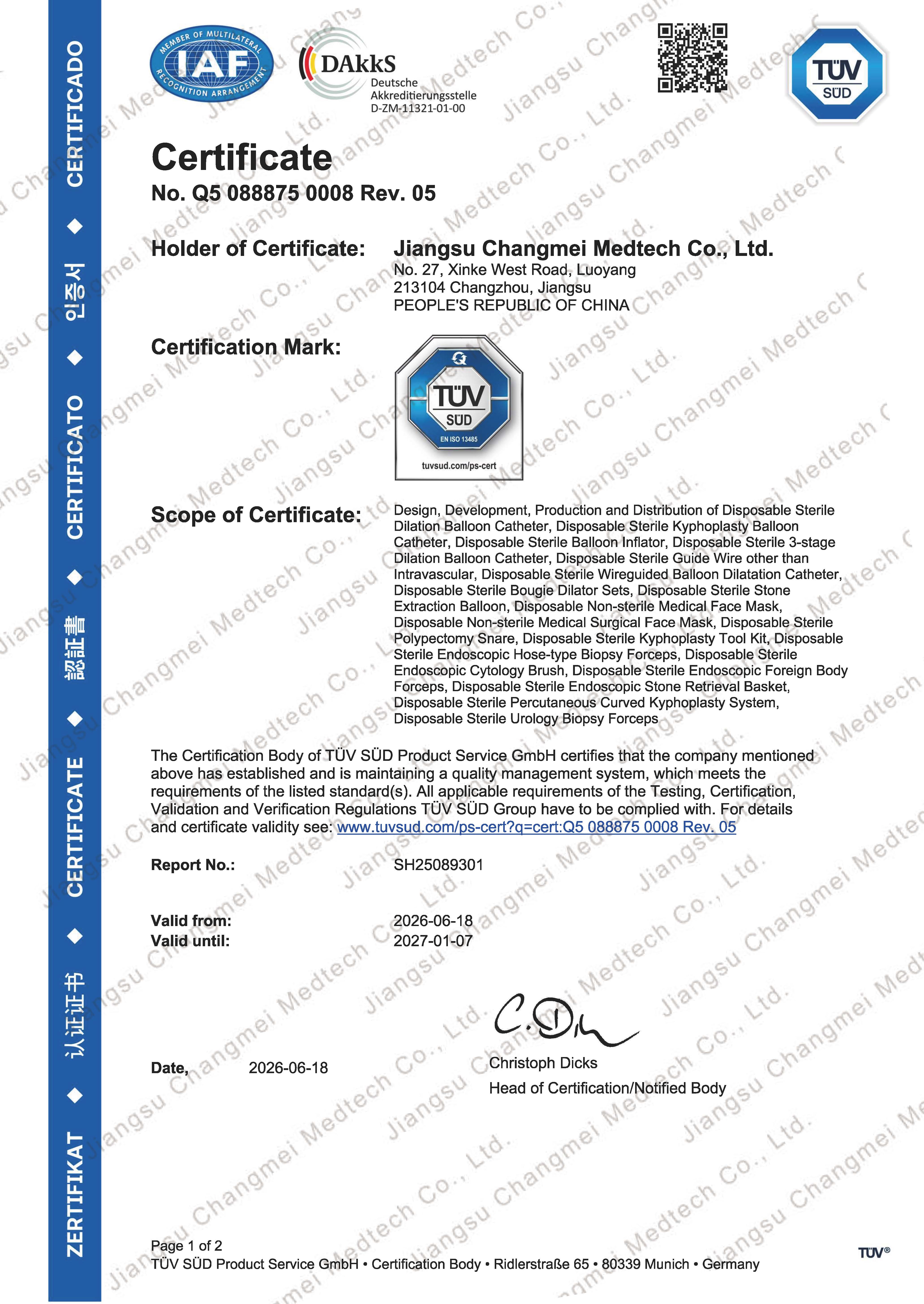
| Quality system (site level) | ISO 13485 certificate, current revision | ISO 13485:2016 certificate Q5 088875 0008 Rev. 05, TÜV SÜD Product Service GmbH, issued 28 June 2026, valid to 7 January 2027 | That design, development, production and distribution of disposable sterile medical devices are certified to ISO 13485:2016 | Product-specific conformity on its own; the site certificate is the frame, not the product decision |
Two practical checks follow from this table. First, compare the model number in the quotation with the model numbers inside the certificate or clearance scope; a family certificate does not automatically name every variant a buyer might order. Second, read the validity dates as operational data. The ISO 13485 certificate in this file runs to 7 January 2027, so a buyer signing a twelve-month supply agreement should ask for the surveillance-audit status and the renewal plan as part of the qualification file, rather than discovering the expiry on the next audit.
Factory proof: how to test whether the supplier is the manufacturer
A trading intermediary can present a professional catalog and a valid certificate set while owning none of the process. The distinguishing evidence is not a claim of factory ownership but a description of which steps happen inside the supplier's own plant — and which are bought in.
In Changmei's case, the company describes a vertically integrated chain rather than an assembly operation: three balloon-tube extrusion lines, self-developed balloon forming, necking, welding, four-wing folding and leak-test equipment, and in-house pressure testing of every catheter at ≥400 psi. The balloon body is not subcontracted, which is the single most useful statement in the file, because the balloon is where burst performance, folding geometry and leak risk are determined. The site is described as 51,985 m² with 235 employees, including a 40-engineer R&D team, producing an annual output of 1,000,000 kyphoplasty balloon catheters, with exports at roughly 30% of volume across the EU, USA, Asia, South America and the Middle East.
Two further claims in the supplier file should be read with their evidence status stated plainly. Changmei reports that its kyphoplasty balloon catheters hold approximately 80% of the Chinese market, and that it supplies as a qualified vendor to member companies of Medtronic and Stryker, having passed supplier audits from those member companies. Neither figure is an audited market statistic or a public endorsement: the share is company-reported, and a supplier audit belongs to the auditing party. Both are reasonable scale indicators, and both should be verified through documents the buyer can actually see — site audit access, an audit summary where disclosure is permitted, and a capacity plan matched to the buyer's forecast.
A workable factory-proof sequence looks like this:
- Request the site address, floor area and headcount, then confirm them against the address on the certificates and on the shipping documents.
- Ask which production steps are in-house and which are subcontracted, and require the list in writing.
- Ask for the release routine: is the pressure test 100% per piece or sampled, and where is the record kept?
- Walk one lot number from extrusion to sterilization load — a traceability demonstration is faster and more convincing than a capabilities brochure.
- Match stated annual capacity against your own order volume and lead time, so that “scalable” becomes a number rather than an adjective.
Acceptance criteria: turning purchase terms into inspectable conditions
The stated purchasing terms are straightforward. MOQ for standard in-stock products is 10 sets; for OEM or ODM customized orders the minimum is negotiable against the specific requirement. Delivery terms are EXW, FOB or CIF. Acceptance criteria are pre-shipment test, and payment terms are full T/T before shipping. Lead time is 30–45 days, with OEM/ODM production running about 30 working days after specification confirmation, and stock items shipping at roughly seven days ex-works when available.
Those terms are a starting framework, not a finished contract. Two of them deserve particular attention from an evaluation-to-execution buyer:
- “Pre-shipment test” is a category, not a specification. The purchase order should state what is tested (visual, dimensional, pressure, packaging seal), on what sample basis, and which record is issued with the lot. Without that, acceptance depends on the supplier's internal definition at the moment of shipment.
- Full T/T before shipping places pre-shipment risk on the buyer. The natural control is an inspection before dispatch — either a documented pre-shipment inspection report from the supplier or a third-party inspection — tied to the agreed test list, so that payment release and evidence release happen at the same point.
A practical acceptance package for a first kyphoplasty order usually includes: the certificate of conformity referencing the lot; the release test record; the sterilization load reference or certificate; the labeling and IFU set in the agreed language, consistent with the UDI data; packing list and quantity check; a minimum remaining shelf life at delivery, expressed against the three-year shelf life; and a nonconformance route that states who decides, within what period, and how replacement or credit is handled. For OEM and ODM orders, add the approved artwork, the private-label specification and the change-control rule — a label change is a documentation event, and the buyer should be notified before it happens, not after the goods arrive.
Where the evidence stops: fit boundaries a buyer should record
Accurate supplier evidence includes the limits of the product, and those limits belong in the qualification file beside the specifications.
- Single-use, EO sterilized, three-year shelf life means inventory rotation and storage conditions are part of quality, and reuse or re-sterilization is excluded outright.
- Contraindications apply at the clinical level: the catheter is not intended for patients with a damaged vertebral posterior edge, nerve injury, infection at the operative site or uncorrectable coagulopathy, and the full contraindication set sits in the IFU.
- Volume and pressure limits are model-specific. The 6 cc maximum inflation volume and ≥400 PSI constrained rating apply to the model as stated; transferring them to another diameter, another gauge or an unconstrained condition is not supported by the document.
- Different documents, different scopes. The balloon catheter, the tool kit and the inflator do not share one clearance; a buyer registering the system in a new market should map each family separately.
- Company-reported figures such as domestic market share and customer audits are scale indicators, not certifications, and should be labelled as such in any internal approval memo.
Market context: why the evidence bar is rising
One commercial research source values the global kyphoplasty market at USD 764.13 million in 2025, with a projection of USD 813.50 million in 2026 rising to USD 1,342.29 million by 2034, and places North American revenue share at roughly 42.5%–50.0% in 2025. Published estimates for this category vary with scope — whether bone cement and vertebroplasty are bundled changes the total materially — so these figures are best used as directional context for volume planning rather than as a procurement input. What they do support is the practical point behind this article: as order volumes and audit expectations rise, the supplier that can hand over a coherent document chain on request is a lower-risk partner than one that answers with a catalog.
Evidence checklist before the first purchase order
- Model number in the quotation matches the model named in the clearance or certificate scope.
- Certificate numbers, revisions and validity dates recorded, with renewal or surveillance status confirmed for anything expiring inside the contract term.
- Sterilization route (EO), validation reference and shelf-life rationale received, not just stated.
- Release test defined in the purchase order: what is tested, on what basis, and which record ships with the lot.
- Pre-shipment inspection route agreed, given full T/T payment before shipping.
- In-house versus subcontracted production steps listed in writing.
- Minimum remaining shelf life, labeling language and UDI data agreed for each destination market.
- Fit boundaries — single-use status, contraindications, model-specific volume and pressure limits — recorded in the qualification file.
FAQ
Is the kyphoplasty balloon catheter single-use, and how is it sterilized?
Yes. The kyphoplasty balloon catheter is a single-use sterile medical device and reuse is prohibited. It is sterilized by ethylene oxide (EO) and has a three-year shelf life; it should be used immediately once the package is opened, must not be re-sterilized or reused, and the official IFU governs handling. Because sterility depends on the sterile barrier, goods-in checks should confirm pouch integrity, the sterilization indicator and the expiry date.
Which regulatory documents should a buyer request for the balloon catheter, the tool kit and the inflator separately?
For the balloon catheter family (KB0115, KB0120, KB0210 and the S1 variants), request the US FDA 510(k) K223709 and the EU MDR quality management certificate G10 088875 0012 Rev. 01. For the kyphoplasty tool kits KT-00-01 and KT-00-05, the relevant records are the coverage of the same MDR certificate and the FDA establishment registration and device listing 3016789487. For the BI-20A-10 balloon inflator, request the EU Quality Assurance Certificate (MDR) G21 088875 0011 Rev. 00 for Class I sterile devices under Annex XI Part A and the same FDA listing. At site level, request ISO 13485:2016 certificate Q5 088875 0008 Rev. 05. A device listing is not a 510(k) clearance, so the three families should be mapped separately.
What purchasing terms and acceptance criteria does the supplier state?
MOQ for standard in-stock products is 10 sets, while OEM and ODM minimum quantities are negotiable against the specific requirement. Delivery terms are EXW, FOB or CIF. The stated acceptance criterion is a pre-shipment test, and payment terms are full T/T before shipping, with lead time of 30–45 days. Because “pre-shipment test” is a broad category, a purchase order should define the test items, the sample basis and the record issued with each lot, and should link payment to a pre-shipment inspection where the buyer wants additional control.
How can a buyer confirm that the supplier is a real factory rather than a trading company?
Look for process-level evidence rather than ownership claims. The supplier describes three balloon-tube extrusion lines, self-developed balloon forming, necking, welding, four-wing folding and leak-test equipment, pressure testing of every catheter at ≥400 psi, and no subcontracting of the balloon body, on a 51,985 m² site with 235 employees, 40 R&D engineers and annual output of 1,000,000 kyphoplasty balloon catheters, certified to ISO 13485:2016 by TÜV SÜD. A buyer can test those statements by requesting site audit access, a written in-house versus subcontracted process list, and a lot-level traceability demonstration from tube extrusion to sterilization load.
What does “CE 0123” on the KT-00-05 tool kit actually cover?
It refers to CE marking under the notified body identified by the number 0123 — TÜV SÜD Product Service GmbH, the authority named on certificate G10 088875 0012 Rev. 01, which lists KT-00-05 among the covered products. That certificate is a quality management system certificate for Class IIa and Class IIb medical devices under MDR (EU) 2017/745 Annex IX Chapters I and III, issued 18 June 2026 and valid to 20 March 2029. It establishes certified conformity for the device's intended purpose within that system; it is not a warranty of clinical outcome, of reimbursement in a given market, or of coverage for models that do not appear in the certificate scope.
For buyers who want the full model and configuration reference in one place, the supplier's kyphoplasty system product brochure (8G and 11G, CE and FDA) covers the catheter, tool kit and inflator range, and is publicly available for download.
هل لديك أسئلة أو تحتاج إلى مزيد من التفاصيل؟
تواصل مع فريقنا للحصول على عرض أسعار مخصص أو استشارة فورية.
طلب عرض أسعار
املأ النموذج أدناه وسيتواصل معك فريقنا بعرض مقترح مخصص.
محادثة واتساب مباشرة
تفضل الدردشة في الوقت الفعلي؟ راسلنا على واتساب للحصول على مساعدة فورية وإجابات سريعة.
- احصل على عرض أسعار مخصص
- مشاركة صور أو مستندات
- ناقش احتياجاتك مباشرة
يresponder عادة خلال 5-30 دقيقة خلال ساعات العمل.