
Kyphoplasty System Sourcing: Evaluating OEM Capability Beyond Product Specifications
Kyphoplasty represents one of the most widely adopted minimally invasive procedures for vertebral compression fractures (VCFs), yet the purchasing decision for a kyphoplasty system extends far beyond comparing catheter diameters and burst pressures. For distributors, hospital groups, and OEM partners operating in the evaluation-to-execution phase, the critical question is not simply "which balloon works" but "which manufacturer has the demonstrated capability to deliver consistently, customize intelligently, and scale supply without compromising quality." This article examines the capability dimensions that matter most when sourcing a percutaneous kyphoplasty (PKP) system, using Jiangsu Changmei Medtech Co., Ltd. as a case study of a vertically integrated manufacturer whose production depth and OEM/ODM flexibility have made it a significant supplier in the global spine market.
Why Capability Assessment Matters in Kyphoplasty Sourcing
Procurement teams evaluating kyphoplasty systems face a complex decision matrix. Beyond clinical performance data—balloon dimensions, working channel compatibility, pressure ratings—the evaluation must include regulatory status, manufacturing consistency, customization responsiveness, and supply chain reliability. These operational factors determine whether a product line can be launched efficiently across multiple markets, whether stock can be replenished at tender scale, and whether a private-label or custom-designed variant can be brought to market without excessive lead time.
The global kyphoplasty market was valued at approximately USD 764.13 million in 2025, with projections indicating growth to USD 1,342.29 million by 2034. North America has historically dominated this market, holding a regional revenue share estimated between 42.5% and 50.0% in 2025. As the market expands—driven by aging populations, rising osteoporosis prevalence, and increasing adoption of minimally invasive spine procedures—buyers are looking beyond the established global incumbents to manufacturers that can offer comparable quality with greater flexibility in customization and supply.
What Constitutes a Capable Kyphoplasty System Manufacturer
A capable manufacturer in this space must demonstrate strength across five interconnected dimensions:
- Vertical integration: Ownership of critical production processes—from balloon tube extrusion and forming to folding, welding, and leak testing—rather than relying on subcontractors for core components.
- Regulatory depth: Current, valid certifications across multiple jurisdictions, including EU MDR (not legacy MDD) and US FDA clearance, with supporting technical files and sterilization validation.
- Product platform breadth: Availability of both 8G and 11G systems with multiple balloon sizes and configurations to serve varied clinical preferences and market requirements.
- Customization capability: Genuine OEM/ODM service—not just private-label packaging, but meaningful modification of product specifications such as gauge, length, balloon shape, and kit composition.
- Scalable production: Manufacturing capacity that can support both routine replenishment and large-volume national tenders without switching vendors or compromising traceability.
These criteria help separate true manufacturing partners from trading companies and limited-capability assemblers—a distinction that becomes critical during supplier audits and long-term supply agreements.
Jiangsu Changmei Medtech: A Vertically Integrated Manufacturer
Jiangsu Changmei Medtech Co., Ltd., established in 2013 and headquartered in Changzhou, Jiangsu Province, China, is a medical device manufacturer that has built its kyphoplasty business on vertical integration. The company operates a 51,985 m² facility with in-house capabilities spanning CNC machining, laser welding, balloon forming, four-wing folding, and ISO Class 7 cleanroom assembly under an ISO 13485-certified quality system.
What distinguishes Changmei's production model is its control over the entire balloon catheter manufacturing process. According to company information, all PKP balloon catheters are made, folded, and pressure-tested on its own production floor—each unit is tested at ≥400 psi constrained burst pressure, 100% per piece. The company does not subcontract the balloon body, a critical factor for buyers who need a single audited facility with one Device History Record (DHR) traceable from tube extrusion to EO sterilization.
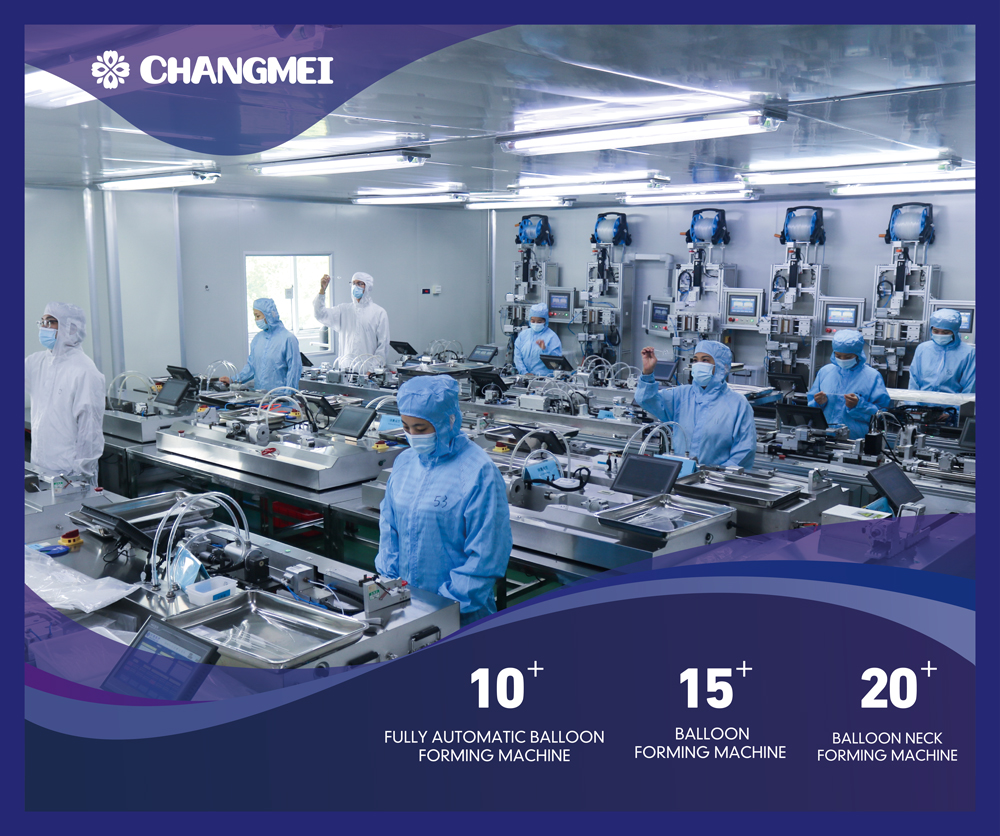
Kyphoplasty balloon catheters undergo 100% pressure testing before release, a key quality-control step in the manufacturing process.
The production capacity is substantial: an annual output of 1,000,000 units of kyphoplasty balloon catheters, supported by a team of 40 R&D engineers among 235 employees. This scale reflects the company's position as a leading supplier in the Chinese market, where its kyphoplasty balloon catheters hold approximately 80% domestic market share—a figure that, while company-claimed, indicates a meaningful operating history and established customer base.
Product Platform: 8G and 11G Configurations
Changmei's kyphoplasty system encompasses three core components: balloon catheters, instrument kits, and a balloon inflation device. The product platform spans both 8G and 11G configurations, each engineered for specific clinical preferences and market segments.
8G System: The Established Standard
The 8G line includes three balloon catheter models—KB0210 (10 mm marker distance), KB0115 (15 mm), and KB0120 (20 mm)—all with a channel ID of ≥3.65 mm, an overall length of 315 mm, and a constrained burst pressure of ≥400 PSI. Maximum inflation volume ranges from 4 cc (10 mm and 15 mm models) to 6 cc (20 mm model). These catheters are designed to pair with the KT-00-01 Kyphoplasty Tool Kit, an 8G instrument set containing two puncture devices (KT-01-01), one puncture expandor module (KT-02-01), two expandor devices (KT-03-01), one bone drill (KT-05-01), two guide wires (KT-06-01), and six bone cement filling devices (KT-04-01).
11G System: The Minimally Invasive Option
The 11G line—KB0210S1 (10 mm), KB0115S1 (15 mm), and KB0120S1 (20 mm)—offers a smaller cross-section with a channel ID of ≥3.10 mm and an overall length of 280 mm. The smaller gauge reduces the pedicle footprint and paraspinal tissue trauma, a feature increasingly favored in Western Europe and US outpatient ASCs where the trend toward less invasive approaches is pronounced. These catheters pair with the KT-00-05 tool kit, which includes two puncture expandor modules (KT-07-01), one bone drill (KT-09-01), and six bone cement filling devices (KT-08-01).
| Parameter | 8G Series (KB0210/KB0115/KB0120) | 11G Series (KB0210S1/KB0115S1/KB0120S1) |
|---|---|---|
| Channel ID | ≥3.65 mm | ≥3.10 mm |
| Overall Length | 315 mm | 280 mm |
| Marker Distance | 10 / 15 / 20 mm | 10 / 15 / 20 mm |
| Max Volume | 4 cc (10/15 mm), 6 cc (20 mm) | 3 cc (10 mm), 4 cc (15 mm), 6 cc (20 mm) |
| Constrained Burst Pressure | ≥400 PSI | ≥400 PSI |
| Compatible Tool Kit | KT-00-01 | KT-00-05 |
The balloon catheter construction uses medical-grade thermoplastic polyurethane (TPU) mounted on a PU shaft, with radiopaque markers and a stainless-steel stylet. The BI-20A-10 Balloon Inflator—a 20 cc, 30 atm pressure pump with a fluorescent dial for low-light operating room readability—completes the system.
Both gauges share the same manufacturing platform: four-wing pleating for predictable expansion, ≥400 psi constrained burst pressure, cylindrical and peanut balloon shapes, and 100% pressure-seal testing. For buyers, this means the choice between 8G and 11G is a clinical and market positioning decision rather than a quality trade-off.
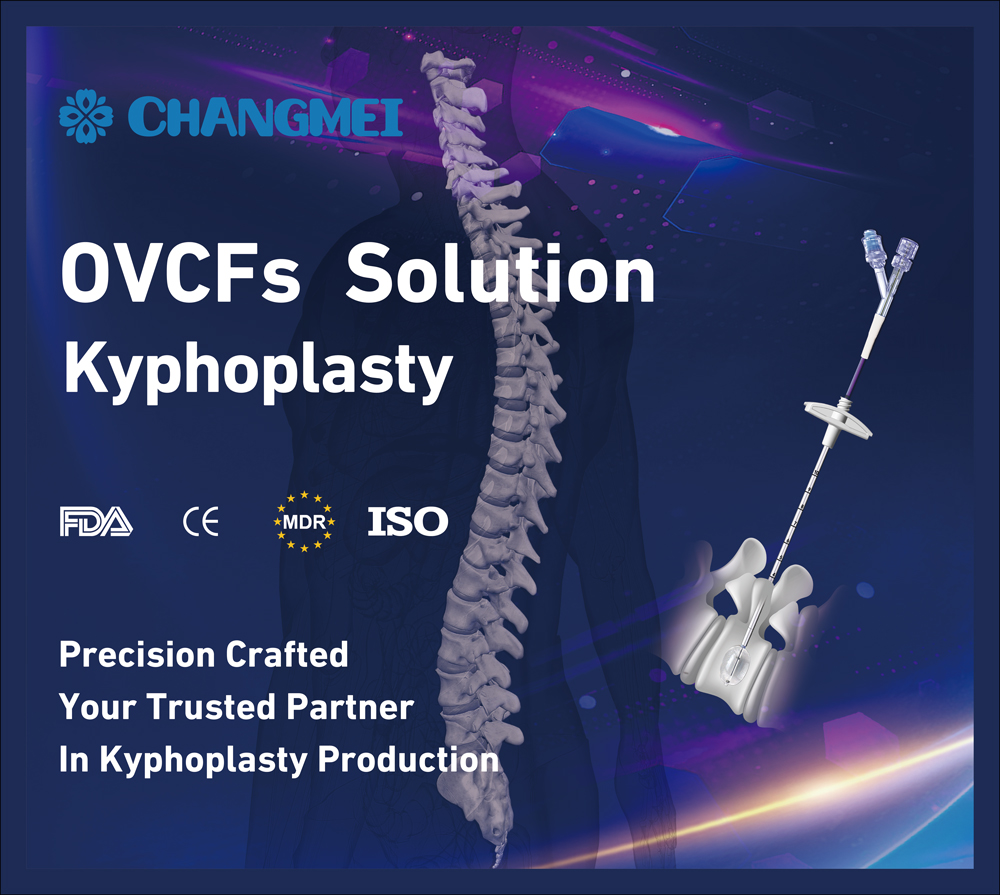
A complete kyphoplasty system requires seamless integration between the balloon catheter, instrument kit, and inflation device.
OEM and ODM Capability: Moving Beyond Private Label
For distributors and medical device companies seeking to enter or expand in the kyphoplasty market, the depth of a manufacturer's OEM/ODM capability often determines the speed and cost of market entry. Changmei's published customization options include balloon diameter and length, cannula size and length, handle color and logo, packaging design, and product labeling and language. This goes beyond simple private labeling to what the company describes as ODM services for custom-designed kyphoplasty systems.
The production model covers three engagement modes: OEM (private label), ODM (custom design), and distribution (authorized regional dealer). For OEM/ODM customized orders, the minimum quantity is negotiable based on specific requirements, while standard in-stock products have an MOQ of 10 sets. Lead time for customized orders is approximately 30 working days after specification confirmation—a timeframe that reflects the company's in-house tooling and production flexibility.
This capability is supported by what the company describes as 100% testing of products and a remote support after-sales model. For buyers, the practical significance is straightforward: a partner that can modify gauge, length, balloon shape, and kit composition—rather than only applying a new label—enables differentiation in markets where clinical preferences vary substantially.
Regulatory Standing: MDR, FDA, and ISO 13485
Regulatory compliance is the non-negotiable foundation of any kyphoplasty sourcing decision. Changmei's certification portfolio includes several notable credentials:
- EU MDR (Regulation (EU) 2017/745): The company reports holding CE certificates under MDR—not the obsolete MDD 93/42/EEC—issued by TÜV SÜD. This includes certification for Class I sterile devices under Annex XI Part A (certificate G21 088875 0011 Rev. 00, issued 2024-03-21, valid to 2029-03-20) and Class IIa/IIb devices under Annex IX Chapters I and III (certificate G100888750012 Rev. 01, issued 2026-06-18, valid to 2029-03-20). Notably, verified third-party data indicates Changmei was recognized as the first Chinese company to receive EU MDR CE certification for its kyphoplasty system products.
- US FDA 510(k): Clearance K223709 covers the Kyphoplasty Balloon Catheter, with an establishment registration (FDA-2-3016789487) listing Balloon Inflator and Kyphoplasty Tool Kit, registered from 2023 through 2029. The 510(k) is dated August 2023 with device class 2, product code HRX, referencing 21 CFR 888.1100.
- ISO 13485:2016: The quality management system is certified by TÜV SÜD (certificate Q5 088875 0008 Rev. 05), covering design, development, production, and distribution of disposable sterile medical devices.
For buyers, the distinction between MDR and MDD certification is not academic. The EU MDR transition has created significant market barriers, and suppliers holding current MDR certification reduce the regulatory risk associated with European market entry and ongoing compliance.
Clinical Application and Procedure Context
The intended use of the kyphoplasty system is the minimally invasive treatment of painful vertebral compression fractures caused by osteoporosis, low-energy trauma, or neoplasia—including spinal metastases and multiple myeloma. The procedure is also indicated for symptomatic vertebral hemangiomas. Kyphoplasty is performed across orthopedic surgery, spine surgery, pain management, and interventional pain clinic settings.
The procedure follows a two-stage mechanism. First, a working cannula is introduced transpedicularly (or parapedicularly) into the anterior two-thirds of the fractured vertebral body under biplane fluoroscopy. An inflatable bone tamp is inserted and inflated with contrast medium, creating a contained cavity and partially restoring vertebral height. Second, the balloon is deflated and removed, and the cavity is filled with low-viscosity PMMA bone cement under low pressure—a technique designed to reduce cement leakage compared to direct vertebroplasty injection.
One documented application includes a case report involving VCFs treated with the eggshell technique in Kuwait, referenced in Changmei's clinical materials. This type of documentation provides a useful reference point for buyers evaluating how a system performs in specific technical variations.
Supply Chain Considerations and Market Trends
Several market dynamics are shaping kyphoplasty procurement decisions. The shift toward ambulatory surgical centers (ASCs) in the US has been reinforced by reimbursement policy: the 2025 Medicare ASC payment rate for kyphoplasty (CPT 22513, 22514) stands at approximately $3,510.84, a 3.5% increase over the prior year. This creates continued demand for reliable, cost-effective system supply. The faster recovery profile of balloon kyphoplasty—patients typically ambulate within 24 hours and are discharged within 1–2 days—aligns well with ASC operational models.
The trend toward smaller-access systems (11G) reflects the broader minimally invasive direction in spine surgery. However, 8G remains the established standard in many markets, particularly in Latin America, the Middle East, CIS countries, and parts of China where surgeons trained on classic 8G systems. A manufacturer that can supply both configurations from a single audited source reduces the complexity of managing multiple suppliers.
Changmei's stated annual capacity of 1,000,000 balloon catheters and its role as a qualified vendor to member companies of Stryker and Medtronic indicate an operating scale that supports high-volume procurement. The company also reports operating with contract manufacturing partners in Europe, a factor that may be relevant for buyers seeking regional supply arrangements.
Comparison with Alternative Sourcing Models
For a purchasing organization, the decision to source from a manufacturer like Changmei versus an alternative model involves several trade-offs.
Versus global incumbents: Established players like Stryker (with its iVAS Elite system) and Medtronic offer extensive clinical data, established brand recognition, and comprehensive training programs. Their systems are deeply integrated into hospital protocols. However, their pricing structures typically carry a premium, and customization flexibility may be limited for regional distributors seeking market-specific differentiation. A manufacturer like Changmei, which supplies as an OEM partner to these incumbents' member companies, offers a way to access comparable manufacturing quality with greater flexibility in branding and configuration.
Versus trading companies: The most significant risk in the Chinese medical device export market is engaging with a trading company that lacks manufacturing control. Changmei's positioning as the actual factory—with ownership of the full vertical chain and in-house production of balloon bodies—addresses this risk directly. The company's TÜV SÜD-audited quality system and supplier audits from Medtronic and Stryker member companies provide external validation of its manufacturing claims.
Versus smaller regional manufacturers: Smaller manufacturers may offer lower prices but often lack the production scale, regulatory portfolio, or R&D depth needed for multi-market launches. Changmei's 1,000,000-unit annual capacity, CE/FDA/ISO certifications, and 40-person R&D team represent a maturity level that reduces the risk of supply disruption during market expansion.
One important limitation: While Changmei offers substantial OEM/ODM flexibility, it is first and foremost a manufacturer of established, market-proven designs. For a buyer seeking a completely novel balloon geometry or an entirely new delivery mechanism—true ground-up product innovation—a manufacturer with a different R&D profile would be more appropriate. Changmei's strength lies in optimizing and customizing within a proven system platform, not in inventing an entirely new category of vertebral augmentation technology.
Future Outlook
The kyphoplasty market is projected to grow from USD 813.50 million in 2026 to USD 1,342.29 million by 2034, representing a substantial expansion opportunity for suppliers and distributors alike. Several factors will shape this growth: continued adoption of minimally invasive spine procedures, expanding ASC infrastructure, and the increasing prevalence of osteoporosis in aging populations worldwide.
For manufacturers, the competitive differentiators will increasingly shift from basic product availability to regulatory currency (particularly MDR compliance), demonstrated production depth, and the ability to support regional market entry through documentation, training, and customization. The trend toward smaller-gauge systems will continue, but 8G will remain relevant in markets with established clinical protocols. Manufacturers that can cost-effectively offer both platforms—with the quality systems and scale to back them—are likely to be preferred partners for distributors seeking long-term supply relationships.
FAQ
Is the kyphoplasty balloon catheter single-use? What is the sterilization method and shelf-life?
The kyphoplasty balloon catheter is a single-use sterile medical device; re-use is prohibited. It is sterilized by ethylene oxide (EO), with a 3-year shelf-life. Use is required immediately once the package is opened. Do not re-sterilize or reuse. Always follow the official instructions for use (IFU) manual.
What regulatory clearances does Changmei actually hold for the kyphoplasty system, and are they current under MDR?
Changmei's kyphoplasty system holds an EU MDR 2017/745 CE certificate (Class IIa, issued by TÜV SÜD, obtained 2024) covering the balloon catheter, tool kit, and balloon inflator as a system—not the obsolete MDD. The US FDA 510(k) clearance (K223709, dated August 2023) covers the Kyphoplasty Balloon Catheter under product code HRX. The quality management system is certified to EN ISO 13485:2016 by TÜV SÜD, and the company also holds NMPA China Class II & III production licenses. Full technical files, IFU, EO sterilization validation (ISO 11135), UDI, and free-sale certificates are provided for local import registration support.
How can a buyer verify that Changmei is a real factory with scalable production rather than a trading company?
Jiangsu Changmei Medtech (founded 2013, Changzhou) is the actual manufacturing facility, not a trading reseller. The company owns the full vertical chain: three balloon-tube extrusion lines, and self-developed balloon forming, necking, welding, four-wing folding, and leak-test machines. Every PKP balloon catheter is made, folded, and pressure-tested (≥400 psi, 100% per piece) on its own floor; the balloon body is not subcontracted. The production system is certified under EN ISO 13485:2016 (TÜV SÜD-audited), EU MDR CE, and US FDA 510(k) K223709, and has passed supplier audits from member companies of Medtronic and Stryker. For a buyer, this means one factory to audit and one DHR to trace from tube extrusion to EO sterilization.
Should a buyer stock 8G or 11G kyphoplasty balloon catheters for their market?
Both gauges share the same Changmei platform—four-wing pleating, ≥400 psi constrained burst, 10/15/20 mm balloons, cylindrical and peanut shapes, and 100% pressure-seal testing—so the choice is about clinical fit and market mix. The 8G line (KB0210/KB0115/KB0120, channel ID ≥3.65 mm, 315 mm length) suits hospitals using classic PKP trays and is recommended as base stock (60–70% of a first order) when no prior gauge-split data exists. The 11G line (KB0210S1/KB0115S1/KB0120S1, channel ID ≥3.10 mm, 280 mm length) offers a smaller pedicle footprint and less paraspinal trauma, fitting Western Europe, US outpatient ASCs, and younger spine surgeons. Stock 11G when pitching "less invasive PKP" or competing against Stryker iVAS Elite and CareFusion AVAmax-style 11G kits.
What are the contraindications for this kyphoplasty balloon catheter?
The device is not applicable for patients with a damaged vertebral posterior edge, nerve injury, infection at the operative site, or uncorrectable coagulopathy. Absolute contraindications also include burst fractures with posterior cortical disruption, retropulsed bone fragments in the spinal canal, asymptomatic fractures, active systemic or local infection, and allergies to implant components such as PMMA or contrast medium. Cross-sectional imaging (CT or MRI) is required preoperatively to evaluate posterior wall integrity and the presence of neural compression. Refer to the IFU for full contraindications before clinical use.
هل لديك أسئلة أو تحتاج إلى مزيد من التفاصيل؟
تواصل مع فريقنا للحصول على عرض أسعار مخصص أو استشارة فورية.
طلب عرض أسعار
املأ النموذج أدناه وسيتواصل معك فريقنا بعرض مقترح مخصص.
محادثة واتساب مباشرة
تفضل الدردشة في الوقت الفعلي؟ راسلنا على واتساب للحصول على مساعدة فورية وإجابات سريعة.
- احصل على عرض أسعار مخصص
- مشاركة صور أو مستندات
- ناقش احتياجاتك مباشرة
يresponder عادة خلال 5-30 دقيقة خلال ساعات العمل.