
LED All-in-One Display: Factory Evidence to Inspect
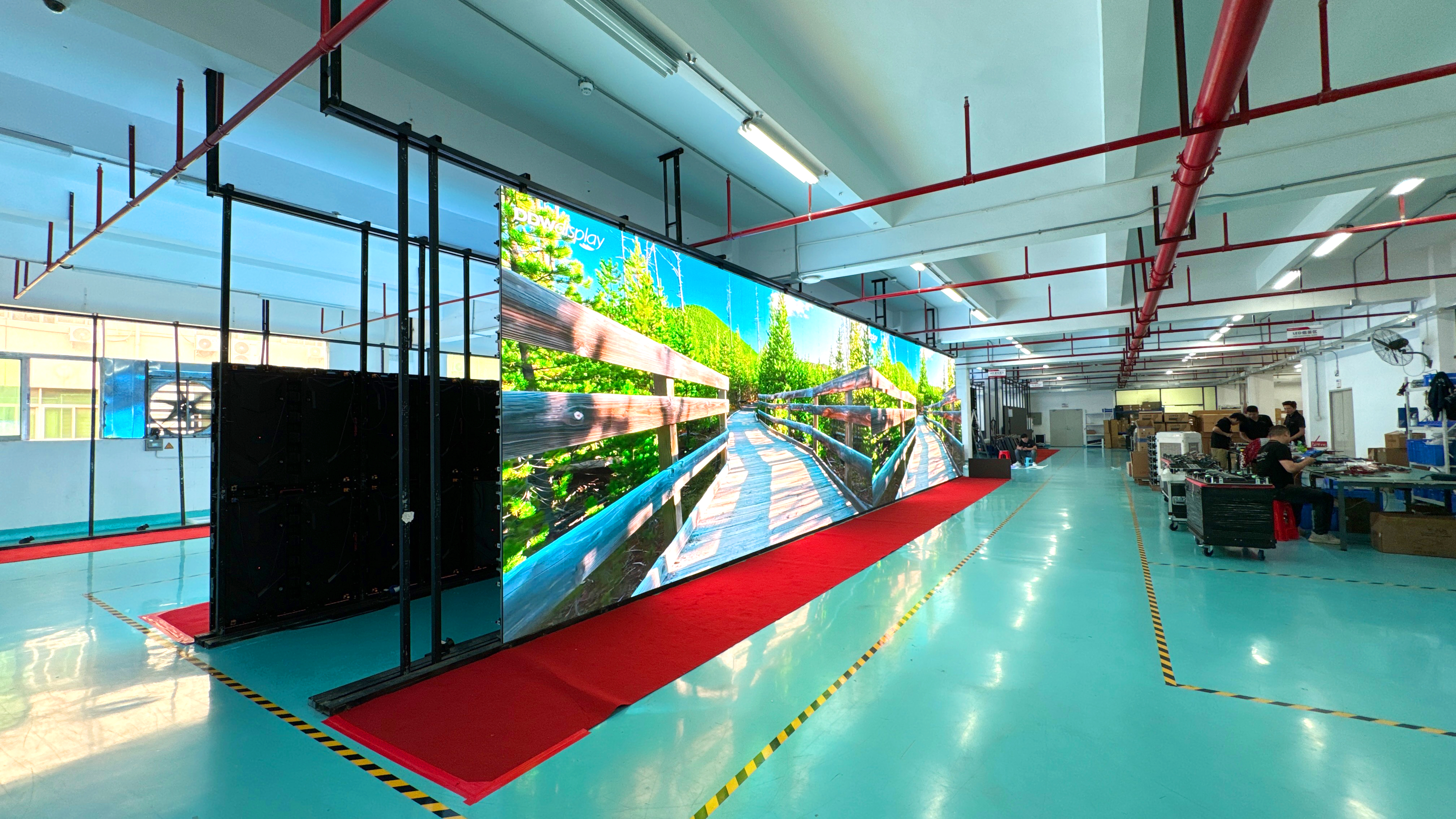
Answer first: An all-in-one LED display should be judged by what the factory can prove about the integrated assembly, not by the label alone. For a conference room, training room, or corporate meeting space, the buyer needs evidence that the cabinet, modules, control system, and service access were designed and checked as one unit.
This guide sets out the inspection points that matter when evaluating an integrated LED display. It uses the DDW Display AIOF Series as a reference because its published configuration provides concrete items to verify: a die-cast aluminum cabinet, an integrated receiving card and control system, front maintenance, and floor-stand or wall-mount installation. DDW Display (Shenzhen DDW Technology Co., Ltd.) is a Shenzhen-based LED display manufacturer founded in 2012, with a 10,000 ㎡ factory and a stated monthly capacity of 8,000 ㎡.
Why integration evidence is now a procurement issue
The procurement risk in an LED wall is usually not the LED chip alone. It is the interface between mechanical parts, electronics, control software, and the room. In a conventional modular wall, those elements may be specified separately and reconciled on site. In an all-in-one display, the factory takes more of that integration into a single product. That can simplify deployment, but it also changes the evidence a buyer should request. The question becomes: can the supplier show how the integrated unit was assembled, tested, and serviced?
Factory evidence is not a tour impression. It is a set of records and demonstrations that can be tied to the ordered model, pixel pitch, size, and destination market. For the AIOF Series, the published facts are specific enough to anchor that review.
What the AIOF Series actually specifies
| Parameter | AIOF Series published configuration |
|---|---|
| Product type | All-in-One LED Display / Integrated LED Display / Conference Room LED Screen |
| Pixel pitch | P0.78, P0.93, P1.25, P1.56 |
| Display size | 135 inch / 3020 × 1687.5 mm; 162 inch / 3620 × 2025 mm |
| Cabinet structure | Integrated design |
| Cabinet material | Die-casting aluminum cabinet |
| Control system | Integrated receiving card and control system |
| Maintenance | Front maintenance |
| Installation | Floor stand / wall mount |
| Application type | Indoor fixed LED display |
| Listed use environments | Conference rooms, meeting rooms, corporate offices, training rooms, education spaces, hotels, exhibition centers, smart commercial spaces |
Anything outside this table, such as installed seam tolerance, measured brightness uniformity, control compatibility with a specific room system, or wall-load requirements, should be verified for the project rather than inferred from the phrase all-in-one.
Factory evidence 1: mechanical integration and the aluminum cabinet
Start with the cabinet. The AIOF Series lists a die-casting aluminum cabinet and an integrated design. During a factory inspection, ask to see the cabinet before modules are fully dressed and again after assembly. Check mounting points, corner joints, module seating, and the interface between the cabinet and the wall bracket or floor stand. For a wall-mounted room, the critical evidence is not a polished front view; it is how the cabinet aligns at the joints and how the service path is preserved.
Seam consistency should be checked on a dry-fit or pre-assembled unit. The buyer should confirm the wall opening and the mounting method because the product lists both floor stand and wall mount. A wall-mounted installation also requires wall condition, bracket fixing, and access clearance to be reviewed by the project team.
Ask for cabinet drawings and material confirmation. If the project includes custom details, confirm that the factory accepts project-based orders and custom LED display manufacturing. DDW Display states that it provides OEM, ODM, custom LED display manufacturing, and project-based LED display solutions.
Factory evidence 2: front maintenance in a wall-mounted room
The AIOF Series lists front maintenance. That is a practical advantage in a conference room, because service can be planned from the front of the display rather than requiring rear access. But front maintenance is a design claim that should be demonstrated. Ask for a module removal and replacement demonstration on the same cabinet type, and confirm how the receiving card and control components are reached. Check whether spare modules and critical parts are available.
For a wall-mounted installation, front maintenance still depends on safe access. The room layout should leave enough clearance for service, and the mounting height should allow technicians to work safely. A front-service design does not remove the need for a service plan.
Factory evidence 3: integrated control and the receiving card
An integrated receiving card and control system reduces the number of separate boxes a buyer has to specify. It also concentrates support questions in one place. During evaluation, ask for a system block diagram that shows the signal path from the source to the integrated control system and the display. Test the display with the source devices that will be used in the room, not only with the factory test pattern.
Because the control system is integrated, buyers should confirm how firmware updates, replacement cards, and configuration backups are handled. They should also check whether the room control or video-conferencing environment will be connected through the integrated system or through external equipment. Those details should be documented before the order, not resolved during commissioning.
Factory evidence 4: visual consistency at the ordered pixel pitch
The AIOF Series offers P0.78, P0.93, P1.25, and P1.56. The pixel pitch should be selected against viewing distance and content, not simply the smallest number available. At the factory, ask for calibration records and test patterns at the ordered pitch. Check module-to-module brightness and color uniformity, low-gray presentation, and the appearance of fine text and graphics at the intended viewing distance.
DDW Display states that quality control includes brightness and color calibration. The buyer should ask for the calibration record tied to the specific display or batch, and should review a sample or reference installation under room lighting. A data sheet can list a pixel pitch; it cannot show how the finished wall looks at the front row of a conference table.
Factory evidence 5: aging, inspection, and pre-shipment records
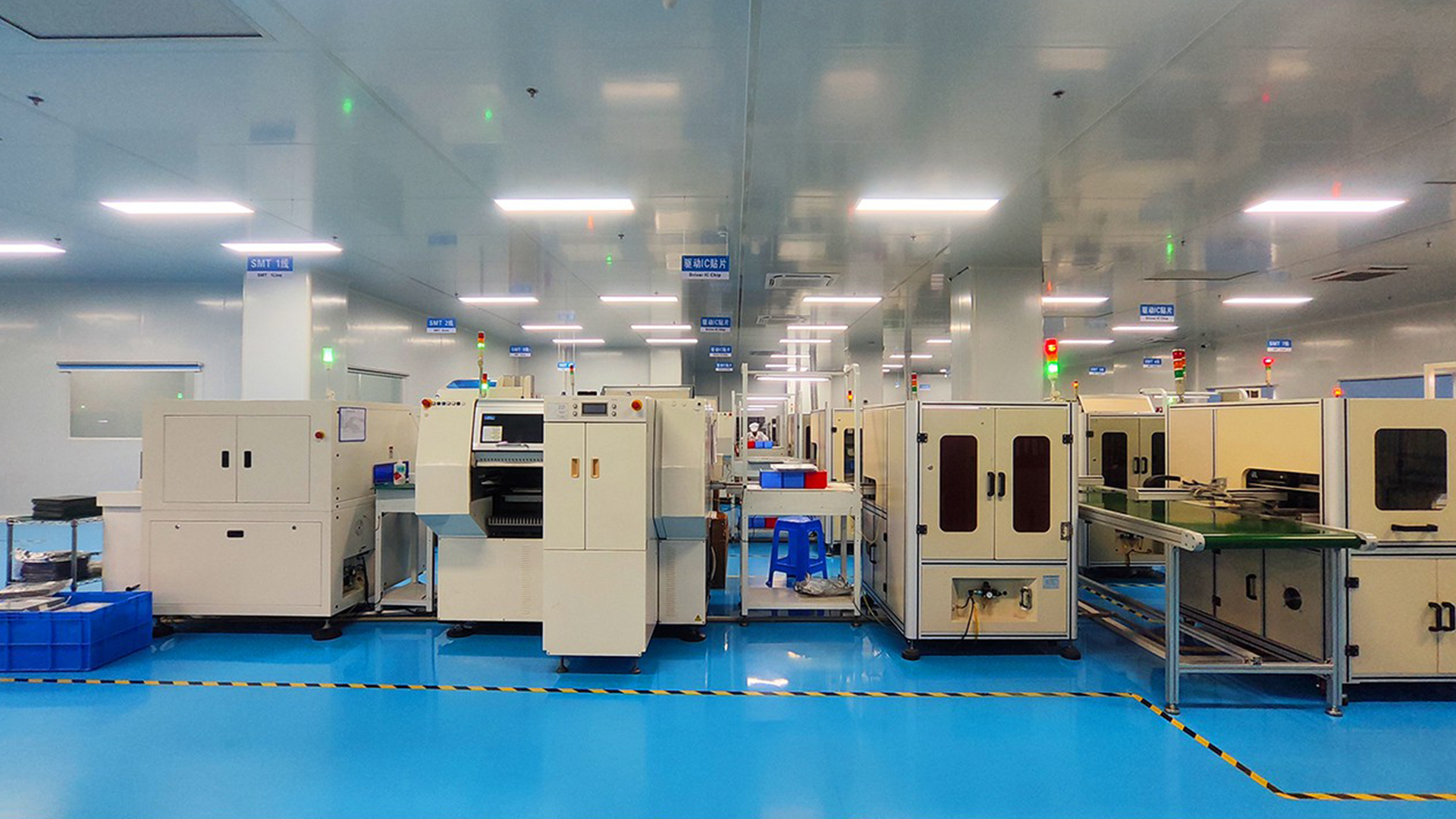
The stated quality-control process includes 100% product inspection, aging test, module testing, brightness and color calibration, waterproof test, power safety test, and performance inspection before shipment. For an indoor AIOF order, the relevant evidence includes the aging log, module test record, power safety check, and final performance inspection. Ask for the records to be identified by order number or serial number.
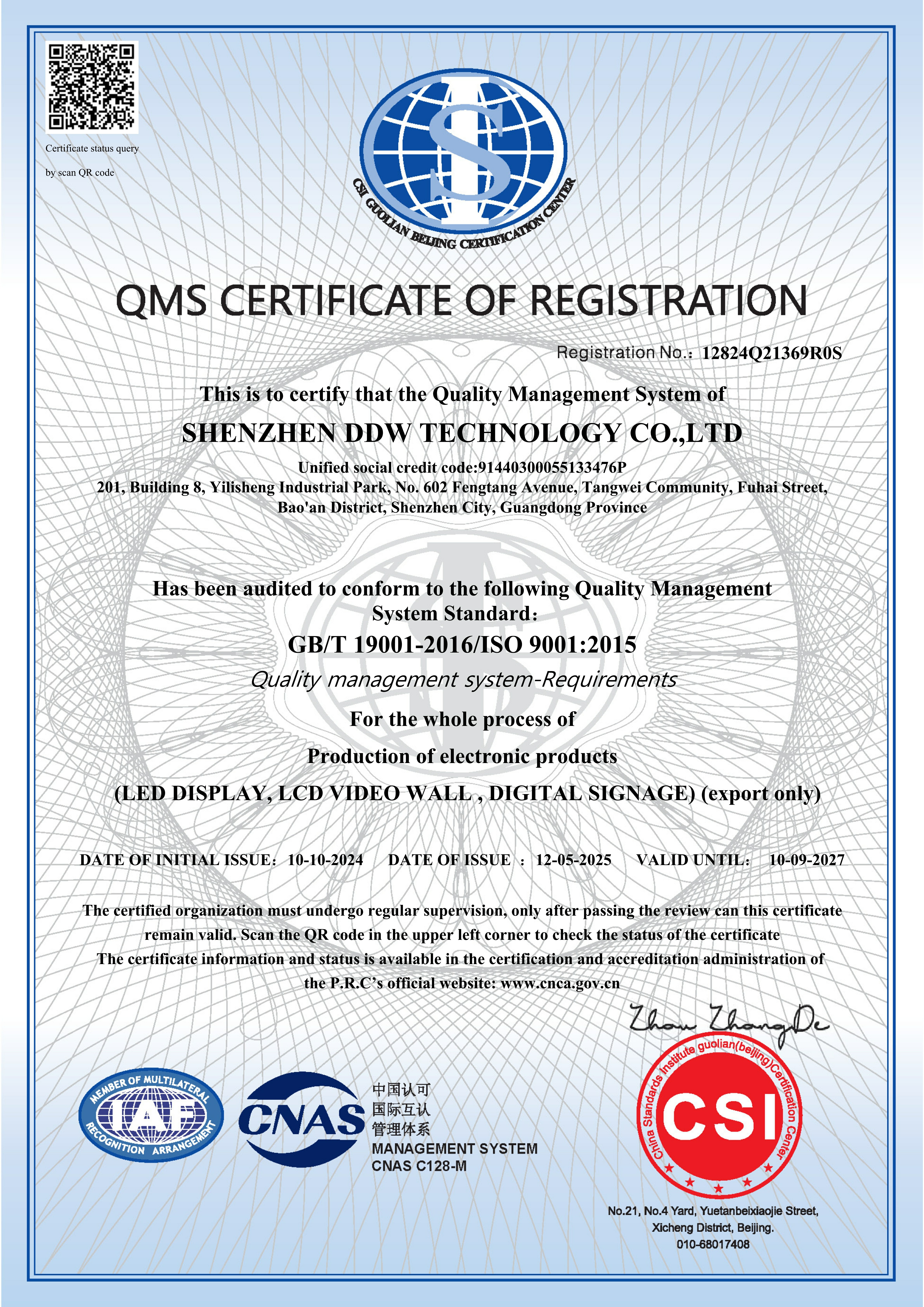
Certification is a separate layer. DDW Display's compliance file includes CE-EMC certificate BKC25062531FC, FCC Supplier's Declaration of Conformity BKC25062532FC-R1, EU RoHS 2.0 certificate HXTS2506230030007-1, and ISO 9001 certificate 12824Q21369R0S. The ISO 9001 certificate covers production of electronic products including LED display, LCD video wall, and digital signage for export. Buyers should confirm that the certificate scope and the specific model and destination market are covered.
The CE-EMC certificate BKC25062531FC was issued on 2025-07-01 and expires on 2030-07-01. The EU RoHS 2.0 certificate HXTS2506230030007-1 was issued on 2025-06-27 and expires on 2030-06-27. The ISO 9001 certificate 12824Q21369R0S was issued on 2025-05-12 and expires on 2027-10-09.
Factory evidence 6: production capacity and project timing
Capacity and lead time are part of factory evidence because they show whether the integration can be repeated within the project schedule. DDW Display states a monthly production capacity of 8,000 ㎡ for LED displays. Standard products have a typical production lead time of 15 to 30 days; customized projects depend on design, quantity, and technical requirements. The company also states a 10,000 ㎡ factory, 100+ employees, 15 engineers, an export ratio of 95%+, and projects delivered to more than 120 countries and regions.
These figures do not prove that a specific unit will be defect-free. They do show the scale of the production system that the buyer is qualifying. The inspection should still focus on the records and demonstrations for the ordered AIOF configuration.
An inspection checklist for buyers
| Inspection area | What to request | Why it matters | AIOF reference point |
|---|---|---|---|
| Mechanical integration | Cabinet drawing, material confirmation, dry-fit or pre-assembly evidence, wall bracket details | Confirms cabinet construction, mounting interface, and joint alignment | Die-casting aluminum cabinet, integrated design, wall mount or floor stand |
| Service access | Front-maintenance demonstration, spare module availability, service clearance review | Shows how the display is serviced after installation | Front maintenance |
| Control integration | System block diagram, source-device test, receiving card location, firmware and backup process | Confirms the integrated control system works with the room | Integrated receiving card and control system |
| Visual consistency | Calibration records, test patterns, sample or reference installation review | Checks uniformity at the ordered pixel pitch and viewing distance | P0.78, P0.93, P1.25, P1.56; 135 inch and 162 inch sizes |
| Quality records | Aging log, module test record, power safety check, final inspection report | Links pre-shipment testing to the specific order | Stated 100% inspection and aging process |
| Compliance | Certificate scope, model coverage, destination-market requirements | Supports market access and quality-system review | CE-EMC, FCC SDoC, EU RoHS 2.0, ISO 9001 |
Where an integrated display fits: application scenarios
The AIOF Series is listed for conference rooms, meeting rooms, corporate offices, training rooms, education spaces, hotels, exhibition centers, and smart commercial spaces. In these rooms, the display is part of daily operations: presentations, video meetings, training content, and visitor communication. Front maintenance and integrated control matter because downtime is visible to everyone in the room.
For a 135-inch or 162-inch display, the room plan should be checked before the order: wall opening, mounting method, service clearance, and viewing distance. The product list gives two display sizes, so a room with a non-standard opening should be reviewed as a project rather than assumed to fit. Floor stand installation is an alternative where wall mounting is not suitable.
Market trend: integration is moving into the procurement file
Mordor Intelligence projects the global LED display market at USD 20.73 billion in 2026, rising to USD 26.98 billion by 2031. That growth does not change the inspection logic, but it does explain why buyers are asking for more system-level evidence. As the category expands into conference rooms and corporate spaces, the difference between a display that works on a data sheet and one that works in a room becomes a procurement issue.
Comparison with conventional modular LED walls
| Aspect | AIOF Series all-in-one display | Conventional modular LED wall |
|---|---|---|
| Integration | Integrated cabinet, receiving card, and control system | Cabinet, sending and receiving hardware, and control may be specified separately |
| Dimensions | 135 inch and 162 inch listed configurations | Project-specific dimensions are more typical, subject to design |
| Service access | Front maintenance listed | Front or rear access depends on the chosen design |
| Installation | Floor stand or wall mount | Structure and service access designed per project |
| Application fit | Indoor fixed use in listed spaces | Can be configured for different applications depending on product |
| Boundary to confirm | Fixed listed sizes; not a rental or outdoor product | Greater dimensional flexibility, but more site integration work |
The comparison is not a claim that one architecture is always better. The AIOF Series is an indoor fixed display with two published sizes and front maintenance. A conventional modular wall may be the better fit when the opening is non-standard or when the project requires a different service strategy. The buyer should choose the architecture that matches the room, then request evidence for that architecture.
What an all-in-one display does not solve
An all-in-one display does not remove project risk. The AIOF Series is listed as an indoor fixed LED display. It is not presented as a rental LED screen or an outdoor LED display. Its published display sizes are 135 inch and 162 inch, so a non-standard wall opening needs project review. The integrated control system should be tested with the room sources and control environment. Front maintenance requires safe access. Wall mounting depends on the wall structure and bracket design. These are the boundaries to confirm before the order.
Also, seamless appearance should be treated as an inspection outcome. Ask for a dry-fit or reference installation and judge the joints under the intended lighting. Do not accept the word as a substitute for a demonstrated result.
Future outlook
Integrated LED displays are likely to be evaluated more like IT equipment: with configuration records, firmware support, service access, and lifecycle documentation. For buyers, the practical response is to build a factory evidence file for each project. The file should include the AIOF configuration, cabinet and control drawings, front-maintenance demonstration, calibration and aging records, compliance certificates, and the pre-shipment inspection report.
DDW Display's public 2026 LED display catalog is available for download at the link below. It can be used as a starting reference, but the order-specific evidence should still be confirmed in writing: DDW LED Display Catalog 2026.
FAQ
Q: What factory evidence should a buyer request for an all-in-one LED display?
A: Request cabinet drawings and material confirmation, a dry-fit or pre-assembly record, a front-maintenance demonstration, a control-system block diagram, calibration and aging records, and the pre-shipment inspection report. For the AIOF Series, confirm the integrated receiving card and control system, die-cast aluminum cabinet, front maintenance, and wall-mount or floor-stand configuration against the order.
Q: Which pixel pitches and display sizes does the AIOF Series list?
A: The AIOF Series lists pixel pitches of P0.78, P0.93, P1.25, and P1.56. The listed display sizes are 135 inch / 3020 × 1687.5 mm and 162 inch / 3620 × 2025 mm. It is an indoor fixed LED display.
Q: How is the AIOF Series maintained after installation?
A: The AIOF Series lists front maintenance. The buyer should confirm the front access path, spare module availability, and the location of the receiving card and control components. A wall-mounted installation also needs safe service clearance in the room plan.
Q: What quality checks are stated before shipment?
A: DDW Display states that quality control includes 100% product inspection, aging test, module testing, brightness and color calibration, waterproof test, power safety test, and performance inspection before shipment. For an indoor AIOF order, buyers should ask which records are generated for that model and order number.
Q: Which compliance documents are available?
A: The compliance file includes CE-EMC certificate BKC25062531FC, FCC Supplier's Declaration of Conformity BKC25062532FC-R1, EU RoHS 2.0 certificate HXTS2506230030007-1, and ISO 9001 certificate 12824Q21369R0S. The ISO 9001 certificate covers LED display, LCD video wall, and digital signage production for export. Confirm the certificate scope and model coverage before relying on it for a project.
Q: What are the main limits of the AIOF Series?
A: The AIOF Series is an indoor fixed LED display with listed sizes of 135 inch and 162 inch. It is not presented as a rental or outdoor product. A non-standard wall opening requires project review. The integrated control system should be tested with the room sources, and front maintenance requires safe access.
Q: Which room types is the AIOF Series intended for?
A: The listed use environments are conference rooms, meeting rooms, corporate offices, training rooms, education spaces, hotels, exhibition centers, and smart commercial spaces. The display is intended for indoor fixed installation, with floor stand or wall mount options.
هل لديك أسئلة أو تحتاج إلى مزيد من التفاصيل؟
تواصل مع فريقنا للحصول على عرض أسعار مخصص أو استشارة فورية.
طلب عرض أسعار
املأ النموذج أدناه وسيتواصل معك فريقنا بعرض مقترح مخصص.
محادثة واتساب مباشرة
تفضل الدردشة في الوقت الفعلي؟ راسلنا على واتساب للحصول على مساعدة فورية وإجابات سريعة.
- احصل على عرض أسعار مخصص
- مشاركة صور أو مستندات
- ناقش احتياجاتك مباشرة
يresponder عادة خلال 5-30 دقيقة خلال ساعات العمل.