
LED Compliance Guide: IP20, CRI Ra≥97, 24V/48V for Retail
LED Lighting Compliance Guide: IP20, CRI Ra≥97, and 24V/48V for Museums and Retail
Museum, gallery and luxury retail lighting projects are rarely lost on brightness. They are lost on colour accuracy, ingress protection and power architecture — three details fixed at the specification stage and expensive to correct after installation.
This guide sets out a four-point qualification checklist built entirely from verifiable product specifications: IP20 ingress protection, CRI Ra≥97, rated voltage of 24V or 48V DC, and power ratings of 12W and 30W. It uses three products from XPUP LED as worked examples — the DK3 linear strip, the XP-BD18DC24V-2835-140D-8MM full-spectrum strip, and the XP-CX-18 48V magnetic track module — and shows how each specification maps onto a real installation scenario.
XPUP LED is the trading identity of Zhongshan Xiangpai (XPUP) Lighting Technology Co., Ltd., a manufacturer established in 2012 in Zhongshan, Guangdong, China, producing LED linear strips, LED magnetic track lights and smart lighting control systems. The company operates a 10,000 m² factory with around 80 employees, reports an annual output of 35,000,000 metres, and exports to more than 170 countries and regions, with its main markets in the European Union and the United States.
Why scenario specifications decide museum and retail projects
In general commercial lighting, the buying conversation tends to be about lumens per watt, price per metre and delivery time. In a museum vitrine, a jewellery display case or a luxury retail fit-out, the visible failure modes are different. A strip with a lower colour rendering index makes gold read as brass and shifts the perceived colour of textiles. A strip with visible emitter spacing shows as dots through a diffuser viewed at short distance. A fixture rated for dry indoor use, installed in a humid or exterior position, degrades early.
Because these problems surface after installation, specifiers increasingly screen suppliers against a fixed list of scenario requirements before price is discussed. The screen is not a brand preference; it is a short list of measurable values that either match the project or do not.
Regulation reinforces the same logic. In the United States, the 2024 International Energy Conservation Code requires lights in commercial interiors to dim to 10% or lower, according to the International Code Council. That makes dimming compatibility a code-level consideration in commercial retail interiors rather than an optional feature — and it means the dimming behaviour of a strip or track module has to be verified at specification stage, not discovered on commissioning day.
The four-point qualification checklist
1. IP20 — a dry-interior scope limitation, stated explicitly
IP20 is an ingress protection classification. It means the fixture is protected against solid objects above a defined size and has no protection against water ingress. For a specifier, that is a scope limitation rather than a quality claim: IP20 products belong in dry indoor positions — display cases, coves, the ceilings of air-conditioned retail interiors, and gallery walls.
XPUP states this scope explicitly in its application data for strip products. The operating conditions list an indoor dry environment, an operating temperature range of −20°C to +45°C, the use of a proper power supply or adapter to avoid overload, and keeping the product away from chemically corrosive environments and free from covering objects.
Where a project includes a wet, damp or exterior position, the specification has to move up the IP ladder rather than stretch the IP20 product. XPUP's range includes IP65 strip such as the XP-C13DC24V-6060-48D-10MM, and IP68 silicone and COB options including XP-C818DC24V-2835-120D-8MM, XP-C5DC24V-2835-120D-8MM and XP-CH1DC24V-2025-280D-8MM, which are positioned for façade, landscape and outdoor work.
2. CRI Ra≥97 — the colour-fidelity threshold for objects under judgement
CRI describes how faithfully a light source renders colour relative to a reference source. For displays, Ra≥97 is the value most often written into specifications for museum, gallery and premium retail applications, because the product on display is being judged on its colour.
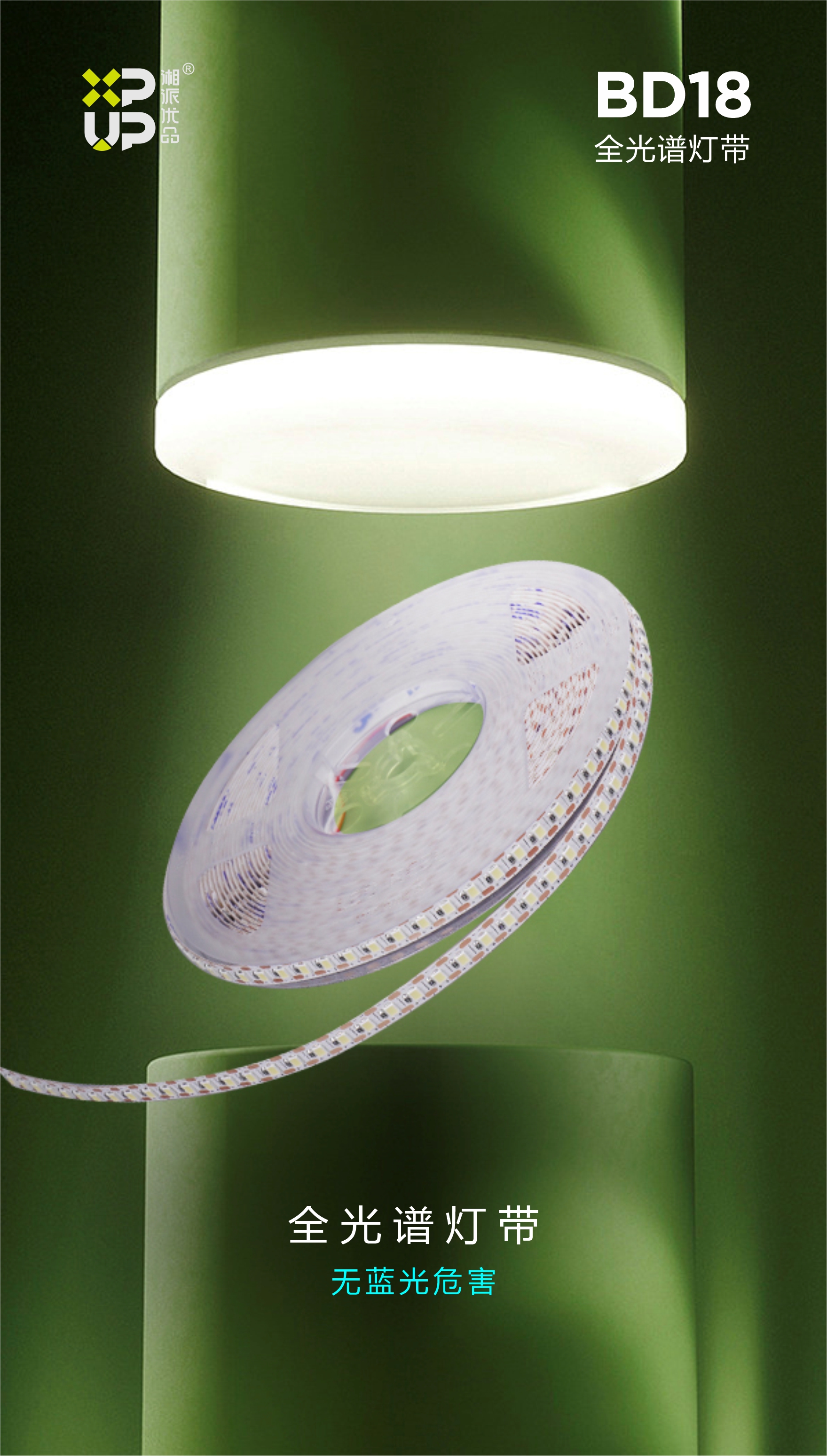
Within XPUP's portfolio, CRI is a model-level specification, not a company-level one. The XP-BD18DC24V-2835-140D-8MM is rated CRI Ra≥97, with 140 LEDs per metre, 55–65 lumens per LED, selectable colour temperatures of 2700/3000/3500/4000/5000/6000K, 12W per metre, a 24V input, an 8mm double-layer copper PCB and IP20 protection. Its product documentation positions it for museums and galleries, luxury retail, jewellery stores, education and shopping malls, and describes it as suitable for jewellery stores and display cases.
Specificity is what makes the specification usable in procurement. Other models in the same portfolio are specified differently — the DK3 linear strip at CRI Ra≥80, and the XP-CX-18 magnetic track module at CRI Ra≥90. A buyer comparing a supplier's headline "high CRI" claim against a competitor's should always ask at which model and which SKU the figure applies.
3. 24V and 48V — two low-voltage architectures for two ceiling designs
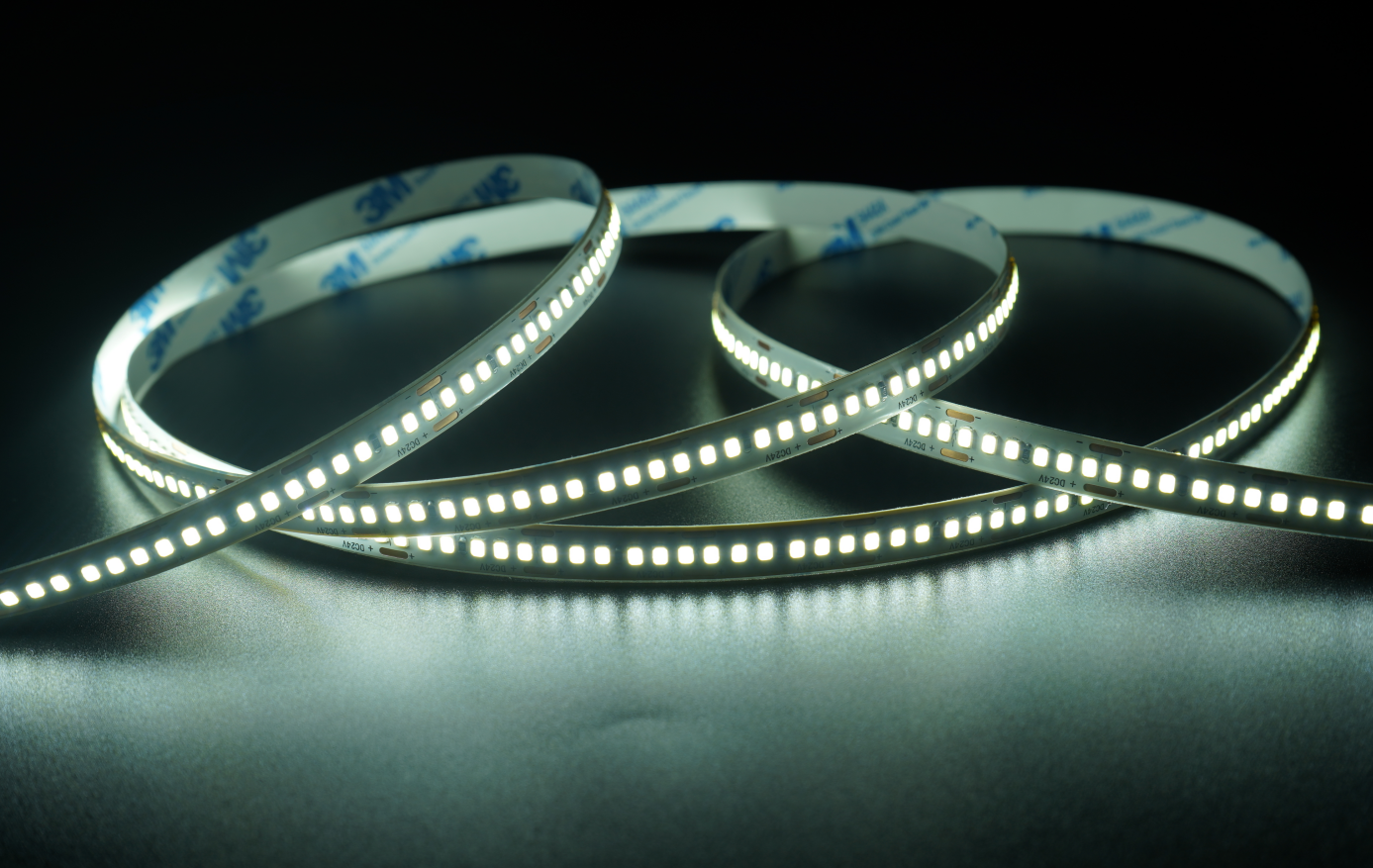
24V DC is the dominant architecture across XPUP's strip products, including the DK3 at 24V/15W and the XP-BD18DC24V-2835-140D-8MM at 24V/12W. Low-voltage strips are typically installed in a profile or channel, cut to length, and fed from a remote driver. The XP-BD18 is described as cuttable at each LED for various lengths, with an 8mm PCB width and strong bending resistance.
48V DC appears in the XP-CX-18, a magnetic track module rated 48V, 30W, CRI Ra≥90, 3000/4000/6000K, with a 120° beam angle, built from aluminium and PC, and offered with OEM and ODM support. Its stated applications are retail, shopping malls, interior design, exhibition and event spaces, and jewellery stores, where it is used on merchandise and exhibits to make materials read more directly and to build a more atmospheric scene.
The choice is architectural, not preferential. Where the ceiling design calls for a continuous line of light, a 24V strip is the natural fit. Where the design depends on repositionable accent heads on a track, the 48V module is the natural fit. Selecting a voltage because it sounds more advanced is a reliable way to create an installation problem.
4. 12W and 30W — power as a design constraint, not a selling point
Power rating determines driver sizing, thermal load and output per length. The 12W XP-BD18 delivers 55–65 lumens per LED across 140 LEDs per metre. The 30W XP-CX-18 concentrates its output into a directional module for accent use.
Emitter density matters as much as wattage. The DK3 linear strip runs 240 LEDs per metre at 15W and is specified for high-density, uniform light emission with no grainy appearance, making it suitable for indoor lighting strips and black profiles where the diffuser sits close to the emitters. In a display case with a diffuser a few millimetres from the strip, that density is the difference between a clean line of light and a visibly dotted one.
Qualification checklist at a glance
| Specification | What it confirms | Where it fits | Verified example |
|---|---|---|---|
| IP20 | Protection against solid objects above a defined size; no water protection; dry indoor use only | Museum vitrines, gallery ceilings, dry retail interiors | DK3-DC24V-2835-240D-9.3mm and XP-BD18DC24V-2835-140D-8MM, both listed IP20 |
| CRI Ra≥97 | Colour fidelity for objects being visually judged | Museum and gallery display, luxury retail, jewellery | XP-BD18DC24V-2835-140D-8MM, CRI Ra≥97 |
| 24V DC rated voltage | Low-voltage strip architecture requiring a remote driver | Linear runs, coves, display case strips | DK3-DC24V-2835-240D-9.3mm; XP-BD18DC24V-2835-140D-8MM |
| 48V DC rated voltage | Track-mounted module architecture | Adjustable accent lighting in retail and exhibitions | XP-CX-18, 48V magnetic track module |
| 12W | Power class per metre for strip runs | Display case and cove lighting | XP-BD18DC24V-2835-140D-8MM, 12W |
| 30W | Fixture power for directional track units | Merchandise and exhibit accent lighting | XP-CX-18, 30W |
How the four specifications interact on a real project
The checklist only works when the four values are read together. A Ra≥97 strip at low emitter density will still show banding. A high-density strip at Ra≥80 will render merchandise cleanly but not accurately. A 48V module with the correct CRI still fails if the track system and driver are not matched.
Three interactions matter most in museum and retail work.
- Colour accuracy and density. Accurate colour at low output requires enough emitters. The XP-BD18 combines CRI Ra≥97 with 140 LEDs per metre on an 8mm double-layer copper PCB, which keeps both the colour specification and the physical appearance of the light within the same model.
- Architecture and installation logic. A 24V strip is a cut-to-length component installed into a profile; a 48V module is a finished unit installed onto a track. Specification documents that mix the two create site problems during installation, not during procurement.
- Dimming behaviour. With the 2024 IECC dimming threshold applying to commercial interiors in the United States, dimming performance has to be verified rather than assumed. XPUP supplies COB and smart strip options with dimming functions, and reports a completed German café and chain retail project in which dimmable COB LED strip achieved smooth, flicker-free lighting and uniform illumination, with smart LED strip integrated for flexible control across operating scenarios.
Application fit: museums, galleries and retail
Museums, galleries and display cases
The combination that answers this scenario is CRI Ra≥97 with high emitter density at a low, safe voltage. The XP-BD18DC24V-2835-140D-8MM meets that pattern: Ra≥97, 140 LEDs per metre, 12W, 24V, IP20, and a documented application set covering museums and galleries, interior design, luxury retail, jewellery stores, education and shopping malls. The DK3 addresses the adjacent requirement — where a continuous, dot-free line matters more than the highest colour index — with 240 LEDs per metre at 24V/15W and listed applications including museums and galleries, restaurants, offices and apartments.
Luxury retail, jewellery and exhibition spaces
Retail and exhibition spaces need two behaviours at once: accurate colour on the merchandise, and the ability to move the light as displays change. The XP-CX-18 is specified for this pattern — 48V, 30W, CRI Ra≥90, 3000/4000/6000K, 120° beam angle, aluminium and PC construction — with listed applications covering retail, shopping malls, interior design, exhibition and events, and jewellery stores. Where the display itself is behind glass and the light comes from within the case, the XP-BD18 at Ra≥97 is the more appropriate specification.
Interior design and hospitality interiors
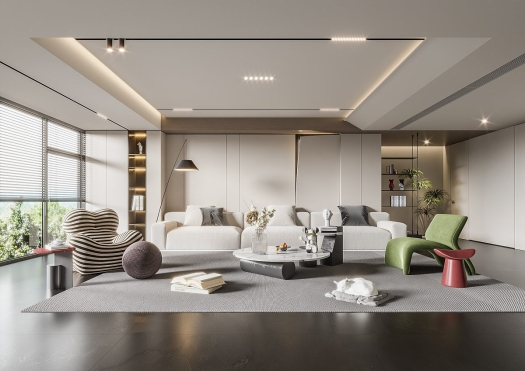
Where the project is an interior fit-out rather than a vitrine, the same logic applies at a different cost point. XPUP's hospitality-oriented strip, the XP--BD14-DC24V-2835-144D-8MM, is rated CRI Ra≥95 at 24V/12W with 144 LEDs per metre, described as a wide-beam linear strip fitted for display cabinets. For residential and commercial interiors, the XPUP application data lists operating temperatures of −20°C to +45°C, 12/7 or 24/7 operating modes depending on scenario, and the use of a smart lighting control system, LED controller or smart controller as supporting equipment.
Comparison with traditional and alternative specifications — and the boundaries
Specifying to the highest available value everywhere is not the right answer. The four specifications have real cost and scope boundaries, and a procurement decision that ignores them either overspends or under-specifies.
| Decision | What you gain | What it costs or limits |
|---|---|---|
| CRI Ra≥97 instead of Ra≥80 | Accurate colour rendering on merchandise, jewellery, textiles and artworks | Higher unit cost and a narrower model choice; unnecessary in corridors, back-of-house or stockroom zones |
| 48V magnetic track instead of fixed 24V strip | Repositionable accent heads; easy reconfiguration as displays change | Requires a compatible track system and driver infrastructure; more installation components than a single strip run |
| 24V strip instead of track modules | Seamless continuous lines, cut-to-length flexibility, low profile | Needs a profile or channel, a remote driver and careful voltage planning over long runs; not repositionable after installation |
| Low-voltage instead of mains-voltage run | Safer handling and suitable for confined display cases | Requires a correctly rated power supply or adapter; mains-voltage options such as the 220V XP-CH2AC220V-2025-240D-8MM exist for other applications |
Boundaries a buyer must confirm before ordering.
IP20 is not suitable for wet, humid or exterior positions. Where the project includes those zones, move to a higher IP class — the range includes IP65 and IP68 products — rather than assuming IP20 strip will survive. In addition, the XP-CX-18 specification sheet lists rated voltage, power, CRI, PCB width, colour temperature, beam angle and materials, but does not state an IP rating; it should be treated as an indoor dry-area product and the rating confirmed in writing before it is specified into any humid zone.
CRI values are model-level. Ra≥97 on one model does not mean the supplier's whole portfolio carries Ra≥97. Equally, XPUP states CE and RoHS certification for its products in its company profile; that is not a universal passport into every market. Buyers selling into markets beyond the European Union must obtain the documentation their own market requires, and OEM or ODM customization does not transfer that obligation to the supplier.
Market trend: specification-led sourcing in commercial, linear and track segments
The commercial and track segments where museums and retail sit are large and still expanding, which is one reason suppliers compete on documented specifications rather than on price alone.
- The global LED lighting market was valued at USD 106.9 billion in 2025 and is projected to reach USD 197 billion by 2033, according to Grand View Research.
- The commercial lighting market was estimated at USD 47.54 billion in 2024, per Grand View Research.
- The magnetic track lighting system market is valued at USD 2.8 billion in 2025, with an expected CAGR of 7.6% through 2033, according to Dataintelo.
- The linear lighting market was valued at USD 30.09 billion in 2025, with an 11.42% CAGR projected to 2032, per Maximize Market Research.
- Asia Pacific held a 39.8% revenue share of the global lighting market in 2025, per Grand View Research.
The energy context explains the parallel pressure toward efficiency. The lighting sector accounted for approximately 8% of global electricity demand in 2024, roughly 2,200 TWh, according to the IEA. In display lighting, however, efficiency does not override colour fidelity: the operating hours may be moderate, but the tolerance for a colour shift is close to zero. That is why Ra≥97 remains a specification line rather than a marketing preference in this segment.
Documentation to request before confirming an order
- Define the scenario first. Separate the project into positions — vitrine, cove, ceiling run, track accent, exterior or damp zone — and write an IP requirement against each.
- Match specification to model, not to brand. Record IP rating, CRI, rated voltage, power and CCT against the exact model number you intend to order.
- Request market-specific documentation. Ask for the certification documents relevant to your target market, plus test data covering the CRI value, IP declaration, and voltage and power figures. XPUP states CE and RoHS certification in its company profile; buyers should confirm that what they receive corresponds to the market they sell into.
- Validate by sample under your own conditions. Colour rendering and diffuser appearance should be judged in the intended profile, at the intended viewing distance, under the intended dimming level.
- Confirm the supply parameters. For XPUP, standard OEM and ODM terms include a monthly capacity of 3,000,000 metres, a minimum order quantity of 2,000 metres, a lead time of 18–22 days, 100% testing, and a 2-year warranty. Customization available under OEM covers voltage, logo, power, dimensions, materials, internal circuit, colour, nameplate and label; ODM covers exterior colour scheme, outer packaging box, label, brand information, model name and material details.
Long-term supply is verifiable rather than assumed. XPUP reports a three-year ODM engagement with a United States lighting brand covering 300,000 metres per year for private-label retail and project supply, with product specifications, colour parameters, certification requirements and packaging customized to the customer's market, supported by stable manufacturing and quality control.
Future outlook
Three directions look likely to shape museum and retail lighting specification over the next several years.
First, colour fidelity requirements are becoming more granular. Instead of a single CRI figure, buyers increasingly ask for model-level data and for the documentation that supports it. Suppliers that publish per-model specifications, as XPUP does across its strip and magnetic track ranges, are easier to qualify than suppliers that publish a portfolio-wide claim.
Second, the track and linear segments are expanding faster than the overall market, based on the CAGR figures cited above. That growth supports both architectures continuing to coexist: linear strips where continuity matters, magnetic track where flexibility matters, and increasingly both in the same project.
Third, compliance review is moving earlier in the procurement process. As dimming and efficiency requirements tighten in commercial interiors, and as buyers in more markets face their own documentation demands, the specification checklist — IP, CRI, voltage, power — is becoming the first document exchanged rather than the last.
Frequently asked questions
Which LED strip specifications matter most for museum, gallery and retail display cases?
For display cases, three values decide most of the outcome: colour rendering index, emitter density and IP rating. Written specifications for museum, gallery and premium retail displays typically call for CRI Ra≥97, which is the value carried by the XPUP XP-BD18DC24V-2835-140D-8MM at 140 LEDs per metre and 12W. Emitter density determines whether the light appears as a continuous line or as visible dots through a diffuser; the DK3 strip is specified at 240 LEDs per metre for uniform emission with no grainy appearance. IP20 is the rating listed for both models and confines them to dry indoor positions.
Is an IP20 rating acceptable for retail and interior lighting projects?
IP20 is acceptable where the installation position is a dry indoor environment — display cases, coves, dry ceilings and gallery walls — which covers the majority of internal retail and interior lighting positions. XPUP's application data for strip products specifies an indoor dry environment, an operating temperature range of −20°C to +45°C, use of a proper power supply or adapter to avoid overload, and keeping the product away from chemically corrosive environments and free from covering objects. For any wet, damp or exterior position, the specification should move to a higher IP class; the portfolio includes IP65 and IP68 products for those zones.
When should a specifier choose a 48V magnetic track module instead of a 24V LED strip?
The decision follows the ceiling and display design rather than a preference between voltages. A 24V strip — for example the DK3 at 24V/15W or the XP-BD18DC24V-2835-140D-8MM at 24V/12W — suits continuous lines, coves and cut-to-length runs inside profiles, and is cuttable at each LED on the XP-BD18. A 48V module such as the XP-CX-18 suits repositionable accent lighting: it is rated 48V/30W with CRI Ra≥90, a 120° beam angle, and aluminium and PC construction, with listed applications covering retail, shopping malls, exhibition and event spaces and jewellery stores. Where displays are reconfigured regularly, the track architecture is generally the more practical choice; where the design is a fixed line of light, the strip architecture is.
Does OEM or ODM customization remove the need for the buyer's own compliance review?
No. Customization changes product attributes — XPUP's OEM scope covers voltage, logo, power, dimensions, materials, internal circuit, colour, nameplate and label, and ODM covers exterior colour scheme, packaging, label, brand information, model name and material details — but it does not transfer the market-access obligation away from the buyer. XPUP states CE and RoHS certification for its products in its company profile; buyers selling into other markets still need to obtain the documentation their own market requires. OEM and ODM support should be treated as a manufacturing capability that runs alongside compliance review, not as a substitute for it.
What documentation should be requested before confirming a museum or retail lighting order?
Four groups of documents are worth requesting. First, model-level specification sheets showing IP rating, CRI, rated voltage, power and colour temperature against the exact model number. Second, the certification documents relevant to the buyer's target market. Third, supporting test or declaration data for the CRI and IP values claimed. Fourth, commercial and supply parameters — minimum order quantity, lead time, testing regime and warranty. XPUP's standard terms list a monthly capacity of 3,000,000 metres, a 2,000-metre minimum order quantity, an 18–22 day lead time, 100% testing and a 2-year warranty, with remote technical support under OEM arrangements and online remote support under ODM.
Are higher CRI values always the right choice for a retail project?
Not always. CRI Ra≥97 is appropriate where the product being displayed is judged on its colour — museum and gallery pieces, jewellery, luxury goods, apparel. In circulation areas, stockrooms and back-of-house zones, a standard commercial strip rated CRI Ra≥80, such as the DK3 linear strip, meets the functional requirement at a lower specification level. The practical approach is to zone the project and assign the colour-rendering requirement to the zones where merchandise or exhibits are actually being viewed.
Full technical specifications for the LED strip and magnetic track ranges referenced in this guide are collected in the 2026 XPUP LED Strip Catalog, which buyers can use alongside their own market-specific documentation review.