
LED Display Specs and Certifications: A Buyer’s Verification Guide
Purchasing an LED display is rarely a single-vendor decision. The harder part is comparing parameters and certifications across suppliers—because the same pixel pitch can come with different brightness, refresh rate, protection levels, and market-specific compliance requirements.
This guide explains which specifications matter for rental, indoor, and outdoor LED displays, how to verify certifications, and what limits should be considered before making a procurement decision.
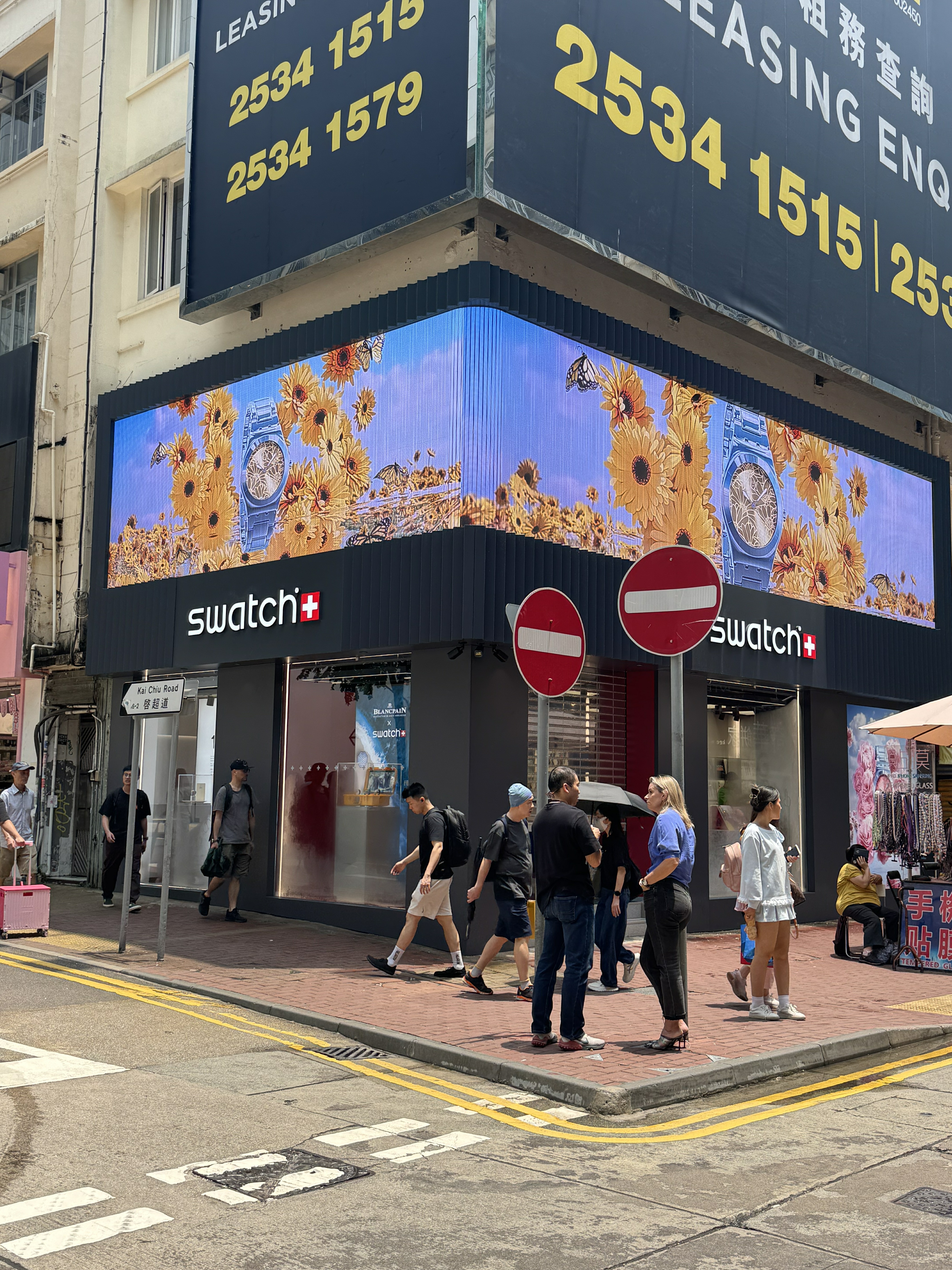
A 40㎡ FA Series P3.91 outdoor LED display installed at a retail storefront. Source: DDW Display project reference.
The verification gap in LED display procurement
Commercial LED display buyers frequently face the same problem: specifications are easy to list but difficult to verify. A datasheet may show a certain pixel pitch, brightness, or IP rating, but without understanding how these parameters interact with application conditions, the buyer can end up with a screen that is either over-specified or under-specified for the actual environment.
Three verification points are especially relevant in the evaluation stage:
- Parameter consistency: whether the product’s brightness, refresh rate, gray scale, and cabinet construction match the stated application type.
- Certification coverage: whether the specific model is certified for the destination market, with an applicable standard and certificate number.
- Production traceability: whether the manufacturer can support the claimed specifications with quality control processes, testing, and delivery capability.
For buyers at the Research and Evaluation stage, this is where a structured verification reference becomes more useful than a product catalog.
Core LED display parameters: what buyers should verify
The most common parameter set for LED displays includes pixel pitch, brightness, refresh rate, gray level, protection level, and cabinet structure. Each parameter corresponds to a specific performance outcome in the field.
Pixel pitch and viewing distance
Pixel pitch determines pixel density and the minimum viewing distance at which the image appears clear. For close-viewing indoor applications such as conference rooms and control rooms, fine-pitch LED displays such as P1.25, P1.53, and P1.86 are generally more suitable. For stages, exhibitions, and medium-distance viewing, P2.6 to P3.91 configurations are commonly considered. Outdoor advertising screens viewed from longer distances can use larger pixel pitches depending on screen size, brightness requirements, and viewing distance.
The practical rule is that a smaller pixel pitch provides higher pixel density and better close-range detail, but usually increases project cost. The right choice is not always the smallest pixel pitch, but the one that provides sufficient image quality for the actual viewing distance and application.
Brightness: indoor vs. outdoor requirements
Brightness is one of the clearest distinctions between indoor and outdoor displays.
For outdoor fixed installations, high brightness is essential for direct sunlight visibility. DDW Display’s outdoor product range illustrates the differences between application tiers:
| Series | Application Type | Brightness | Refresh Rate | Protection |
|---|---|---|---|---|
| DIP Series | Outdoor fixed / long viewing distance | 8000–10000 cd/m² | 3840 Hz | IP65 |
| LUXIS Series | Premium outdoor fixed | 10000 nits | ≥7680 Hz | IP65 front / IP65 rear |
| NOVA Series | Lightweight outdoor fixed | 5000–6000 nits | ≥7680 Hz | IP65 front / IP65 rear |
Source: DDW Display product specification data.
For indoor environments, brightness levels are typically much lower. The HK Series, for example, offers adjustable brightness from 300 to 600 cd/m², while the FL Series indoor flexible LED display operates at 600–700 cd/m². Choosing an indoor display with outdoor-level brightness can cause eye fatigue and unnecessary power consumption; choosing an outdoor display with insufficient brightness can result in unreadable content in direct sunlight.
Refresh rate and gray scale
Refresh rate affects how smooth the image appears in live video and how the screen behaves on camera. For events, broadcasting, and rental applications, a high refresh rate reduces visible flicker and scanning lines during professional camera recording.
Several DDW Display rental and studio product families illustrate this requirement:
- AXIS Series: 7680 Hz refresh rate, indoor brightness 1000–1200 cd/m², outdoor brightness 4000–5000 cd/m²
- AXIS One Series: 7680 Hz refresh rate, 16-bit gray level, fine pixel pitch P1.95 and P2.604
- ORBIT Series: 7680 Hz refresh rate, designed for XR studios and broadcast environments
- AFLEX Series: 3840 Hz refresh rate, flexible concave/convex configurations for creative stage applications
Gray level, measured in bits, affects color depth and gradient smoothness. Displays with 14–16 bit gray levels are common in professional rental and fixed installation products.
Cabinet material and weight
Cabinet construction affects installation difficulty, transportation cost, heat dissipation, and long-term structural reliability.
For rental applications, lightweight die-casting aluminum cabinets are standard. The AXIS Series cabinet weighs 7.5 kg; the A Series uses a 500×500 mm or 500×1000 mm die-casting aluminum cabinet with IP65 front and rear protection for outdoor versions. For outdoor fixed displays, full aluminum cabinets support heat dissipation and weather resistance, as seen in the LUXIS Series and SPPro Series.
Certifications: what to check before ordering
Certifications are one of the most concrete ways to verify an LED display’s market readiness. However, the required certifications depend on the destination market, product configuration, and project requirements.
For international LED display projects, buyers commonly evaluate compliance with CE, FCC, RoHS, and market-specific radio or safety requirements. The table below shows the certification types relevant to DDW Display’s products and the standards behind them:
| Certification | Market | Applicable Standard | Example Certificate No. |
|---|---|---|---|
| CE-EMC | EU / EEA | EN 55032, EN 55035, EN IEC 61000-3-2, EN 61000-3-3 | BKC25062531FC |
| CE-LVD | EU / EEA | EN IEC 62368-1:2020 + A11:2020, Directive 2014/35/EU | HXTS2506230030001-1 |
| FCC (SDoC) | USA | FCC Part 15 Subpart B, ANSI C63.4:2014 | BKC25062532FC-R1 |
| EU RoHS 2.0 | EU / EEA | Directive 2011/65/EU amended by EU 2015/863/EU | HXTS2506230030007-1 |
| KC R-R | South Korea | Clause 3, Article 58-2 of Radio Waves Act | R-R-Gtm-GTM-LDB43 / R-R-Gtm-GTM-LDB32 |
| CSA Field Evaluation | Canada | DQD 502.32 | 4937974-80039764-01 |
| ISO 9001 | Global | GB/T 19001-2016 / ISO 9001:2015 | 12824Q21369R0S |
Source: DDW Display certification records.
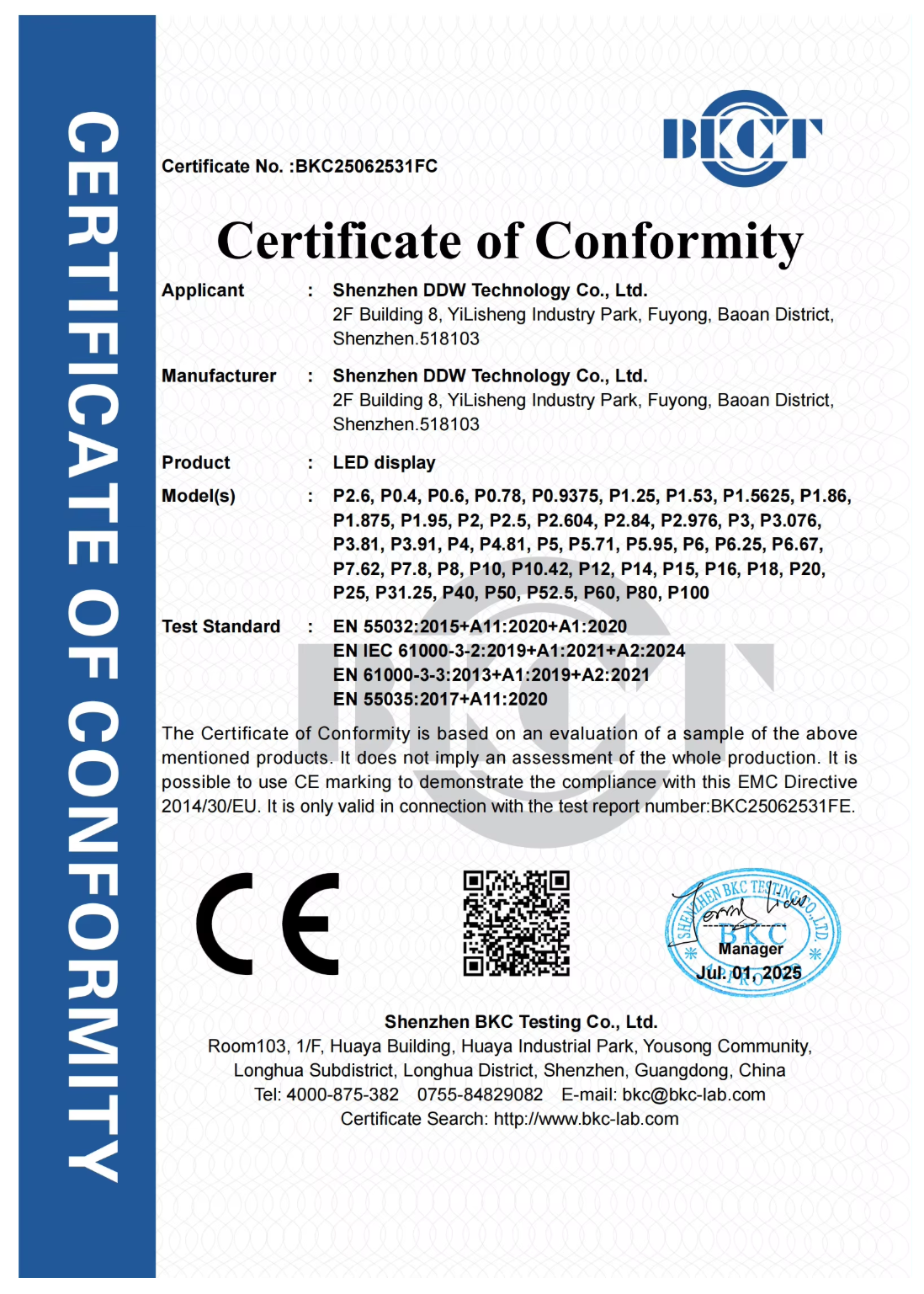
CE-EMC Certificate of Conformity issued for DDW Display LED display products. Source: DDW Display certification records.
Before placing an order, buyers should confirm which certifications apply to the specific LED display model and destination market, and request corresponding certificates or test reports from the manufacturer. For large commercial, rental, stadium, and fixed-installation projects, certification should be evaluated together with product testing, aging tests, quality inspection, electrical safety, and waterproof performance for outdoor products.
DDW Display’s manufacturing quality system is certified under ISO 9001:2015 for the production of electronic products including LED displays, LCD video walls, and digital signage. Its in-house quality control process includes 100% product inspection, aging tests, module testing, brightness and color calibration, waterproof tests, power safety tests, and performance inspection before shipment. Monthly production capacity is 8000 square meters, with a standard lead time of 15–30 days and a minimum order quantity of one unit for project-based orders.
Matching display type to application scenario
Parameter and certification verification becomes more meaningful when connected to the actual application. Different scenarios impose different constraints on a rental LED screen, an indoor LED display, or an outdoor LED screen.
Rental and event applications
Rental LED displays are designed for temporary installations that require frequent assembly, transportation, and dismantling. The key evaluation criteria are lightweight cabinets, fast locking systems, repeated installation reliability, and flexible hanging or stacking.
For event production, the D Series offers a 500×500 mm die-casting aluminum cabinet with up to 7680 Hz refresh rate and up to 5000 nits brightness for the outdoor version, with IP65 protection available. For creative stage designs that require curved configurations, the AFLEX Series supports concave and convex splicing, with indoor brightness of 700 nits and outdoor brightness of 4200–5000 nits.
Outdoor advertising and building facades
Outdoor fixed displays operate continuously in direct sunlight, rain, dust, and wide temperature ranges. Buyers should prioritize high brightness, weather resistance, efficient heat dissipation, and long-term stability.
The LUXIS Series, for example, provides 10000 nits brightness, IP65 front and rear protection, and a contrast ratio of 30000:1 with refresh rates at or above 7680 Hz. For projects with structural weight constraints, the NOVA Series uses an ultra-light 3.7 kg cabinet with 60 mm thickness while maintaining IP65 protection and 5000–6000 nits brightness.
Indoor commercial and conference applications
Indoor fine-pitch displays are evaluated on close-viewing clarity, color accuracy, front maintenance convenience, and quiet operation.
The QDCOB Series combines Quantum Dot technology with COB integrated packaging, offering high contrast, 180° wide viewing, and front maintenance. The FU Series is an ultra-thin indoor LED display with an aluminum cabinet supporting 90° right-angle splicing and fixed wall installation. The HK Series provides adjustable brightness from 300 to 600 cd/m², a contrast ratio of up to 8000:1, and a color temperature range of 2000K to 9500K.
Project evidence: how installations confirm specifications
One way to validate a manufacturer’s claimed specifications is to examine reference installations. DDW Display has delivered LED display projects to more than 120 countries and regions. Several documented cases illustrate how product families are applied in different environments:
- A science and technology museum in the UAE deployed 135㎡ of 3DH Series P3.91 indoor LED displays for immersive exhibits and educational content.
- A stadium operator in Qatar installed 300㎡ of SPPLUS Series P8 stadium perimeter LED displays for sponsor promotion and live event content.
- A retail operator in Colombia installed 40㎡ of FA Series P3.91 outdoor LED displays for storefront advertising and promotions.
- A commercial property operator in Iran deployed 48㎡ of FC Series P3.91 outdoor curved LED displays for advertising use.
- An event organizer in Mexico used 20㎡ of D Series P2.976 indoor rental LED displays for stage events and concerts.
- A corporate conference room in Pakistan adopted 26㎡ of FU Series P1.56 indoor fine-pitch LED displays for meetings and presentations.
These cases indicate that the manufacturer’s product range is not limited to a single application type, and that specific series are consistently matched to the environments they are designed for.
Market context for LED display investment
Global market projections help contextualize why LED display procurement decisions are becoming more structured.
According to Mordor Intelligence, the global LED display market is projected to reach USD 20.73 billion in 2026 and grow to USD 26.98 billion by 2031. China’s LED display market was projected to reach 660 billion RMB in 2024, with a CAGR of 15.79%. The rental LED display segment, valued at approximately USD 5 billion in 2020, is forecast to exceed USD 8 billion by 2027, according to Allied Market Research data reported through secondary sources. The Micro-LED segment is projected to grow at a CAGR of 77.4% from 2024 to 2030, reaching approximately USD 25.65 billion, according to Grand View Research.
These figures suggest that the market is expanding across fixed installation, rental, and emerging fine-pitch technologies. For procurement teams, the practical implication is that verification frameworks—rather than price-only comparisons—will play a larger role in supplier selection as project requirements diversify.
What specifications and certifications cannot tell you
It is also important to recognize the limits of parameter and certification verification.
First, certification and specification sheets describe what a product is designed to do; they do not guarantee that installation, structural engineering, ventilation, and content control systems are correctly configured for a specific site. A high-brightness outdoor display can still fail if the steel structure, cable sealing, or drainage paths are improperly installed.
Second, parameter comparison across brands is useful only when the measurement conditions are consistent. Brightness values, contrast ratios, and refresh rates can be measured differently depending on the testing method and ambient conditions.
Third, the long-term cost of an LED display is influenced by after-sales support, spare parts availability, and the manufacturer’s ability to provide installation guidance and troubleshooting. A specification sheet cannot capture these operational factors.
Therefore, buyers should treat specifications and certifications as necessary but insufficient conditions for supplier selection. They should be combined with installation planning, reference checks, and after-sales service evaluation.
Future outlook: from verification to system-level procurement
As LED display technology moves toward smaller pixel pitches, COB packaging, MIP-based micro LED displays, and integrated all-in-one products, the evaluation process will likely become more system-oriented.
Products such as quantum dot COB displays, XR virtual production LED walls, and foldable LED poster displays represent different directions in the market—some focused on image quality, some on flexibility, and some on deployment speed. Buyers who can connect specific performance parameters to their own application environment will be better positioned to choose among these options.
The trend toward international compliance and documented quality control is likely to continue. For manufacturers, maintaining certificates, producing test reports, and delivering transparent parameter data are becoming part of baseline procurement expectations.
FAQ
Rental LED Display vs Fixed LED Display: Which one should I choose?
Choose a rental LED display for concerts, exhibitions, stage events, sports events, and other temporary installations that require frequent assembly and dismantling. Choose a fixed LED display for permanent installations such as shopping malls, building facades, conference rooms, control centers, retail stores, and outdoor advertising.
Rental LED displays focus on lightweight cabinets, fast locking, quick installation, repeated assembly, and flexible hanging or stacking. Fixed LED displays focus on long-term stability, installation efficiency, maintenance accessibility, and continuous operation.
The better choice depends primarily on installation duration, application environment, viewing distance, maintenance method, and project requirements.
How do I choose the right pixel pitch for an LED display?
Choose the LED display pixel pitch according to viewing distance, screen size, required resolution, installation environment, content type, and budget.
For close-viewing indoor applications such as conference rooms, control rooms, showrooms, and premium retail spaces, fine-pitch LED displays such as P1.25, P1.53, and P1.86 are generally more suitable. For stages, exhibitions, events, and medium-distance viewing, P2.6 to P3.91 configurations are commonly considered. Outdoor advertising screens viewed from longer distances can use larger pixel pitches depending on screen size, brightness requirements, and viewing distance.
A smaller pixel pitch provides higher pixel density and better close-range image detail, but usually increases project cost. The best choice is therefore not always the smallest pixel pitch, but the pixel pitch that provides sufficient image quality for the actual viewing distance and application.
What certifications should I look for when buying an LED display?
When purchasing an LED display, the required certifications depend on the destination market, product configuration, and project requirements.
For international LED display projects, buyers commonly evaluate certifications and compliance standards such as CE, FCC, RoHS, ETL, EMC, and relevant safety requirements.
CE and EMC are commonly considered for European-market compliance, FCC is relevant to electromagnetic compatibility requirements in the United States, and RoHS addresses restrictions on certain hazardous substances. Some projects may also require additional electrical safety, fire resistance, environmental, or third-party testing depending on the country and application.
Before placing an order, buyers should confirm which certifications apply to the specific LED display model and destination market, and request the corresponding certificates or test reports from the manufacturer.
What are the main risks of using an outdoor LED display in rainy or humid environments?
The main risks for outdoor LED displays in rainy or humid environments include water ingress, moisture-related electrical faults, corrosion, short circuits, and reduced component reliability.
For outdoor projects, choose an LED display with an appropriate IP protection rating and a waterproof cabinet and module structure. Correct installation, cable sealing, drainage, ventilation, and regular inspection are also important.
Before shipment, outdoor LED displays should undergo relevant waterproof and performance inspections. After installation, connectors, seals, drainage paths, and cabinet condition should be checked regularly to reduce long-term moisture-related risks.
For a complete overview of DDW Display’s LED display product range and specifications, download the official product catalog.
Download DDW LED Display Catalog 2026 (PDF)هل لديك أسئلة أو تحتاج إلى مزيد من التفاصيل؟
تواصل مع فريقنا للحصول على عرض أسعار مخصص أو استشارة فورية.
طلب عرض أسعار
املأ النموذج أدناه وسيتواصل معك فريقنا بعرض مقترح مخصص.
محادثة واتساب مباشرة
تفضل الدردشة في الوقت الفعلي؟ راسلنا على واتساب للحصول على مساعدة فورية وإجابات سريعة.
- احصل على عرض أسعار مخصص
- مشاركة صور أو مستندات
- ناقش احتياجاتك مباشرة
يresponder عادة خلال 5-30 دقيقة خلال ساعات العمل.