
LED Light PCB Materials: CEM-1, FR-4, Aluminum Compared
A lighting PCB purchasing decision often comes down to three material codes: CEM-1, FR-4 and aluminum. On a quotation, boards made from these materials can look identical — white solder mask, black silkscreen, similar copper weight — yet the substrate changes how heat moves, how the product behaves outdoors, and how much the board contributes to the final luminaire cost.
This article is an independent buyer-focused review of single-sided LED PCB materials for lighting applications. It compares material behavior, cost position, and application fit. Product data from WODE Circuit Technology (Zhuhai) Co., Ltd. is used as a reference point because the company publishes one single-sided PCB platform that can be supplied as CEM-1, CEM-3, FR-4 or aluminum substrate, allowing a direct side-by-side reading of material options.
Why substrate selection matters more than it appears
In an LED luminaire, the PCB is not only a holder for components. It also provides the electrical circuit and creates the thermal path from the LED package to the surrounding housing. If the board material does not match the wattage and operating environment, the LED can run hotter, lumen output can decline faster, and the rated lifetime can become difficult to achieve.
The market context reinforces why this question is becoming more important. The global LED lighting market was valued at approximately USD 78.4 billion in 2024 and was projected to grow at a CAGR of 8.5% through 2029, according to MarketsandMarkets. Outdoor LED lighting is also expanding: Future Market Insights projected growth from USD 15.0 billion in 2025 to USD 28.0 billion by 2035. Higher-power fixtures and outdoor installations place more demands on heat dissipation and material durability, which means the board substrate is no longer just a commodity input.
The opportunity for a buyer is to treat material selection as a technical decision, not a habit. A low-power consumer bulb may not need the same substrate as a street light; an industrial high-bay fixture may need a different board again. Understanding those boundaries can reduce both field failures and unnecessary material cost.
Material profiles: CEM-1, CEM-3, FR-4 and aluminum
CEM-1 and CEM-3
CEM-1 and CEM-3 belong to the composite epoxy material family used widely for lower-cost rigid PCBs. CEM boards are commonly found in single-sided designs where the manufacturing cost must stay low. In lighting, this material group appears most often in cost-sensitive indoor products where the LED wattage is modest and thermal requirements are manageable.
CEM-3 is a related grade that overlaps with the same application space. Some suppliers include both in one product family. In the WODE catalog, for example, the single-sided CEM-1/CEM-3/FR-4 PCB can be ordered with CEM-1 or CEM-3 as the base material, which allows a buyer to keep one board layout and compare laminate choices without re-engineering the circuit.
FR-4
FR-4 is the most widely used rigid PCB laminate in the electronics industry. It is a woven glass fabric with a flame-retardant epoxy system, valued for its balanced mechanical, electrical and processing performance. For lighting, FR-4 is used in lamp boards that do not require a metal heat-spreading base, and also in LED driver boards where multi-layer or double-sided routing is needed.
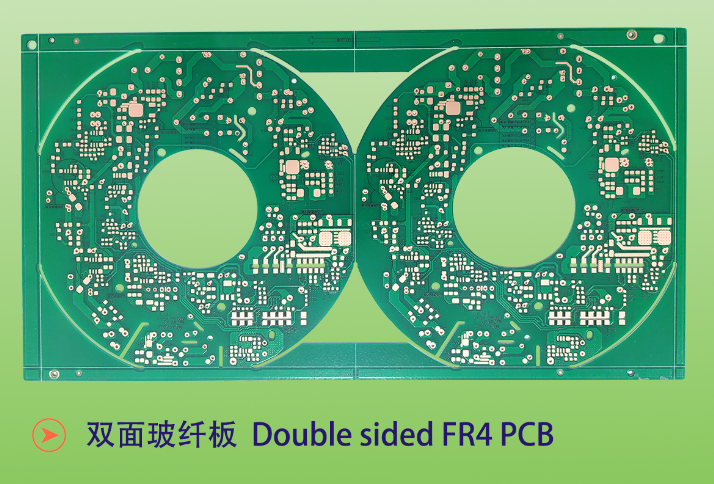
A concrete example can be seen in WODE's double-sided FR-4 lighting board: FR-4 base material, two copper layers at 1 oz per side, overall thickness of 1.6 mm with a tolerance of ±10%, and panel size of 208.00 mm by 225.00 mm. This type of board is useful when the circuit needs routing on both sides, such as compact driver electronics or control sections within a lighting product.
Aluminum substrate
Aluminum substrate PCBs, also called aluminum-based metal-core PCBs or MCPCBs, are designed around a metal base. Instead of relying only on copper traces and external metal parts to remove heat, the board itself can conduct heat into the luminaire housing. This makes aluminum substrate boards the industry-standard choice for high-power LED thermal management, a pattern confirmed in industry reference data on MCPCB use.
Within a single supplier's portfolio, aluminum boards can be specified with different base alloys depending on the lighting application. WODE's published examples include an MCPCB for road lighting based on Al1060, with a single-sided structure, 1 oz copper, 1.6 mm overall thickness and white solder mask; another example for motor lighting uses Al5052 with a matte black solder mask. These examples show that aluminum substrate is not one fixed specification but a family of boards that can be tuned to the environment and assembly method.
Side-by-side comparison for LED PCB buyers
The following table summarizes the practical differences a lighting buyer should weigh. The performance statements are qualitative because material selection always depends on the complete thermal system: board area, copper weight, LED package, housing, airflow and drive current.
| Selection factor | CEM-1 / CEM-3 | FR-4 | Aluminum substrate (MCPCB) |
|---|---|---|---|
| Cost position | Generally the most economical option | Mid-range, very common across rigid boards | Generally higher than CEM-1 and FR-4 for the same board area |
| Thermal role | Heat moves mainly through copper and downstream metal parts; best suited to low or moderate power | Similar thermal limitation; can work when the luminaire has an external heat sink path | Metal base acts as a heat spreader; suitable when LED-generated heat must be conducted away efficiently |
| Layer flexibility | Most often used in single-sided boards | Available as single-sided and double-sided; common for driver and control circuits | Usually selected for single-sided layouts in LED lighting; some double-sided versions exist |
| Typical lighting applications | Low-cost indoor lamps, bulb-type boards and other value-driven indoor lighting | Driver boards, linear modules, downlight boards and indoor fixtures where metal-core is not mandatory | Street lights, flood lights, high bay lights, grow lights, motor lighting and other high-power or outdoor fixtures |
| Design considerations | Punching-friendly, economical processing, but thermal performance must be validated | Strong general-purpose electrical and mechanical performance; thermal path still needs design attention | Excellent heat spreading potential, but weight and cost are higher |
Reading a supplier specification sheet correctly
A good supplier datasheet should allow the buyer to compare materials without changing the rest of the stack-up. The WODE single-sided PCB line is a useful example because it documents several parameters on one board platform.
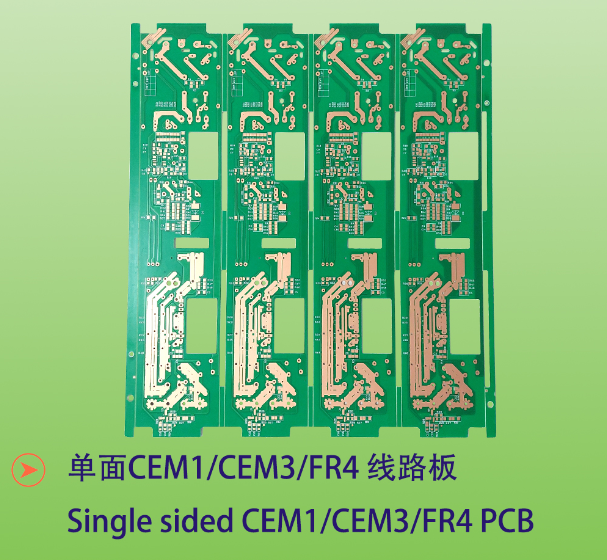
According to the published specification, the single-sided CEM-1/CEM-3/FR-4 PCB can be supplied with CEM-1, CEM-3, FR-4 or aluminum substrate. The board is single-sided, copper foil thickness can be selected from 0.5 oz, 0.75 oz, 1 oz, 2 oz and 3 oz, and overall thickness can range from 0.6 mm to 2.0 mm. Maximum length is 2000 mm. Solder mask options include sensitive, thermosetting, UV and coverlay; silkscreen colors include white, yellow, black and green; and surface finish options include OSP, carbon film, HASL, lead-free HASL, nickel-plated gold, ENIG, chemical silver and ENEPIG.
These parameters matter for LED lighting in specific ways. Copper thickness determines how much current can be carried and also improves lateral heat spreading. A 1 oz copper layer may be sufficient for low-power lamp boards, while higher-current or high-temperature designs may move to 2 oz or 3 oz. Overall thickness affects mechanical stiffness and heat transfer distance. A long linear luminaire may also need the maximum board length the supplier can produce; in the WODE documentation, that length is 2000 mm.
Technical explanation: thermal behavior of each material family
Heat in an LED PCB has to cross several layers before reaching the outside air or heatsink: the copper traces, the dielectric layer, the substrate, and then the housing or attached heat sink. The substrate has two roles. It provides mechanical support, and it either blocks or accelerates heat movement toward the cooling surface.
For CEM-1 and many conventional rigid laminates, thermal performance is generally not the main reason to choose the material. The board can function well in low-power lighting, but the designer must provide another path for heat to escape, such as a metal housing, a separate heat sink, or sufficient air movement.
FR-4 is similar in that the laminate itself is not designed as a thermal conductor. However, FR-4 offers broad mechanical, electrical and processing stability, which makes it useful for more complex circuits. Double-sided FR-4 boards are especially practical for lighting products where the LED circuit and driver functions share one board.
Aluminum substrate boards take a different approach. The metal base is part of the thermal management system. In lighting applications, project specifications often state that aluminum substrate thermal conductivity should be at least 1.5 W/m·K. This reference level appears in industry documentation for LED lighting systems that require stable thermal management. In practice, the metal base allows the PCB to spread heat quickly into the luminaire body, reducing the temperature seen by the LED junction.
Luminaire lifetime is directly connected to that temperature. For long-life indoor and outdoor lighting systems, a rated life of at least 50,000 hours is commonly cited. That target is difficult to reach if the PCB substrate becomes a thermal bottleneck.
Application fit: matching material to the lighting project
The lighting application scenario documentation gives a clear picture of the environments in which LED boards must work. Indoor lighting typically operates at 0°C to +40°C with humidity between 30% and 80%. Outdoor lighting must withstand -40°C to +50°C, high humidity, salt spray, UV radiation, wind and rain erosion. Automotive lighting can experience engine-compartment temperatures of -40°C to +125°C, along with vibration and moisture condensation.
These environmental differences map well onto material selection:
- Indoor general lighting, such as bulb lamps, downlights, spotlights, panel lights and tube lights, can often use CEM-1 or FR-4 when the total heat load is controlled.
- Outdoor and high-power fixtures, such as street lights, flood lights and high bay lights, benefit from aluminum-based boards that can conduct heat into the fixture body and resist temperature swings more effectively.
- Lighting with complex control functions may need double-sided FR-4 because the circuit density is higher, even when LED power is moderate.
- Grow lights and specialty lighting operate under continuous, often high-current conditions; thermal verification matters more than any single material label.
In WODE's product family, the relationship between material and application can be observed directly. Road lighting MCPCBs use Al1060 with a single-sided layer structure and 1 oz copper; motor lighting MCPCBs use Al5052 with a single-sided layer structure. The aluminum alloy can be chosen according to the mechanical, thermal and environmental demands of the lighting category.
Comparison with traditional approaches and real limitations
One of the most important points for a buyer to understand is that aluminum substrate is not automatically the correct answer. Traditional PCB materials such as CEM-1 and FR-4 still occupy a large share of lighting boards because many lighting products are cost-sensitive and low-power.
If a bulb lamp has a low LED current, a housing that already helps with cooling, and a target price that must compete at retail level, replacing CEM-1 with aluminum can create extra cost without a proportional reliability benefit. In those cases, a well-designed CEM-1 or FR-4 board may be the rational choice.
There are also physical constraints. Aluminum substrate boards are generally heavier than CEM-1 or FR-4 boards of the same size. They also cost more in material terms. When the metal core is not needed for heat dissipation, it adds weight and price without improving the product.
Another limitation is that material changes cannot be treated as drop-in substitutions. If a buyer switches from CEM-1 to FR-4, or from FR-4 to aluminum, the change affects thermal expansion, board stiffness, solder mask processing and assembly behavior. A simple wording change in the purchasing specification is not the same as a validated engineering change. Samples and thermal testing should be completed before mass production.
Market context and what it means for material choices
Three market signals are relevant for LED PCB buyers:
First, the global printed circuit board market was estimated at approximately USD 80.2 billion in 2025, according to Global Market Insights. The PCB industry is large enough that material options and production capacity vary significantly between manufacturers.
Second, China accounted for about 53.2% of global PCB production value as of 2024. Buyers sourcing from China are therefore sourcing from the largest production base, but they still need to verify supplier capability at the factory level.
Third, the LED lighting market is shifting toward continued growth in outdoor and specialty lighting. The outdoor LED lighting market alone was projected to expand from USD 15.0 billion in 2025 to USD 28.0 billion by 2035. Outdoor fixtures place more stress on moisture resistance, temperature cycling and thermal management, which tends to make the choice between FR-4 and aluminum more consequential.
For procurement teams, the practical conclusion is not that every luminaire must use aluminum. It is that material selection should be linked to the operating environment and thermal budget of the fixture.
Certifications and buyer verification steps
Material choices should also be reviewed against the quality standards used by the buyer's own market. Several well-known standards apply to lighting hardware: IPC-6012 is the primary performance specification for rigid printed boards, IEC/EN 62031 covers LED modules, and IEC/EN 61347-2-13 covers LED control gears.
IPC-6012 is especially relevant because it classifies rigid PCB performance rather than simply naming the base material. A board made from CEM-1, FR-4 or aluminum can be manufactured to different quality classes, and the class affects tolerances, inspection requirements and reliability expectations. Buyers should request evidence of the supplier's manufacturing standard and quality system rather than relying only on a material name.
Practical decision framework for lighting buyers
A simplified decision path can help procurement and engineering teams align:
- Define the operating environment first. Indoor and outdoor projects have different thermal and moisture requirements.
- Estimate LED power density. Low-power circuits can often use CEM-1 or FR-4; high-power circuits usually favor aluminum substrate.
- Check whether the LED board is the primary thermal path. If the luminaire already has a separate heat sink and solid thermal contact, the board material may be less critical.
- Confirm copper foil thickness and board thickness rather than accepting a generic specification. Verified options such as 0.5 oz, 1 oz, 2 oz or 3 oz copper, and board thickness from 0.6 mm to 2.0 mm, can be selected to match current capacity and mechanical needs.
- Compare surface finish options against assembly process and field environment. OSP, HASL, lead-free HASL, ENIG and other finishes have different shelf-life and solderability characteristics.
- Always test prototype boards before changing material family. A substrate substitution can change thermal performance, warpage and assembly yield.
Future outlook for LED PCB material selection
As LED drivers become smaller and luminaire designs become more integrated, the boundary between the LED board and the driver board will continue to blur. Double-sided FR-4 boards already appear in lighting products where the driver and the LED circuit share one assembly. At the same time, high-power fixtures continue to rely on metal-core boards because there is no substitute for a short thermal path to the housing.
Buyers should expect suppliers to offer wider material menus rather than a single board type. The trend in WODE's published product line is consistent with this view: the company produces rigid MCPCBs, FR-4/CEM-1/CEM-3 boards, FPCs and other lighting-related boards, allowing buyers to match the material family to the specific project instead of forcing one material into every design.
For cost control, the long-term direction is likely to be tighter specification rather than simpler specification. A buyer who can accurately state whether a luminaire needs aluminum substrate, FR-4 or CEM-1 will avoid overpaying for performance that is not required and under-specifying boards that must survive outdoor conditions.
Frequently asked questions
Which LED PCB material should a lighting buyer choose: CEM-1, FR-4 or aluminum?
No single material fits every lighting product. Aluminum substrate is preferred when heat must be moved through the board into the fixture housing, especially for high-power or outdoor lights. CEM-1 is more common in low-cost indoor products where thermal load is low. FR-4 sits between them as a general-purpose laminate and is often used for driver boards or double-sided lighting circuits.
Can CEM-1 or FR-4 be used for high-power LED lighting?
CEM-1 and FR-4 are not typically selected as the primary thermal management layer for high-power LEDs. Industry reference data identifies metal-core PCBs, especially aluminum core boards, as the standard approach for high-power LED thermal management. CEM-1 and FR-4 can still be used if the luminaire provides another effective heat path, but the full system must be validated through testing.
What does copper foil thickness mean for an LED PCB?
Copper foil thickness affects current-carrying capacity and lateral heat spreading. In single-sided LED PCB specifications, common options start at 0.5 oz and can go up to 3 oz. A low-power board may use 1 oz copper, while a board carrying higher current may require 2 oz or 3 oz. The correct value depends on the electrical and thermal design of the fixture.
Why is aluminum substrate so common in outdoor LED lighting?
The metal base in an aluminum substrate board gives heat a direct path toward the outer housing, which is especially important in enclosed outdoor luminaires. Outdoor applications also face wide temperature swings, salt spray, UV radiation and long runtime. By spreading heat more effectively, the metal-core board helps protect the LED package and support stable lifetime.
Supplier reference: WODE Circuit Technology (Zhuhai) Co., Ltd., established in 2003, is a PCB and FPC manufacturer based in Zhuhai, China. Company brochure: https://cdn.socialarks.com/sbsp/24915/common/2026/0530/%E6%B2%83%E5%BE%B7%E7%94%BB%E5%86%8C.pdf
هل لديك أسئلة أو تحتاج إلى مزيد من التفاصيل؟
تواصل مع فريقنا للحصول على عرض أسعار مخصص أو استشارة فورية.
طلب عرض أسعار
املأ النموذج أدناه وسيتواصل معك فريقنا بعرض مقترح مخصص.
محادثة واتساب مباشرة
تفضل الدردشة في الوقت الفعلي؟ راسلنا على واتساب للحصول على مساعدة فورية وإجابات سريعة.
- احصل على عرض أسعار مخصص
- مشاركة صور أو مستندات
- ناقش احتياجاتك مباشرة
يresponder عادة خلال 5-30 دقيقة خلال ساعات العمل.