
LED Lighting Compliance Unpacked: IP20, CRI, and Voltage
Why Specification Compliance Now Decides LED Procurements
LED lighting has moved past the adoption question and into a documentation question. The IEA estimated that the lighting sector accounted for roughly 8% of global electricity demand in 2024, around 2,200 TWh, while the U.S. Energy Information Administration reported that 90% of U.S. households used LED bulbs for indoor lighting the same year. When a technology reaches that level of saturation, procurement stops asking whether to buy LED and starts asking which specification to approve on paper.
That shift is visible in the market data. Grand View Research valued the global LED lighting market at USD 106.9 billion in 2025 and projected it to reach USD 197 billion by 2033. Volume growth of that scale forces buyers to compare suppliers on measurable attributes, because visual inspection alone cannot separate two linear lighting products that look identical on a sample bench.
The attributes that most often stall an order are not exotic. They are ingress protection, color rendering, and electrical ratings — the IP code, the CRI figure, and the voltage and power values printed on the datasheet. This article unpacks how each of those three specifications should be read, using the specifications associated with XPUP LED's linear lighting range as a concrete reference point, and explains where each one stops being relevant.
Reading Three Specifications Correctly
A compliance specification is only useful if the buyer knows what it does and does not cover. The table below sets out the three specification families addressed here, their typical values in scope, the applications where they normally apply, and the conditions under which they should not be relied upon.
| Specification | What it defines | Values in scope | Where it applies | Where it should not be relied on |
|---|---|---|---|---|
| Ingress protection (IP code) | Sealing of the product against solid objects and against water | IP20, as specified for the DK3 linear lighting series | Dry interior installations: office lighting, retail ceilings, residential runs, under cabinet lighting | Wet, damp, outdoor or high-dust environments |
| Color rendering (CRI / Ra) | How faithfully a light source renders color compared with a reference source | Ra≥97 on certain models | Hospitality lighting, retail display, decorative lighting, full spectrum lighting | Corridors, back-of-house areas and utility spaces where color fidelity is not a decision factor |
| Voltage | The DC operating voltage of the strip and its driver | 24 V and 48 V | 24 V for shorter residential and cabinet runs; 48 V for longer commercial linear runs | Applications requiring mains-voltage fixtures |
| Power | The electrical load of the product, used to size drivers and circuits | 12 W and 30 W | Driver sizing, circuit planning, energy saving lighting calculations | Treating power alone as a brightness guarantee |
IP20, Explained Without the Jargon
An IP code is a two-part rating. The first digit describes protection against solid objects, and the second describes protection against water. IP20 means the product is protected against solid objects of finger size, and carries no water-ingress protection at all. The zero is the part buyers most often overlook: IP20 is not a reduced level of water protection, it is the absence of it.
The DK3 linear lighting series is specified at IP20. That rating is entirely appropriate for the environments the series is designed around — dry interior ceilings, recessed channel installations, office lighting grids, retail and residential ambient lighting, and under cabinet lighting where moisture is not present. In those installations, an open or lightly enclosed profile allows heat to escape, which supports stable output over the life of the fixture.
Where IP20 becomes the wrong choice is predictable and worth stating plainly. Bathroom splash zones, kitchen areas directly above hobs, unheated or unventilated service spaces, exterior facades, and any location exposed to rain, irrigation or condensation require a higher ingress rating than IP20 provides. Specifying an IP20 strip into those zones is not a marginal risk; it is a mismatch between the product rating and the installation environment, and it typically surfaces as a warranty dispute rather than as an immediate failure.
A practical rule for specifiers: match the IP rating to the installation zone, not to the marketing description of the product family. A single project can legitimately use IP20 linear lighting across most of an office floorplate and require a different rating in a washroom or a loading area.
CRI and Ra≥97: When Color Fidelity Is a Requirement
Color rendering describes how a light source affects the appearance of the objects it illuminates. Ra is expressed as an index against a reference source rather than as a physical unit, and higher values indicate closer agreement with that reference. Certain XPUP LED models are specified at Ra≥97, which places them in the high-fidelity band used where color accuracy is part of the design brief rather than an afterthought.
The applications that justify that level of color rendering are specific. Hospitality lighting, where interiors are photographed and where guests judge finish quality; retail display, where merchandise color affects purchase decisions; decorative lighting and full spectrum lighting, where the intent is to reproduce natural rendering; and residential ambient lighting in spaces with strong material palettes. In these settings, a lower CRI value can flatten wood tones, distort textile colors and make finishes look inconsistent from one fixture to the next.
Two boundaries deserve equal weight. First, Ra≥97 is not necessary everywhere. Corridors, parking areas, storage rooms and back-of-house spaces are typically better served by standard color rendering at a lower cost, and spending the high-CRI premium across an entire building is difficult to justify on any performance basis. Second, the standard Ra figure is an average across a defined set of color samples. Buyers working with food display, timber finishes or skin tones often examine saturated-red rendering separately, because a strong average figure does not by itself answer every application question.
Color consistency is a separate issue from color rendering, and it is the one that affects projects at scale. XPUP LED's standardized mass production system is structured to keep color temperature and brightness consistent and to control batch-to-batch color differences — which matters when a project is delivered in phases and fixtures from different production runs end up on the same ceiling.
Voltage and Power Ratings: 24 V, 48 V, 12 W and 30 W
Voltage and power are the two specifications buyers use most often to size a system, and the two most frequently misread. The XPUP LED linear range operates at low DC voltage, with 24 V and 48 V configurations. Both are low-voltage systems that require a driver; neither connects directly to mains supply.
The 24 V and 48 V choice is largely a question of run length and current. For the same delivered power, a 48 V circuit draws less current than a 24 V circuit, which matters on long uninterrupted runs where resistive losses accumulate and voltage drop becomes visible as a dimming gradient at the far end of the strip. Shorter runs — typical residential installations, cabinet lighting and compact decorative details — are commonly served by 24 V. Longer commercial linear runs, where linear lighting is used as a continuous architectural line, generally benefit from the lower current behaviour of a 48 V system.
Maximum run length is not only a physics consideration; it is also a risk-control consideration. XPUP LED manages overloading risk through maximum length control, supplying product in 10-meter rolls to avoid overloading during transport and handling. For specifiers, this has a practical translation: continuous installations longer than the supplied roll length need planned power injection points and additional drivers rather than a single feed at one end.
Power ratings of 12 W and 30 W appear across the range and serve a different purpose. They are sizing inputs. Total load determines the driver rating, the dimmer compatibility and the circuit capacity, and it also has a thermal dimension — higher-power product generates more heat, which has to be managed through the profile, mounting surface and ventilation. A high-power strip installed into a sealed, unventilated channel is a reliability problem regardless of how good the product is.
How XPUP LED Documents Its Specifications
Zhongshan Xiangpai (XPUP) Lighting Technology Co., Ltd. is a LED strip manufacturer established in 2012 and based in Zhongshan, Guangdong Province, China. The company operates a factory of more than 10,000 square meters with 80 employees, an annual output of 35,000,000 meters, and an R&D team of six engineers. Its main product line is LED strip, with an export ratio of 50% and primary markets in the EU and the USA.
The reason this matters to a compliance discussion is that a specification figure is only as reliable as the process behind it. XPUP LED manages product quality risk through a full-process quality control system covering incoming material inspection, in-process inspection, aging tests and final inspection, with non-conforming product not permitted to proceed or ship. In practice, that sequence is what allows an IP20, Ra≥97, 24 V or 12 W figure on a datasheet to represent a repeatable production result rather than a single sample outcome.
On the compliance side, the company's products hold CE and RoHS certification and are manufactured in accordance with applicable safety, environmental and energy-efficiency standards, which are the mainstream market access requirements for the European Union and other global markets. The company also holds design and structural/process patents in linear lighting, including original design patents for the C19 and C20 series LED strips.
For buyers assessing whether a specification is dependable, three documentation questions are worth asking before the sample arrives. Is the IP rating stated as a product-level rating rather than a description of the installation? Is the CRI figure attached to a specific model rather than to the product family as a whole? And are voltage, power and maximum run length stated together, so that the driver and feed plan can be calculated from one document?

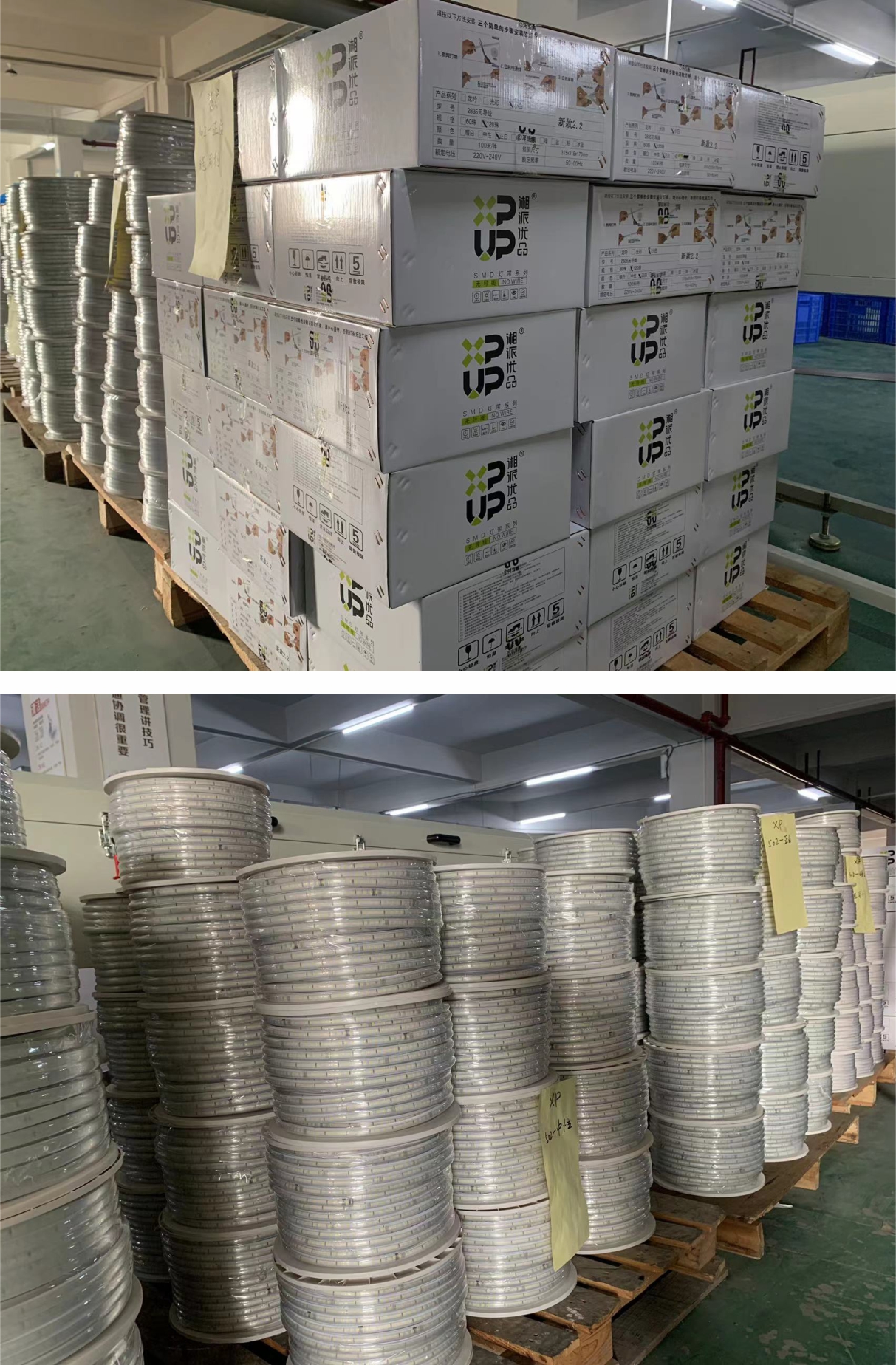
Production and inspection stages that allow ingress protection, color rendering and electrical ratings to be verified before shipment.
Application Notes: Matching Specs to Installation Zones
Office lighting and linear lighting
Dry interior ceiling grids are the natural home of an IP20 linear product. The compliance detail that catches specifiers here is dimming. The 2024 International Energy Conservation Code (IECC) requires lights to dim to 10% or lower for commercial interiors, as published by the International Code Council. That is a control requirement rather than a strip requirement, but it means driver and dimmer selection has to be confirmed alongside the strip specification.
Hospitality lighting
Hotel and restaurant interiors combine the highest color-rendering expectations with the tightest tolerance for visible variation, which is why Ra≥97 models sit in this category alongside ambient lighting and wall washing lighting installations.
Residential, recessed and under cabinet lighting
These are dry, short-run installations. They are typically served well by 24 V, IP20 product, and the main planning question is driver placement and ventilation rather than ingress protection.
Retail, decorative and full spectrum applications
Where merchandise or finishes must be evaluated under light, high color rendering is a functional requirement. Full spectrum and decorative lighting specifications are usually driven by the same logic.
Magnetic track lighting and smart lighting
Control integration adds a layer to the voltage decision, because the driver, the controller and the strip have to be electrically compatible. Wireless connectivity is no longer a niche configuration — Precedence Research reported that Zigbee and Bluetooth Mesh together captured 35% of the smart lighting market in 2024 — which means interoperability is now part of specification review rather than a separate technical track.
Sample-level verification of IP rating, color rendering and voltage before a specification is approved.
Flexible LED Strip vs Traditional Neon: What Changes, and What Does Not
The comparison most buyers run during evaluation is between flexible LED strip and traditional neon lighting. The documented differences are meaningful. XPUP LED's own comparison material states that under typical applications, energy consumption can be reduced by up to 40% while service life can be up to three times longer than traditional neon, with lower maintenance frequency supported by standardized replacement components. Against rigid LED light bars, flexible LED strips offer significantly higher installation flexibility for curved and irregular layouts — relevant wherever custom or architectural lighting design is involved.
The limitations are equally concrete, and buyers should treat them as part of the specification rather than as objections.
- Ingress protection is not transferable. An IP20 LED strip cannot be substituted into an installation that previously used a sealed neon tube in a wet or outdoor location. The energy and lifetime advantages do not compensate for a rating mismatch.
- Continuous run length has a ceiling. Maximum length control, including supply in 10-meter rolls, means long architectural lines require additional feeds, power injection points and drivers. This is a design cost that should be planned at tender stage, not discovered on site.
- High color rendering carries a cost. Ra≥97 models sit at a different price point from standard rendering product, and covering an entire project with high-CRI specification is rarely the most efficient allocation of budget.
- Low-voltage systems depend on the driver. A 24 V or 48 V strip performs according to the driver and dimmer it is paired with. Driver compatibility is part of the specification, not an accessory decision.
- Some lighting effects remain application-specific. Where a sealed tube appearance or a particular light distribution is the design intent, the choice between product types is a per-application decision that depends on the installation environment rather than on a general rule.
Market Signals Behind Spec-Driven Procurement
Several independent data points explain why specification review has become a formal procurement step rather than an informal check. Maximize Market Research valued the linear lighting market at USD 30.09 billion in 2025 with an 11.42% CAGR projected to 2032, and Grand View Research estimated the commercial lighting market at USD 47.54 billion in 2024. Both figures represent categories where linear products are specified at project level, which is exactly where compliance documentation is scrutinised.
The requirements are also tightening. The 2024 IECC dimming threshold of 10% or lower for commercial interiors creates a controllable-lighting expectation that propagates into driver and control specification. On the product side, the global smart LED lighting market was valued at USD 27.3 billion in 2024 by Grand View Research, with indoor applications accounting for 66% of the smart lighting sector that year according to Precedence Research — confirming that the compliance discussion is centred on interior installations.
Hospitality lighting, valued at USD 14.2 billion in 2025 by Dataintelo, is the segment where color rendering specifications carry the most weight. That is consistent with the pattern in XPUP LED's own export structure: 50% of output is exported, with the EU and USA as the main markets, where CE and RoHS certification and documented specification values are baseline expectations rather than differentiators.
Future Outlook
The direction of travel is toward specifications being verified rather than asserted. Dimming thresholds are becoming code requirements in more jurisdictions, which pulls driver and control documentation into the same review as the luminaire itself. Color rendering expectations are rising in hospitality, retail and residential segments as full spectrum, circadian and human-centric lighting concepts move from concept studies into procurement documents.
At the same time, the practical constraints described in this article will not disappear. Ingress protection ratings will still define the boundary between an indoor and an outdoor application. Maximum run length will still determine how many power injection points a long linear run requires. High color rendering will still carry a cost premium that has to be justified application by application.
The most likely differentiator for suppliers over the next cycle is not a new specification but clearer specification practice: stating voltage, power, CRI and IP together, with the unit and the boundary conditions attached, so that a buyer can calculate a system from a single document. As AI lighting concepts and connected control platforms spread, that clarity becomes more valuable, not less — because every added control layer introduces another compatibility question that a datasheet has to answer before a purchase order is released.
FAQ
What does an IP20 rating actually mean for LED strip lighting?
An IP code has two parts. The first digit covers protection against solid objects and the second covers protection against water. IP20 indicates protection against solid objects of finger size and no water-ingress protection. The DK3 linear lighting series is specified at IP20, which suits dry interior installations such as office lighting, retail ceilings, residential runs and under cabinet lighting. It is not a rating for bathrooms, kitchens, outdoor facades or any location exposed to moisture or condensation.
How much does CRI matter when choosing LED strip lighting?
It depends on whether color accuracy is part of the design intent. Certain XPUP LED models are specified at Ra≥97, which is the high-fidelity band used in hospitality lighting, retail display, decorative lighting and full spectrum lighting, where material and finish colors need to read correctly. In corridors, storage areas and back-of-house spaces, standard color rendering is usually adequate, and specifying high CRI there adds cost without a corresponding benefit. Buyers should also note that the standard Ra figure is an average across a defined sample set, so applications sensitive to saturated reds — food display or timber finishes, for example — are often checked separately.
Is 24 V or 48 V LED strip better for a commercial project?
Neither is universally better; the choice follows run length and current. For equivalent delivered power, a 48 V circuit carries lower current than a 24 V circuit, which matters on long uninterrupted runs where voltage drop would otherwise produce a visible dimming gradient. Shorter residential, cabinet and decorative runs are commonly served by 24 V. Both are low-voltage DC systems and require a compatible driver — neither connects to mains supply directly. Maximum run length also applies: XPUP LED supplies product in 10-meter rolls using maximum length control to manage overloading risk, so longer continuous lines require planned power injection points.
How can a buyer verify claimed CRI, IP and voltage values before placing an order?
Three checks reduce most of the risk. Confirm that the IP rating is stated as a product-level rating rather than inferred from the installation description. Confirm that the CRI figure is attached to a specific model rather than to a product family as a whole. Confirm that voltage, power and maximum run length are documented together, so that driver sizing and feed planning can be calculated from one source. XPUP LED's production process includes incoming material inspection, in-process inspection, aging tests and final inspection, which is the mechanism by which documented values are intended to remain consistent across batches.
What is the standard warranty on XPUP LED product series, and can it be extended?
All product series are covered by a standard 2-year warranty. Extended warranty terms can be customized for large-scale projects and ODM brand partnerships. Warranty handling is supported through dedicated after-sales contacts, defined procedures for quality issue handling and responsibility management, and after-sales solutions adapted to individual project requirements.
What are the limitations of IP20 LED strip in hospitality and outdoor projects?
IP20 product has no water-ingress protection, so it is unsuitable for outdoor facades, wet areas and any location exposed to rain, irrigation or condensation, regardless of how well it performs in other respects. In hospitality interiors, IP20 linear lighting is appropriate for dry ceiling, cove and wall washing applications, but wet zones such as bathrooms and back-of-house kitchens require a higher ingress rating. The other boundary is run length: continuous installations beyond the supplied 10-meter roll length need additional feeds and drivers, which should be planned at design stage rather than resolved during installation.
The Practical Takeaway
Compliance specifications are not paperwork attached to a lighting product; they are the terms on which a product is approved for a given location. IP20 tells a buyer which spaces a linear lighting installation can enter. Ra≥97 tells a buyer whether the light will render finishes and merchandise the way the design intends. Voltage and power tell a buyer how to size the driver, plan the feeds and manage heat. Read together and read with their boundaries attached, those three figures answer most of the questions that otherwise surface as change orders, warranty claims or rework on site.