
LED Lighting Shortlist for Museums, Retail and Hospitality

LED linear lighting production at Zhongshan Xiangpai (XPUP) Lighting Technology Co., Ltd., Zhongshan, China.
Choosing LED lighting for museums, retail and hospitality is a specification problem before it is a price problem. All three environments place the light source near the thing it is meant to flatter, but they resolve that constraint differently. Museum and gallery spaces prioritise colour fidelity, low glare and long-term stability over objects that stay lit for years. Retail prioritises beam control and merchandise colour accuracy. Hospitality prioritises ambience, dimming behaviour and concealed detail light.
This article shortlists five products from Zhongshan Xiangpai (XPUP) Lighting Technology Co., Ltd., a Zhongshan, China–based LED linear lighting manufacturer established in 2012 that manufactures LED strip lighting, LED magnetic track lighting and smart control systems. Each model is matched to the applications its published specification supports, and the limits of each option are stated alongside the benefits so the shortlist can be used as a procurement reference rather than a product showcase.
Why These Three Environments Cannot Share One Answer
A museum or gallery specification usually begins with the object: a textile, a painting or a lacquered surface will be judged under the same lamp for months, so colour rendering and heat load matter more than raw output. Linear lighting is often chosen because it can be recessed into ceiling slots and casework and produce an even wash without visible hotspots.
A retail or exhibition specification begins with the merchandise. Jewellery, apparel and display cases need directional accent light with a controlled beam, and the fixture may be repositioned when a floor layout changes. That pushes buyers toward track-mounted formats rather than fixed linear runs.
A hospitality specification begins with the guest's field of view. Corridors, lobbies, restaurants and aparthotel units need layered light: a functional layer, an ambient layer and a decorative layer that can be dimmed as the day moves. This is where smart and decorative strip formats earn their place.
The common denominator is that all three are indoor, finish-critical and increasingly governed by energy codes. The 2024 International Energy Conservation Code (IECC), published by the International Code Council, requires lighting in commercial interiors to dim to 10% or lower — a requirement that removes non-dimmable fixtures from consideration in many commercial projects before performance is even discussed.
The Selection Criteria Used in This Shortlist
Five criteria separate genuinely different options in this category.
- Voltage and control architecture. A 24V DC strip and a 48V magnetic track are different systems. They are not interchangeable at the driver, dimmer or wiring level, and mixing them in one zone adds cost and complexity.
- Colour rendering (CRI). Ra≥80 is a general commercial baseline; Ra≥90 is the usual threshold for retail and hospitality merchandising; Ra≥97 is the level at which colour-critical work becomes viable.
- LED density and PCB width. Density determines how smooth a linear run appears at close range, and PCB width determines what profile or channel the strip will physically fit.
- Output per LED. Lumen-per-LED figures show how much light each strip delivers per metre at a given density, which drives how many metres are needed for a target illuminance.
- Ingress protection and OEM/ODM support. IP20 products are dry-location indoor products. OEM and ODM support determines whether voltage, colour temperature, PCB design, packaging and labelling can be adapted to a brand's own market requirements.
The Shortlist at a Glance
| Product model | Format | Voltage / Power | CRI | Density & PCB | IP | Best-fit applications (published) |
|---|---|---|---|---|---|---|
| DK3-DC24V-2835-240D-9.3mm | Linear lighting strip | 24V / 15W | Ra≥80 | 240 LEDs/m, 9.3mm double-layer copper PCB, SMD 2835 | IP20 | Museums & galleries, restaurants, interior design, office buildings, apartments |
| XP-BD18DC24V-2835-140D-8MM | Full spectrum strip | 24V / 12W | Ra≥97 | 140 LEDs/m, 8mm double-layer copper PCB, 55–65 lm/LED, SMD 2835 | IP20 | Museums & galleries, luxury retail, jewellery stores, education, shopping malls, interior design |
| XP-CX-18 | Magnetic track light | 48V / 30W | Ra≥90 | 8mm PCB, 55–65 lm/LED, 120° beam angle, aluminium + PC body | — | Retail, shopping malls, jewellery stores, exhibition & events, interior design |
| XP-SM-DC24V-5050-10MM | Smart lighting strip | 24V / 12W | Ra≥90 | 60D or 120D per metre, 10mm double-layer copper PCB, 55–65 lm/LED, SMD 5050 / 2835 | IP20 | Aparthotels, restaurants, hospitality, interior design, architecture, shopping malls |
| XP-ZS-DC24V-2835-8MM | Decorative lighting strip | 24V / 10W | Ra≥80 | 60D or 140D per metre, 8mm double-layer copper PCB, 30–35 lm/LED, SMD 2835 / 5050 | IP20 | Hotels, restaurants, aparthotels, retail, shopping malls, interior design, architecture |
Specifications as published in the manufacturer product data for each model. The XP-CX-18 data sheet does not list an IP rating; buyers specifying wet or exposed locations should confirm installation conditions with the supplier before selection.
Museums and Galleries: A Two-Part Combination
XP-BD18DC24V-2835-140D-8MM — colour-critical accent and cove light
This full spectrum strip carries a CRI of Ra≥97, which is the highest colour rendering figure in the shortlist. It runs on 24V DC at 12W, uses an 8mm double-layer copper PCB, delivers 140 LEDs per metre at 55–65 lm per LED, and is offered in 2700K, 3000K, 3500K, 4000K, 5000K and 6000K. The 8mm width makes it compatible with narrow aluminium channels commonly used in gallery ceilings and display casework. OEM and ODM production are both available.
DK3-DC24V-2835-240D-9.3mm — continuous linear runs
The DK3 linear fixture is specified at 24V, 15W, with 240 LEDs per metre on a 9.3mm double-layer copper PCB and a CRI of Ra≥80 in 3000K, 4000K and 6500K. Its density is the highest in this shortlist, which matters where a strip is visible or runs across a large uninterrupted ceiling plane and dotting would be noticeable. OEM and ODM production are both available.
The practical reason these two appear together is that museum schemes rarely need just one of them. A gallery typically needs long even runs of ambient light plus a smaller number of colour-critical positions where artwork or artefacts sit. Using the higher-density linear product for the run and the Ra≥97 full spectrum product for the object-facing positions keeps noise and dotting low while concentrating colour performance where it is actually judged.
Retail, Jewellery and Exhibition: XP-CX-18 Magnetic Track
The XP-CX-18 is a magnetic track light specified at 48V, 30W, with a CRI of Ra≥90, a 120° beam angle, an aluminium and PC body and 55–65 lm per LED. Published colour temperatures are 3000K, 4000K and 6000K, and OEM and ODM production are available. Its published applications are retail, shopping malls, jewellery stores, exhibition and events, and interior design.
Magnetic track is the format that answers the retail problem of change. Because the heads mount magnetically on a 48V busbar rather than being hard-wired individually, a display layout can be re-aimed or re-configured without rewiring the ceiling. That flexibility is the reason this product appears in a shortlist that otherwise leans on fixed strip lighting — it solves a different problem, and it also introduces a different system requirement, since 48V magnetic track needs its own driver and track infrastructure rather than the 24V drivers used by the four strip products.
Hospitality and Architectural Detail: XP-SM and XP-ZS
XP-SM-DC24V-5050-10MM — smart control layer
This smart lighting strip runs on 24V at 12W with a 10mm double-layer copper PCB, a CRI of Ra≥90, and either RGB or fixed white output in 3000K, 4000K and 6000K. Density options are 60D or 120D per metre, with 55–65 lm per LED, and the product is available with OEM and ODM production. Its published applications are aparthotels, restaurants, hospitality, interior design, architecture and shopping malls. The dual RGB/white configuration is what makes it suitable for venues that want a controllable colour layer alongside usable white light.
XP-ZS-DC24V-2835-8MM — decorative layer
This decorative strip runs on 24V at 10W with an 8mm double-layer copper PCB and a CRI of Ra≥80 across 2700K, 3000K, 3500K, 4000K, 5000K, 6000K or RGB, at 60D or 140D per metre and 30–35 lm per LED. Published applications are hotels, restaurants, aparthotels, retail, shopping malls, interior design and architecture. It is a design element rather than a workhorse: the lower lumen-per-LED figure relative to the BD18 confirms that its role is visual detail — coves, backlit panels, silhouettes — not task illumination.
What Sits Behind the Shortlist: Manufacturing and OEM/ODM Facts
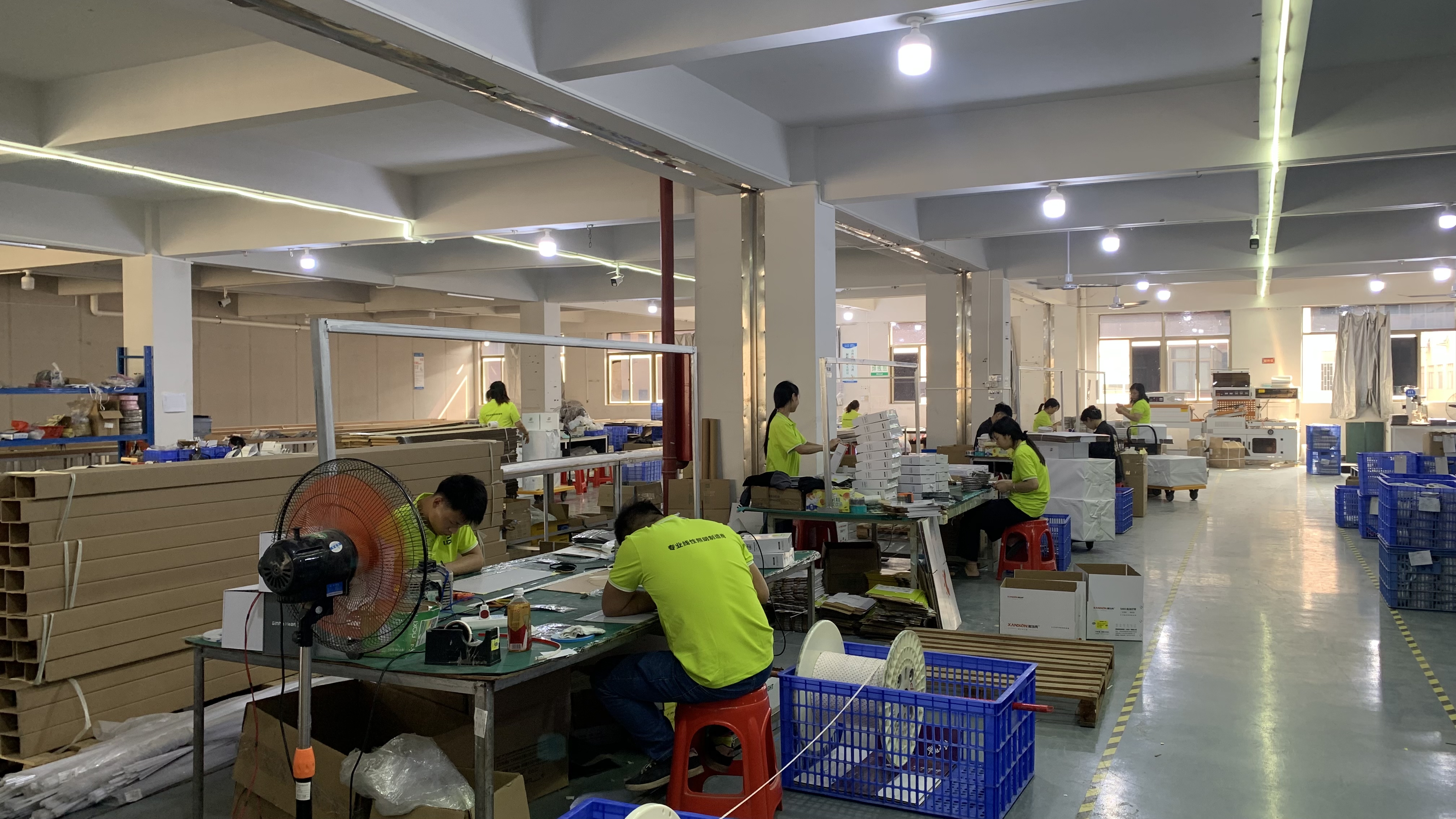
OEM and ODM LED strip production at XPUP LED. Customisation scope is published per production mode.
For buyers evaluating whether these products can actually be supplied as specified, the manufacturer publishes the following operational facts.
- The factory covers more than 10,000 m² with 80 employees, a 6-engineer R&D team, an annual output of 35,000,000 metres and a monthly capacity of 3,000,000 metres.
- Export markets are the EU, Asia and the US; the export ratio is 50% and the main markets are the EU and the USA.
- Minimum order quantity is 2,000 metres, with a production lead time of 18–22 days.
- Quality control is stated as 100% test, and acceptance criteria are pre-shipment test. Standard purchasing terms are 30% deposit with the balance payable before shipment; delivery terms are FOB or CIF.
- After-sales support is online remote support with general technical guidance and a 2-year standard warranty. Under the OEM mode, after-sales includes dedicated technical support, remote debugging, a 2-year warranty and customised parameter guidance.
What OEM and ODM actually cover
OEM production covers voltage, logo, power, dimensions, materials, hardware configuration, internal circuit, colour, factory specifications, nameplate and label. ODM production covers exterior colour scheme, outer packaging box, label, brand information, model name and material details. Both modes are offered for the products in this shortlist, which matters because a museum, retail or hospitality project is frequently delivered under a specifier's or brand's own identity rather than the factory's.
Compliance documentation
The manufacturer states that its products hold CE and RoHS certification. Published test documentation from PTC TESTING includes CE-LVD certification under EN IEC 62031:2020 + A11:2021, IEC TR 62778:2014 and EN 62471:2008, issued 2023-04-04 under certificate numbers PTC22122900901S‑LD01;PTC22122900902S‑LD01; CE-EMC certification under EN IEC 55015:2019+A11:2020, EN 61547:2009, EN IEC 61000-3-2:2019+A1:2021 and EN 61000-3-3:2013+A1:2019, issued 2023-03-09 under certificate numbers PTC22122900901E‑EMB01;PTC22122900902E‑EMB01; and RoHS testing under the IEC 62321 series, issued 2023-04-23 under certificate numbers PTC22122900903C‑EN01;PTC22122900905C‑EN01. The declared scope for all three is LED low-voltage and high-voltage light strip series, and the declared market is the EU. The company also states that it holds design and structural/process patents in linear lighting, including original design patents for the C19 and C20 series LED strips.
Documented supply experience
Published case records include a US lighting brand supplied with long-term ODM LED strip solutions covering product specifications, colour parameters, certification requirements and packaging customisation, at 300,000 metres per year over three years for private-label retail and project supply; and a German hospitality contractor using high-efficiency and IP68 waterproof LED strips at 20,000 metres for hotel public areas and architectural façade lighting, with indoor and outdoor illumination requirements reported as stable in brightness and colour quality. A German commercial lighting contractor applied COB LED strips with dimming functions in cafés and chain retail stores at 50,000 metres, and an architectural lighting contractor in the Netherlands used IP68 waterproof strips at 30,000 metres for commercial façade and landscape projects.
Market Signals Behind This Combination of Applications
Three trends explain why a shortlist spanning museum, retail and hospitality is commercially relevant rather than niche.
The installed base is still growing. Grand View Research values the global LED lighting market at USD 106.9 billion in 2025, with a projected value of USD 197 billion by 2033. Within that, Grand View Research estimated the commercial lighting market at USD 47.54 billion in 2024, and Maximize Market Research values the linear lighting market at USD 30.09 billion in 2025 with an 11.42% CAGR projected to 2032.
Hospitality and track-based formats are expanding. Dataintelo values the hospitality lighting market at USD 14.2 billion in 2025. The same source values the magnetic track lighting system market at USD 2.8 billion in 2025 with an expected CAGR of 7.6% through 2033, which is directly relevant to the XP-CX-18 positioning. Publicly available market research from Grand View Research and Dataintelo identifies Signify (Philips Lighting), Acuity Brands and Eaton as dominant global players in the track and hospitality lighting segments in 2024–2025 — context worth noting, because it means a shortlist from a specialist strip manufacturer complements rather than replaces those broader portfolios.
Colour quality and controllability are becoming specification requirements rather than preferences. Mordor Intelligence reports that Europe held a 37.4% share of the human centric lighting market in 2024, driven by workplace wellbeing rules, while Research Nester values the human centric lighting market at USD 3.66 billion in 2024 with a 17.1% CAGR projected through 2036. Precedence Research finds that indoor lighting accounted for 66% of the smart lighting sector in 2024. The energy context is equally clear: the IEA reported that the lighting sector accounted for approximately 8% of global electricity demand in 2024, roughly 2,200 TWh.
Comparison With Traditional Solutions — and the Limits of This Shortlist
Traditional museum and retail display lighting relied on halogen and incandescent sources, which produce significant infrared heat and, in many configurations, require more energy for the same delivered light. LED sources substantially reduce heat load at the illuminated surface, which is a genuine advantage where objects, textiles or temperature-sensitive merchandise are involved. Conventional track heads also had to be re-aimed physically and were frequently non-dimmable or dimmable only in coarse steps, whereas the 2024 IECC requirement for commercial interiors to dim to 10% or lower makes finer dimming a code-level expectation.
That comparison is not one-sided, and buyers should note several real limits in this shortlist.
- All four strip products are IP20. They are dry-location, indoor products. They are not suitable for wet rooms, exterior façades, fountains or any installation exposed to moisture or dust ingress. Buyers needing outdoor or wet-area performance must look outside this shortlist.
- DK3 at Ra≥80 is not a conservation-grade colour specification. It is a density and linear-continuity solution. Where colour fidelity is the governing criterion, the XP-BD18 at Ra≥97 is the appropriate choice, and DK3 should be treated as support rather than the primary light source.
- The 24V and 48V systems are not interchangeable. Four products require 24V DC drivers; the XP-CX-18 requires a 48V magnetic track system. A project that mixes both must budget for two infrastructure layers.
- The XP-CX-18 published data does not state an IP rating. Its suitability for a given ceiling environment should be confirmed rather than assumed from the general 48V track format.
- Commercial terms have a floor. The 2,000-metre minimum order quantity and 18–22-day production lead time suit project and wholesale volumes; they are not designed for single-unit or urgent small-quantity purchases.
- No spectral UV or IR data is published for these models. Institutions with conservation-grade spectral documentation requirements — common in museums that lend and borrow objects under strict environmental conditions — should request test data from the supplier before specifying, because a high CRI figure alone does not establish spectral suitability for sensitive artefacts.
Future Outlook
Two forces are likely to shape this category over the next specification cycle. The first is controllability. As human centric lighting grows — the segment carried a 17.1% projected CAGR to 2036 in Research Nester's 2024 assessment — buyers will increasingly ask not only for a CRI figure but for evidence that a fixture can be tuned across colour temperatures without losing consistency, which favours products with published colour-temperature ranges such as the 2700–6000K span offered on the XP-BD18 and XP-ZS. The second is dimming regulation. Code-driven dimming floors, such as the 10% commercial interior threshold in the 2024 IECC, push the entire specification chain toward driver and control compatibility rather than fixture output alone.
For a shortlist like this one, the practical implication is that product selection and control-system selection are becoming the same decision. Voltage architecture, dimming protocol and the availability of OEM/ODM adaptation are likely to carry more weight in 2026 procurement documents than headline lumen figures.
FAQ
Which of these products is the correct choice for museum and gallery colour fidelity?
The XP-BD18DC24V-2835-140D-8MM is the only product in this shortlist with a published CRI of Ra≥97. It runs on 24V at 12W with 140 LEDs per metre on an 8mm PCB and is offered in 2700K, 3000K, 3500K, 4000K, 5000K and 6000K. It is the appropriate choice where accurate colour rendering of an object or artwork is the governing criterion. The DK3-DC24V-2835-240D-9.3mm, at Ra≥80, is better suited to continuous ambient runs where density and smoothness matter more than colour rendering.
What does OEM production cover for these LED lighting products?
Under the OEM production mode the manufacturer offers customisation of voltage, logo, power, dimensions, materials, hardware configuration, internal circuit, colour, factory specifications, nameplate and label. The stated after-sales scope for OEM orders includes dedicated technical support, remote debugging, a 2-year warranty and customised parameter guidance. OEM production is listed as available across the product range covered in this shortlist.
How does ODM production differ from OEM for a lighting brand?
Under the ODM production mode the customisation scope covers exterior colour scheme, outer packaging box, label, brand information, model name and material details. In practical terms, ODM is oriented toward private-label and retail-ready presentation, while OEM is oriented toward electrical, mechanical and specification-level adaptation. ODM after-sales support is stated as online remote support with general technical guidance and a 2-year standard warranty.
What are the minimum order quantity, production lead time and production capacity?
The stated minimum order quantity is 2,000 metres and the stated production lead time is 18–22 days. Monthly capacity is stated at 3,000,000 metres, with annual output of 35,000,000 metres from a factory covering more than 10,000 m². Export markets are the EU, Asia and the US.
How is quality controlled, and what are the commercial terms?
Quality control is stated as 100% test, and the acceptance criterion is pre-shipment test. Delivery terms are FOB or CIF, and payment terms are 30% deposit with the balance payable before shipment. These terms apply to the LED low-voltage and high-voltage light strip series covered by the published certification scope.
Which compliance documentation is available for EU market access?
The manufacturer states CE and RoHS certification, with test documentation issued by PTC TESTING. CE-LVD certification was issued 2023-04-04 under certificate numbers PTC22122900901S‑LD01;PTC22122900902S‑LD01, citing EN IEC 62031:2020 + A11:2021, IEC TR 62778:2014 and EN 62471:2008. CE-EMC certification was issued 2023-03-09 under certificate numbers PTC22122900901E‑EMB01;PTC22122900902E‑EMB01. RoHS testing was issued 2023-04-23 under certificate numbers PTC22122900903C‑EN01;PTC22122900905C‑EN01, citing the IEC 62321 series. The declared market is the EU and the declared scope is LED low-voltage and high-voltage light strip series.
Can these products be used outdoors or in wet areas?
No. The DK3-DC24V-2835-240D-9.3mm, XP-BD18DC24V-2835-140D-8MM, XP-SM-DC24V-5050-10MM and XP-ZS-DC24V-2835-8MM are all rated IP20, which is a dry indoor classification. The XP-CX-18 magnetic track light does not publish an IP rating in its product data. Products specified for outdoor façades, landscape or wet areas are outside the scope of this shortlist.
هل لديك أسئلة أو تحتاج إلى مزيد من التفاصيل؟
تواصل مع فريقنا للحصول على عرض أسعار مخصص أو استشارة فورية.
طلب عرض أسعار
املأ النموذج أدناه وسيتواصل معك فريقنا بعرض مقترح مخصص.
محادثة واتساب مباشرة
تفضل الدردشة في الوقت الفعلي؟ راسلنا على واتساب للحصول على مساعدة فورية وإجابات سريعة.
- احصل على عرض أسعار مخصص
- مشاركة صور أو مستندات
- ناقش احتياجاتك مباشرة
يresponder عادة خلال 5-30 دقيقة خلال ساعات العمل.