
LED PCB FAQ: Materials, Tolerances, Certifications, Acceptance
Most procurement friction in LED lighting does not come from the LED itself. It comes from the circuit board underneath it. Buyers frequently issue an RFQ that states a substrate name and a thickness, then discover at first-article inspection that the delivered boards use a different dielectric definition, a lighter copper weight, a different panel layout, or an acceptance standard nobody wrote down. The result is re-quoting, schedule slippage and, in the worst case, a thermal design that cannot be validated after tooling has been committed.
Market context explains why this matters more each year. Grand View Research valued the global printed circuit board market at USD 82.7 billion in 2025 and projects USD 87.8 billion in 2026, rising to USD 130.3 billion by 2033 (SRC-0001, Grand View Research, 2026). As volumes grow, so does the number of suppliers quoting on near-identical language — which makes specification discipline, rather than price alone, the decisive procurement skill.
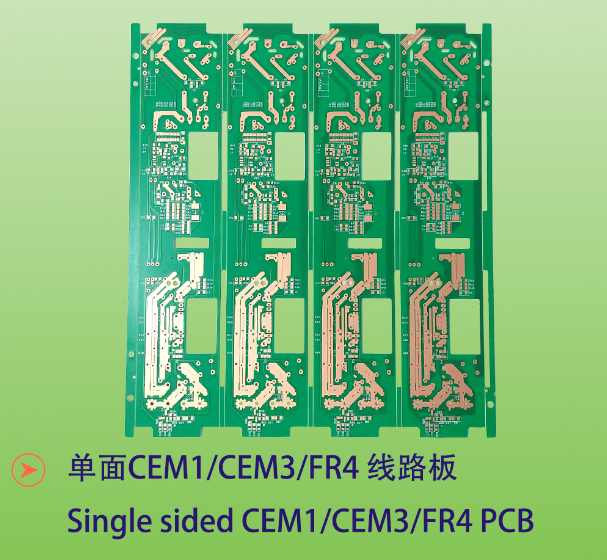
Single-sided CEM-1 / CEM-3 / FR-4 LED PCB — the most common rigid entry point for indoor and outdoor lighting boards.
Why LED PCB Specifications Become a Procurement Problem
Three specification gaps account for most disputes between lighting brands and board suppliers.
1. Material naming is not a specification. “CEM-1”, “CEM-3”, “FR-4” and “aluminium” describe substrate families, not grades, dielectric thicknesses or thermal performance. A purchase order that names only the family leaves the supplier free to choose within a wide band.
2. Tolerances are omitted. Board thickness, copper weight and panel dimensions are usually quoted as nominal values. Without an explicit tolerance — for example ±10% on a 1.6 mm board — incoming inspection has no objective basis for accept or reject.
3. Acceptance criteria are assumed rather than agreed. Suppliers run their own inspection regimes; buyers assume those regimes match their own incoming quality plan. Unless the inspection basis is written into the order, both sides can be correct and still disagree.
Opportunity: an LED PCB RFQ that specifies substrate, layer count, copper foil weight, overall thickness with tolerance, panel size and UPS count, solder mask and silkscreen colour, surface finish, and an acceptance basis is not longer to write than a vague one — it simply converts an assumption into a contractual line item.
The WODE LED PCB and FPC Portfolio at a Glance
WODE Circuit Technology (Zhuhai) Co., Ltd. is a printed circuit board and flexible circuit board manufacturer founded in 2003 and based in Zhuhai, Guangdong, China. The company operates a 150,000 m² facility with more than 500 employees and an annual output of 6,000,000 m², holds more than 40 patented technologies, and reports an export ratio of approximately 50% with main markets in Brazil, Turkey, India, Vietnam and Russia. Its product lines cover rigid MCPCB, FPCB, infinity length FPCB, FR-4 / CEM-1 / CEM-3 PCBs and CCL, and PCB inks — a vertically integrated scope that includes in-house CCL production.
Six product families, one specification matrix
The table below consolidates the published specification data for the six LED PCB and FPC families most often requested in lighting RFQs. It is the reference a buyer should carry into a first supplier conversation, because it shows exactly where the specification variables sit.
| Product family | Material | Layers | Copper foil | Overall thickness | Panel size | Mask / legend | Surface finish |
|---|---|---|---|---|---|---|---|
| Single sided CEM1.CEM3.FR4 PCB | CEM-1 / CEM-3 / FR-4 / Alu | Single sided | 0.5, 0.75, 1, 2, 3 oz | 0.6–2.0 mm; max length 2000 mm | Up to 2000 mm length | Sensitive / thermosetting / UV solder mask or coverlay; white, yellow, black, green legend | OSP, carbon film, HASL, lead-free HASL, nickel-plated gold, ENIG, chem. Ag, ENEPIG for wire bonding |
| Double sided FR4 PCB | FR-4 | Double sided | 1/1 oz | 1.6 mm ±10% | 208.00 × 225.00 mm (/2) ups | White mask / black legend | ENIG |
| COB FPC | PI | Single / double sided | 1/1 oz or 1 oz | 0.115 mm | 366.00 × 250.00 mm (/1) ups | White coverlay / white legend | OSP |
| Single / double sided LED strip FPC | PI | Single / double sided | 1/1 oz or 1 oz | 0.115 mm | 366.00 × 250.00 mm (/1) ups | White coverlay / white legend | OSP |
| Single sided LED tube FPC | PI | Single sided | 0.5 oz | 0.08 mm | 1239.50 × 255.00 mm (/39) ups | White mask / holographic legend | OSP |
| Roll to Roll Infinity FPCB | PI | Single sided | 1 oz | 0.15 mm | 1000.00 × 124.00 mm (/13) ups | White mask / black legend | OSP |
Materials: what CEM-1, CEM-3, FR-4, aluminium and polyimide actually mean
WODE’s single-sided family accepts CEM-1, CEM-3, FR-4 and aluminium within one product definition, which is useful for buyers because it isolates material choice as a variable rather than a separate product category. In practice the selection logic runs along thermal and mechanical load rather than price: CEM-1 and CEM-3 are composite substrates used for cost-sensitive single-sided work, FR-4 is the glass-reinforced laminate used where double-sided routing or tighter dimensional behaviour is required, aluminium is chosen when the board itself is part of the heat path, and polyimide (PI) is the base material for every FPC in the portfolio.
The consequence for a lighting buyer is direct: a “single-layer LED PCB” request can legitimately be answered with four different substrates. Naming the substrate family is therefore the minimum acceptable level of specification, and naming the grade is better.
Copper foil thickness and layer count
Copper foil weight determines current-carrying capacity and lateral heat spreading. The single-sided family supports 0.5 oz, 0.75 oz, 1 oz, 2 oz and 3 oz; the double-sided FR-4 and the COB / LED strip FPC families are specified at 1/1 oz or 1 oz; the LED tube FPC uses 0.5 oz; and the Roll to Roll Infinity FPCB uses 1 oz. Two practical rules follow. First, a heavier copper weight on the same substrate changes etching behaviour and cost, so it belongs in the RFQ rather than in a post-quote negotiation. Second, layer count is not a proxy for performance: a single-sided board on a thermally suitable substrate can outperform a double-sided board chosen only because “two layers” sounded more robust.
Overall thickness and panel size
Overall thickness across the portfolio spans 0.08 mm to 2.0 mm, which is a factor of 25 and a frequent source of confusion when buyers compare quotations that are not for the same structure. The LED tube FPC at 0.08 mm and the Roll to Roll Infinity FPCB at 0.15 mm suit long, narrow, bending or reeling formats; the COB and LED strip FPC sit at 0.115 mm; the double-sided FR-4 is specified at 1.6 mm ±10%; and the single-sided family covers 0.6–2.0 mm with a maximum board length of 2000 mm.
Panel size deserves equal attention because it converts directly into unit cost. A panel that yields two boards per panel, such as the 208.00 × 225.00 mm format used for the double-sided FR-4 and for several aluminium MCPCB formats, carries a different cost per board from one that yields 39 ups, as the LED tube FPC panel at 1239.50 × 255.00 mm does. Panel efficiency, not board area alone, is the number a buyer should compare between offers.
Certifications: What Each Standard Covers — and What It Does Not
WODE’s stated certification set comprises ISO 9001:2015, ISO 14001:2015 and IATF 16949, and the company states that its products comply with UL, RoHS and REACH. Certification questions in LED PCB procurement usually fail not because the certificates are missing, but because the buyer has not separated system certification from product qualification.
| Standard | What it addresses | What it does not prove on its own |
|---|---|---|
| ISO 9001:2015 | Quality management system: process control, inspection discipline, corrective action | That a specific board batch meets a specific technical parameter |
| ISO 14001:2015 | Environmental management system: waste, emissions, process environmental control | Product-level environmental compliance or substance content |
| IATF 16949 | Automotive quality management system requirements applicable to the manufacturing site | That a given board is qualified for automotive use (see FAQ below) |
| UL 796 | UL safety standard for printed wiring boards (rigid constructions) | Thermal performance or long-term lumen maintenance of the luminaire |
| UL 796F | UL safety standard for flexible materials interconnect constructions | Flex-to-installation durability in a specific mechanical design |
| RoHS / REACH | Restricted substances and substance-of-very-high-concern declaration obligations | Absence of every substance unless a current declaration or test report is supplied |
The practical rule: treat certificates as evidence about how a factory is managed, and treat test reports, first-article reports and material declarations as evidence about the board in your hand. Procurement files should carry both, and should record the expiry or issue date of each so that a renewal does not pass unnoticed between orders.
For design-side documentation, IPC-2221 is the widely referenced standard for printed board design, and IPC-6011 is referenced by suppliers as a generic performance specification for printed boards. Both should be confirmed at the current edition and applicability level with the standard owner before being written into a purchase contract as a compliance requirement, since applicability is design- and product-specific.
Purchasing Terms: MOQ, Samples, Lead Time and Customisation
WODE operates in OEM / ODM mode with a stated mass-order minimum of 100 m² and a monthly capacity of 600,000 m². Sample quantity is not restricted by the mass-order minimum, which matters for lighting programmes that need to validate thermal behaviour and assembly fit before releasing a production order. Standard lead time is quoted at 7–25 days, depending on order quantity and design complexity — a range wide enough that the specific figure should be confirmed for each part number rather than assumed from the general statement.
Customisation options available within the portfolio include layer count, substrate, surface finish (for example ENIG, OSP, HASL and HASL-LF), impedance control, and routing, slotting or cutting. For a lighting buyer the most consequential of these is usually routing and panel format, because it determines whether the board can run on the customer’s existing SMT line without a new carrier or fixture.
Quality control is described as a continuous improvement system covering incoming, in-process and final inspection plus electrical function testing. Buyers should request the specific inspection equipment list and acceptance criteria used on their part, since the general description alone does not define pass/fail limits. After-sales support covers technical support and quality liaison, with warranty, returns and defect-handling terms specified in the customer contract.
WODE states its boards have been qualified by global brands including Signify, Osram, Opple, NVC, Honeywell, Randong, Dixon, Ozdisan, IKIO and Motheson.
Acceptance Criteria: What to Write Into the Purchase Order
Acceptance criteria are the difference between a quote and a contract. For an LED PCB, the following fields should appear explicitly, because each one is a routine source of mismatch on delivery.
- Substrate and grade — for example CEM-3 or FR-4 rather than “CEM” or “FR4 family”. Where aluminium is used for thermal reasons, state the function it serves.
- Layer count — single sided or double sided, stated numerically.
- Copper foil weight — for example 1/1 oz or 2 oz, with the tolerance and the measurement basis.
- Overall thickness and tolerance — for example 1.6 mm ±10%, matching the format already quoted in the portfolio.
- Panel size and UPS count — the production format, not only the finished board dimension.
- Solder mask and legend — mask type (sensitive, thermosetting, UV, or coverlay) and legend colour.
- Surface finish — OSP, HASL, lead-free HASL, ENIG, chem. Ag, nickel-plated gold, carbon film, or ENEPIG where wire bonding is required.
- Electrical function test — the test method and the sampling basis agreed with the supplier.
- Documentation — first-article report, material declaration, and the applicable certificate copies with issue dates.
A useful discipline is to separate these into two blocks on the drawing: parameters that are inspected on every lot, and parameters that are verified at first article only. That distinction prevents both under-inspection of critical dimensions and unnecessary measurement cost on stable ones.
Where Each Board Type Fits in a Lighting Project
WODE’s published application scope for these boards covers LED strips and fixtures, display module interconnects and consumer electronics connectors, and the client profile spans electronics manufacturers, lighting companies, OEM / ODM vendors and trading companies. One documented case is a lighting OEM in Germany that used 5,000 m² of board as a main project component over five years, with stable operation reported in a harsh European climate and compliance with German safety requirements.
Mapping formats to lighting formats is straightforward once the specification logic is clear. The single-sided CEM-1 / CEM-3 / FR-4 family, with its 2000 mm maximum length, suits linear indoor fixtures, downlights, panel lights and driver boards. The double-sided FR-4 format at 1.6 mm suits control and driver sections where routing density requires two layers. The COB FPC and LED strip FPC at 0.115 mm suit flexible strip and COB module constructions. The LED tube FPC at 0.08 mm, with a 1239.50 × 255.00 mm panel yielding 39 ups, is configured around tubular lamp formats. The Roll to Roll Infinity FPCB at 0.15 mm addresses continuous-length strip production.
Operating conditions should be stated alongside the board type. WODE’s lighting reference data places indoor lighting at 0 °C to +40 °C with 30% to 80% humidity and no special corrosion exposure; outdoor lighting at –40 °C to +50 °C with high humidity, salt spray, UV radiation and wind and rain erosion; and automotive lighting in the engine compartment at –40 °C to +125 °C with vibration, shock, oil contamination and moisture condensation. A board specified for the indoor band should not be assumed to serve the outdoor or automotive band without re-validation.
Market Trend: Why Specification Discipline Is Increasing
Two observable trends are pushing LED PCB procurement toward tighter written specifications. The first is scale. With the global PCB market projected to move from USD 87.8 billion in 2026 toward USD 130.3 billion by 2033, the supplier pool expands faster than most buyers’ qualification capacity, so written criteria become the only scalable filter.
The second is thermal differentiation. Suppliers increasingly position dielectric thermal conductivity and board structure as their main differentiators; published supplier claims in the market range from roughly 1.0 to 8.0 W/m·K for metal-core dielectrics, and secondary reporting places aluminium core thermal conductivity in the 1–3 W/m·K band, with the higher end used for high-power LED modules. These figures are supplier-reported and are not directly comparable across vendors unless the dielectric definition and test method are harmonised — which is precisely why sophisticated RFQs now ask for the test method, not just the number. Any claim that a specific W/m·K value guarantees a junction temperature outcome should be treated as unverified until supported by thermal simulation or sample measurement.
A note on data limits: no verified LED-specific PCB or MCPCB market size, growth rate or segment share was available for this analysis. Market figures cited here refer to the overall PCB market and should not be read as LED PCB segment estimates.
Comparison With Traditional Sourcing Approaches
The traditional approach to LED PCB sourcing is to buy one rigid format from one supplier and to treat flexibility as a separate, later problem. Comparing that approach with a multi-format portfolio produces a clear trade-off rather than a clear winner.
| Dimension | Single rigid format, single supplier | Multi-format portfolio (rigid + FPC) |
|---|---|---|
| Design fit | Adequate for fixed linear and panel fixtures | Allows strip, tube, COB and continuous-length formats to be matched individually |
| Assembly impact | Standard SMT fixtures; no new tooling | Thin FPC (0.08–0.15 mm) and reel formats may require carriers or reel-capable lines |
| Specification effort | One specification to maintain | Multiple specifications, each needing its own acceptance criteria |
| Length ceiling | 2000 mm maximum on the single-sided rigid family | Longer continuous runs addressed by FPCB formats rather than rigid boards |
| Commercial minimum | One MOQ of 100 m² for mass order | MOQ applies per part number, so fragmentation raises order complexity |
The most important limitation is a hard technical one. The single-sided CEM-1 / CEM-3 / FR-4 family has a maximum board length of 2000 mm; a lighting design that requires a longer uninterrupted rigid board cannot be served by that format, and must either accept a joint, redesign around an FPC format, or use a different construction. Similarly, the thin FPC formats are not drop-in replacements for a 1.6 mm rigid board: they change handling, stencil support and reflow fixturing requirements in ways that affect the assembly line, not just the board price.
Future Outlook
Three developments are likely to shape LED PCB procurement over the next several years. First, specification language will continue to migrate from material names toward measurable parameters, with dielectric test method and acceptance class becoming standard RFQ fields. Second, the split between rigid and flexible formats will sharpen as strip, tube and continuous-length constructions grow, which favours suppliers able to hold both under one quality system — the structure WODE has built around rigid MCPCB, FPCB, infinity length FPCB and in-house CCL production. Third, compliance documentation will be managed as a living file rather than a one-time attachment, with certificate issue dates and material declarations tracked per part number.
What will not change is the underlying rule: an LED PCB performs as specified, and it is specified only as precisely as the purchase order allows.
FAQ
What is the difference between CEM-1, CEM-3 and FR-4 for a single-sided LED PCB?
CEM-1, CEM-3 and FR-4 are three substrate options that WODE lists within a single product family, the Single sided CEM1.CEM3.FR4 PCB, which also accepts aluminium. They are substrate families rather than grades, so the family name alone does not fix dielectric thickness or thermal behaviour. In a specification, the substrate family should be stated together with layer count, copper foil weight and overall thickness — the same product family spans 0.5 to 3 oz copper and 0.6 to 2.0 mm overall thickness.
What copper foil thickness options are available, and why does the choice matter?
WODE’s single-sided family supports 0.5 oz, 0.75 oz, 1 oz, 2 oz and 3 oz copper. The double-sided FR-4, COB FPC and single/double-sided LED strip FPC are specified at 1/1 oz or 1 oz; the single-sided LED tube FPC uses 0.5 oz; and the Roll to Roll Infinity FPCB uses 1 oz. Copper weight affects current-carrying capacity and lateral heat spreading, and it also changes etching behaviour and cost, so it should be fixed in the RFQ rather than negotiated after quotation.
Why does overall thickness across the portfolio range from 0.08 mm to 2.0 mm?
Because the six families serve structurally different formats. The single-sided LED tube FPC is 0.08 mm, the COB FPC and LED strip FPC are 0.115 mm, the Roll to Roll Infinity FPCB is 0.15 mm, the double-sided FR-4 is 1.6 mm ±10%, and the single-sided CEM / FR-4 family covers 0.6–2.0 mm. Thin polyimide constructions are used where bending, reeling or narrow profile matters; thicker rigid constructions are used where mechanical stiffness and standard SMT handling are priorities.
How do panel size and UPS count affect LED PCB unit cost?
Panel size determines how many boards are produced per panel, which drives the effective cost per finished board. Within WODE’s published data, the double-sided FR-4 format is 208.00 × 225.00 mm yielding 2 ups, the COB FPC and LED strip FPC formats are 366.00 × 250.00 mm yielding 1 up, the LED tube FPC is 1239.50 × 255.00 mm yielding 39 ups, and the Roll to Roll Infinity FPCB is 1000.00 × 124.00 mm yielding 13 ups. Two quotations for the same board area can therefore carry different unit prices purely because of panel utilisation, so the panel format should be compared, not only the board dimension.
Which certifications should an LED PCB supplier hold, and what do they actually prove?
WODE’s stated set comprises ISO 9001:2015, ISO 14001:2015 and IATF 16949, with products stated to comply with UL, RoHS and REACH. ISO 9001:2015 addresses quality management system discipline and inspection control; ISO 14001:2015 addresses environmental management; IATF 16949 addresses automotive quality management system requirements for the manufacturing site; UL 796 covers printed wiring boards and UL 796F covers flexible materials interconnect constructions; RoHS and REACH address restricted substances and declaration obligations. None of these, on its own, certifies the measured performance of a specific production lot. Product-level evidence must come from first-article reports, test reports and current material declarations.
Does IATF 16949 mean an LED PCB is automotive-qualified?
No. IATF 16949 is a quality management system standard applicable to the manufacturing site; it is not a product qualification for a specific board. Automotive electronics scenarios demand adherence to ISO 26262 functional safety up to ASIL-D, AEC-Q100 stress test qualification and ISO 16750 electrical load standards, and products must operate from –40 °C to +125 °C with chassis vibration of 20–2000 Hz at 50 g and rapid temperature change of ΔT >80 °C/min. A board intended for automotive lighting therefore needs its own qualification evidence in addition to a site-level IATF 16949 certificate.
What are the standard purchasing terms — MOQ, samples and lead time?
WODE operates in OEM / ODM mode with a mass-order minimum of 100 m² and a monthly capacity of 600,000 m². Sample quantity is not restricted by the mass-order minimum, which allows thermal and assembly validation before a production commitment. Standard lead time is 7–25 days and depends on order quantity and design complexity, so the specific figure should be confirmed per part number. Customisation covers layer count, substrate, surface finish such as ENIG, OSP, HASL and HASL-LF, impedance control, and routing, slotting or cutting.
What acceptance criteria should be written into an LED PCB purchase order?
At minimum: substrate family and grade, layer count, copper foil weight, overall thickness with tolerance such as 1.6 mm ±10%, panel size and UPS count, solder mask type and legend colour, and surface finish. Add the electrical function test method and sampling basis, plus the documentation set — first-article report, material declaration and current certificate copies with issue dates. It helps to separate parameters inspected on every lot from parameters verified at first article only, so that critical dimensions are not under-inspected and stable ones are not over-measured.
When should a lighting project use an FPC rather than a rigid FR-4 or MCPCB?
FPC formats are the appropriate choice when the board must bend, fit a narrow profile, or run in continuous length. WODE’s polyimide formats span 0.08 mm for the single-sided LED tube FPC, 0.115 mm for COB and LED strip FPC, and 0.15 mm for the Roll to Roll Infinity FPCB, with panel formats up to 1239.50 × 255.00 mm and 39 ups. Rigid boards remain appropriate where mechanical stiffness, standard SMT fixturing and a 2000 mm maximum length are sufficient. The choice changes handling and assembly fixtures, not only board price, so it should be made with the production engineering team involved.
How should a buyer validate a new LED PCB supplier before a mass order?
A defensible sequence is: confirm the certificate set and issue dates (ISO 9001:2015, ISO 14001:2015, IATF 16949, UL, RoHS, REACH); request the inspection regime and electrical test basis for the specific part; order samples, noting that sample quantity is not restricted by the 100 m² mass-order minimum; measure the sample against the written specification rather than against a visual impression; and review after-sales terms, since warranty, returns and defect handling are specified in the customer contract rather than in a general policy. WODE states its boards have been qualified by brands including Signify, Osram, Opple, NVC, Honeywell, Randong, Dixon, Ozdisan, IKIO and Motheson, and one documented German lighting OEM case covers 5,000 m² used as a main project component over five years.
Requesting a Quotation or Technical Clarification
WODE Circuit Technology (Zhuhai) Co., Ltd.
Contact: Melody Huang / Amy Bae
Email: GJMYB1@wodepcb.com
Address: No. 2, South Qianwan Road, Qianwu, Doumen, Zhuhai, 519170, China
Tel: +86-756-3906072 / +86 13392068667 | Fax: +86-756-3906333
WhatsApp: +1 9294341657 | Website: www.wodepcbfpc.com
The company brochure, including product and capability details, is available for download: WODE product brochure (PDF).
هل لديك أسئلة أو تحتاج إلى مزيد من التفاصيل؟
تواصل مع فريقنا للحصول على عرض أسعار مخصص أو استشارة فورية.
طلب عرض أسعار
املأ النموذج أدناه وسيتواصل معك فريقنا بعرض مقترح مخصص.
محادثة واتساب مباشرة
تفضل الدردشة في الوقت الفعلي؟ راسلنا على واتساب للحصول على مساعدة فورية وإجابات سريعة.
- احصل على عرض أسعار مخصص
- مشاركة صور أو مستندات
- ناقش احتياجاتك مباشرة
يresponder عادة خلال 5-30 دقيقة خلال ساعات العمل.