
LED PCB Materials and Types: A Reference for Lighting Buyers
An LED PCB is the printed circuit board that carries and connects LED light sources inside a luminaire. In modern lighting products, the board is more than a mounting platform: it is the main electrical path, the main thermal path, and a positioning structure for optical components. Because LED lighting now spans indoor general lighting, outdoor street and flood lighting, automotive lamps, smart connected fixtures, and specialty applications, PCB material and construction choices have become a purchasing decision with direct impact on reliability and lifetime.
The market context is significant. The global LED lighting market was valued at approximately USD 78.4 billion in 2024 and is projected to grow at a CAGR of 8.5% through 2029 (MarketsandMarkets). The global printed circuit board market was estimated at about USD 80.2 billion in 2025 (Global Market Insights). China accounts for around 53.2% of global PCB production value as of 2024 (Farway Electronic / industry report). The outdoor LED lighting segment is projected to expand from about USD 15.0 billion in 2025 to USD 28.0 billion by 2035 (Future Market Insights).
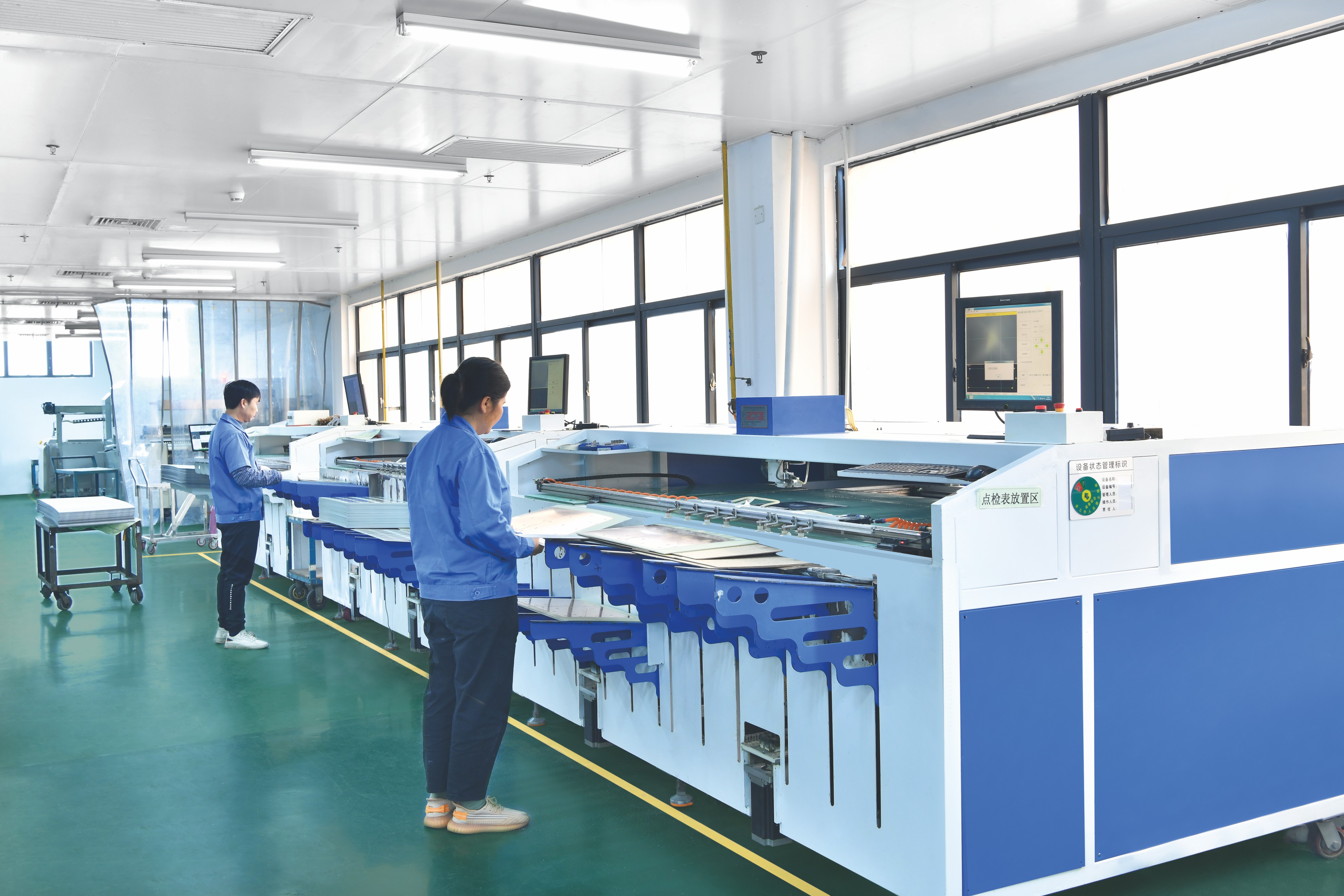
Production view: PCB drilling workshop at WODE Circuit Technology (Zhuhai) Co., Ltd.
Why the Board Decides LED Performance
In conventional lighting, the circuit board was a minor structural element. In LED systems, it plays three simultaneous roles. It provides electrical interconnection for constant-current or constant-voltage LED driving, dimming, and control signals. It manages heat by conducting energy away from the LED junction toward the luminaire body. And it holds LEDs in precise alignment with reflectors, lenses, and diffusers so that beam distribution and color uniformity meet spec.
These functions explain why lighting-specific requirements have been formalized. Outdoor fixtures typically need protection levels such as IP65 or IP67 and must survive salt spray, UV radiation, wind, and rain. Automotive lighting adds AEC-Q102 qualification for LED devices and ISO 16750 electrical load testing. Luminaire safety references UL 8750 / EN 60598; LED drivers reference IEC 62384; LED modules reference IEC/EN 62031 and control gears reference IEC/EN 61347-2-13. Rigid printed boards are commonly classified against IPC-6012. A buyer who evaluates an LED PCB only on electrical specification risks selecting a board that is electrically correct but thermally inadequate.
The opportunity is equally clear. A correctly selected board extends rated lifetime, which for lighting products is commonly stated at ≥50,000 hours (L70/B50). A wrong material choice shortens that lifetime and increases warranty exposure. For this reason, LED PCB sourcing sits at the center of luminaire quality programs, not at the edge of the bill of materials.
The Main LED PCB Families
LED PCBs are best understood by separating base material from construction format.
- FR-4 is a glass-reinforced epoxy laminate used widely in general lighting boards. It offers good electrical insulation and lower cost, but its thermal conductivity is limited compared with metal-core alternatives.
- CEM-1 and CEM-3 are composite laminates used mainly in single-sided boards. CEM-1 is cost-effective and punchable; CEM-3 provides better mechanical and electrical properties.
- Aluminum-based metal core boards (MCPCB) are the industry standard for high-power LED thermal management. The metal core spreads heat from the LED to the housing.
- Copper-based and ceramic-based substrates serve higher-performance or specialty cases, such as thermoelectric-separated copper-base boards and ceramic boards used in ultraviolet phototherapy.
- Polyimide (PI) is the base material for flexible printed circuits (FPC), enabling thin, bendable LED strips, LED tube boards, and COB modules.
In terms of construction, lighting buyers normally choose among single-sided boards, double-sided boards, and flexible circuits. A single-sided CEM-1/CEM-3/FR-4 board is sufficient for many simple lamp circuits. A double-sided FR-4 board handles denser routing. A metal-core board is chosen when heat must move quickly into a heatsink. A flexible circuit is chosen when the light engine must bend, wrap, or fit into a thin profile.
What to Verify Before Choosing an LED PCB Substrate
Procurement conversations should focus on four testable parameters.
- Thermal requirements. Aluminum substrates for lighting typically use thermal conductivity of at least 1.5 W/m·K, with high-power designs at or above 3.0 W/m·K. Junction temperature should be kept at or below 85°C, with 75°C recommended in many designs.
- Mechanical format. Rigid boards suit downlights, panels, and high-bay fixtures. Flexible circuits suit strips, tubes, and curved light engines. Roll-to-roll FPC formats support long continuous runs.
- Environmental and certification requirements. Outdoor products must tolerate -40°C to +50°C, high humidity, salt spray, and UV. Automotive systems demand AEC-Q102 and ISO 16750 compliance. Medical applications reference IEC 60601-1 and ISO 13485. Industrial controls reference IEC 61000-4 immunity levels.
- Cost structure. Metal-core boards cost more than FR-4 or CEM composites. Low-power, cost-sensitive products may not need them.
Surface finish is another selection criterion. Common options include OSP, carbon film, HASL, lead-free HASL, nickel-plated gold, ENIG (electroless nickel immersion gold), immersion silver, and ENEPIG. The choice depends on solderability, shelf life, and the assembly process used by the luminaire maker.
A Lighting-Focused Portfolio Example: WODE
To make this reference concrete, it is useful to examine a supplier that focuses on lighting circuits. WODE Circuit Technology (Zhuhai) Co., Ltd. is a PCB and FPC manufacturer based in Zhuhai, China, established in 2003. The company operates a 150,000 m² facility with more than 500 employees and an annual output capacity of 6,000,000 m². Roughly 50% of its products are exported, with stated main markets including Brazil, Turkey, India, Vietnam, and Russia. WODE holds ISO9001, ISO14001, and IATF16949 certifications, and reports product compliance with UL, RoHS, and REACH. The company lists more than 40 patented technologies and more than 1,000 customers across more than 30 countries.
WODE's product line covers rigid metal-core PCBs, flexible PCBs, Infinity Length FPCB, FR-4/CEM1/CEM3 PCBs, and upstream materials such as CCL (copper clad laminate) and PCB inks. For LED lighting, the representative portfolio includes the following board classes.
| Board type | Key specifications | Typical deployment |
|---|---|---|
| Single sided CEM1.CEM3.FR4 PCB | CEM-1, CEM-3, FR-4, or aluminum; single layer; 0.5-3 OZ copper; 0.6-2.0 mm thickness; max length 2000 mm; OSP, HASL, ENIG, and other finishes | Lighting, home appliance, medical electronics, communications, automotive, industrial controls, consumer electronics |
| Double sided FR4 PCB | FR-4; two layers; 1/1 oz copper; 1.6 mm ±10%; 208.00 x 225.00 mm panel; ENIG | Lighting fixtures with denser routing |
| COB FPC | PI; single or double sided; 1/1 oz or 1 oz copper; 0.115 mm; 366.00 x 250.00 mm panel; OSP; white coverlay | Chip-on-board lighting modules |
| Single/double sided LED strip FPC | PI; single or double sided; 1/1 oz or 1 oz copper; 0.115 mm; 366.00 x 250.00 mm; OSP; white coverlay | LED strip lighting |
| Single sided LED tube FPC | PI; single layer; 0.5 oz copper; 0.08 mm; 1239.50 x 255.00 mm; OSP | LED tube lamps |
| Roll to Roll Infinity FPCB | PI; single layer; 1 oz copper; 0.15 mm; 1000.00 x 124.00 mm; OSP | Long-format LED lighting circuits |
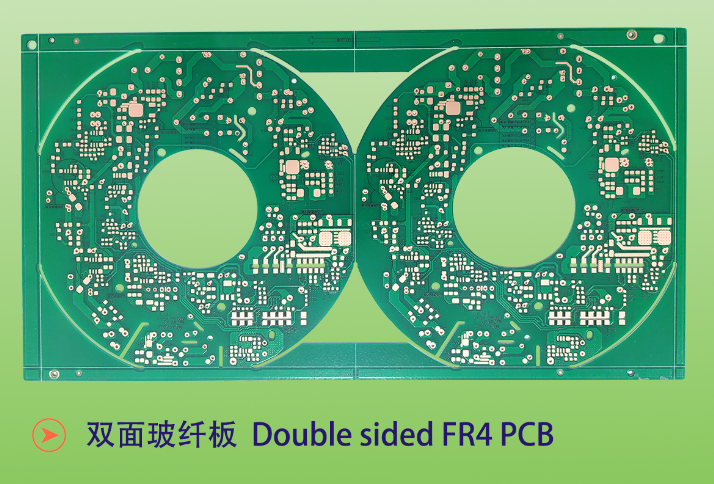
Double-sided FR-4 PCB for lighting applications, finished with ENIG.
One practical detail is board length. The single-sided rigid board supports a maximum length of 2000 mm, while flexible formats are panel-based and the Roll to Roll Infinity FPCB is produced in continuous form. These dimensions affect how a lighting manufacturer lays out a linear light engine and how efficiently panels are utilized in mass production.
Mapping LED PCBs to Real Lighting Projects
Different lighting projects place different demands on the PCB.
- General indoor lighting operates from 0°C to +40°C with humidity of 30% to 80%. Bulb lamps, downlights, spotlights, panel lights, ceiling lights, tube lights, and industrial high-bay lights are the main project types. Simple single-sided or double-sided boards cover many of these; high-drive-current designs step up to aluminum-based MCPCBs.
- Outdoor lighting operates from -40°C to +50°C and faces high humidity, salt spray, UV radiation, and wind-driven rain. Street lights and flood lights benefit from high-thermal-conductivity aluminum boards and housing designs that support IP65/IP67.
- Smart lighting adds tunable white or color control, sensor activation, connected luminaire control, and DALI-2 systems. The board must integrate wireless modules, sensor interfaces, and dimming circuits.
- Automotive lighting operates under engine-compartment conditions from -40°C to +125°C with vibration, shock, and moisture condensation. LED device qualification follows AEC-Q102.
- Specialty lighting includes stage lights, grow lights, UV curing lamps, infrared illumination, and surgical lights. These projects emphasize spectrum control and thermal behavior; ceramic-based boards appear in niche cases such as ultraviolet phototherapy.
Within the flexible segment, LED strip FPCs serve decorative and architectural lighting, LED tube FPCs support linear lamp retrofits, and COB FPCs enable chip-on-board modules with compact form factors. Roll-to-roll FPCB production reduces splicing points and supports automated assembly of long light engines.
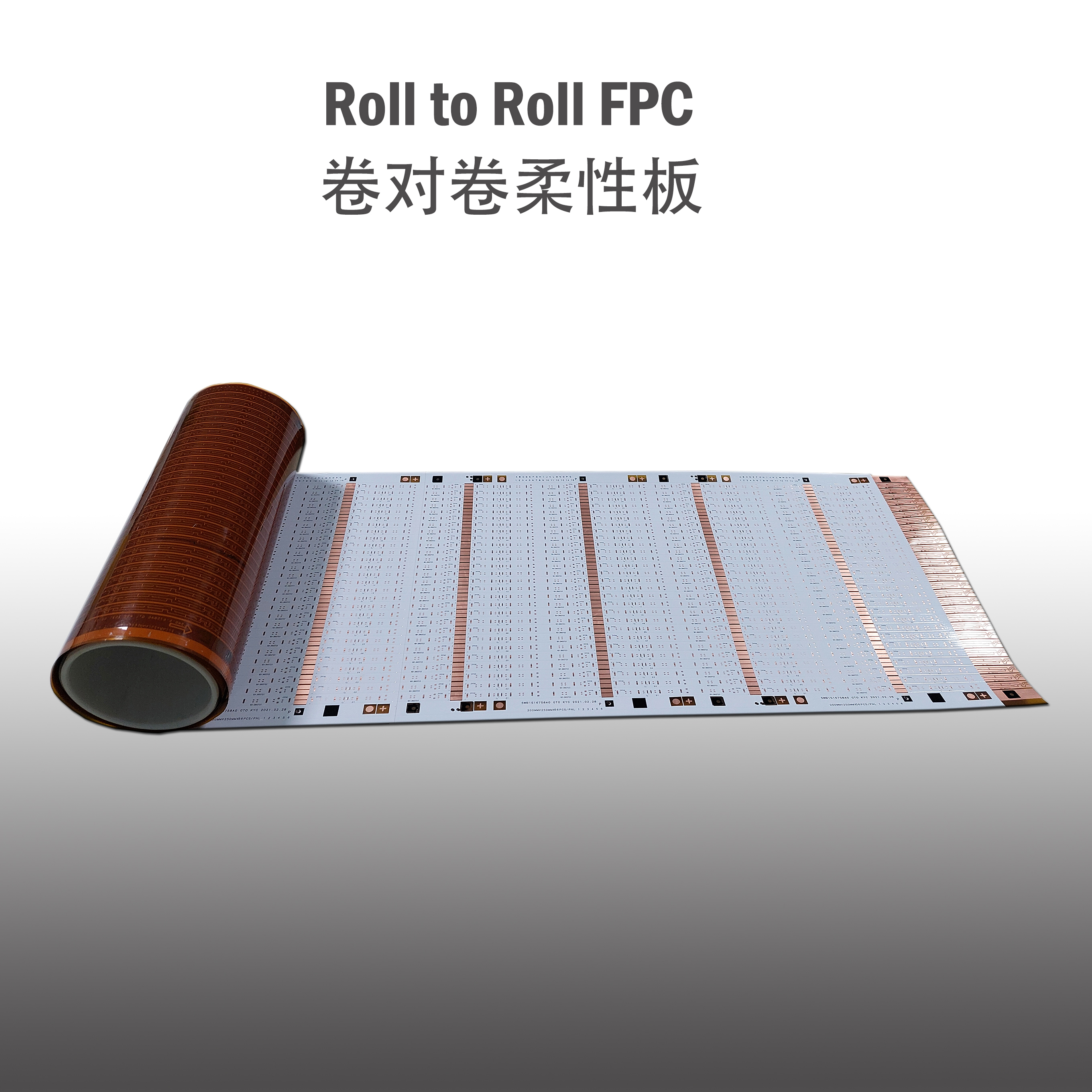
Roll to Roll Infinity FPCB, a single-sided flexible circuit for LED lighting applications.
Market Trends in LED PCB Sourcing
Several verified market signals shape LED PCB sourcing.
- Metal-core boards, particularly aluminum core, are the industry standard for high-power LED thermal management (Precedence Research).
- China dominates global PCB production value, accounting for 53.2% of the market as of 2024 (Farway Electronic / industry report). Many international lighting buyers therefore source directly from Chinese manufacturers or through specialist trading partners.
- The global PCB market was approximately USD 80.2 billion in 2025 (Global Market Insights), providing scale for continued capacity investment.
- The LED lighting market reached about USD 78.4 billion in 2024 and is projected to grow at a CAGR of 8.5% through 2029 (MarketsandMarkets).
- Outdoor LED lighting is projected to grow from USD 15.0 billion in 2025 to USD 28.0 billion by 2035 (Future Market Insights), supporting demand for thermally efficient boards.
On the supply side, the world's largest PCB manufacturers include Zhen Ding Tech (ZDT), Unimicron, DSBJ, Nippon Mektron, and TTM Technologies (NTI / Dr. Hayao Nakahara). These companies are primarily general-purpose producers. For lighting-specific procurement, the relevant supply base also includes specialists such as WODE that combine rigid MCPCB, FR-4/CEM, and FPC production in one facility.
LED PCB vs Traditional Approaches: Comparison and Limits
| Selection factor | FR-4 / CEM boards | Aluminum-based MCPCB | Flexible PCB (FPC) |
|---|---|---|---|
| Thermal conductivity | Limited; suitable for low power | High; designed for power LEDs | Depends on design; often with stiffener for heat spreading |
| Typical cost | Lower | Higher | Medium |
| Typical products | Bulbs, simple panels, low-cost fixtures | Downlights, street lights, flood lights, high-bay lights | LED strips, LED tubes, COB modules, curved light engines |
| Routing flexibility | Single or double sided | Usually single sided; double-sided variants exist | Single or double sided |
| Bending capability | None | None | Good |
A fair limitation must be stated. Aluminum-based MCPCB is not always the right answer. Its material cost is higher than FR-4 or CEM composites, and dense two-layer routing is more difficult on metal-core constructions than on standard double-sided FR-4. For low-power, cost-sensitive products such as a simple bulb lamp or a basic panel, a single-sided CEM-1/CEM-3/FR-4 board can meet reliability requirements at a meaningfully lower cost.
Flexible circuits also have boundaries. They require more careful handling and assembly process control than rigid boards. Brightness consistency and solder joint quality depend on the manufacturer's process discipline. In addition, a high-spec board cannot compensate for a poorly designed thermal path elsewhere in the luminaire: solder joints, thermal interface material, heatsink, and housing must be engineered as a system.
How Buyers Should Evaluate an LED PCB Supplier
- Manufacturing scale: facility size, headcount, and annual output are indicators of delivery stability. WODE, for example, lists a 150,000 m² facility and 6,000,000 m² annual capacity.
- Certification and compliance: ISO9001, ISO14001, and IATF16949 are commonly expected; product compliance with UL, RoHS, and REACH matters for export markets.
- Product range: a supplier that covers rigid MCPCB, FR-4/CEM boards, FPC, and roll-to-roll formats can consolidate the lighting bill of materials.
- Engineering depth: an internal R&D team and a patent portfolio indicate capability for design-for-manufacture support.
- Export experience: familiarity with target markets such as Brazil, Turkey, India, Vietnam, and Russia reduces communication and logistics risk.
Future Outlook
Several directions are visible in LED PCB development. Long-format and roll-to-roll flexible circuits will continue to gain share in linear lighting and architectural applications because they reduce splicing points and simplify automated assembly. Higher-thermal-conductivity base materials will spread beyond street and flood lighting into downlights, panels, and grow lights as compact high-lumen fixtures become more common. Smart lighting will push board designs toward integrated control circuits, sensor interfaces, and wireless modules, requiring closer cooperation between luminaire designers and board manufacturers.
Certification and traceability will remain central. Buyers will increasingly request documentation supporting UL, RoHS, REACH, and industry-specific standards such as AEC-Q102, IEC 61000-4, and ISO 13485. Manufacturers that combine rigid MCPCB, FR-4/CEM, and FPC production under one roof are positioned to serve lighting OEMs that want to consolidate suppliers and respond quickly to application changes.
FAQ
What is an LED PCB?
An LED PCB is a printed circuit board designed to mount and connect LED packages in a lighting product. It provides the electrical circuit, the mechanical support, and in metal-core versions the thermal path for heat dissipation.
What materials are used to make LED PCBs?
Common base materials include FR-4, CEM-1, CEM-3, aluminum, copper, ceramic, and polyimide for flexible circuits. Copper foil forms the circuit layer, and the board is finished with solder mask, silkscreen, and a surface finish such as OSP, HASL, or ENIG.
What does MCPCB mean and why is it used in LED lighting?
MCPCB stands for Metal Core PCB, usually built on an aluminum base. It is used in high-power LED lighting because it conducts heat away from the LED more effectively than standard FR-4, helping keep the junction below recommended temperature limits.
What is the difference between FR-4 and aluminum-based LED PCBs?
FR-4 is a glass-reinforced laminate with good electrical insulation but limited thermal conductivity. Aluminum-based boards add a metal core that spreads and conducts heat away from the LED. Aluminum MCPCBs are generally more expensive and are preferred for higher-power fixtures.
What types of LED PCBs are available?
Common types include single-sided and double-sided rigid PCBs, aluminum-based metal core PCBs, ceramic-based PCBs, copper-based PCBs, and flexible printed circuits such as LED strip FPC, LED tube FPC, COB FPC, and roll-to-roll FPCB.
What surface finishes can be specified for LED PCBs?
Available finishes include OSP, carbon film, HASL, lead-free HASL, nickel-plated gold, ENIG, immersion silver, and ENEPIG. The choice depends on the assembly process and the reliability requirements of the product.
Which industries use LED PCBs beyond general lighting?
LED PCBs are used in automotive electronics, smart lighting, medical electronics, communications equipment, industrial controls, and consumer electronics. Lighting versions of these boards emphasize thermal management and long-term reliability.
For additional product and capability details, a company brochure is available: WODE Circuit Technology brochure (PDF).