
LED PCB Sourcing Q&A: Materials, Copper Weight, Compliance
LED PCB sourcing rarely fails at the moment of manufacture. It fails earlier, when a substrate is selected before copper weight is fixed, copper weight is fixed before panel format is understood, and a certificate is filed without checking whether it actually covers the construction being ordered.
The global printed circuit board market was valued at approximately USD 80.2 billion in 2025, and China accounted for 53.2% of global PCB production value as of 2024. Those two figures explain why so much LED lighting procurement now routes through Chinese board suppliers, and why buyers are being asked to evaluate documented capability rather than price alone. The questions arriving from engineering and quality teams are specific: which dielectric, which copper weight, which certificate, which lead time.
This reference answers those questions in the order a procurement team usually meets them, moving from materials and copper selection through panel format, order terms and compliance scope. Each answer is tied to published product data, certificate scopes or stated order terms, and the limits of each answer are stated where a limit exists.
Why LED PCB Sourcing Questions Cluster Around Three Decisions
Three decisions determine whether an LED PCB order proceeds smoothly: the substrate family, the copper weight, and the scope of the compliance documents that travel with the shipment. Each one constrains the others. A polyimide (PI) flexible circuit can be made very thin, but it will not carry the heavy copper available on a rigid board. An aluminium metal-core PCB solves a thermal problem, but in most listed constructions it is a single-sided part. A UL file number looks reassuring until the buyer discovers the recognition covers specific models and layer counts rather than every board the supplier produces.
The opportunity for buyers is that all three constraints can be resolved before the request-for-quote stage. Doing so removes the most common causes of re-quoting, tooling changes and delayed approvals in LED lighting programmes, where fixture housings, driver compartments and assembly methods are often already fixed by the time the board is specified.
PI, FR-4 and Aluminium: What Actually Changes in an LED PCB
In LED PCB sourcing, the "PI versus FR-4" question is really a question about whether the circuit must flex. PI (polyimide) is the dielectric used in flexible printed circuits (FPC) — the thin substrates that carry LED strips, tubes and chip-on-board (COB) arrays inside narrow, curved or continuous fixtures. FR-4 is a rigid glass-reinforced epoxy laminate, used where the board must hold its shape, support connectors, or host driver and control circuitry. Metal-core substrates — aluminium and copper based — form a third family, selected for heat management rather than flexibility.
Industry research positions aluminium-core metal-core PCBs (MCPCB) as the standard approach to high-power LED thermal management, because the metal base spreads heat away from the LED junction more effectively than a conventional laminate. That is a thermal argument, not a universal recommendation: the correct substrate is the one that simultaneously satisfies the fixture's thermal, mechanical and assembly requirements.
| Substrate family | Published construction example | Layers | Copper | Overall thickness | Typical role |
|---|---|---|---|---|---|
| PI flexible (FPC) | Single sided LED tube FPC | Single sided | 0.5 oz | 0.08 mm | Thin linear LED tube circuits |
| PI flexible (FPC) | Roll to Roll Infinity FPCB | Single sided | 1 oz | 0.15 mm | Continuous-format flexible circuits |
| PI flexible (FPC) | Single/double sided LED strip FPC and COB FPC | Single or double sided | 1 oz or 1/1 oz | 0.115 mm | LED strips and COB arrays |
| FR-4 rigid | Double sided FR4 PCB | Double sided | 1/1 oz | 1.6 mm ±10% | Driver and control sections |
| CEM-1 / CEM-3 / FR-4 / aluminium | Single sided CEM1.CEM3.FR4 PCB | Single sided | 0.5 oz, 0.75 oz, 1 oz, 2 oz, 3 oz and above | 0.6–2.0 mm | General rigid boards, up to 2,000 mm length |
| Aluminium MCPCB | MCPCB for Road lighting (Al1060) | Single sided | 1 oz | 1.6 mm ±10% | Outdoor and road lighting thermal path |
| Aluminium MCPCB | Double sided MPCB (Al5) | Double sided | 70/70 µm | 1.6 mm ±0.16 | Home appliance and enclosed fixtures |
Read as a whole, the table shows how substrate families divide the work. Flexible PI constructions dominate thin and continuous formats and stay within a 0.5 oz to 1 oz copper range. The rigid CEM-1, CEM-3 and FR-4 listings cover the widest copper span — 0.5 oz to 3 oz and above — with board thickness from 0.6 mm to 2.0 mm and a maximum length of 2,000 mm for single-sided parts. Aluminium MCPCBs sit at 1 oz copper and 1.6 mm nominal thickness in the listed road-lighting, high-voltage, coverlay and double-sided constructions.
Copper Weight: What 0.5 oz, 1 oz and 2 oz Mean on an LED Board
Copper weight is quoted in ounces per square foot, where 1 oz corresponds to a nominal foil thickness of about 35 µm. On an LED board, copper does two jobs at once: it sets current-carrying capacity and voltage drop along the conductor run, and it contributes lateral heat spreading beneath the LED array.
Published constructions show how that choice is applied in practice:
- Single sided LED tube FPC — 0.5 oz copper on a PI substrate, 0.08 mm overall thickness.
- Roll to Roll Infinity FPCB — 1 oz copper, PI, 0.15 mm overall thickness.
- Single/double sided LED strip FPC and COB FPC — 1 oz, or 1/1 oz on double-sided versions, 0.115 mm overall thickness.
- Double sided MPCB — 70/70 µm copper (approximately 2 oz per side) on a 1.6 mm metal-core construction.
- Thermoelectric Separated Cu based PCB — 35 µm copper on a copper base.
- Single sided CEM-1, CEM-3, FR-4 and aluminium boards — 0.5 oz, 0.75 oz, 1 oz, 2 oz, 3 oz and higher options.
Two procurement implications follow. First, heavy copper and flexibility pull in opposite directions: thicker copper increases stiffness, which matters when an FPC has to pass through a narrow fixture channel or wrap around a bend. Second, the available range differs by family — in the listed flexible constructions copper runs from 0.5 oz to 1 oz, while 2 oz and above appear on the rigid and metal-core listings. Buyers specifying heavy copper should confirm that the requested weight exists inside the chosen substrate family before design freeze rather than after.
Panel Formats and Roll-to-Roll Capability
Panel data answers a question that is often raised late in the process: how many circuits fit on one working panel. The "ups" figure in a panel specification is the number of individual circuits produced from a single panel, and it drives material utilisation and, indirectly, unit cost.
- Single sided LED tube FPC — 1,239.50 mm × 255.00 mm, 39 up.
- Roll to Roll Infinity FPCB — 1,000.00 mm × 124.00 mm, 13 up.
- Single/double sided LED strip FPC and COB FPC — 366.00 mm × 250.00 mm, 1 up.
- MCPCB for Road lighting — 208.00 mm × 225.00 mm, 2 up.
- Double sided MPCB — 217.54 mm × 197.80 mm, 56 up.
- Single sided CEM-1, CEM-3, FR-4 and aluminium — maximum length 2,000 mm.
The difference between a 1-up and a multi-up format is largely a function of circuit outline and available panel size: long or large outlines typically yield one circuit per panel, while compact repeated circuits yield higher counts. Roll-to-roll FPCB production supports continuous-format circuits, which is the format used for flexible linear LED products where a fixed-length rigid board would introduce joints.
What WODE publishes about its LED PCB capability
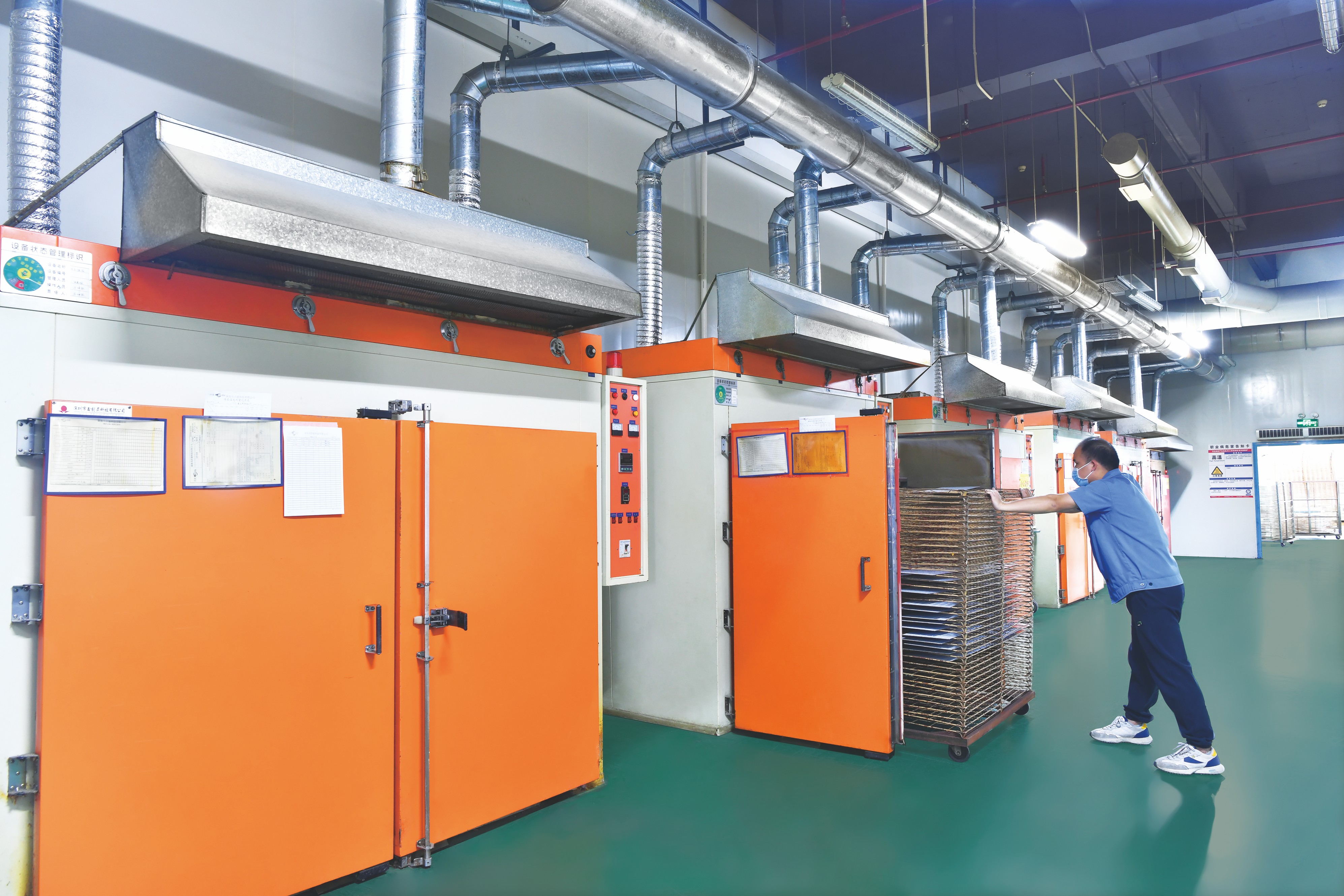
WODE Circuit Technology (Zhuhai) Co., Ltd. is a PCB and FPC manufacturer founded in 2003 and based in Zhuhai, China. The company operates a 150,000 m² facility with more than 500 employees and an annual output of 6,000,000 sqm, and states more than 40 patented technologies across PCB and FPC development. Its product lines include rigid MCPCB, FPCB, infinity-length FPCB, FR-4, CEM-1 and CEM-3 PCBs, copper-clad laminates and PCB inks.
Production is offered under OEM and ODM arrangements. Customisable parameters stated by the company include layer count, substrate, surface finish — ENIG, OSP, HASL, HASL-LF and others — impedance control, and routing, slotting or cutting. Surface finishes listed across the single-sided rigid range also include carbon film, nickel-plated gold, chemical silver and ENEPIG for wire bonding. The company reports an export ratio of 50% and states that it has supplied more than 1,000 customers in more than 30 countries.
Lead Time, MOQ and Order Structure
Quoted lead time for WODE PCB and FPC production is 7–25 days, depending on order quantity and design complexity. Minimum order quantity is 100 sqm for mass orders, while sample quantities are not limited — a structure that allows a buyer to validate a construction before committing to production volume.
Delivery follows the logistics method designated by the customer, with supported shipping methods and cost terms confirmed per order. Quality control is described as a continuous improvement system covering incoming, in-process and final inspection, together with electrical function testing, with the specific inspection equipment and acceptance criteria agreed case by case rather than published as a fixed default.
After-sales support is defined as technical support and quality liaison, with warranty, return and defect-handling terms to be specified in the customer contract. For buyers entering the execution stage, that means commercial protection sits in the agreement rather than in a standing policy — a point better resolved before the first production order than after it.
Compliance Questions: Which Certificate Covers Which Board
Certification is scope-based, not brand-based. A supplier can hold UL recognition, IATF 16949, ISO 9001, ISO 14001 and CQC certification and still not have the exact construction you are buying inside any of those scopes. The practical question is not "are you certified" but "which document covers this substrate, this layer count and this thickness".
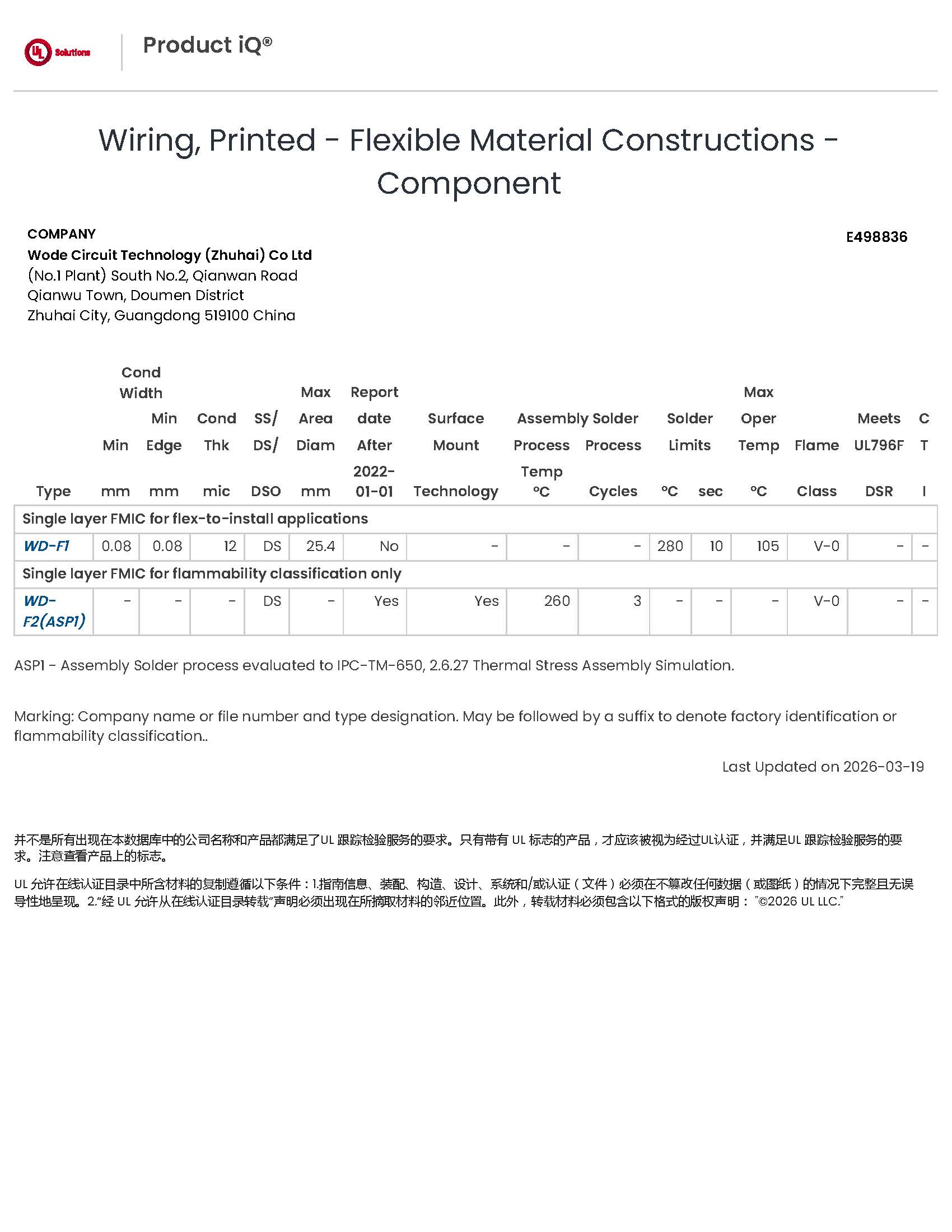
- UL 796F — flexible printed circuit material. Certificate E498836, issued through UL Solution on 1 January 2022, covering single-layer FMIC flexible printed circuit models WD-F1 and WD-F2 (ASP1), tested against UL 796F and IPC-TM-650 2.6.27.
- UL 796 — rigid printed wiring boards. Certificate E323980, issued 1 January 2022, covering single-layer metal base printed wiring boards (WD-14, WD-15, WD-16, WD-17) and single-layer rigid printed wiring boards (RXD-11, WD-12, WD-13, RXD-10).
- IATF 16949 — certificate 0584371, issued by NQA Certification Limited on 27 September 2025 and valid to 26 September 2028, scoped to human resources, purchasing and strategic planning for automotive printed circuit board manufacturing.
- ISO 9001:2015 — certificate 51325Q4258ROM, valid 13 October 2025 to 12 October 2028, covering production of circuit boards.
- ISO 14001:2015 — certificate 51325E2142ROM, valid 13 October 2025 to 12 October 2028, covering environmental management activities related to circuit board production.
- CQC — certificate CQC22001367683, valid 13 January 2026 to 16 November 2027, covering defined substrates (22F CEM1 5152, CEM-1, FR-4 GF211, FR-4 KB6160) at 0.2–3.2 mm thickness with V-0 flammability, under GB 4943.1-2022.
- REACH SVHC — test report DGC251204025BD03, issued by NSTL on 10 December 2025 for a double-sided aluminium-based board, assessed against EU REACH Regulation (EC) No 1907/2006 and the ECHA SVHC candidate list.
Three points matter when these documents are read into a procurement file. The UL recognition lists specific models and single-layer constructions, so a multi-layer or different-substrate design should be checked against the file before the number is cited in a specification. The CQC certificate names four substrate types within a 0.2 mm to 3.2 mm thickness band, which excludes thicker constructions. The REACH report addresses a double-sided aluminium-based board specifically, not every substrate the supplier produces.
Fixture-level standards sit alongside board-level certificates in the compliance chain. LED modules are commonly evaluated under IEC/EN 62031 and LED control gear under IEC/EN 61347-2-13, while IPC-6012 is the performance specification widely used for rigid printed board quality classification. A board certificate answers a construction and flammability question; a fixture standard answers a different one, and buyers usually need both.
Application Fit: Matching the Substrate to the Fixture
Substrate choice becomes easier once the fixture format is fixed.
- Linear and strip products — single or double sided LED strip FPC on PI with 1 oz or 1/1 oz copper at 0.115 mm overall thickness, and single sided LED tube FPC at 0.08 mm with 0.5 oz copper. These constructions are used in LED strips and fixtures, display module interconnects and consumer electronics connectors.
- COB arrays — COB FPC, sharing the 0.115 mm PI platform with 1 oz or 1/1 oz copper, relevant to chip-on-board configurations.
- Outdoor and road lighting — MCPCB for Road lighting on Al1060 aluminium, single layer, 1 oz copper, 1.6 mm ±10%, HASL-LF finish; and High Voltage MCPCB on an aluminium base with 1 oz copper and OSP finish.
- Enclosed fixtures and appliances — Double sided MPCB with 70/70 µm copper on a metal base, and Double sided FR4 PCB with 1/1 oz copper and ENIG finish for driver and control sections.
- Coverlay-protected metal-core boards — Coverlay MCPCB on Al1060 with white coverlay solder mask and HASL-LF finish, where the solder mask surface must tolerate handling in assembly.
Across the product range, these boards serve indoor and outdoor lighting, automotive lighting, new energy, home appliances and 5G communication applications, and are used by electronics manufacturers, lighting companies, OEM and ODM vendors and trading companies. The regional pattern is also visible in the case record: a lighting OEM project in Germany used the board as a main part of the fixture, with 5,000 sqm in service and stable operation over five years under a European climate and the safety standards applied in that market.
Market Signals Behind These Sourcing Questions
Three data points explain why material, lead-time and compliance questions have become more detailed in the past procurement cycles.
- Demand context. The global LED lighting market was valued at USD 78.4 billion in 2024, with a projected compound annual growth rate of 8.5% through 2029 (MarketsandMarkets). Outdoor LED lighting is projected to grow from USD 15.0 billion in 2025 to USD 28.0 billion by 2035 (Future Market Insights). Estimates vary by scope — separate research puts the outdoor lighting market at USD 17.06 billion for 2024 (Grand View Research) and the broader outdoor LED category at USD 31.0 billion (The Business Research Company) — so planning should treat these as directional ranges rather than single figures.
- Thermal substrate demand. Aluminium-core metal-core PCBs are positioned by industry research as the standard route to high-power LED thermal management, which places substrate thermal capability at the centre of supplier evaluation for high-power, high-bay and outdoor formats.
- Supply concentration. China's share of global PCB production value reached 53.2% as of 2024, concentrating supplier selection, compliance documentation and lead-time negotiation in one manufacturing region. Total PCB market estimates also diverge between research houses — approximately USD 80.2 billion for 2025 (Global Market Insights) versus USD 82.7 billion (Grand View Research) — which is itself a reminder to validate supplier-specific data rather than rely on a single market number.
Where This Approach Has Limits
An honest sourcing reference has to state the boundaries of the capability it describes.
- Certificate scope. UL recognition covers identified models and single-layer constructions; a board outside the listed models is not automatically covered by the cited file, and the REACH report applies to the specific tested construction.
- Copper on flexible circuits. The listed flexible constructions sit between 0.5 oz and 1 oz copper. Designs requiring 2 oz or 3 oz generally need a rigid or metal-core substrate, which changes the mechanical solution rather than only the electrical one.
- Metal-core layering. The published aluminium MCPCB constructions are predominantly single-sided; where a double-sided metal-core board is required, the listed construction is a defined stack-up (70/70 µm copper, 1.6 mm ±0.16) rather than an open specification.
- Inspection criteria. The quality framework covers incoming, in-process and final inspection plus electrical function testing, but specific equipment and acceptance criteria are agreed per project rather than published as a default.
- After-sales terms. Warranty, returns and defect handling are contract-defined, so two customers running comparable boards may hold different commercial protection.
- Lead time. The 7–25 day window is a range governed by quantity and design complexity, not a guaranteed ship date.
Future Outlook: Compliance Files as a Procurement Gate
Two shifts are visible in how LED PCB sourcing is being evaluated. The first is documentary. As outdoor, high-power and long-run lighting volumes grow, more buyers are mapping certificate scope to a specific construction at the RFQ stage instead of discovering the gap at audit stage. Suppliers that can state which UL file, which CQC scope and which REACH report applies to a given stack-up will spend less time in clarification loops and more time in production planning.
The second is continuity. Board sourcing was historically organised project by project; current patterns point toward longer supply relationships, in which the ability to hold a construction — same substrate, same copper weight, same panel format — across several production years becomes part of supplier qualification. That shifts evaluation weight from a single quotation toward the factory base, material control and inspection discipline behind it.
For procurement teams, the preparation is unglamorous but effective: fix the substrate family, confirm that the required copper weight exists within that family, check certificate scope against the actual stack-up, and put inspection criteria and after-sales terms into the contract before the first production order is released.
FAQ
What is the difference between PI and FR-4 in an LED PCB?
PI (polyimide) is the dielectric used in flexible printed circuits — thin, bendable substrates used for LED strip, tube and COB constructions, with published examples at 0.08 mm and 0.115 mm overall thickness. FR-4 is a rigid glass-reinforced epoxy laminate used where the board must hold its shape or host driver circuitry, with published examples at 1.6 mm ±10% thickness and 1/1 oz copper. The choice follows the mechanical requirement: flexible PI for linear and curved formats, rigid FR-4 for structural and control sections, and metal-core substrates where thermal performance dominates.
How much copper should an LED PCB have?
Copper weight is set by current, voltage drop along the conductor run and lateral heat spreading. Published constructions show 0.5 oz on the single sided LED tube FPC, 1 oz on the Roll to Roll Infinity FPCB and the LED strip FPC, 70/70 µm (about 2 oz per side) on the double sided metal-core board, and 0.5 oz to 3 oz and above on single sided CEM-1, CEM-3, FR-4 and aluminium boards. Heavy copper is more limited on flexible substrates, so a design requiring 2 oz or more usually moves to a rigid or metal-core family.
What panel sizes are available for roll-to-roll FPCB?
The Roll to Roll Infinity FPCB uses a PI substrate with 1 oz copper at 0.15 mm overall thickness, produced on a 1,000.00 mm × 124.00 mm panel with 13 circuits per panel. For comparison, the single sided LED tube FPC panel measures 1,239.50 mm × 255.00 mm with 39 up, and the single/double sided LED strip FPC and COB FPC panel measures 366.00 mm × 250.00 mm with one circuit per panel. Single sided rigid boards in the CEM-1, CEM-3, FR-4 and aluminium range support a maximum length of 2,000 mm.
Can LED PCB constructions be customised beyond the standard listings?
WODE offers OEM and ODM production services. Customisable parameters published by the company include layer count, substrate, surface finish options such as ENIG, OSP, HASL and HASL-LF, impedance control, and routing, slotting or cutting. Because copper range, panel format and certificate scope are tied to the substrate family, customised requests are normally checked against the relevant product data and certificate listings before tooling starts.
What lead time and minimum order quantity apply to custom LED lighting PCB orders?
Quoted lead time is 7–25 days and depends on order quantity and design complexity. Minimum order quantity is 100 sqm for mass orders, while sample quantities are not limited. Delivery follows the customer's designated logistics method, with cost terms confirmed per order.
How long do the certificates remain valid, and do they cover any LED PCB design?
Validity differs by certificate. IATF 16949 certificate 0584371 runs from 27 September 2025 to 26 September 2028; ISO 9001:2015 certificate 51325Q4258ROM and ISO 14001:2015 certificate 51325E2142ROM both run from 13 October 2025 to 12 October 2028; CQC certificate CQC22001367683 runs from 13 January 2026 to 16 November 2027. UL recognition E498836 covers specified single-layer flexible printed circuit models under UL 796F, and E323980 covers specified single-layer metal base and rigid printed wiring boards under UL 796. Coverage is defined by the models, layer counts and substrates listed in each file, so a design outside those scopes is not automatically certified.
What acceptance criteria and delivery terms apply to LED PCB shipments?
Acceptance is carried out against technical specifications and inspection standards agreed with the buyer, using incoming inspection, outgoing inspection or third-party inspection as agreed for the order. Delivery is arranged through the logistics method designated by the customer, with supported shipping methods and cost terms confirmed per order, and payment terms set in the order or contract.
Reference
Additional process and product reference material is available in the WODE Circuit company brochure, which can be viewed or downloaded here: https://cdn.socialarks.com/sbsp/24915/common/2026/0530/%E6%B2%83%E5%BE%B7%E7%94%BB%E5%86%8C.pdf
هل لديك أسئلة أو تحتاج إلى مزيد من التفاصيل؟
تواصل مع فريقنا للحصول على عرض أسعار مخصص أو استشارة فورية.
طلب عرض أسعار
املأ النموذج أدناه وسيتواصل معك فريقنا بعرض مقترح مخصص.
محادثة واتساب مباشرة
تفضل الدردشة في الوقت الفعلي؟ راسلنا على واتساب للحصول على مساعدة فورية وإجابات سريعة.
- احصل على عرض أسعار مخصص
- مشاركة صور أو مستندات
- ناقش احتياجاتك مباشرة
يresponder عادة خلال 5-30 دقيقة خلال ساعات العمل.