
LED PCB Supplier Selection in 2026: What Procurement Teams Should Verify
LED PCB selection is becoming a procurement-level decision. For lighting OEMs, the circuit board determines how heat is removed from high-power LEDs, whether the luminaire can meet safety and environmental requirements, and how predictable the supply chain can be across multiple production cycles. This article uses market data and documented supplier evidence to explain what belongs in an LED PCB evaluation, using WODE Circuit Technology (Zhuhai) Co., Ltd. as a reference example.
The Procurement Problem and the Opportunity
Most LED PCB datasheets show layer count, copper weight, solder mask color, and surface finish. They do not show how a board performs after thousands of thermal cycles, how consistently a factory can hold tolerances on a large annual output, or whether the supplier has evidence of qualification by major lighting brands. These gaps create procurement risk.
The opportunity is that buyers can replace part of that risk with structured verification. A practical LED PCB supplier evaluation should cover substrate capability, certification evidence, production scale, application-specific product range, and long-term reference cases.
What to Verify in an LED PCB Supplier Evaluation
Before comparing prices, a lighting OEM should verify five areas.
- Substrate and thermal path. Metal core PCBs, especially aluminum-based boards, are widely used for high-power LED thermal management. An LED PCB supplier should be able to move from standard FR-4 to aluminum, copper, ceramic, or thermoelectric separated substrates when the project requires it.
- Certification and compliance evidence. Certificate names are not enough; file numbers, issued standards, and scope matter. Relevant references include UL 796 for rigid boards and UL 796F for flexible circuits, ISO 9001 and ISO 14001, IATF16949 for automotive-related manufacturing, and REACH or RoHS substance testing.
- Manufacturing scale and quality control. The supplier should describe its monthly capacity, inspection stages, and electrical testing process.
- Application-specific product range. Single-layer, double-layer, metal core, flexible, and specialty boards serve different lighting products.
- Long-term proof. Brand acceptance and stable project operation are stronger evidence than a datasheet.
Reference Example: WODE as a Documented LED PCB Supplier
One documented example is WODE Circuit Technology (Zhuhai) Co., Ltd., a PCB and FPC manufacturer founded in 2003 and based in Zhuhai, China. WODE reports more than 40 patented technologies, a 150,000 m² production facility, more than 500 employees, 6,000,000 sqm annual output, and a 15-person R&D team. Its main product range includes rigid MCPCB, FPC, Infinity Length FPCB, FR-4/CEM1/CEM3 PCBs, CCL, and PCB inks. About 50% of output is exported, with main markets including Brazil, Turkey, India, Vietnam, and Russia. The company states that it has provided solutions for more than 1,000 customers in more than 30 countries.
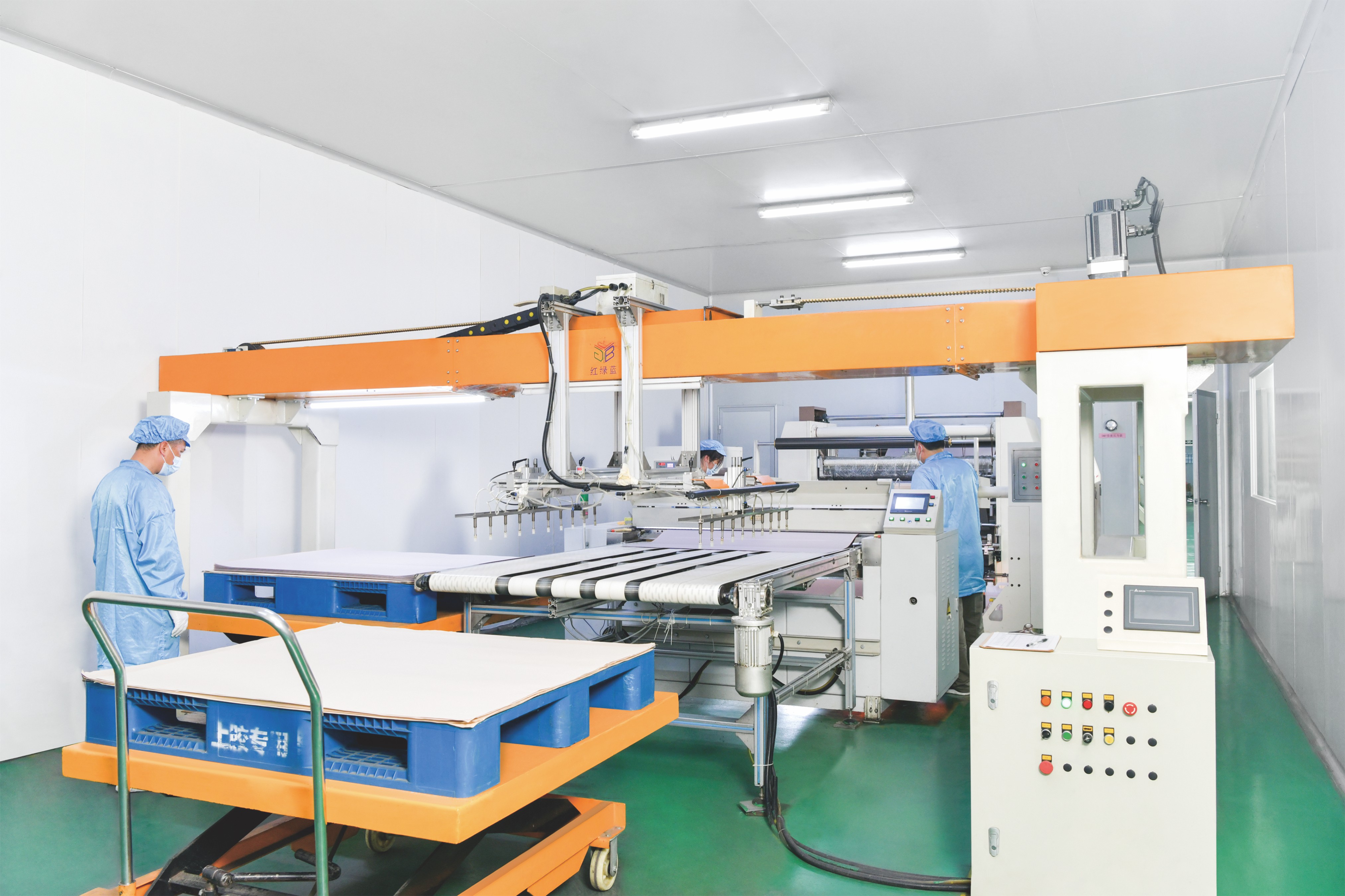
Under its OEM/ODM production model, WODE offers customization of layer count, substrate, surface finish, impedance control, routing or slotting or cutting, and other parameters. Monthly capacity is reported at 600,000 sqm. Lead time is 7 to 25 days depending on order quantity and design complexity. The mass-order MOQ is 100 sqm, with no limit on samples. Quality control includes incoming, process, and final inspections and electrical function tests.

LED PCB Materials and Construction Details
Thermal Path Is the First Criterion
In an aluminum MCPCB, the circuit layer is bonded to a thermally conductive dielectric layer, which transfers heat to the aluminum base. This is why street light LED PCBs and flood light LED PCBs commonly use aluminum-based MCPCBs rather than standard FR-4. In WODE’s road-lighting MCPCB, the base material is Al1060, the board is single-sided with 1 oz copper, 1.6 mm total thickness, white solder mask, and HASL-LF surface finish. A motor-lighting MCPCB option uses Al5052, 1 oz copper, 1.6 mm total thickness, matt black solder mask, and HASL.
Layer Count and Copper Weight
For more complex circuits, double-sided metal-core boards are available. WODE lists a double-sided MPCB using Al5 substrate, 70/70 um copper, 1.6 mm total thickness, and HASL-LF finish. For applications where electrical and thermal paths must be separated, a thermoelectric separated Cu-based PCB is offered with 35 um copper thickness, 1.6 mm total thickness, and OSP finish. For ultraviolet phototherapy, a ceramic-based PCB is listed.
Surface Finish and Flexible Options
Surface finish matters for solderability and reliability. WODE’s customization options include ENIG, OSP, HASL, and HASL-LF, among others. Flexible and ultra-thin PCB options are relevant for LED tubes and strips. WODE includes a single-sided LED tube FPC with PI substrate, 0.5 oz copper, 0.08 mm overall thickness, and OSP finish, and a single or double-sided LED strip FPC with 0.115 mm overall thickness, white coverlay, and OSP finish. COB FPC is also available for chip-on-board LED packaging.
Application Mapping for Common LED Products
Different lighting products require different trade-offs. The following table maps some of WODE’s documented board configurations to typical lighting use.
| Lighting use | Documented board configuration |
|---|---|
| Road lighting / street light LED PCB | MCPCB for Road lighting; Al1060; single-sided; 1 oz copper; 1.6 mm; HASL-LF |
| Motor lighting LED PCB | MCPCB for Motor lighting; Al5052; single-sided; 1 oz copper; 1.6 mm; HASL; matt black solder mask |
| High-voltage LED board | High Voltage MCPCB; Al1; single-sided; 1 oz copper; 1.6 mm; OSP |
| Small appliance lighting | PCB for Small Appliance Lighting Motherboard; FR-4; double-sided; 1/1 oz copper; 1.0 mm; HASL-LF |
| Home application lighting | Double sided MPCB; Al5; 70/70 um copper; 1.6 mm; HASL-LF |
| LED strips | Single or double sided LED strip FPC; PI; 0.115 mm; white coverlay; OSP |
| LED tubes | Single sided LED tube FPC; PI; 0.5 oz copper; 0.08 mm; OSP |
| Ultraviolet phototherapy | Ceramic based PCB |
For industrial or high-bay fixtures where power density is high, thermal design becomes even more important. Suppliers may offer copper-based or thermoelectric separated substrates rather than a standard aluminum board, depending on the project requirements.
Evidence From Long-Term LED PCB Use
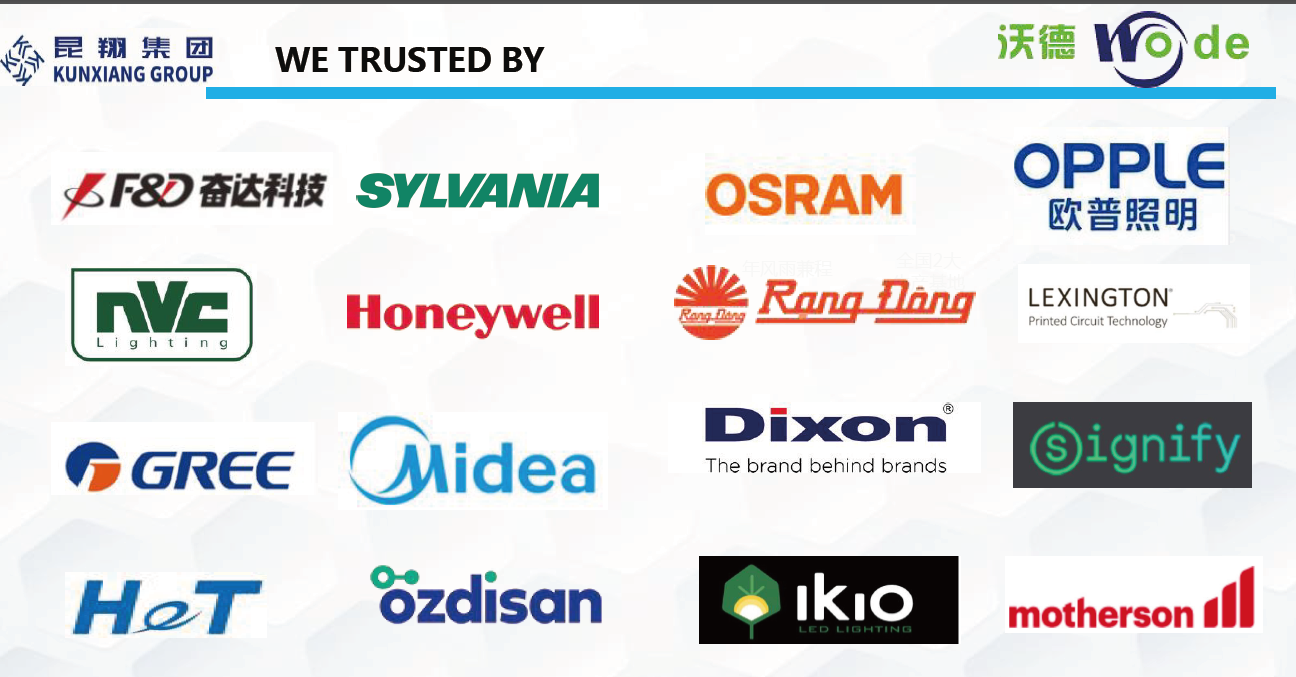
Two documented evidence points are relevant for buyers. First, WODE states that its product has been qualified by global brands including Signify, Osram, Opple, NVC, HoneyWell, Randon, Dixon, Ozdisan, IKIO, and Motheson. Second, a lighting project in Germany has been in stable operation for 5 years, using 5000sqm of PCB materials. The product demonstrates high thermal conductivity, reliable performance in harsh European climate, and compliance with German safety standards. This success case demonstrates global market acceptance, with clients in multiple countries.
Market Context and LED PCB Demand
The broader market context supports this focus. According to Global Market Insights, the global printed circuit board market was valued at approximately USD 80.2 billion in 2025. An industry report cited by Farway Electronic places China at 53.2% of global PCB production value in 2024. MarketsandMarkets estimates the global LED lighting market at USD 78.4 billion in 2024, with a projected CAGR of 8.5% through 2029. Future Market Insights projects the outdoor LED lighting market to grow from USD 15.0 billion in 2025 to USD 28.0 billion by 2035. In addition, Precedence Research identifies metal core PCBs, especially aluminum core, as the industry standard for high-power LED thermal management.
At the top of the global PCB industry, widely cited manufacturers include Zhen Ding Tech, Unimicron, DSBJ, Nippon Mektron, and TTM Technologies, according to NTI research reported by Evertiq. That concentration matters because lighting OEMs often need application-specific suppliers that combine rigid, metal-core, flexible, and material capabilities, rather than relying only on the largest general-purpose PCB groups.
Comparison With Traditional Solutions
Traditional LED assemblies often used standard FR-4 with a separate heat sink. That approach remains cost-effective in many indoor products, but high-power and outdoor lighting increasingly use integrated MCPCBs.
| Approach | Thermal path | Typical use |
|---|---|---|
| FR-4 board | Lower thermal transfer; external heatsink often required | Panel lights, bulb lamps, low-power indoor fixtures |
| Aluminum MCPCB | Heat moves through dielectric to aluminum base | Street lights, flood lights, downlights, high-bay, outdoor lighting |
| Ceramic or Cu-based / thermoelectric separated | Higher thermal conductivity or separated electrical and thermal paths | UV devices, extreme thermal density, specialty lighting |
An aluminum-based MCPCB is not a universal answer. In designs with extreme thermal density, electrical isolation constraints, or special optical or medical requirements, a ceramic-based PCB or a thermoelectric separated Cu-based PCB may be more appropriate. A competent LED PCB supplier should be able to discuss these trade-offs rather than offering a single default board.
Future Outlook for LED PCB Sourcing
Future LED PCB sourcing will likely emphasize three things: outdoor reliability, regulatory traceability, and supply continuity. As outdoor LED lighting grows from USD 15.0 billion to an estimated USD 28.0 billion by 2035, thermal and weather resistance will remain central. Certifications need to be maintained, and their scopes need to be checked against the actual product. Buyers are also likely to consolidate around suppliers that can support both rigid and flexible boards and control upstream material production such as CCL.
Frequently Asked Questions
Which substrate is best for high-power LED lighting?
Aluminum-based MCPCB is the most widely used substrate for high-power LED thermal management because it transfers heat more effectively than standard FR-4. For very demanding designs, copper-based or ceramic-based boards can be considered. The best choice depends on power density, mechanical requirements, and cost.
What is the difference between single-layer and double-layer LED PCBs?
Single-layer boards have copper on one side and are common in aluminum MCPCBs used for street lights, flood lights, and downlights. Double-layer or double-sided boards allow more complex routing and are used when the circuit requires connections on both sides. WODE offers both, including a double-sided MPCB with 70/70 um copper on Al5.
What certifications should an LED PCB supplier hold?
Common certification evidence includes UL 796 for rigid boards, UL 796F for flexible circuits, ISO 9001 for quality management, ISO 14001 for environmental management, IATF16949 for automotive-related manufacturing, and REACH or RoHS substance compliance. Buyers should verify certificate numbers and scopes, not just names.
What are typical lead times and MOQs for custom LED PCBs?
In WODE’s OEM/ODM model, the standard MOQ for mass orders is 100 sqm, with no limit on samples. Lead time is 7 to 25 days depending on order quantity and design complexity.
Can a single supplier cover indoor, outdoor, and flexible LED PCB products?
A supplier with a broad product portfolio can. WODE’s documented range includes FR-4 or CEM boards for indoor lighting, aluminum MCPCBs for road and motor lighting, a thermoelectric separated Cu-based PCB, a ceramic-based PCB, and flexible PCBs for LED strips and tubes. This can reduce the number of suppliers a lighting OEM needs to qualify.
Reference document: the WODE Circuit Technology company brochure is available at https://cdn.socialarks.com/sbsp/24915/common/2026/0530/%E6%B2%83%E5%BE%B7%E7%94%BB%E5%86%8C.pdf.