
LED Supplier Capability Evidence: DK3, XP-CX-18 and XP-BD18
The global LED lighting market was valued at USD 106.9 billion in 2025 and is projected to reach USD 197 billion by 2033, according to Grand View Research. Once a category reaches that scale, and once roughly 90% of U.S. households report using LED bulbs for indoor lighting, per the U.S. Energy Information Administration, the buying conversation changes. Fewer procurement teams ask whether LED technology works. More ask which supplier can be verified.
That shift shows up in the numbers behind the sector itself. Lighting accounted for approximately 8% of global electricity demand in 2024, roughly 2,200 TWh, according to the IEA, and Asia Pacific held a 39.8% revenue share of the global lighting market in 2025, according to Grand View Research. For buyers in Europe and North America, the practical consequence is a long list of suppliers whose catalogs look nearly identical at first glance.
This article takes a narrower route than a general supplier profile. It examines one manufacturer's capability through three specific product lines — the DK3 linear lighting strip, the XP-CX-18 magnetic track light, and the XP-BD18 full-spectrum strip — and treats their published specifications, materials and applications as the evidence base. The question underneath is straightforward: what can a buyer actually verify before placing a production order?
Entity context: who publishes these product lines
Zhongshan Xiangpai (XPUP) Lighting Technology Co., Ltd. is a LED strip and linear lighting manufacturer established in 2012 and located in Zhongshan, China. The company operates a factory of more than 10,000 square meters with 80 employees and six R&D engineers, states an annual output of 35,000,000 meters, exports approximately 50% of its production, and names the EU and USA as its main markets. Its declared product scope covers LED strips, LED magnetic lights and smart control, and it describes itself as a source manufacturer rather than a trading intermediary.
Those details matter because a product line is only as verifiable as the entity that publishes it. A model number attached to a company with a stated factory location, headcount and export ratio is checkable. A model number attached to an anonymous trade account is not.
The problem: specification sheets are easy to publish and hard to trust
During the evaluation stage of a sourcing project, most suppliers present a similar document: a voltage, a power figure, a color temperature range, a CRI value, and a list of applications. That document is inexpensive to produce and difficult to falsify at a glance. The gap buyers face is not a shortage of specifications; it is a shortage of specifications that hang together.
Three practical tests tend to separate a manufactured product line from a curated one:
- Model-number discipline. Does the part number encode real engineering variables — voltage, LED chip type, diode density, PCB width — or is it decorative?
- Internal consistency. Do voltage, power, diode count and board width describe a physically plausible assembly rather than a copied combination?
- Application specificity. Does the supplier name use environments, and do the specifications actually suit them?
The three XPUP lines reviewed here can be tested against all three questions using published data alone.
Reading the part numbers as engineering evidence
For the DK3: DK3-DC24V-2835-240D-9.3mm indicates the DK3 series, a 24V DC input, 2835 SMD LEDs, 240 diodes per meter, and a 9.3 mm PCB width. For the full-spectrum strip: XP-BD18DC24V-2835-140D-8MM indicates the BD18 series, 24V DC, 2835 SMD LEDs, 140 diodes per meter, and an 8 mm PCB. The magnetic track light uses a separate convention — XP-CX-18 — which is consistent with the fact that it is a luminaire rather than a strip: it carries a housing material, an optical beam angle and a 48V track architecture instead of a diode density per meter.
That distinction is itself a signal. A supplier that applies strip naming logic to a luminaire, or luminaire naming logic to a strip, is usually repackaging rather than engineering. Maintaining two separate conventions suggests the catalog is organized around real product architectures.
Product line 1: DK3-DC24V-2835-240D-9.3mm linear lighting
The DK3 is a 24V linear lighting strip built on 2835 SMD LEDs at a density of 240 diodes per meter, carried on a 9.3 mm double-layer copper PCB. It is rated 15W, offered in 3000K, 4000K and 6500K, specified at CRI Ra≥80, and rated IP20. Both OEM and ODM customization are offered. The named applications are restaurants, interior design, office buildings, apartments, and museums and galleries.
The technically interesting element is the pairing of 240 diodes per meter with a 9.3 mm board. High diode density on a narrow PCB is a manufacturing constraint rather than a marketing feature: it compresses the copper geometry available for current distribution and heat spreading, which is precisely why the double-layer copper construction matters. For a designer trying to run continuous, uninterrupted light lines inside a slim architectural reveal, that combination is the reason to specify the model.
The boundaries are equally clear and worth stating plainly. At Ra≥80, the DK3 is a general architectural linear product rather than a color-critical grade. With an IP20 rating it is intended for dry indoor locations. Buyers who need damp or wet location performance should be looking at a different part of the portfolio, not at this one.
Product line 2: XP-CX-18 magnetic track lighting
The XP-CX-18 is a magnetic track lighting fixture with an aluminum and PC construction, a 48V input, 30W power, CRI Ra≥90, an 8 mm PCB, a 120-degree beam angle, and 55–65 lumens per LED. Color temperatures are 3000K, 4000K and 6000K. OEM and ODM customization are offered. The listed applications are retail, shopping malls, interior design, exhibition and events, and jewelry stores.
This model is the strongest single piece of capability evidence in the set, for one reason: it moves outside the strip category. A 48V track fixture requires a different electrical and thermal design approach than a 24V flexible strip — a rigid or semi-rigid aluminum housing, a defined optical system with a 120-degree distribution, and compatibility with a track bus rather than a simple two-conductor feed. A supplier that only assembles strips does not typically publish a 48V track luminaire with a stated housing material and beam angle.
The market context explains why this matters commercially. The magnetic track lighting system market is valued at USD 2.8 billion in 2025 with an expected CAGR of 7.6% through 2033, according to Dataintelo — a smaller but faster-moving segment than general LED lighting. It rewards suppliers who can deliver both the fixture and the linear strip components of the same scheme.
Product line 3: XP-BD18DC24V-2835-140D-8MM full-spectrum strip
The XP-BD18 is a 24V full-spectrum LED strip using 2835 SMD LEDs at 140 diodes per meter on an 8 mm double-layer copper PCB. It is rated 12W, specified at CRI Ra≥97, delivers 55–65 lumens per LED, and is rated IP20. It is offered across six color temperature steps — 2700K, 3000K, 3500K, 4000K, 5000K and 6000K — rather than the more common three. OEM and ODM customization are offered. Named applications include museums and galleries, interior design, luxury retail, jewelry stores, education, and shopping malls.
Two details carry the capability argument here. First, Ra≥97 is a color-quality specification rather than a brightness specification — the kind of rating that matters when merchandise, artwork or finishes must be judged under the light. Second, offering six color temperature steps from a single strip family points to a stocked or readily configurable LED bin structure rather than a single-SKU operation.
Two honest limits apply. The model is IP20, so it is an indoor dry-location product. And while diode density and color temperature options are published, the available specification data for this model does not state a lumens-per-watt efficacy figure. Buyers who need an absolute efficiency number for a compliance calculation should request it rather than assume it.
Specification comparison across the three lines
| Parameter | DK3-DC24V-2835-240D-9.3mm | XP-CX-18 | XP-BD18DC24V-2835-140D-8MM |
|---|---|---|---|
| Product type | Linear lighting | Magnetic track lighting | Full-spectrum lighting |
| Input voltage | 24V DC | 48V | 24V DC |
| Power | 15W | 30W | 12W |
| LED type | 2835 SMD | Not stated | 2835 SMD |
| LEDs per meter | 240D | Not stated | 140D |
| PCB width | 9.3 mm | 8 mm | 8 mm |
| CRI | Ra≥80 | Ra≥90 | Ra≥97 |
| Color temperature | 3000 / 4000 / 6500K | 3000 / 4000 / 6000K | 2700 / 3000 / 3500 / 4000 / 5000 / 6000K |
| Output per LED | Not stated | 55–65 LM/LED | 55–65 LM/LED |
| Beam angle | Not stated | 120° | Not stated |
| Ingress protection | IP20 | Not stated | IP20 |
| Primary material | Double-layer copper PCB | Aluminum + PC | Double-layer copper PCB |
| OEM / ODM | Both offered | Both offered | Both offered |
| Named applications | Restaurants, interior design, office buildings, apartments, museums and galleries | Retail, shopping malls, interior design, exhibition and events, jewelry stores | Museums and galleries, interior design, luxury retail, jewelry stores, education, shopping malls |
All values are as published in the manufacturer's product data for the three models. Cells marked "Not stated" indicate that the corresponding value is not part of the available specification data for that model.
What the technical detail means in practice
CRI is a fit criterion, not a ranking. The three lines sit at three different color-rendering levels: Ra≥80 for the DK3, Ra≥90 for the XP-CX-18, and Ra≥97 for the XP-BD18. That spread is useful rather than confusing, because it maps to three different applications. An office or apartment linear run does not require Ra≥97. A jewelry display or gallery wall usually does.
Board geometry drives installability. A 9.3 mm PCB carrying 240 diodes per meter and an 8 mm PCB carrying 140 diodes per meter are both narrow-format products. Narrow boards fit into aluminum channels and architectural reveals where a wider assembly will not, and their double-layer copper construction is what allows current to be distributed along the length of a run without disproportionate voltage drop.
Voltage architecture shapes system design. The DK3 and XP-BD18 operate at 24V DC, the mainstream architecture for flexible strip systems. The XP-CX-18 operates at 48V, characteristic of magnetic track systems. These are not interchangeable, and a buyer specifying a mixed scheme needs to plan drivers and track infrastructure accordingly.
Dimming requirements are tightening. The 2024 International Energy Conservation Code mandates that lights dim to 10% or lower for commercial interiors, according to the International Code Council. That requirement pushes dimming capability and driver compatibility up the evaluation checklist, alongside the fixture specification itself.
Applications: matching the line to the environment
The published application lists are specific enough to support a direct match:
- Museums and galleries, general architectural linear: DK3, at 240 diodes per meter for continuous, low-profile lines, with the caveat that Ra≥80 suits general architectural illumination rather than color-critical judgment.
- Museums and galleries, luxury retail, jewelry, education: XP-BD18, where Ra≥97 and six selectable color temperature steps support accurate material rendering across different display briefs.
- Retail, shopping malls, exhibition and events: XP-CX-18, where the 48V track architecture, aluminum and PC housing and 120-degree beam angle support repositionable accent lighting.
The supplier's own project records show how these product families are used at scale. A U.S. lighting brand has received long-term ODM LED strip solutions covering product specifications, color parameters, certification requirements and packaging customization at a project scale of 300,000 meters per year, used for private label retail and project supply. A German DIY retail channel has received a complete range of LED strip solutions covering residential, outdoor and commercial applications at 100,000 meters per year, with a supply relationship lasting six years and customized retail packaging. A French residential lighting distributor has been supplied with CRI 90+ COB LED strips for six years at 80,000 meters per year, cited for accurate color rendering. A Netherlands project used 30,000 meters of IP68 waterproof LED strips for commercial façade and outdoor landscape lighting by architectural lighting contractors. A German hospitality contractor applied 20,000 meters of LED strip lighting for hotel public areas and architectural façade lighting.
None of those cases involves the three models reviewed above, and it would be wrong to imply otherwise. Their value here is different: they show that the same supplier operates recurring, multi-year, multi-hundred-thousand-meter programs in the EU and U.S. markets — the operational background against which a single product line's specifications should be read.
Market trend analysis
Three verified trend lines are directly relevant to how buyers evaluate lines like these.
Linear lighting is expanding faster than the overall category. The linear lighting market was valued at USD 30.09 billion in 2025 with an 11.42% CAGR projected to 2032, according to Maximize Market Research. That is above the headline LED lighting growth rate, which supports the strategic case for suppliers with genuine linear manufacturing depth — narrow boards, high diode density, controlled color consistency.
Color quality and human-centric specifications are moving from premium to mainstream. The Human Centric Lighting market was valued at USD 3.66 billion in 2024 and is projected to grow at a CAGR of 17.1% through 2036, according to Research Nester, with Europe holding a 37.4% share in 2024 due to stricter workplace wellbeing rules, according to Mordor Intelligence. Separately, the Circadian Rhythm Lighting market is projected to reach USD 8.4 billion by 2030, a 10.5% CAGR from 2024, according to Strategic Market Research. High-CRI families such as the Ra≥97 XP-BD18 sit inside that direction of travel rather than outside it.
Control and category convergence are pulling suppliers beyond a single product type. Wireless connectivity such as Zigbee and Bluetooth Mesh captured 35% of the smart lighting market in 2024, according to Precedence Research, and indoor lighting generated 66% of the smart lighting sector's market share that year. Magnetic track lighting — the segment the XP-CX-18 belongs to — is itself valued at USD 2.8 billion in 2025 with a projected 7.6% CAGR through 2033, according to Dataintelo. Convergence is visible in other directions too: the acoustic panel market was estimated at USD 8.6 billion in 2025 according to Global Market Insights, and search interest in sustainable acoustic lighting rose by 180% over the 2024–2025 period according to ShelfTrend.
For scale, the commercial lighting market overall was estimated at USD 47.54 billion in 2024, according to Grand View Research, and the hospitality lighting market at USD 14.2 billion in 2025, according to Dataintelo. Grand View Research and Dataintelo identify Signify (Philips Lighting), Acuity Brands and Eaton as dominant global players in the track and hospitality lighting markets in 2024–2025. Those names define the top tier of a global landscape in which specialized source manufacturers occupy a different position: supplying the component-level and private-label volumes that brand portfolios and project pipelines require.
Comparison with conventional sourcing options — and where these lines stop
Buyers evaluating a supplier like XPUP are usually comparing it against two alternatives rather than against a light source. The first is the conventional trading company, which can quote a specification but cannot change an internal circuit, a PCB layout or a nameplate. The second is a single-category strip workshop, which may handle strips competently but has no luminaire architecture — no 48V track fixture with a defined housing material and beam angle.
Against those, the verifiable differentiators in this set are concrete: two strip architectures at different diode densities and board widths, one luminaire at a different voltage class, CRI spanning Ra≥80 to Ra≥97, documented OEM scope covering voltage, logo, power, dimensions, materials, hardware configuration, internal circuit, color, factory specifications, nameplate and label, and ODM scope covering exterior color scheme, outer packaging, label, brand information, model name and material details.
The limits are just as concrete, and they should be part of any evaluation:
- Ingress protection. Both the DK3 and the XP-BD18 are rated IP20, meaning dry indoor locations only. Outdoor, façade or wet-area requirements fall outside these two models.
- Color-criticality of the DK3. At Ra≥80, the DK3 is not the correct choice where accurate color judgment is the primary requirement.
- Unpublished efficacy for the XP-BD18. The available data does not include a lm/W figure for this model; absolute efficiency must be requested.
- Certification scope. The CE and RoHS documentation described below covers the LED low-voltage and high-voltage light strip series. The XP-CX-18 magnetic track fixture is a different product category and is not listed among the covered models in the available certification data.
- Order economics. Standard terms are a 2,000-meter minimum order quantity, an 18–22 day lead time and a monthly capacity of 3,000,000 meters. Trials below the MOQ fall outside the standard mass-production model.
Certification scope: what is documented and what is not
Third-party certification is one of the few supplier claims a buyer can verify independently. XPUP holds CE documentation covering three directives, all issued by PTC TESTING for the EU market and applicable to the LED low-voltage and high-voltage light strip series.
| Document | Certificate numbers | Issue date | Standards cited |
|---|---|---|---|
| CE – LVD | PTC22122900901S-LD01; PTC22122900902S-LD01 | 2023-04-04 | EN IEC 62031:2020 + A11:2021; IEC TR 62778:2014; EN 62471:2008 |
| CE – EMC | PTC22122900901E-EMB01; PTC22122900902E-EMB01 | 2023-03-09 | EN IEC 55015:2019+A11:2020; EN 61547:2009; EN IEC 61000-3-2:2019+A1:2021; EN 61000-3-3:2013+A1:2019 |
| RoHS | PTC22122900903C-EN01; PTC22122900905C-EN01 | 2023-04-23 | IEC 62321-1:2013 through IEC 62321-8:2017 series |
Both the DK3-DC24V-2835-240D-9.3mm and the XP-BD18DC24V-2835-140D-8MM appear among the product models associated with these certificates. The XP-CX-18 does not appear in the available certification data, and a buyer sourcing the magnetic track range should request the applicable documentation for that category before finalizing a specification. Stating that boundary is more useful than implying blanket coverage across a catalog.
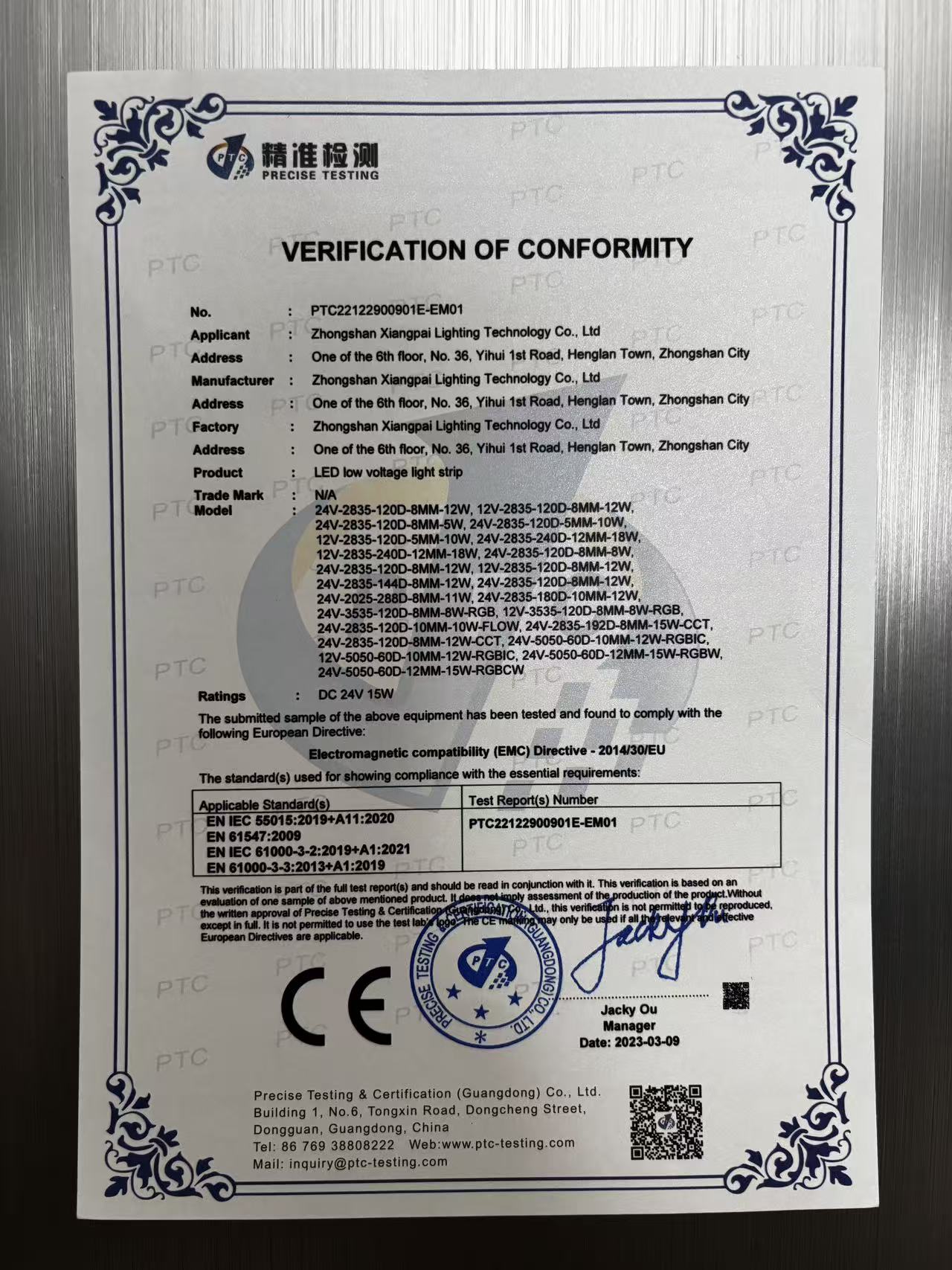
CE EMC documentation for the XPUP LED strip series, issued by PTC TESTING in 2023 and cited in the certification table above.
Future outlook
Three forces are likely to shape how buyers assess suppliers like XPUP over the next planning cycle.
Specification depth will matter more as standardized pricing compresses. Smart bulb average selling prices fell 22% between 2024 and 2025 due to scaled production in Asia, according to Mordor Intelligence. When commodity pricing falls, the suppliers that hold margin are those whose value sits in specifications a buyer cannot easily replicate — a 240-diode-per-meter 9.3 mm linear board, a 48V track luminaire, or an Ra≥97 strip with six selectable color temperatures.
Human-centric and color-quality requirements will keep expanding in regulated markets. With the IECC requiring commercial interior dimming to 10% or lower under the 2024 code, and with Europe already holding 37.4% of the human centric lighting market, the direction is toward fixtures that dim smoothly and render color accurately rather than simply producing light.
Category convergence will reward breadth. Acoustic lighting, magnetic track systems and smart control are converging into single project scopes. The supplier profile that wins those scopes is the one that can supply a linear strip, an accent fixture and the control layer from the same manufacturing base — with a published model number and a document trail for each.
XPUP's stated corporate roadmap through 2028 is to keep focusing on LED strip and linear lighting as a source manufacturer serving European, American and global markets. Whether that roadmap holds is not something a specification sheet can prove. What a specification sheet can prove is whether a given model number describes a real product, built to a stated material and electrical configuration, for a stated environment. On that narrower but more useful test, the three lines examined here hold up.
FAQ
1. What counts as verifiable evidence of an LED supplier's capability?
Verifiable evidence is documentation a buyer can check independently: model numbers that encode real engineering variables such as voltage, chip type, diode density and PCB width; disclosed housing or board materials; internal consistency between voltage, power and diode count; applications specific enough to be tested against the specifications; clearly scoped certification; and stated capacity, MOQ and lead time. For example, DK3-DC24V-2835-240D-9.3mm describes a 24V strip with 2835 SMD LEDs at 240 diodes per meter on a 9.3 mm double-layer copper PCB — every element of the part number corresponds to a stated specification.
2. Which of these three product lines is suitable for museum and gallery lighting?
Two of the three list museums and galleries among their applications, but they are not equivalent. The DK3-DC24V-2835-240D-9.3mm is specified at CRI Ra≥80 and is intended for general architectural linear illumination. The XP-BD18DC24V-2835-140D-8MM is specified at CRI Ra≥97 with six color temperature steps from 2700K to 6000K, which suits color-critical display environments. Both are IP20 products and therefore intended for dry indoor locations only.
3. How does the XP-CX-18 magnetic track light differ from the DK3 in specification terms?
They are different product categories. The XP-CX-18 is a magnetic track luminaire with an aluminum and PC housing, a 48V input, 30W power, CRI Ra≥90, an 8 mm PCB, a 120-degree beam angle and 55–65 lumens per LED, offered in 3000K, 4000K and 6000K. The DK3 is a 24V flexible linear strip rated 15W with 240 diodes per meter on a 9.3 mm double-layer copper PCB, offered in 3000K, 4000K and 6500K at CRI Ra≥80. The XP-CX-18 specification does not publish a diodes-per-meter figure, and the DK3 does not publish a beam angle.
4. What certifications cover these products, and what falls outside their scope?
Three CE-related documents are held, all issued by PTC TESTING for the EU market: CE – LVD under certificate numbers PTC22122900901S-LD01 and PTC22122900902S-LD01 (issued 2023-04-04, citing EN IEC 62031:2020 + A11:2021, IEC TR 62778:2014 and EN 62471:2008); CE – EMC under PTC22122900901E-EMB01 and PTC22122900902E-EMB01 (issued 2023-03-09); and RoHS under PTC22122900903C-EN01 and PTC22122900905C-EN01 (issued 2023-04-23, citing the IEC 62321 series). The stated scope is the LED low-voltage and high-voltage light strip series, and both the DK3 and XP-BD18 models are listed among the associated products. The XP-CX-18 magnetic track fixture is a different product category and is not listed in the available certification data.
5. What are the minimum order quantity, lead time and production capacity for OEM and ODM orders?
Both the OEM and ODM production modes are stated as a 2,000-meter minimum order quantity, an 18–22 day lead time, and a monthly capacity of 3,000,000 meters, with quality control described as 100% testing. Export markets for these modes are listed as the EU, Asia and the US. The OEM customization scope covers voltage, logo, power, dimensions, materials, hardware configuration, internal circuit, color, factory specifications, nameplate and label. The ODM scope covers exterior color scheme, outer packaging box, label, brand information, model name and material details.
6. What after-sales support and warranty apply?
Both production modes include a two-year warranty. Under OEM, the stated support is dedicated technical support, remote debugging and customized parameter guidance. Under ODM, the stated support is online remote support and general technical guidance, with a two-year standard warranty.
The 2026 XPUP LED Strip Catalog, covering the LED strip, linear and magnetic lighting range, is available for download here: 2026 XPUP LED Strip Catalog (PDF). Additional product and capability information is published at www.xpupled.com.