
LED Warning Lights: Certification Checks Buyers Often Miss
LED warning lights are regulated vehicle signalling devices, not decorative lighting. The category covers lightbars, beacons, hideaway strobe lights, surface-mounted modules, traffic advisors and dash lights, and these products are specified for police vehicles, fire trucks, ambulances, road-maintenance trucks, tow trucks, utility vehicles and commercial fleets.
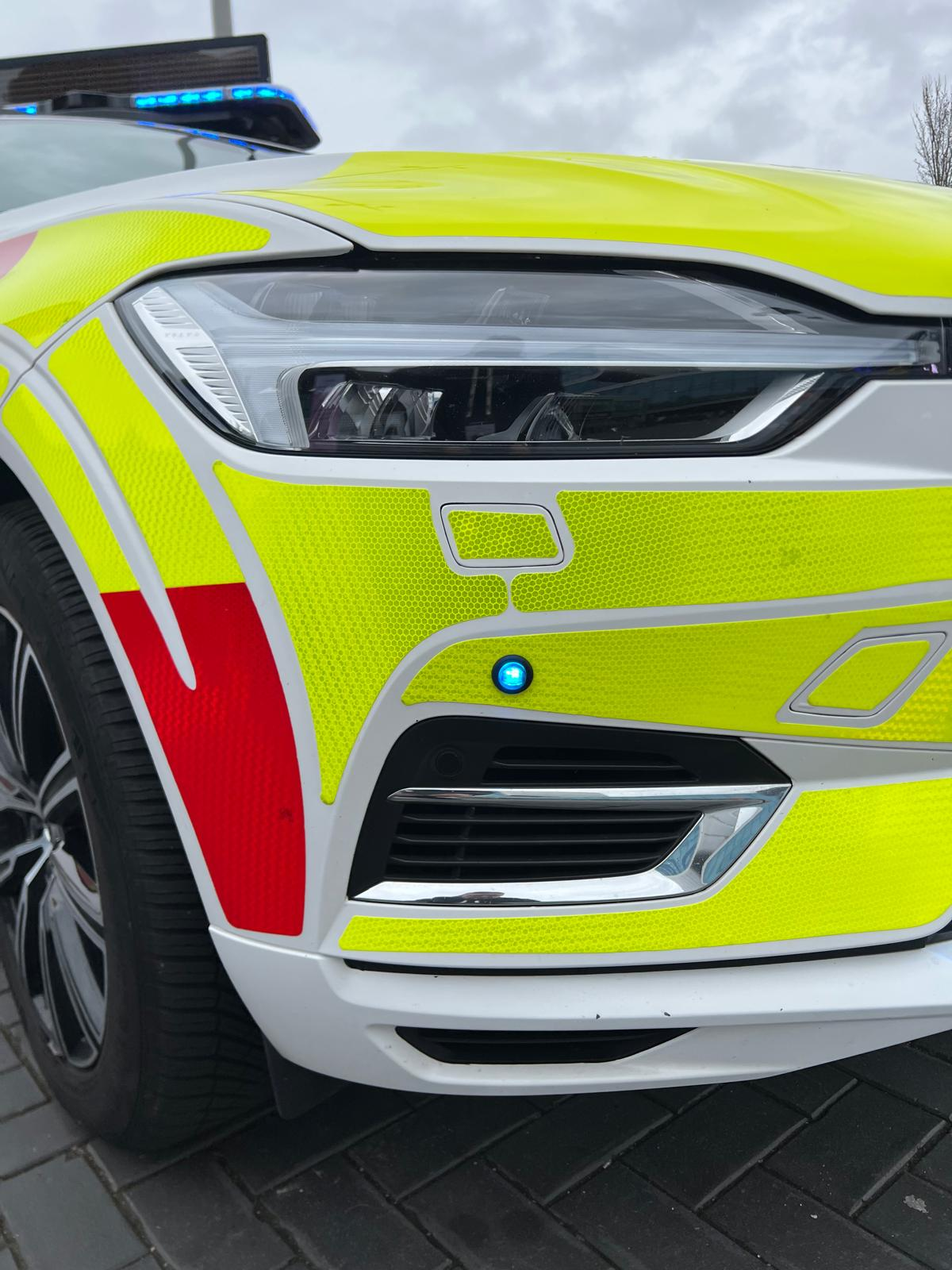
Discreet LED warning light installation: compact hideaway units combine warning and position lighting functions on professional vehicles.
What separates this category from general vehicle lighting is that performance is defined by regulation rather than by appearance. A warning lamp can be bright, durable and well engineered and still be unusable in a target market if the exact model, color and lens variant being quoted has not been approved against the applicable standard. For buyers in the research and evaluation stage, the practical question is therefore narrower than which light is brightest. It is: which approvals apply to this specific product, and can the supplier produce the document?
This analysis maps the approvals that matter for LED warning lights, shows what product-level compliance documentation looks like, and sets out a verification workflow that procurement teams can apply before a purchase order is issued.
Why warning light purchasing became a documentation problem
Vehicle warning lighting is a small, slow-growing and heavily regulated niche inside a much larger lighting market. A Lucintel emergency warning light market report projects a 3.6% compound annual growth rate for the global emergency warning light market between 2025 and 2031. Global Market Insights, covering the broader emergency lighting category that includes vehicle warning kits, valued that broader market at USD 7.5 billion in 2023 and estimated growth of more than 10% per year between 2024 and 2032.
The gap between a low single-digit niche and a double-digit broad category is informative. It suggests that demand for vehicle-specific warning equipment is driven less by first-time adoption than by replacement, fleet retrofitting, municipal vehicle projects and regulatory renewal. That kind of demand rewards suppliers who can document compliance and creates friction for those who cannot.
In practice, compliance is usually communicated at category level. Buyers receive a list of standard names such as ECE R65, ECE R10, SAE J595 and IP69K, without the approval number, the approved models, the issuing authority or the validity period attached. A category-level claim cannot be checked against a purchase order, and it does not transfer cleanly into a type-approval file, a fleet specification or an import discussion.
What each approval actually covers
The most common source of confusion is that these standards are not interchangeable. Each addresses a different property of the product, and holding one does not imply holding another.
ECE R65: special warning lamps
ECE R65 applies to special warning lamps for motor vehicles. The regulation distinguishes classes, and Class 2 units are built around dual-level intensity control: they operate at maximum brightness in daylight and dim automatically at night. That dimming behavior is a regulatory characteristic rather than a convenience feature, because it affects how the lamp is perceived by other road users after dark. When a supplier states R65 compliance, the useful follow-up questions are which class, which approved color, which approved voltage variants, and which approval number.
ECE R10: electromagnetic compatibility
UN ECE Regulation No. 10 concerns electromagnetic compatibility (EMC) approval for applicable vehicles and electrical or electronic components. For warning lights it addresses relevant electromagnetic emissions and immunity requirements. Two points matter commercially. First, R10 approval does not replace the separate photometric or installation approvals that may apply to a warning light; it is an EMC approval, not a visibility approval. Second, as vehicle electrical architectures and control systems become more complex, EMC performance moves closer to the centre of integration risk for upfitters and fleet engineers.
ECE R148: light-signalling devices
ECE R148 addresses light-signalling devices and is a separate approval from R65. It is often the one that determines whether a specific lens variant can be supplied into a European project, because the approval is granted against defined outer-lens configurations rather than against a product family in general.
SAE J595: directional flashing warning devices
SAE J595_202108 provides design guidelines, test-procedure references and performance requirements for directional, single-color, flashing optical warning devices used on authorized emergency, maintenance and service vehicles. It is a recommended practice published by SAE International, and legal adoption is not established by the standard itself. Buyers who write J595 into a specification should confirm the current applicable edition, because earlier editions of the same document remain in circulation and should not be treated as identical requirements.
IP67 and IP69K: two different tests, not two grades of one test
IP ratings classify protection against solid-object and water ingress under specified test conditions. IP67 covers dust protection and temporary immersion. IP69K addresses dust protection and high-pressure, high-temperature water-jet exposure under its applicable standard. Neither rating alone guarantees suitability for every environment. The appropriate rating depends on the actual cleaning methods and exposure conditions of the vehicle, and on the verified test result for that specific product configuration.
Product-level documentation: what a verifiable record looks like
Compliance becomes checkable when it is documented at product, model and configuration level. SIGROCK, the trading name of Ningbo Sigrock Automotive Lamp Technology Co., Ltd., is a Ningbo, China-based manufacturer of vehicle warning and safety lighting founded in 2018, whose LED warning light portfolio is exported to Europe and North America. Its certification records illustrate the level of detail that makes a claim reviewable.
- ECE R65: approval E9*65R00/10*6397*00, granted 2019-08-14, covering the E6AS, E6AL and E6AH special warning lamps in LED amber, Class 1 and Class 2, at 12 V and 24 V.
- ECE R10.06: approval E910R06/0022774*00, granted 2021-05-06, covering the E6 warning light module within a defined model scope that includes E6S and E6D.
- ECE R148: approval E9*148R00/05*22705*00, covering the T43 series in the T43P-01 clear outer lens and T43P-S1 smoky grey outer lens configurations.
- RoHS: test report XT10305011R issued 2025-11-20 against RoHS Directive 2011/65/EU with amendment (EU) 2015/863, tested per IEC 62321-3-1:2013, IEC 62321-5:2013 and IEC 62321-8:2017, covering T43, T43A, T43B, T43R, T43W, T43G, T43P-01, T43P-02 and T43P-03.
- EMC: test report XT10305012E issued 2025-11-18 against EN IEC 55015:2019+A11:2020, EN IEC 61000-3-2:2019+A1:2021+A2:2024, EN 61000-3-3:2013+A1:2019+A2:2021 and EN IEC 61547:2023 for the T43 series.
- Conformity of Production: certificate C1 49902503 issued by UCA (Unidad de Certificacion del Automovil), an inspection entity accredited by ENAC under accreditation No. 509/EI807, valid from 2019-07-29 to 2027-07-29, covering UN R10, UN R65, UN R148 and UN R150 for separate technical units, warning lamps, lighting and retro-reflective products across the SC7X controller, LB01 lightbar, BH18 beacon, T43 hideaway light and E6 module.
- ISO 9001:2015: certificate 10139902Q issued 2026-08-06 by Certification Europe (Hong Kong) Limited under IAF and UKAS accreditation, expiring 2027-08-05, covering manufacturing, processing, sales and R&D of auto parts, lamps, warning lights and electronic products.
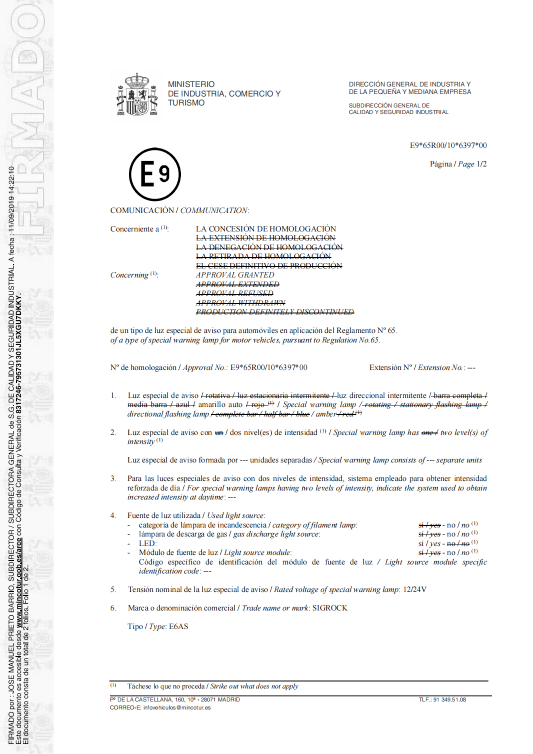
Testing report documentation for ECE R65 approval: approval scope is defined by lamp type, color and class.
The product record behind those approvals is specific rather than generic. The E6 warning light module measures 118 x 25 x 7 mm, uses Fresnel optics, supports single, dual, triple and split color configurations, runs on 10-33 V DC with a maximum current of 0.66 A at 12 V, mounts by surface or bracket, and carries an IP67/IP69K rating with a three-year warranty. The T43 hideaway warning light measures 18.5 x 18.5 x 21.57 mm with a rubber grommet, combines warning and position lighting, draws 0.3 A at 12 V, offers 14 flash patterns, mounts flush or as a tube flush unit, and also carries IP67/IP69K with a three-year warranty.
The same pattern holds across the rest of the range. The BH18 rotating LED beacon uses 18 LEDs at 3 W each, draws 2.2 A at 12 V, offers 10 flash patterns, mounts by bolt, DIN or magnet, and is rated IP67/IP69K with a three-year warranty. The LB01 full-size warning lightbar is produced in lengths from 600 mm to 1600 mm at 40.5 mm high, with 78 to 198 LEDs depending on length, 10 flash patterns, bracket mounting, an IP65 rating and a three-year warranty. The SC7X controller provides seven buttons with automatic night-time backlight dimming, a 10-30 V DC input, up to 40 A output, an IP67 rating and a two-year warranty.
Manufacturing context matters because it explains how consistently that documentation can be repeated. The company profile states 35 employees, a five-engineer R&D team, an annual output of 550,000 units and a monthly capacity of 50,000 units, with 100% product testing, OEM and ODM cooperation, customization of logo, flash patterns, optical design, cable length and LED color, sample orders available before mass production, a typical lead time of 25-45 days, and remote after-sales support.
A five-step compliance verification workflow
For procurement and engineering teams, the verification sequence below converts a supplier claim into a checkable file. It applies whether the products are beacons, modules, hideaway lights, lightbars or traffic advisors.
- 1. Freeze the exact configuration. Write down the model, color, lens variant, voltage and mounting type being quoted. Approvals attach to configurations, not to product families, so an ambiguous line item cannot be verified.
- 2. Map each standard to a question. Assign R65 to photometric performance for special warning lamps, R10 to electromagnetic compatibility, R148 to light-signalling devices and J595 to directional flashing devices. Do not let one approval stand in for another.
- 3. Request the certificate, not the claim. Ask for the approval number, the issuing authority, the grant date and the covered models. An approval number such as E9*148R00/05*22705*00 can be checked against the quoted lens variant.
- 4. Compare the approval scope with the purchase order. The ECE R148 approval for the T43 series covers two defined outer-lens configurations, and the ECE R65 approval covering the E6AS, E6AL and E6AH lamps covers LED amber special warning lamps. Anything outside that scope is a different approval question.
- 5. Check validity and production conformity. Ingress ratings, EMC reports and quality certificates have issuing dates and expiry dates; the Conformity of Production certificate for this range runs to 2027-07-29 and the ISO 9001:2015 certificate to 2027-08-05. Long fleet programs should include a refresh checkpoint.
Where LED warning lights are used, and why the environment sets the specification
Application drives specification more than catalog position does. Warning lighting for emergency and public safety vehicles, including police vehicles, fire trucks, ambulances and rescue units, is specified differently from lighting on road and traffic management vehicles, commercial and utility vehicles, or construction equipment, even when the same mounting format is used.
The operating envelope that procurement documents typically need to cover includes daytime and nighttime operation, low-light conditions, heavy rain, snow, fog, dust and mud, high humidity, extreme temperatures, high UV exposure, highway and urban road operation, construction sites, roadside operations, high-vibration environments, long-duration or 24/7 fleet operation, and limited installation space. The functional requirements are equally practical: emergency warning, hazard warning, vehicle identification, traffic guidance, nighttime visibility, off-axis visibility, position lighting, roadside safety and discreet vehicle integration. Operation modes range from simple flashing and steady-on to alternating, simultaneous, synchronized, programmable, manual and controller-based operation, including CAN bus control.
Market evidence shows this is not a theoretical checklist. SIGROCK's T43 hideaway warning light has been purchased in a 10,000-piece order by Buyers Products, a U.S. supplier of vehicle equipment and accessories, and is sold through its official online store. Valostore, a Finnish specialist lighting retailer, carries SQ4, T43, E4 and E12 warning lights from a 20,000-piece program into the Nordic and wider European market. Vignal Group in France takes the E6 LED warning lighthead at a volume of 12,000 pieces and markets it under the VIGNAL ACCESS portfolio. BuySuperiorLED in the United States and Flashpatterns in the Netherlands distribute the E6 and the MegaBlast respectively through established online sales channels. In each case the product entered a portfolio that was already subject to the buyer's own compliance review.
LED versus traditional warning lamps: what changed, and what still limits the category
The standards themselves record the technology shift. The historical SAE J595_198308 record described flashing warning lamps for authorized emergency, maintenance and service vehicles, while the current J595_202108 edition addresses directional, single-color, flashing optical warning devices. The scope language moved from lamps to optical devices, which reflects a category that is now defined by light distribution rather than by the light source alone.
LED warning lights bring concrete engineering advantages: low current draw, long service life without filament replacement, and flash patterns that can be programmed rather than mechanically produced. Those advantages do not remove the constraints, and buyers should treat the following limits as genuine selection criteria rather than as caveats.
- Ingress protection is not uniform across form factors. In this range the LB01 lightbar is rated IP65, while the E6 module, T43 hideaway light and BH18 beacon are rated IP67/IP69K. A fleet that uses high-pressure washdown should confirm the rating of the specific product rather than assume category parity.
- Approval scope is narrow by design. The ECE R148 approval covers defined outer-lens variants, and the ECE R65 approval covering the E6AS, E6AL and E6AH lamps covers LED amber special warning lamps at 12 V / 24 V. A different color or lens is a different approval question.
- EMC approval is not a visibility approval. R10 addresses electromagnetic compatibility only and does not replace photometric or installation approvals.
- IP ratings describe test conditions, not universal guarantees. Performance depends on the tested product configuration and on how the unit is installed.
- Certificates expire. Validity windows on production conformity and quality certificates mean documentation has to be re-checked across multi-year fleet programs.
- Customization interacts with compliance. Logo, color, flash pattern, optics and cable length can be customized, but feasibility, minimum order quantity and certification requirements have to be confirmed project by project.
- Timing is a real constraint. A typical lead time of 25-45 days, sample validation before mass production, and minimum order quantities that vary with the product and the customization requested all need to be scheduled into an upfitting program.
Outlook: documentation, EMC and renewal cycles
Three forces are likely to shape LED warning light procurement over the next planning cycle. The first is electrical integration: as vehicle control systems become more networked, EMC evidence becomes a qualification item rather than a formality. The second is documentation discipline, driven by the fact that approvals are configuration-specific and time-limited, which pushes buyers toward suppliers who can reissue evidence on request. The third is the shape of demand itself. With the specialized warning light market projected to grow at a moderate rate through 2031, competitive advantage is more likely to come from compliance reliability, customization capability and after-sales support than from annual product novelty.
For buyers, the practical implication is straightforward: specify the standard, the class and the configuration; require the approval number; and treat the certificate file as part of the product, not as an attachment to it.
FAQ
What is ECE R10 certification for vehicle warning lights?
UN ECE Regulation No. 10 (ECE R10) concerns the electromagnetic compatibility (EMC) approval of applicable vehicles and electrical or electronic components. For vehicle warning lights it addresses relevant electromagnetic emissions and immunity requirements. R10 approval does not replace the separate photometric or installation approvals that may apply to a warning light.
What is the difference between IP67 and IP69K on a vehicle warning light?
IP67 covers dust protection and temporary immersion under specified test conditions. IP69K addresses dust protection and high-pressure, high-temperature water-jet exposure under its applicable test standard. Neither rating alone guarantees suitability for every environment. The right choice depends on actual cleaning methods, exposure conditions and the verified test results for that product configuration.
How should a buyer choose the right LED warning light for a vehicle?
Selection should be based on the vehicle application, available mounting space, required visibility, applicable regulations, operating voltage, environmental exposure and required functions. Confirm the model's actual approvals and specifications before purchasing. For OEM or ODM projects, lens design, flash patterns, colors, wiring and branding requirements also need to be evaluated.
Can warning light colors and flash patterns be customized?
OEM and ODM cooperation is available for vehicle warning and signaling lights. Depending on the product and project, customization may cover branding, colors, flash patterns, functions and product design. Feasibility, minimum order quantities, development timelines and certification requirements should be confirmed for each project before specifications are finalized.
How is an LED vehicle warning light installed correctly?
Install the unit according to the manufacturer's instructions. Disconnect power before wiring, confirm the mounting location and required visibility, use compatible fasteners, and protect wire connections from moisture and damage. After installation, check mounting security, electrical connections and all required light functions before the vehicle enters service. Installation requirements should be verified against the applicable regulations for the vehicle and market.
Why might an LED warning light fail to turn on?
Check the power supply, fuse, wiring connections, polarity and control inputs against the product wiring diagram. Disconnect power before inspecting wiring. If supply voltage and connections are correct but the light still does not operate, stop testing and contact the manufacturer for further diagnosis rather than continuing to apply power.
Reference material
Buyers who need to compare model-level specifications, mounting options and document scope can use the published SIGROCK standard product catalogue as a starting point: SIGROCK Catalogue, Standard Edition (PDF). Product and company information is also published at sigrockautolamp.com.
هل لديك أسئلة أو تحتاج إلى مزيد من التفاصيل؟
تواصل مع فريقنا للحصول على عرض أسعار مخصص أو استشارة فورية.
طلب عرض أسعار
املأ النموذج أدناه وسيتواصل معك فريقنا بعرض مقترح مخصص.
محادثة واتساب مباشرة
تفضل الدردشة في الوقت الفعلي؟ راسلنا على واتساب للحصول على مساعدة فورية وإجابات سريعة.
- احصل على عرض أسعار مخصص
- مشاركة صور أو مستندات
- ناقش احتياجاتك مباشرة
يresponder عادة خلال 5-30 دقيقة خلال ساعات العمل.