
LF6801, LG7801 or LY1804? Three PVC Film Ranges Compared
LF6801, LG7801 or LY1804? Three PVC Film Ranges Compared
Marble-grain, Japanese-style wood-grain and standard self-adhesive PVC film are frequently shortlisted together because they share a roll format, an adhesive system and a comparable installed cost, yet each is chosen for a different visual job. This buyer comparison sets three ranges from leiyegaoke — the brand of Foshan Nanhai Jiadamei Decoration Material Co., Ltd, a Foshan-based manufacturer of self-adhesive PVC decorative film founded in 2001 — against each other on the criteria that decide a specification: appearance realism, surface finish, application fit, cleaning behaviour, minimum order terms and roll-to-roll consistency.
The practical answer is a three-way split. Marble-grain film is the stronger choice when a surface should read as stone — vertical panels, cabinet fronts, reception and feature surfaces — and when the buyer can plan pattern continuity across adjacent panels. Wood-grain film suits joinery-led interiors where doors, frames and panels are meant to look like a coordinated timber finish, and it rewards early decisions about grain direction. The standard range carries the plain, pattern-free work that makes up much of a renovation: large wall runs, replacement panels and multi-surface jobs where colour consistency and coverage matter more than imitation. Because all three ranges are built on the same 0.16 mm film, 1240 mm width, 50 m roll and water-based acrylic pressure-sensitive adhesive on a paper release liner, the selection turns on appearance, finish and order terms rather than on a different installation method.
Why the comparison is not simply a colour decision
Buyers usually begin with a swatch deck and a roll price, but the result of a film decision is settled later, at the join. Three factors separate a clean installation from a patchy one: how the pattern repeats across neighbouring panels, how closely rolls from different production runs match, and how much material is lost to pattern matching and rework. That is why a comparison of marble-grain, wood-grain and standard film has to weigh order terms alongside appearance.
Consistency is the least visible and most expensive variable. For interior renovation PVC decorative film, a perfect single sample proves very little if the tenth roll arrives a shade lighter. The manufacturer states a colour deviation of ΔE ≤ 2.0 and a thickness tolerance of ±0.01 mm across its film output; in a multi-roll order, a declared tolerance is more useful to a project manager than one flawless sample, because it describes what will be repeated rather than what was once achieved.
The shared baseline behind LF6801–LF6830, LG7801–LG7836 and LY1804–LY1869
Before the ranges are separated, it helps to record what does not differ. The table below lists the attributes common to all three families; none of them can justify choosing one range over another.
| Shared attribute | Specification | What it means for the buyer |
|---|---|---|
| Film thickness | 0.16 mm | A wrapping-weight decorative film; substrate smoothness still governs the final look. |
| Roll width | 1240 mm | Covers typical cabinet and panel widths with few seams; wider surfaces need planned joins. |
| Roll length | 50 m | Coverage is calculated per roll, and offcuts remain usable on smaller panels and doors. |
| Release liner | Paper | Keeps the film flat through measuring, cutting and initial positioning. |
| Adhesive | Water-based acrylic, pressure-sensitive | Adhesion depends on a clean, dry and stable substrate rather than on pressure alone. |
| Minimum order | 1 roll per colour | Small sample-led or repair orders are possible without committing to a full pallet. |
These six attributes are identical across the three ranges, so any claim that one of them makes a particular range easier to install does not follow from the specification. What changes is what the film is asked to look like — and how many rolls have to agree with each other.
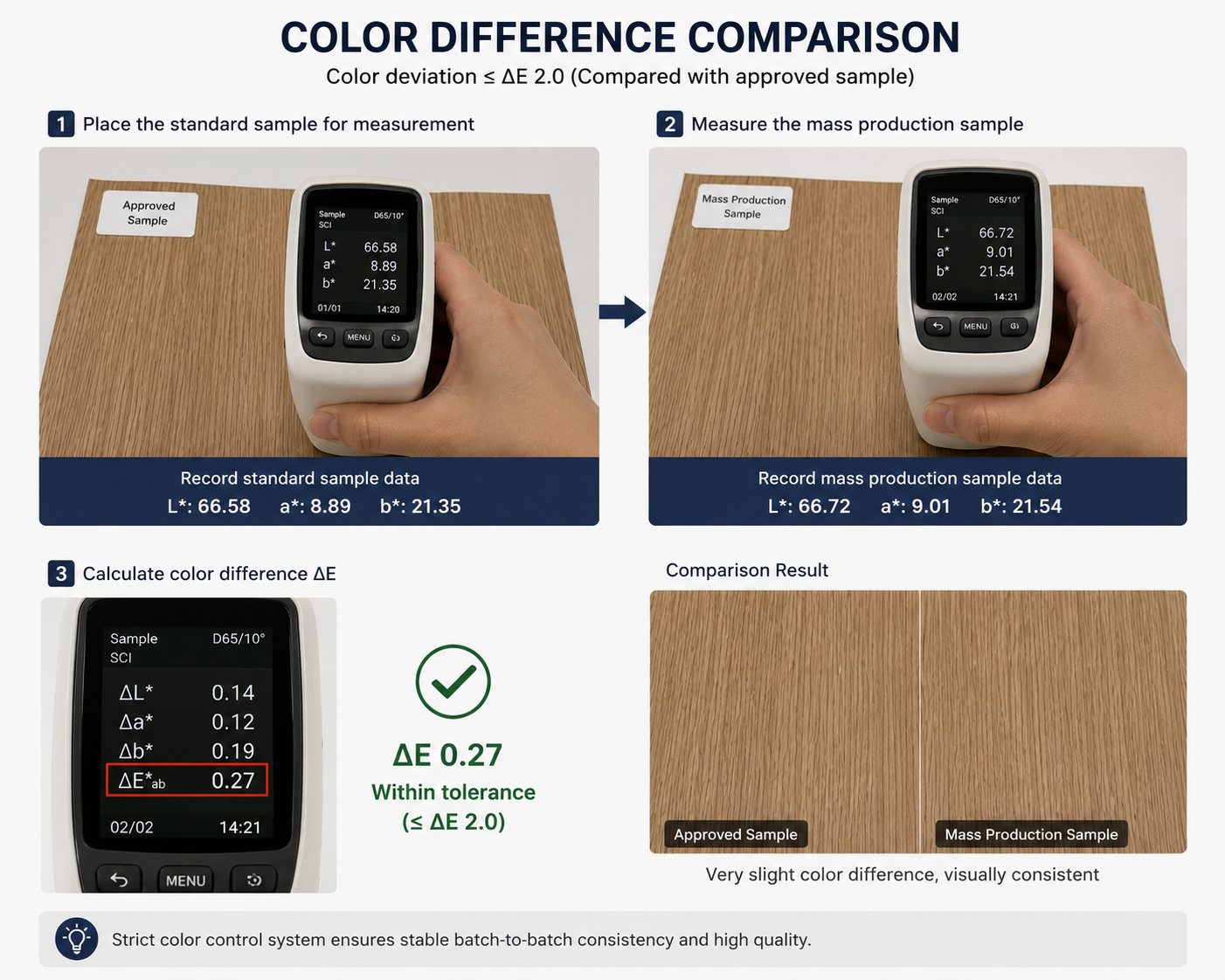
Colour deviation between rolls, not a single sample, decides whether a multi-roll interior installation looks uniform.
Marble-grain LF6801–LF6830: stone appearance without stone handling
Marble-grain PVC decorative film is selected when a surface should carry the visual authority of stone but cannot take the weight, thickness or fabrication time of a stone slab. The LF6801–LF6830 range reproduces marble veining on a flexible, self-adhesive film, which allows a designer to apply a stone reading to cabinet doors, wall and column panels, feature walls, furniture facades, and reception or hospitality surfaces without altering the substrate.
Where the range earns its place is on vertical and light-use surfaces that are seen at close range. Veining is directional and visually continuous, so the buyer's job starts before installation: agree the panel layout, decide where the pattern breaks at corners and cabinet divisions, and request that consecutive rolls come from the same production batch. This is a verification step rather than a product claim; it costs one email and prevents the most common marble-film complaint, which is a visible change of tone between two adjacent panels cut from different rolls.
Finish choice alters the reading of the same pattern more than buyers expect. A gloss surface deepens the contrast of the veins and suits polished-stone references; a matte surface reduces reflections in rooms with strong lighting; a textured surface adds a tactile quality closer to honed stone. These are aesthetic decisions, and the sensible approach is to view all three finishes on a full panel rather than on a small swatch.
Fit boundary: marble-grain film reproduces an appearance, not the mechanical behaviour of stone. Heavy-wear horizontal work surfaces that would normally be specified in stone — where heat, cutting and abrasion are routine — sit outside what a 0.16 mm decorative film is intended to do. Use it where the job is decoration of a stable vertical or light-use surface.
Japanese-style wood-grain LG7801–LG7836: joinery-led interiors
Wood-grain PVC decorative film exists for projects where the visual logic is timber: matched doors, frames, wardrobe fronts, cabinet runs and wall panels that should read as one family of materials. The Japanese-style designation in the LG7801–LG7836 range describes a restrained, low-contrast grain character associated with warm minimal interiors; it is a styling description, not a wood-species specification, and buyers comparing it with a natural timber sample should treat it as a reference tone rather than a match guarantee.
Grain direction is the decision that separates a convincing wood-grain installation from an obviously wrapped one. Doors hung side by side should run grain the same way; a tall wardrobe and the wall panel beside it need an agreed direction before the first cut; horizontal drawer fronts below vertical doors need a deliberate break rather than an accident. Because the film is supplied in a 1240 mm width and 50 m rolls, the layout can usually be planned to keep grain continuous across a run, but the planning has to happen before cutting, not after.
The same range also supports the finish language buyers ask for in this category. A matte or low-gloss finish reads as an oiled or softly lacquered timber and is the more forgiving choice in bright rooms; a textured finish adds a hand-feel that reduces the flatness of a printed grain; a gloss finish pushes the surface towards a lacquered-joinery look. All three are appearance decisions, and each should be judged on a full door panel under the project's actual lighting.
The boundary here is honest and simple: film is not timber. Seams and edges remain the places where a wrap is judged, and a wood-grain pattern cannot fully disguise a poorly aligned joint. Where a project's value rests on joinery details being visible and physical, film is a refurbishment tool rather than a replacement for solid woodwork.
Standard LY1804–LY1869: the plain, general-purpose range
The standard LY1804–LY1869 range is the option in this comparison that is not defined by a stone or wood imitation, so its selection logic is different from the start. It is chosen when the brief calls for a clean, unpatterned surface — a solid colour rather than a simulation — and when the priority is coverage, uniformity and predictable planning across a large or mixed area.
Plain surfaces are where this range is most efficient. There is no grain direction to respect and no vein to align, so cutting plans are simpler, offcuts are more reusable and a multi-surface job can proceed without panel-by-panel pattern decisions. That makes the standard range a practical answer for broad wall runs, replacement panels, mixed furniture sets and interior surface refurbishment where the goal is to refresh rather than to imitate. Furniture renovation PVC decorative film used as a plain colour also allows a project to unify mismatched existing pieces under one finish instead of replacing them.
The trade-off is that a plain surface has nowhere to hide. Substrate defects, sanding marks, seam lines and edge lifting are more visible on an unpatterned film than on a busy marble or directional wood print, so surface preparation becomes more important, not less. Buyers who choose the standard range for speed should budget the same care for filling, sanding and cleaning that a patterned job requires — the difference is that mistakes are easier to see afterwards.
Side-by-side comparison on buyer-relevant dimensions
The table below compares the three ranges on the criteria that most often decide a specification. It is a fit comparison, not a ranking: no range is better in general, and each one is the weaker choice outside the surfaces it was designed for.
| Dimension | Marble-grain LF6801–LF6830 | Wood-grain LG7801–LG7836 | Standard LY1804–LY1869 |
|---|---|---|---|
| Visual role | Stone imitation with directional veining | Timber imitation with directional grain | Plain decorative surface without imitation |
| Surfaces where it fits best | Vertical panels, cabinet fronts, feature and reception walls | Doors, frames, wardrobes, cabinet runs, wall panels | Broad wall areas, replacement panels, mixed furniture sets |
| Finish options | Matte, gloss or textured | Matte, gloss or textured | Matte, gloss or textured |
| Main planning constraint | Vein continuity and batch matching between rolls | Grain direction and seam alignment across panels | Substrate preparation and colour uniformity |
| Routine cleaning | Soft cloth with water or mild neutral detergent | Soft cloth with water or mild neutral detergent | Soft cloth with water or mild neutral detergent |
| Order terms | 1 roll per colour; OEM colour, pattern, size, packaging | 1 roll per colour; OEM colour, pattern, size, packaging | 1 roll per colour; OEM colour, pattern, size, packaging |
| Main watch-out | Not a stone substitute on heavy-wear horizontal surfaces | Joints and edges remain visible on close inspection | Shows substrate defects and seams more readily |
Matte, gloss and textured: how finish changes the decision
All three ranges are offered in matte, glossy and textured finishes, which means finish is a separate decision from pattern and should be made with the room in mind rather than with the swatch alone. A gloss surface reflects light and shows fingerprints and cleaning marks more readily; a matte or low-gloss surface, including the super-matte style of finish buyers often request for quiet interiors, reduces reflection and tends to hide handling marks; a textured surface introduces a physical grain that masks minor substrate unevenness and reads as a more tactile material.
Two further requests appear often enough to deserve a rule. Where a brief specifies an anti-scratch surface or a super-matte finish, that requirement belongs to the specific grade and should be confirmed against the grade's own documentation rather than inferred from the range name or from a similar-looking sample. Finish, pattern and performance additives are separate attributes, and a buyer who needs one of them should ask which grade carries it.
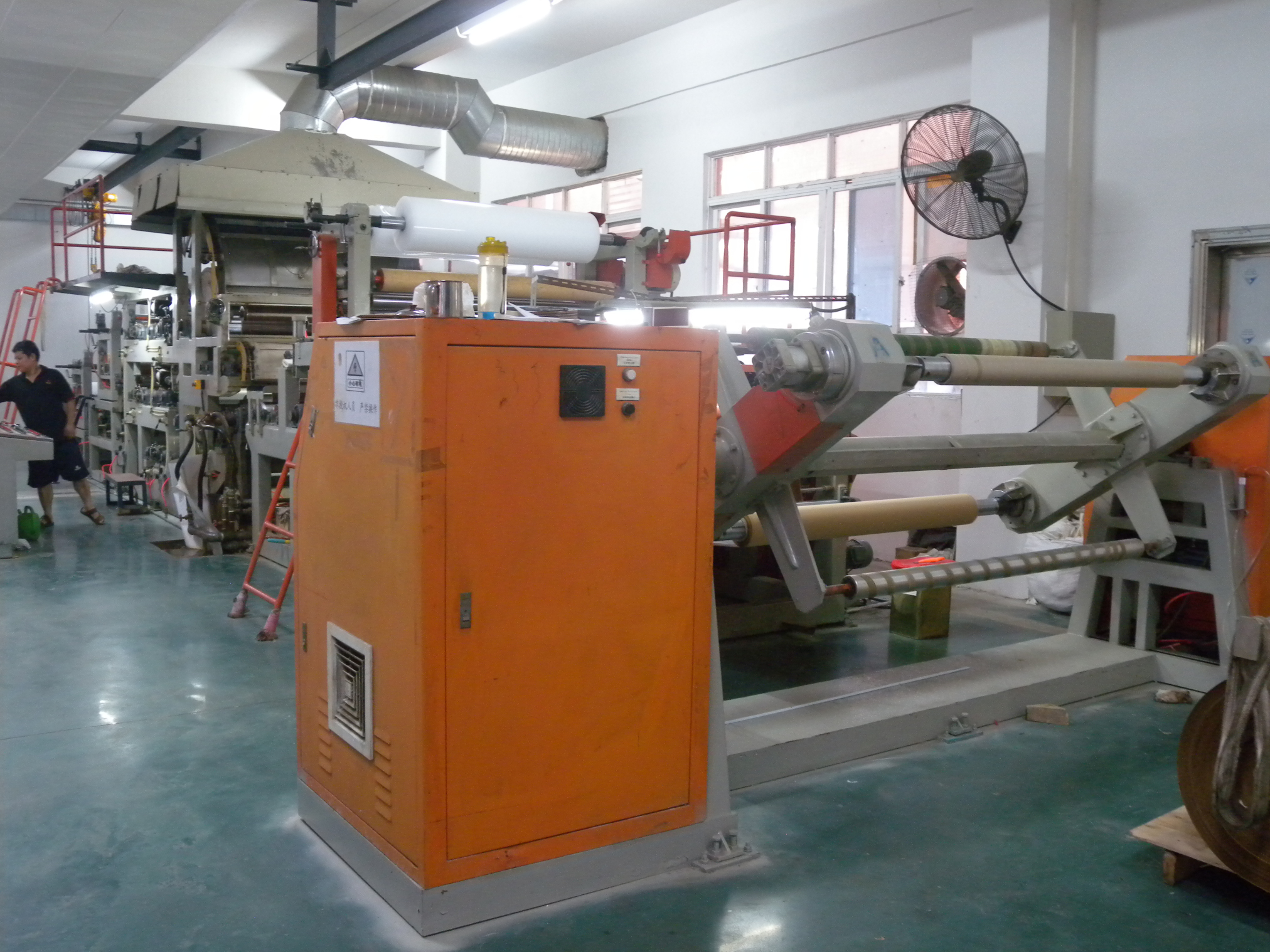
Thickness tolerance and colour control are process outputs; the conversion line, not the swatch, determines roll-to-roll agreement.
Water resistance, cleaning and bathroom use
The PVC surface of these films is water-resistant and easy to clean, which is why cabinet wrap PVC film is commonly used in kitchens and why bathroom waterproof PVC film is a frequent search term. The honest qualification matters here: the film surface resists water, but the edges, joints and the substrate underneath should not be continuously exposed to water or excessive moisture. Water resistance is a property of the decorative surface, not a waterproofing system for the building element beneath it.
Routine maintenance is straightforward and does not require specialist products. Remove loose dust with a soft dry cloth; wipe normal marks with a soft damp cloth; for grease or stubborn dirt, use a mild neutral detergent diluted in water, then wipe again with a clean damp cloth to remove residue and dry with a soft cloth. Any unfamiliar cleaning product should be tested on a small hidden area first, because aggressive solvents can dull a decorative surface in a way that cannot be polished out.
In bathrooms, the same logic applies with tighter conditions. Confirm that the substrate is stable and dry before application, plan how edges around basins, splash zones and panel ends will be finished, and avoid designs where water can stand against a cut edge. Where a project's moisture exposure is persistent rather than incidental, a decorative film should be treated as the visible layer over a properly prepared and protected substrate.
Installation: substrates, bubbles and edges
Self-adhesive PVC decorative film is recommended for smooth, clean, dry and stable interior surfaces such as furniture panels, cabinets, doors, metal, glass and properly finished boards. Rough, dusty, oily, damp, porous or unstable substrates reduce adhesion and affect the final appearance, producing bubbling, edge lifting, peeling or an uneven surface. Cleaning and drying the substrate, removing dust, oil and loose material, and testing a small area when the substrate is uncertain are the steps that prevent most callbacks.
Bubble-free application is a technique question before it is a product question. Apply the film gradually, use a squeegee to push trapped air out ahead of the liner, and remove the release liner step by step rather than peeling it away in one movement. Air-release film constructions exist in the market — a release liner and adhesive structure with micro air channels that let trapped air escape more easily — and they make large-area work more forgiving. The three ranges described here share a paper release liner and a water-based acrylic adhesive, and the supplied material does not present them as air-release films, so on these ranges the burden of a clean finish sits with surface preparation, squeegee discipline and the order in which panels are applied.
Installed cost, not roll price
A roll price is a poor proxy for the cost of a film decision. The manufacturer describes its film as a cost-effective renovation route with low installation cost, low labour cost and low renovation cost relative to replacement-based alternatives, and that framing is only meaningful when the comparison is made on the same basis: material plus labour plus waste plus the cost of redoing a panel that does not match.
On that basis, the three ranges diverge in predictable ways. A plain standard-range surface usually produces the least cutting waste and the fewest planning hours. A directional wood-grain adds layout time because grain must be respected. A marble-grain adds both layout time and batch-matching discipline, because a visible tone shift between adjacent panels is the failure mode that forces rework. None of these differences is large in material terms; all of them are large in labour terms on a project with dozens of panels.
Consistency and supply terms behind the three ranges
For a buyer comparing ranges rather than single samples, the supplier's production structure is part of the specification. Foshan Nanhai Jiadamei Decoration Material Co., Ltd operates a 12,000 m² facility with two adhesive coating lines and an integrated process covering film production, printing, laminating, adhesive coating, slitting, inspection and packaging, with an annual output of 15,000,000 meters, 50 employees and a five-engineer development team. That structure is what makes a stated colour deviation of ΔE ≤ 2.0 and a thickness tolerance of ±0.01 mm meaningful across consecutive orders rather than only within one batch.
Order terms are equally practical. The ranges are offered from 1 roll per colour, which allows a contractor to test a finish on a real door before committing, and OEM and ODM support covers customized colours, patterns, thicknesses, roll sizes, adhesives, release papers, labels, cartons and private-label packaging. Roughly 80% of output is exported, with Europe, South America, the Middle East and CIS countries among the main markets, and the company states that its products comply with relevant international requirements including REACH and RoHS — documentation that overseas buyers should request for the exact grade and destination market rather than assume from a general statement.
Where the category sits: third-party market signals
External estimates help position the three ranges without deciding between them. Dataintelo's PVC Decorative Film Market Research Report 2034, published in April 2026, values the global PVC decorative film market at USD 4.8 billion in 2025 and projects USD 8.6 billion by 2034; the same report estimates that the wood-grain product type held the largest segment share at 38.4% in 2025 and that the furniture sector accounted for approximately 44.6% of global consumption. These are commercial research estimates covering a category broader than the three ranges compared here, so they indicate where demand is concentrated, not how a specific product line will perform.
A separate trade record adds a supply-side signal: International Trader Publications reported in January 2026 that China became the world's largest PVC exporter in 2025, accounting for 24% of global trade volume. For buyers, that is relevant to origin and lead-time assessment rather than to product choice — a reminder to confirm the producing entity, the documentation trail and the batch record behind any quotation, whichever range is selected.
A six-point selection framework
- Start from the surface, not the sample. Vertical, light-use surfaces accept any of the three ranges; heavy-wear horizontal surfaces sit outside the intended use of a 0.16 mm decorative film.
- Decide whether the brief asks for imitation or plainness. Stone and timber readings belong to the marble-grain and wood-grain ranges; a clean unpatterned result belongs to the standard range.
- Check the planning constraint the pattern creates. Vein continuity for marble-grain, grain direction for wood-grain, substrate preparation for standard.
- Choose finish under real lighting. Matte, gloss and textured versions of the same pattern behave differently in a bright room; judge on a full panel.
- Confirm consistency terms before the order. Ask for batch-matched rolls on multi-panel jobs, and treat stated colour and thickness tolerances as the basis for acceptance.
- Match the grade to the added requirement. Anti-scratch, flame classification or a specific moisture exposure should be confirmed for the exact grade, not inferred from the range.
What this comparison cannot establish
This is a comparison of documented characteristics, not a laboratory trial. It does not establish that one range outperforms another in service, that any finish will remain unchanged over a given number of years, or that a film will perform like the stone or timber it imitates. The specifications cited are the manufacturer's stated values, and the market figures are third-party estimates with their own scope and dates. Buyers with critical requirements should verify through their own route: a full-panel sample in the actual finish, a batch-matched roll set for multi-panel work, the compliance documentation for the exact grade and destination, and a test application on the real substrate before full commitment.
Outlook
If the Dataintelo projection holds, category growth through 2034 will keep pressure on suppliers to offer more finishes from fewer production platforms — which is broadly consistent with a model in which one adhesive and liner system supports marble, wood and plain patterns, and differentiation shifts to colour control, finish range and order flexibility. That is an interpretation, not a forecast of any single product line's sales. For buyers, the practical implication is modest but useful: the comparison between these ranges is likely to remain a comparison of appearance and planning discipline, so the selection framework above should outlast any individual pattern reference.
FAQ
How should self-adhesive PVC film be cleaned and maintained?
For routine cleaning, use a soft cloth with water or a mild neutral detergent; regular, gentle cleaning helps maintain the decorative surface and appearance. Remove loose dust with a soft dry cloth, wipe normal stains with a soft damp cloth, use diluted mild neutral detergent for grease or stubborn dirt, then wipe again with a clean damp cloth to remove residue and dry with a soft cloth. Test any unfamiliar cleaning product on a small hidden area before use.
Can self-adhesive PVC film be used on kitchen cabinets?
Yes. Self-adhesive PVC decorative film is suitable for renovating smooth kitchen cabinet doors, panels and other interior furniture surfaces, and provides a decorative, water-resistant and easy-to-clean surface as a quick, cost-effective alternative to replacing the entire cabinet. It works best on smooth, clean, dry and stable surfaces such as painted wood, sealed MDF, metal and properly finished furniture panels; rough, dusty, oily or untreated porous surfaces should be prepared first.
Which surfaces accept the film, and which should be avoided?
The film is recommended for smooth, clean, dry and stable interior surfaces, including furniture panels, cabinets, doors, metal, glass and other properly prepared surfaces. Rough, dusty, oily, damp or unstable substrates may reduce adhesion and affect the final appearance, causing bubbling, edge lifting, peeling or an uneven result. Cleaning and drying the surface, removing dust, oil, moisture and loose material, and testing a small area when the substrate is uncertain are the standard precautions.
Is the film waterproof, and can it be used in a bathroom?
The PVC surface is water-resistant and easy to clean, which suits normal kitchen and bathroom-adjacent use. However, edges, joints and the underlying substrate should not be continuously exposed to water or excessive moisture, so a bathroom installation should be planned around stable, dry substrates, finished edges and no standing water against cut edges. Water resistance applies to the decorative surface, not to the building element beneath it.
How can bubbles be avoided during application?
For a smooth, bubble-free finish, apply the film gradually and use a squeegee to push out trapped air while removing the release liner step by step; proper surface preparation is equally essential. Air-release film constructions, which use a liner and adhesive structure with micro air channels, make this easier, while standard adhesive films without air-release channels require more careful application and are more likely to trap air if installed improperly.
Across marble-grain, wood-grain and standard film, the decision reduces to a small number of verifiable questions: which surface is being covered, whether the brief asks for imitation or a plain finish, which planning constraint the pattern imposes, and whether the supplier can hold colour and thickness within declared tolerances across the whole order. Answering those four questions in writing before the first roll is cut is the most reliable way to keep a renovation looking like one installation.
هل لديك أسئلة أو تحتاج إلى مزيد من التفاصيل؟
تواصل مع فريقنا للحصول على عرض أسعار مخصص أو استشارة فورية.
طلب عرض أسعار
املأ النموذج أدناه وسيتواصل معك فريقنا بعرض مقترح مخصص.
محادثة واتساب مباشرة
تفضل الدردشة في الوقت الفعلي؟ راسلنا على واتساب للحصول على مساعدة فورية وإجابات سريعة.
- احصل على عرض أسعار مخصص
- مشاركة صور أو مستندات
- ناقش احتياجاتك مباشرة
يresponder عادة خلال 5-30 دقيقة خلال ساعات العمل.