
LIFTER Garage Door: Supplier Capability and Product Analysis
A manufacturer-level review of a 2017-founded Chinese garage and industrial door producer — what its panel, hardware and cold-chain lines actually indicate for buyers in the research stage.
The global garage door market was valued at USD 14.8 billion in 2025 and is projected to reach USD 24.6 billion by 2034, a compound annual growth rate of 5.8% (Dataintelo, 2026). Growth of that order keeps a steady stream of new suppliers in front of importers, distributors and project specifiers. It also makes supplier screening harder, because at catalogue level most insulated sectional doors look interchangeable: a steel skin, a foam core, a torsion spring, a track.
LIFTER Garage Door is the trading identity of Xuchang Lifter M&E Equipment Co., Ltd., a garage door and industrial door manufacturer established in 2017 and located in the Weidu Industrial Agglomeration Area of Xuchang City, Henan Province, China. The company manufactures residential sectional garage doors, industrial lifting and sliding doors, and cold-chain door and loading-dock equipment, and reports that exports account for 80% of sales, with the EU and USA as its main markets.
This analysis examines the company as a manufacturing entity rather than as a product brochure: what its production footprint supports, where its technical strengths are concentrated, which parts of the range carry real procurement value, and which claims a buyer should verify before committing to a first order.

LIFTER's manufacturing base in the Weidu Industrial Agglomeration Area, Xuchang City, Henan Province, China.
Why garage door sourcing has become a capability question
The technical standards that govern garage doors are unusually well organised, which is both helpful and misleading. The Door & Access Systems Manufacturers Association lists ANSI/DASMA 102-2018 for sectional overhead-type door specifications, ANSI/DASMA 103-2017 for residential sectional-door counterbalance systems, ANSI/DASMA 108-2017 for structural performance under uniform static air pressure, ANSI/DASMA 109-2017 for life-cycle testing, ANSI/DASMA 105-2017 for thermal transmittance and air infiltration, ANSI/DASMA 110-2025 for lifting cables, and ANSI/DASMA 203-2020 for non-fire-rated commercial and industrial rolling doors.
None of those documents certifies a supplier. They define test methods and minimum specifications. A door can be described as 'built to DASMA practice' while the underlying panel density, steel gauge, weld quality on hardware and spring wire grade remain undocumented. That gap is where most sourcing failures originate — not in the visible finish, but in the components that decide whether a door still closes squarely in year eight.
For a buyer at the research stage, the useful question is therefore not 'who sells the cheapest sectional door' but 'which supplier controls enough of the process to keep the specification stable across repeat orders'. Vertical integration, standard coverage on both European and American product architectures, and the ability to supply door hardware alongside the door are the three signals worth checking first.
The manufacturer behind the LIFTER brand
LIFTER is not a trading intermediary assembling third-party panels. Its published company profile describes a facility of 35,000 m², more than 200 employees, an R&D team of 13 engineers, and an annual output of 1,000,000 m² with a stated capacity of 200,000 units — a production rhythm the company describes as one door leaving the line every minute. Those figures are company-reported and should be read as such until a factory audit or third-party inspection confirms them.
| Parameter | Reported detail |
|---|---|
| Legal entity | Xuchang Lifter M&E Equipment Co., Ltd. |
| Established | 2017 |
| Location | Weidu Industrial Agglomeration Area, Xuchang City, Henan Province, China |
| Facility size | 35,000 m² |
| Employees | 200+ |
| R&D team | 13 engineers |
| Annual output | 1,000,000 m²; stated capacity 200,000 units |
| Panel lines | Two fully automatic PU composite panel production lines |
| Export share | 80% of sales |
| Main markets | EU and USA; products delivered to customers in over 100 countries |
| Quality system | 6S quality management; ISO 9001:2015; CE certification; products stated to meet EN13241-1 |
The company's origin is worth noting for context. It was established during the restructuring and development of Xuji Group, with a management and technical team that the company states has worked in the garage door and industrial door industry for more than ten years. That background explains the shape of the portfolio: the company entered through panel manufacturing and expanded outward into industrial doors, cold-chain doors and loading-dock equipment rather than starting as a consumer door brand.
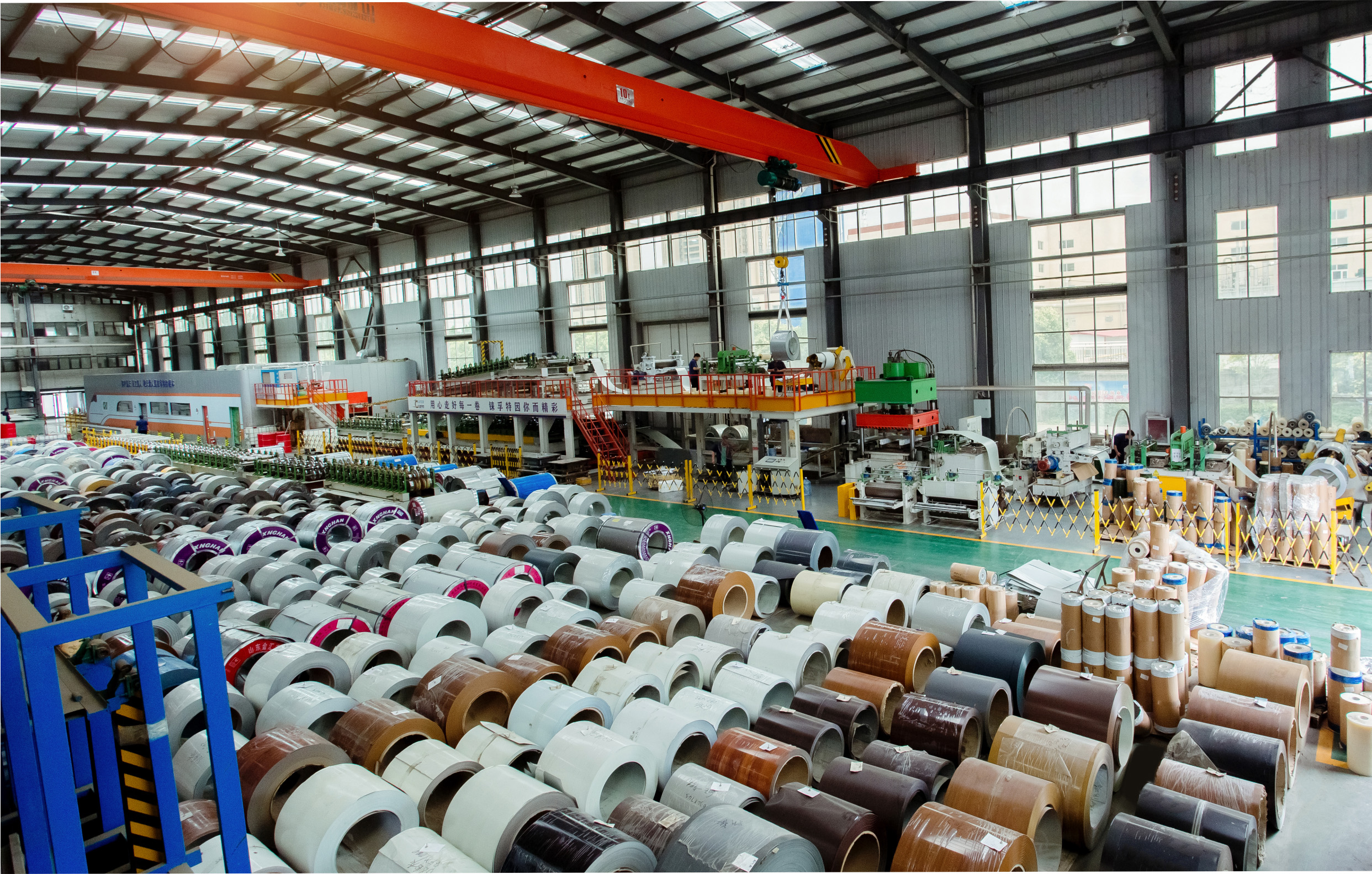
Automatic continuous colour-steel and PU composite panel production line, the core asset behind LIFTER's insulated sectional door range.
Four sources of competitive strength
1. Panel production is in-house, not outsourced
The insulated panel is the single largest cost and performance element in a sectional door. LIFTER runs two fully automatic PU composite panel lines and specifies polyurethane core density by product family: ≥42 kg/m³ for the European-standard residential range, 45 kg/m³ for the American-specification range, and ≥48 kg/m³ for cold room doors and rapid doors. The European panels carry a 16 mm × 1.0 mm steel strip embedded at panel joints, a detail that keeps hinge screws anchored to steel rather than to foam and reduces panel bulging over time. The American carriage house range uses four full-length steel strips per panel for the same reason.
Panel density alone does not determine insulation — closed-cell ratio and cell structure matter as much — but density is a checkable proxy for foam compactness and mechanical strength, and it is one of the first values a buyer should request in writing.
2. Hardware and spring manufacturing sit inside the same operation
Torsion springs are the component most likely to strand a door in the closed position, and they are frequently bought in. LIFTER manufactures its Jiuheng Series torsion springs from 72B, 82B, 60Si2Mn or 55SiCr spring steel wire with a 5.0–12.0 mm wire diameter range, inner diameter tolerance of ±1%, coil clearance under 0.2 mm, and coil count tolerance of ±1%. The company's stated life test result is more than 20,000 cycles without breakage with load loss under 15%, and its stated salt spray result is more than 72 hours neutral salt spray without rust spots, roughly equivalent to three years of service exposure. Electroplated coating thickness is specified at 8–12 μm.
The same operation supplies the garage door hardware kit: torsion springs, tracks, rollers, hinges, cable drums, bottom brackets, bearing plates and shafts. Rollers are nylon with sealed ball bearings; cable drums are cast aluminium; tracks are galvanised steel. For a distributor, hardware supply from the door manufacturer shortens the bill of materials and removes the compatibility guesswork that appears when panels from one source are fitted with hardware from another.
3. Two standard architectures instead of one
European-standard and American-standard garage doors differ in panel geometry, headroom requirements, spring arrangement and hardware conventions. LIFTER maintains both: a European family of 40 mm finger-safe panels in H-Line, stripe, micro-wave, smooth and classic raised-panel textures, and an American family built around 40–50 mm panels, recessed and raised panel profiles, grid windows and carriage-house decorative hardware. Both families are listed with CE EN13241-1 and ISO 9001:2015 certification for the European range, and CE / ISO 9001:2015 with SGS reports available for the American carriage house range.
That dual architecture matters commercially. A distributor serving both a European-standard housing project and a US-specification builder programme can consolidate with one manufacturer instead of running two supply relationships with two sets of documentation.
4. Adjacency into cold chain and loading dock equipment
LIFTER's catalogue extends past the garage door into the whole opening envelope: industrial lifting doors, rapid spiral doors, PVC curtain rapid doors, cold room sliding and swing doors, dock levelers, dock seals and flexible anti-impact barriers. A cold-chain project that needs an insulated door, a sectional door at the dock face, a dock leveller and a dock seal can source all four from one manufacturer, which reduces interface risk at the point where door sealing, dock sealing and vehicle docking meet.
Product architecture: what LIFTER actually supplies
| Family | Representative models and specifications | Primary application |
|---|---|---|
| European-standard residential sectional | H-Line, stripe, micro-wave, smooth and classic raised-panel doors; 40 mm finger-safe panel; PU ≥42 kg/m³; panel heights 450 / 500 / 550 mm; heat resistance −50 °C to +100 °C long-term; corrosion resistance stated at 25–30 years; 200+ RAL colours | Villas, housing communities, European-standard projects |
| American-standard sectional | Flush-panel and carriage-house profiles; 40 / 43 / 50 mm panels; PU 45 kg/m³; R-16.55 at 40 mm; air tightness Class 6 (GB/T 7106); standard openings 2400–5500 mm wide × 2100–3000 mm high, maximum custom 6000 × 3500 mm | US residential, light commercial, builder programmes |
| Glass and full-view | Full glass model with non-thermo-break aluminium frame and 5 mm tempered glass; aluminium-frame model with thermo-break profile and double 5/5 mm tempered glass; steel-aluminium combined doors with insulated steel bottom section | Showrooms, car dealerships, commercial façades |
| Economical residential | Single skin door, 50 × 0.5 mm steel, no PU core, four lifting configurations | Rental properties, budget renovation |
| Industrial lifting doors | Panels 40 / 43 / 50 / 75 mm; maximum width up to 9000 mm; maximum area 60 m²; IP54 control enclosure; Sommer German motors available at 100 Nm and 140 Nm | Factories, warehouses, logistics centres |
| Cold chain doors | Single and double cold room sliding doors to 4500 × 7000 mm and 7000 × 7500 mm; PU ≥48 kg/m³; rated to ≥1 million openings; operating environment to −45 °C; rapid spiral door 0.8–2.5 m/s with K < 0.5 W/(m²·K) | Cold stores, food and pharma facilities |
| Loading dock equipment | Hydraulic tilting and telescopic dock levellers at 6000 / 12000 kg; portable EOD leveller at 6000 kg; inflatable, mechanical and sponge dock seals; flexible bollards and guardrails | Distribution centres, temperature-controlled docks |
The technical variables that actually decide performance
Five parameters separate a door that meets its specification from one that merely looks like it does.
Panel construction and thermal break. A 40 mm panel with a high-density core performs differently from a 40 mm panel with a low-density core, and both behave differently again once a thermal break is introduced at the frame. LIFTER's micro-wave range illustrates the point within a single product family: the 43 mm thermal-break version is documented at a U-value of ≤1.0 W/(m²·K) with sound insulation of R = 22 dB, while the 40 mm finger-safe version carries no published U-value. Buyers comparing quotes should insist on the panel thickness and thermal-break status attached to each price line.
Air infiltration and sealing. Published air tightness of Class 6 to GB/T 7106 on the American flush-panel range, and full-perimeter EPDM sealing, are the values that determine real energy loss at the door. ANSI/DASMA 105-2017 exists precisely because thermal transmittance and air infiltration are separate measurable properties; a supplier quoting insulation without an air-tightness figure has answered only half the question.
Counterbalance life. LIFTER specifies 65Mn high-strength spring steel for the American range with a standard cycle life of 20,000 operations and an optional heavy-duty spring rated at 100,000 cycles. High-frequency commercial openings should be specified at the higher cycle rating from the outset, because a spring replacement is a scheduled cost, not a warranty event. Spring break protection and cable break devices are listed as standard safety features across the European range, alongside a safety track, bottom cover and multi-function lock.
Wind and water performance on industrial and rapid doors. The rapid spiral insulated door is documented at 32 m/s wind resistance, water tightness of ΔP > 700 Pa, air tightness of 0.62 m³/(m²·h) and IP65 protection on the drive, with a counterweight balance system that the company describes as maintenance-free for life. On the industrial lifting door range, the widened galvanised end cap is specified to improve wind-load resistance, and an anti-derail track and safety airbag are available.
Control and integration. The industrial door range offers push-button, pull-cord, remote, geomagnetic, infrared and radar control on an IP54 enclosure, with manual chain release for power failure and an absolute encoder limit switch. For projects where the door must interlock with a dock leveller, LIFTER's dry warehouse sectional door is documented as supporting high-frequency opening with leveller interlock — a specification detail that matters more in a live logistics facility than any finish option.
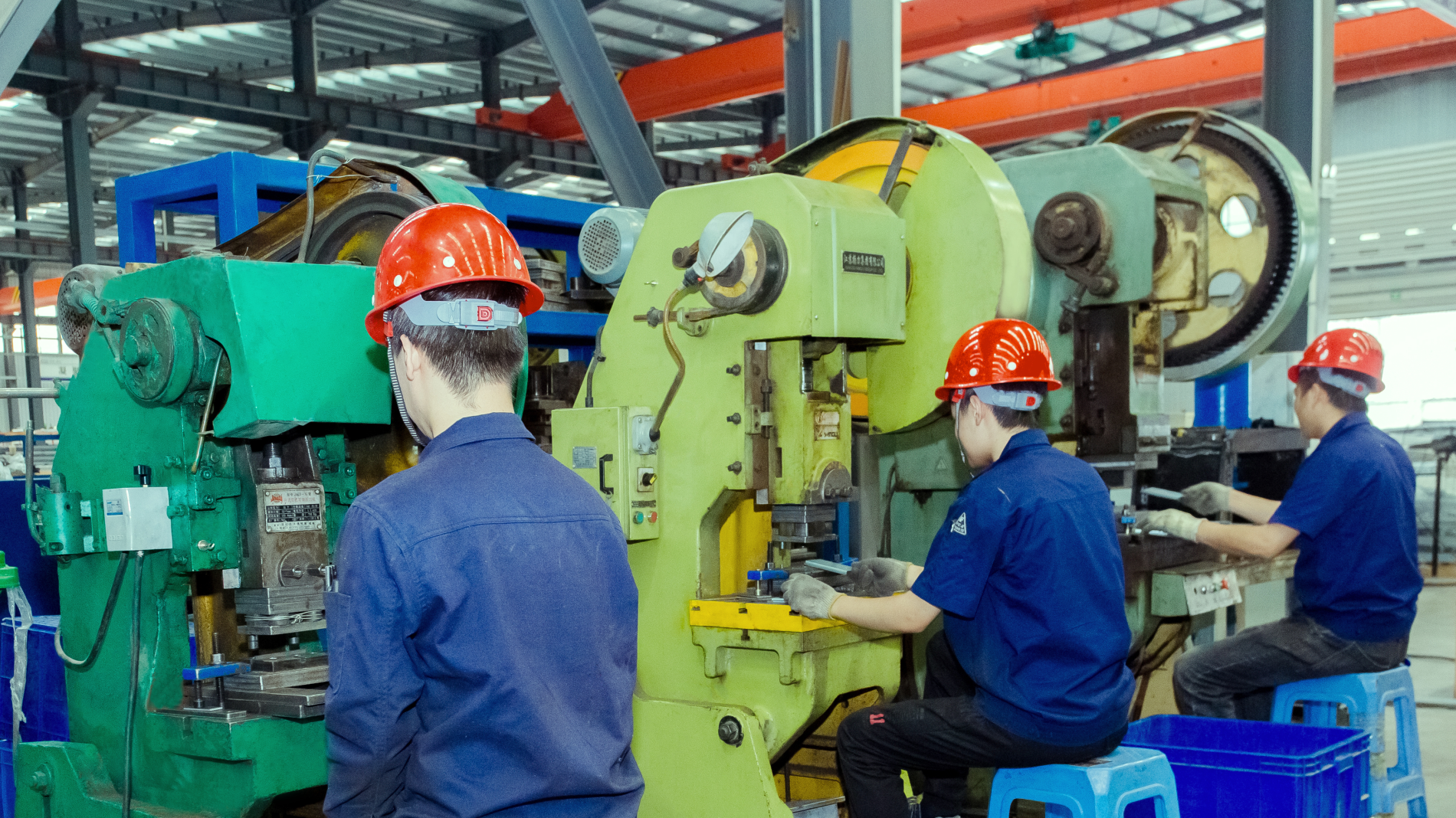
In-house hardware manufacturing: spring and fitting production held to the same tolerance regime as the panels.
Where the range fits, and where it does not
The residential range is the most broadly applicable part of the portfolio. The European H-Line and stripe doors are explicitly aimed at villas, housing communities and European-standard projects; the American flush-panel and carriage-house doors at suburban residential, new home building, renovation and builder-developer programmes. A 10-year panel warranty and a stated lead time of 10–15 working days on standard designs, with a minimum order of one unit, make the range usable for both sample orders and repeat project supply.
The glass and full-view segment serves a different need. Full-glass doors with aluminium frames are documented for car dealerships, showrooms, commercial buildings and high-end villas, where transparency and façade consistency outweigh thermal performance.
The cold-chain and loading-dock segment is where the engineering depth sits, and it comes with clearer boundaries. Cold room doors in the LMT-001 and LMT-002 families are rated to ≥1 million openings at working temperatures down to −45 °C, but both are described as manual in their standard opening method, with motor drive offered as an option — so they suit low to medium-frequency access rather than a forklift-driven throughput environment. The portable EOD leveller DL-003 has a working range of only −100 mm to +100 mm and a 6000 kg capacity, and is positioned by the manufacturer for infrequent handling in facilities without fixed dock equipment; it is not a substitute for a hydraulic leveller at a high-traffic dock.
Market signals shaping buyer expectations
Three data points frame what distributors and specifiers are being asked for.
First, scale. A market moving from USD 14.8 billion in 2025 to USD 24.6 billion by 2034 at 5.8% CAGR implies steady volume growth rather than a spike, which favours suppliers with repeatable production rather than project-by-project capacity.
Second, automation. Automatic mechanisms accounted for 61.5% of the garage door market in 2025, driven by smart-home integration. This shifts part of the buying decision from the door to the operator interface and entrapment protection. In the United States, UL 325 has required two independent entrapment-protection systems on every automatic opener since 1993. A manufacturer that supplies door, hardware and spring as one system, with a documented balance calculation, reduces the risk of an operator being paired with a door it was not designed for.
Third, replacement economics. The 2024 Cost vs. Value study placed garage door replacement at approximately 194% return on investment in the US residential market, with a cost of about USD 4,513 returning an estimated resale value of USD 8,751. Where a door is bought for resale value rather than for shelter, the visible panel profile and colour range become commercially significant — which is why LIFTER's 200+ RAL colour options and multiple surface textures are a procurement-relevant feature rather than a cosmetic one.
How LIFTER compares with two common supply models
The comparison that matters at the research stage is not LIFTER versus a named competitor, but LIFTER versus the supply models a buyer typically encounters.
| Criterion | LIFTER (integrated manufacturer) | Single-category trading supplier | Domestic-market factory |
|---|---|---|---|
| Panel and core control | In-house PU composite panel lines with density specified per product family | Panel sourced from third parties; density often undisclosed | In-house, but typically one panel architecture |
| Hardware | Torsion springs, tracks, rollers, hinges and drums manufactured and supplied together | Hardware bought in; compatibility varies by batch | Hardware sourced locally, documentation limited |
| Standard coverage | European-standard and American-standard architectures in parallel | Usually one standard only | Usually domestic standard only |
| Range depth | Residential, industrial, cold chain and dock equipment | Residential doors only | Industrial doors only |
| Export documentation | CE EN13241-1 and ISO 9001:2015 on the European range; SGS reports available on the American range | Variable; often generic statements | Limited export documentation |
| Order flexibility | Minimum order of one unit; 10–15 working days on standard designs | Low minimums but no production control | High minimums, long changeover |
Boundary conditions buyers should plan around
A credible assessment has to include what the company is not. LIFTER was founded in 2017 and operates primarily as an export manufacturer; it does not carry the consumer brand recognition of long-established Western door brands. A dealer whose end customers buy on brand name alone will need to build local marketing around the product rather than rely on pull-through from the manufacturer's name.
Within the range, insulation performance is not uniform and should be matched to the application: the single skin door has no PU core and belongs in rental and budget renovation work, and the full-glass model uses a non-thermo-break aluminium profile — cost-effective for showroom and dealership façades, but the thermo-break aluminium-frame version is the appropriate choice where thermal performance matters.
Finally, capacity and performance figures in this article are company-reported. A first order should be preceded by a factory audit, a request for the specific test reports behind any EN13241-1 or ANSI/DASMA reference, and a sample door cycled under the buyer's own supervision. Standards define what can be tested; they do not certify a supplier.
A procurement checklist for the first order
| Check | What to request |
|---|---|
| Panel specification | Panel thickness, PU core density in kg/m³, steel type and gauge, presence and size of internal reinforcement strip |
| Thermal and air performance | U-value or R-value per panel thickness; air tightness class; test method reference (for example ANSI/DASMA 105-2017) |
| Counterbalance | Spring material grade, cycle rating, break-protection device, cable break device |
| Safety documentation | Finger-safe panel confirmation, entrapment-protection provisions where an operator is supplied |
| Certification | CE EN13241-1 and ISO 9001:2015 certificates with the product scope attached |
| Commercial terms | Minimum order quantity, lead time, packing method, spare parts list and spring availability |
| Verification | Factory audit, reference shipments to comparable markets, supervised sample cycling |
Future outlook
Two directions look most consequential for a manufacturer of this profile. The first is documentation depth: as automation reaches 61.5% of the market, buyers increasingly specify the door and the operator as a single system, and suppliers who can present cycle ratings, balance calculations and thermal data in a comparable format will win specification slots that price alone cannot secure.
The second is cold-chain adjacency. LIFTER already spans doors, levellers and seals, and its rapid spiral door is documented at K < 0.5 W/(m²·K) with 32 m/s wind resistance — specifications that speak directly to temperature-controlled logistics, a segment where sealing integrity carries an operating cost every day the door is in service. Whether the company converts that adjacency into recognised project references in Europe and North America is the open question a buyer should test in the first twelve months of a relationship rather than assume at the outset.
Frequently asked questions
What does LIFTER Garage Door manufacture?
Xuchang Lifter M&E Equipment Co., Ltd. manufactures residential sectional garage doors in European and American standard architectures, industrial lifting and sliding doors, rapid and cold room doors, and loading-dock equipment including dock levellers, dock seals and flexible anti-impact barriers. It also produces torsion springs and garage door hardware kits.
Which certifications and standards are attached to the products?
The European-standard residential range is listed with CE EN13241-1 and ISO 9001:2015. The American carriage house range is listed with CE, ISO 9001:2015 and SGS reports available. The company operates a 6S quality management system and states that its products meet the EN13241-1 European safety standard.
How should a buyer choose between the European-standard and American-standard ranges?
The choice follows the project's architectural convention and hardware expectations rather than performance. European-standard doors use 40 mm finger-safe panels with panel heights of 450, 500 or 550 mm and a 16 mm × 1.0 mm reinforcement strip at the joints. American-standard doors use 40, 43 or 50 mm panels with PU density of 45 kg/m³, four full-length steel strips per panel, and profiles such as flush panel, recessed panel and carriage house with grid windows.
What panel thickness and insulation values are available?
Residential panels are offered at 40 mm, 43 mm and 50 mm, with 75 mm options on some industrial and cold room families. The American flush-panel door is documented at R-16.55 with a 40 mm panel and air tightness of Class 6 to GB/T 7106. The European micro-wave door in its 43 mm thermal-break version is documented at a U-value of ≤1.0 W/(m²·K) and sound insulation of R = 22 dB. Cold room doors use PU core density of ≥48 kg/m³.
What are the minimum order quantity and typical lead time?
Standard garage door designs are documented with a minimum order of one unit and a lead time of 10–15 working days. Custom sizes, non-standard colours and integrated industrial or cold-chain packages require a separate quotation because panel thickness, hardware and motor selection change with the opening dimensions.
What limitations should a buyer plan for?
Insulation is not uniform across the range: the single skin door has no PU core and is positioned for rental and budget renovation work, and the full-glass model uses a non-thermo-break aluminium profile, with a thermo-break aluminium-frame version available for projects where thermal performance matters. Cold room sliding doors in the LMT-001 and LMT-002 families are manual in their standard configuration, and the portable EOD leveller DL-003 has a working range of −100 mm to +100 mm at 6000 kg and is intended for infrequent handling. Capacity and performance figures are company-reported and should be verified by factory audit and product-specific test reports.
LIFTER Garage Door publishes its product documentation, including the American door range, as a downloadable brochure for specifiers and distributors evaluating the range.
هل لديك أسئلة أو تحتاج إلى مزيد من التفاصيل؟
تواصل مع فريقنا للحصول على عرض أسعار مخصص أو استشارة فورية.
طلب عرض أسعار
املأ النموذج أدناه وسيتواصل معك فريقنا بعرض مقترح مخصص.
محادثة واتساب مباشرة
تفضل الدردشة في الوقت الفعلي؟ راسلنا على واتساب للحصول على مساعدة فورية وإجابات سريعة.
- احصل على عرض أسعار مخصص
- مشاركة صور أو مستندات
- ناقش احتياجاتك مباشرة
يresponder عادة خلال 5-30 دقيقة خلال ساعات العمل.