
Laboratory Furniture FAQ: Fume Hoods, Worktops and Gas Cabinets
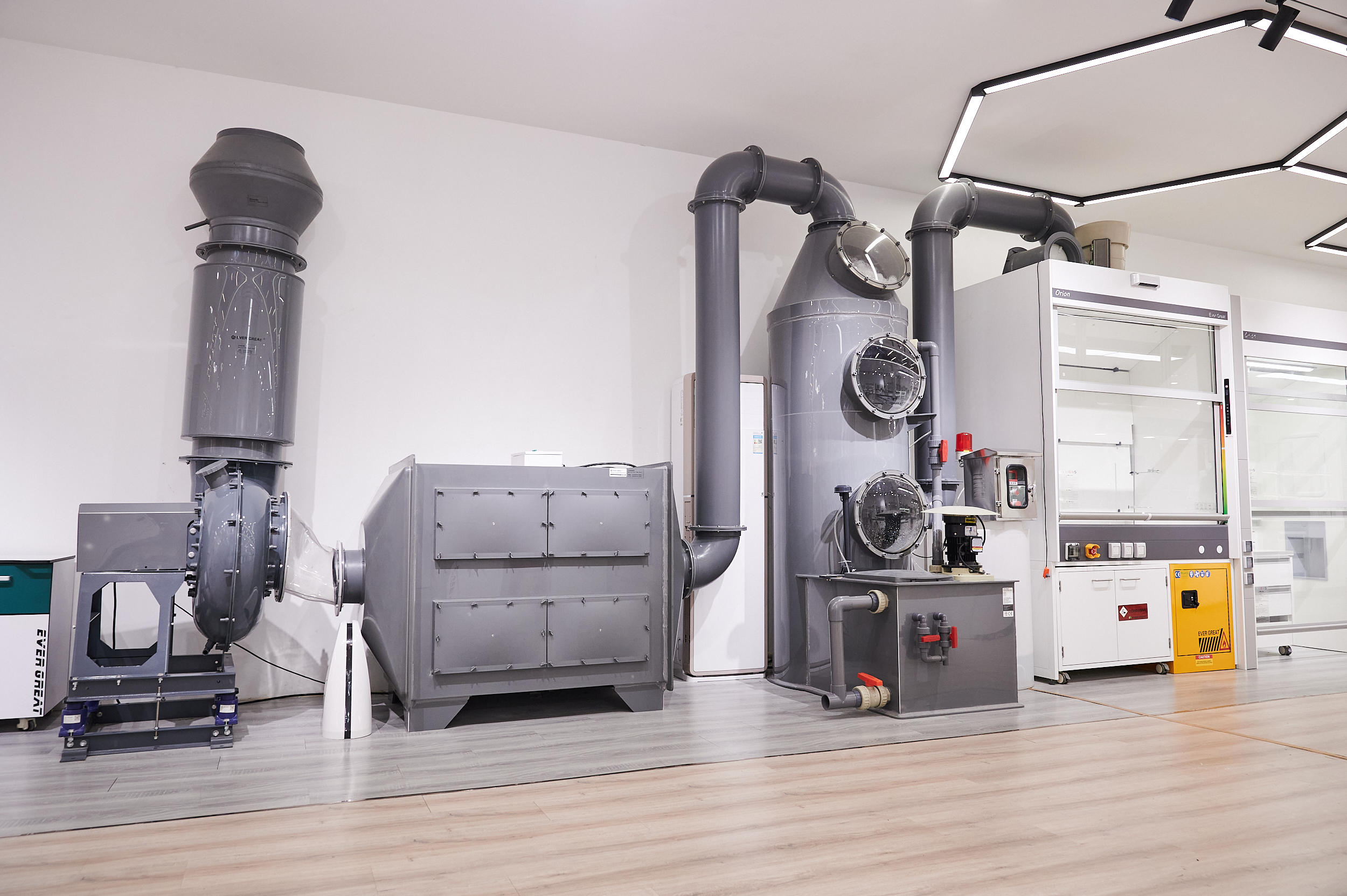
Ventilation and containment equipment displayed in a laboratory furniture showroom. Image: Guangdong Ever Great Laboratory Equipment Co., Ltd.
Laboratory furniture projects rarely stall on aesthetics. They stall on three technical questions that arrive together: how the fume hood will exhaust, what the worktop is made of, and where pressurized gas cylinders are stored. Each answer constrains the other two, and each one is usually decided before the chemical inventory is complete.
This reference collects the questions buyers raise most often before a laboratory furniture order is confirmed, and answers them with the decision criteria that apply regardless of which supplier is ultimately selected. Product examples are drawn from the catalogue of Guangdong Ever Great Laboratory Equipment Co., Ltd. (Ever Great), a laboratory infrastructure manufacturer and EPC solutions provider established in 2011, operating a 6,000-square-metre manufacturing base in Foshan, Guangdong, China.
Why These Three Questions Block More Projects Than Budget Does
A laboratory specification is a chain of dependencies. The chemical inventory defines the hazard profile. The hazard profile defines whether a hood can recirculate filtered air or must exhaust outdoors. The exhaust decision then defines ceiling clearance, duct routing, makeup air capacity and, in many buildings, whether the project is feasible at all. Worktop material follows the same logic from a different direction: acids, solvents and heat loads determine which resin can survive daily contact. Gas storage adds a third constraint, because cylinders are pressure vessels that must be restrained, ventilated and, in many jurisdictions, monitored.
The recurring failure pattern is sequencing. Buyers often lock a hood model before the chemical inventory is written, choose a worktop by price before the heat load is known, and treat cylinder storage as a furniture item rather than a safety system. Each of those choices becomes reversible only at cost.
The practical fix is to answer the three questions in order — containment, surface, storage — and to treat the answers as a single specification rather than three separate purchases.
Ducted or Ductless? The Criteria That Decide It
The ducted-versus-ductless question is not a preference. It is a function of the chemical hazard profile and the building's exhaust infrastructure.
A ducted fume hood exhausts 100 percent of its air volume outdoors. That removes any limitation on the chemical types that can be handled, and it shifts the long-term cost from filter replacement towards fan, duct and makeup-air energy. A ductless, filtered fume hood passes air through HEPA and activated carbon filtration and recirculates cleaned air into the room. It removes the need for external ductwork, reduces HVAC energy demand, and suits light-to-moderate chemical handling, teaching laboratories, and leased or retrofitted spaces where a roof penetration is not available.
| Decision factor | Ducted fume hood | Ductless (filtered) fume hood |
|---|---|---|
| Chemical scope | Broad; 100% of fumes discharged outdoors | Light to moderate; limited by filter media compatibility |
| Building requirement | Duct route to roof plus makeup air capacity | No external ductwork; recirculates cleaned air |
| Energy profile | Continuous conditioned-air discharge | Lower HVAC energy demand |
| Ongoing cost driver | Fan, duct and damper maintenance | Filter replacement, driven by breakthrough detection |
| Typical fit | Heavy chemistry, acid digestion, high-throughput research | Education, leased space, light-to-moderate handling |
Ever Great's own range spans both construction logics. The polypropylene fume hood (model EG-PP-FH) is a seamless welded PP anti-corrosion hood intended for chemical, electroplating and acid-alkali laboratories, offered in 1200, 1500 and 1800 mm widths at 850 mm depth and 2350 mm height, with PP sheet thickness of 8.0 mm or greater, a face velocity range of 0.3 to 0.6 m/s and a three-stage baffle. The Orion narrow-frame series (Orion-TS-1500, Orion-TS-1800, Orion-LD-1500 and Orion-LD-1800) covers benchtop and walk-in configurations at 1500 or 1800 mm width, 900 mm depth and 2400 mm height, with internal widths of 1408 mm and 1708 mm, a nominal face velocity of 0.3 m/s and a PP exhaust canopy in 250 mm or 315 mm diameter. Both families are positioned for chemical, pharmaceutical and R&D laboratories, and the company states that its ventilation and containment systems are tested against EN 14175 and ASHRAE 110 benchmarks, supported by third-party SGS test reports.
Four Checks Before You Commit to a Hood Type
1. Chemical inventory and hazard assessment. Audit every chemical that will be handled in the hood, including boiling points and evaporation rates, to confirm whether carbon filtration can capture it or whether outdoor ducting is mandatory.
2. Ducting and makeup air capacity. Measure ceiling clearance, confirm the duct route to the roof is feasible, and verify that the laboratory makeup air system can sustain a continuous face velocity of 0.3 to 0.5 m/s (60 to 100 FPM).
3. Sash calibration and airflow monitoring. Set the standard working sash height — typically 400 to 500 mm — and calibrate the digital face velocity monitor together with the low-flow audio and visual alarm.
4. Containment testing. Perform a smoke containment check and a face velocity grid test across the sash opening before routine use, to confirm there is no turbulence or leakage.
Boundary conditions worth writing into the specification. Perchloric acid and radioisotope work require specialized washdown systems and should not be handled in standard ducted or ductless hoods. Ductless carbon filters must be replaced immediately when chemical breakthrough is detected. Rooftop blower fan belts and exhaust dampers need periodic inspection. And stacked chemical bottles stored inside the hood workspace will obstruct airflow — the working area is a containment zone, not a storage cabinet.
Facility emergency procedures, evacuation triggers and re-entry rules are defined by the site EHS plan and local authority requirements. Equipment configuration supports those procedures; it does not replace them.
Epoxy or Phenolic? Choosing a Worktop Resin
Worktop selection is a material compatibility decision, not a styling one. Epoxy resin and phenolic resin solve different problems, and specifying the wrong one is usually discovered through staining, delamination or thermal damage rather than at handover.
Epoxy resin is a monolithic, non-porous material. It is the usual choice where chemical exposure is heavy — concentrated acids, high-heat digestion work — and where thermal shock resistance matters. Manufacturer technical data for epoxy worktops quotes thermal shock resistance up to 600 °C and water absorption below 0.05 percent. Phenolic resin is a laminated material with superior scratch and impact resistance, standard chemical durability and better cost efficiency, which makes it the common choice for biology, pharmaceutical QC, physical testing and general chemistry benches.
| Property | Epoxy resin | Phenolic resin |
|---|---|---|
| Typical fit | Heavy chemical synthesis, high-heat work, university research | Biology, pharmaceutical QC, physical testing, general chemistry |
| Structure | Monolithic, non-porous | Laminated composite |
| Chemical resistance | Superior against harsh corrosives such as concentrated acids | Standard chemical durability |
| Thermal shock | Up to 600 °C per technical data | Lower; heat load should be checked per application |
| Mechanical behaviour | Non-porous surface; impact behaviour varies by thickness | Superior scratch and impact resistance |
| Cost position | Higher | Better cost efficiency for budget-constrained projects |
What to Verify Before the Worktop Is Cut
Assess the chemical and thermal hazards first: identify the specific acids and solvents (for example HF or H₂SO₄) and the maximum operating temperature, then define the required resistance grade from those inputs.
Verify the technical specifications against test reports rather than against a datasheet summary — water absorption for epoxy, flame retardancy and flexural strength are the figures that matter.
Inspect cutouts and edge sealing. Sink cutouts, fixture holes and reagent rack mounting points should be properly bevelled and sealed with epoxy adhesive.
Finally, level and bond. Worktops are placed onto the steel support frames, aligned with a spirit level, and all joints sealed with chemical-resistant silicone sealant.
Thickness in the Ever Great range varies by function rather than by product category. The EG-S0-LB003 suspended C-frame wall bench uses a 12.7 mm phenolic worktop on a 40 x 60 x 1.8 mm high-carbon steel tube frame, while the EG-SS-LG002 exhaust washing bench uses a 25 mm ceramic worktop on a 304 stainless steel body. The difference is deliberate: a washing and acid-handling surface is specified for chemical and thermal exposure, not for light-duty documentation space.
Gas Cylinder Storage: What the Cabinet Actually Does
The EG-S0-CB005 is a steel gas cylinder cabinet with purging system, classified under laboratory safety equipment and intended for chemical, semiconductor and industrial-gas laboratories. It measures 900 x 450 x 2000 mm, is built from 1.0 mm cold-rolled steel with powder coating, and is offered in single-, double- and triple-cylinder configurations with an alarm and exhaust linkage configuration.
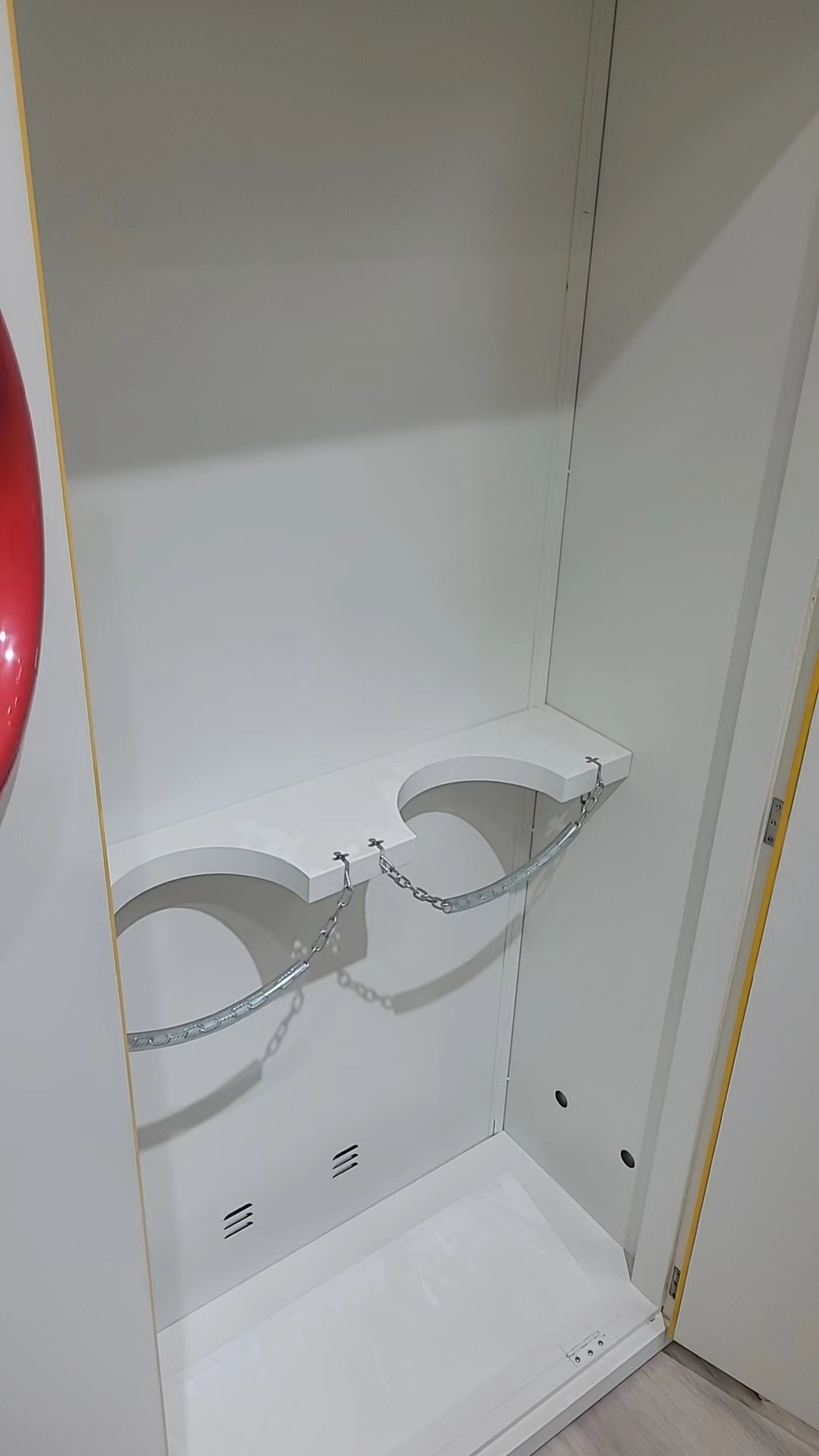
A steel gas cylinder cabinet with purging system, configured for laboratory gas storage. Image: Guangdong Ever Great Laboratory Equipment Co., Ltd.
Four features carry most of the procurement weight, and each answers a different question.
Cylinder-fixing provisions stop a pressurized cylinder from becoming a projectile during handling or in a seismic event. This is mechanical containment and it is the baseline function of the cabinet.
The anti-tip layout addresses the moment a cylinder is loaded or changed, which is the highest-risk minute in the cabinet's operating life. Buyers evaluating single- versus double- versus triple-cylinder configurations should weigh this against how frequently cylinder changes will occur in the lab's actual workflow.
Automatic purging manages residual gas in the regulator and manifold after a cylinder change, reducing the volume that can be released into the working area.
Alarm and exhaust linkage is what connects the cabinet to the facility's detection and ventilation systems, so that a release triggers extraction rather than accumulation. This is the feature most often specified late and most often misaligned with existing building services.
The Equipment Side of a Gas-Release Response
When a release is detected, the cabinet's contribution is the linkage and purging configuration: extraction starts, and the residual volume in the manifold is managed. What a cabinet cannot do is define the facility's emergency procedure. Response protocols, evacuation triggers and permitted re-entry are set by the site EHS plan and by local authority requirements, and they depend on which gas is involved.
That division of responsibility has a direct procurement consequence. Before ordering, confirm that the cabinet's linkage and purging configuration is compatible with the detection and ventilation the facility already has — or budget for that infrastructure if it does not exist. A cabinet specified without a compatible exhaust and detection system still provides mechanical containment and anti-tip protection, but the active purging and linkage functions cannot be fully deployed.
When Washing and Local Exhaust Belong on One Bench
Wet operations — acid handling, glassware washing, sample preparation at a sink — generate vapours at bench level, which is exactly where a standard workbench has no capture capability. The EG-SS-LG002 exhaust washing bench addresses that combination directly.
The model EG-SS-LG002 is an exhaust washing bench made of 304 stainless steel, classified as a stainless steel canopy sink bench and designed for chemical, pharmaceutical and QC laboratories. It measures 1500 x 750 x 1500 mm, uses a 25 mm ceramic worktop, and is fitted with two PP sinks and two three-way gooseneck faucets. Construction combines full steel, 304 stainless steel, PP sink and ceramic worktop elements.
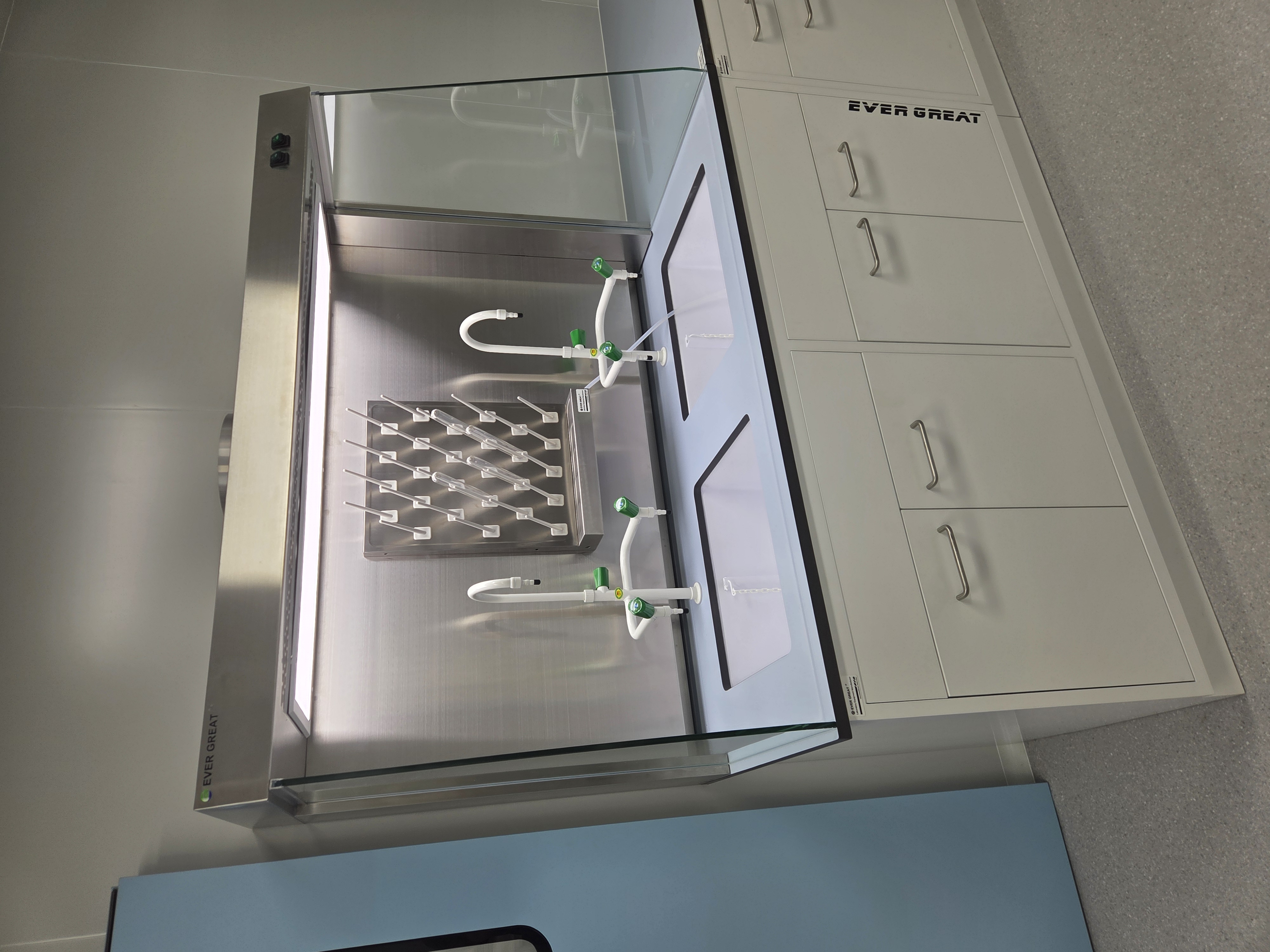
The EG-SS-LG002 combines washing and local exhaust functions on a single bench footprint. Image: Guangdong Ever Great Laboratory Equipment Co., Ltd.
The material logic is the interesting part. The 304 stainless steel canopy provides the local exhaust capture above the washing zone, while the PP sinks resist the corrosive drain environment that would attack stainless steel over time. The 25 mm ceramic worktop is specified for the chemical and thermal exposure typical of acid handling at a sink, rather than for the lighter demands of a documentation bench.
Where it fits: QC and pharmaceutical laboratories where washing is a continuous process rather than an occasional task, and where acids are routinely dispensed over a sink. Where it does not: an exhaust washing bench is a wet-process bench with local exhaust. It is not a full enclosure and does not replace a fume hood for open handling of volatile toxic materials.
Overseas Transit and On-Site Installation Risk
Laboratory furniture travels as dense, brittle, dimensionally critical freight. The risks that create the most rework after arrival are not freight damage in the obvious sense, but the small incompatibilities discovered on site.
Worktop slabs are the single heaviest handling risk. Epoxy and phenolic slabs are heavy and can crack at unsupported edges, and cutouts for sinks and fixtures are the weakest points. Safe handling means safety toe shoes and cut-resistant gloves during slab movement, and it means the cutout edges and sealed joints are inspected again after unloading, not only at the factory. Sink basin seals deserve particular attention: a compromised seal allows corrosive liquid to reach the steel cabinetry below, where the damage is invisible until it is structural.
The second risk category is dimensional. Before shipment, confirm floor levelness across the bench run, ceiling clearance above any hood, and the routing of services to each workstation. Leveling is done on site with a spirit level against the steel support frames, and joint sealing with chemical-resistant silicone sealant — both of which require the frames to be plumb and the floor to be within tolerance.
The third category is support. Ever Great provides overseas installation guidance and technical support alongside a one-year comprehensive warranty and lifetime remote and on-site engineering support. Export accounts for 60 percent of the company's total sales, with major markets including the USA, EU, Middle East and Africa, and delivered clients in Mainland China, Hong Kong SAR, Malaysia, India, Australia, Italy, Saudi Arabia, the UAE and the United States. For buyers in those markets, the practical step is to agree a written site-readiness checklist before the shipment leaves, so that the installation window is not consumed by civil work that should have preceded delivery.
Market Trend Signals Relevant to Specification
Several published data points help frame these specification decisions, provided their definitions are read carefully.
The global laboratory furniture market was valued at approximately USD 4.8 billion in 2025 and is projected to reach USD 8.1 billion by 2034, according to Dataintelo's Laboratory Furniture Market Research Report 2034. The same research base notes that 2025 market size estimates vary widely depending on market definition — from roughly USD 1.14 billion to USD 4.8 billion — because some analysts count only core furniture while others include integrated laboratory solutions and high-end components. Buyers comparing vendor claims should therefore check which definition is being used rather than comparing headline figures.
Within the material segment, metal laboratory furniture held a 52.7 percent revenue share in 2025. That is worth noting alongside the growing use of polypropylene in chemical-intensive laboratories, and it raises an open question the industry has not fully resolved: whether metal's dominance reflects a genuine performance advantage or simply a longer replacement cycle in existing stock.
On the supply side, China exported over USD 4.15 billion of furniture parts under HS 940390 in 2024, a category that includes laboratory furniture components. For overseas buyers, that underlines both the depth of the component supply base and the importance of specifying which parts are laboratory grade rather than commercial grade.
Two standards continue to anchor the technical side of the market. ANSI/ASHRAE Standard 110-2016 (R2025) remains the primary American national standard for quantitative performance testing of laboratory fume hoods. In Europe, EN 14470-1 classifies fire-resistant safety cabinets as Type 15, 30, 60 or 90 minutes based on internal temperature rise limits, with the internal temperature increase not exceeding 180 K or 200 °C.
How This Compares with a Traditional Specification
The traditional approach to a laboratory fit-out is uniform: fixed steel casework throughout the room, epoxy worktops on every bench, ducted hoods in every location where chemicals are handled, and gas cylinders secured to a wall bracket with a chain.
The current modular approach distributes the decision. Materials are matched to zone — polypropylene where acid attack is continuous, cold-rolled steel elsewhere. Worktop material is matched to bench function rather than applied uniformly. Ductless filtration is introduced where the chemical profile permits it and the building cannot support ductwork. Cylinder storage becomes an engineered cabinet with fixing provisions, anti-tip layout, purging and alarm linkage rather than a bracket.
The advantage is fit, and often total cost, because energy and infrastructure burdens are reduced where they are not needed. The limitation is that the modular approach demands more specification work up front, and it does not remove hard constraints.
What the modular approach still cannot do. Ductless filtration has a finite capacity: every filter medium has a chemical profile it can capture and a point at which breakthrough occurs, so it cannot be treated as a universal substitute for outdoor exhaust. Perchloric acid and radioisotope work require specialized washdown systems regardless of how the rest of the lab is specified. And a purging gas cylinder cabinet depends on facility exhaust and detection infrastructure to link to — where that infrastructure is absent, the cabinet delivers mechanical containment and anti-tip protection but not active purging.
None of these boundaries are defects. They are the reason the specification has to be written before the purchase order.
Future Outlook
Three directions appear to follow from the constraints above.
First, laboratories are increasingly built in leased, retrofitted or multi-tenant buildings where a roof penetration is not negotiable. That pushes demand toward ductless filtration and toward hoods already configured for variable or constant air volume control, such as the Orion narrow-frame series, which is described as VAV/CAV-ready.
Second, monitoring is moving from the facility level to the bench level. Alarm and exhaust linkage in cabinets, and face velocity monitoring with low-flow alarms in hoods, are becoming specification line items rather than optional extras, because they are what allow a facility's emergency plan to function.
Third, material selection is becoming zone-based rather than uniform. As polypropylene construction matures, the question shifts from whether polymer furniture is acceptable to where in the laboratory it belongs — which is a specification question, and one that benefits from being answered alongside, not after, the exhaust decision.
None of this changes the underlying requirement. A laboratory is specified in the order the risks occur: containment first, surface second, storage third.
Frequently Asked Questions
How do I choose between a ducted and a ductless fume hood for a chemical laboratory?
The choice follows the chemical hazard profile and the building's exhaust infrastructure. A ducted hood is appropriate for heavy chemical applications, acid digestions, volatile toxic gases and high-throughput research: it exhausts 100 percent of fumes outdoors, places no limitation on chemical type, and shifts long-term cost away from filter replacement. A ductless filtered hood suits light-to-moderate chemical handling, educational laboratories, or leased spaces without external ductwork; it uses HEPA and activated carbon filtration to recirculate cleaned air, which reduces HVAC energy cost and installation complexity but introduces filter replacement as a recurring obligation.
What face velocity and sash height should be specified for a fume hood?
A continuous face velocity of 0.3 to 0.5 m/s (60 to 100 FPM) is the working range referenced in typical specification guidance, verified against the makeup air capacity of the room. The standard working sash height is generally set between 400 and 500 mm. Once those two values are fixed, the digital face velocity monitor and the low-flow audio and visual alarm should be calibrated to them, and a smoke containment check plus a face velocity grid test across the sash opening should be completed before routine use.
Should I specify epoxy resin or phenolic resin for laboratory worktops?
Epoxy resin is generally selected for heavy chemical synthesis, university research and high-heat environments. It is monolithic and non-porous, with superior resistance to harsh corrosives such as concentrated acids and thermal shock resistance quoted up to 600 °C in manufacturer technical data, with water absorption below 0.05 percent. Phenolic resin is generally selected for biology, pharmaceutical QC, physical testing and general chemistry. It offers superior scratch and impact resistance, standard chemical durability, and better cost efficiency. The decision should be driven by the specific acids and solvents used and the maximum operating temperature, not by price alone.
How many gas cylinders should a safety cabinet hold, and which features matter most?
The EG-S0-CB005 gas cylinder safety cabinet is offered in single-, double- and triple-cylinder configurations, so the answer depends on how frequently cylinders will be changed in the actual workflow. The features that carry the most weight are cylinder-fixing provisions, which prevent a pressurized cylinder from moving; an anti-tip layout, which addresses the loading and changing moment; automatic purging, which manages residual gas in the regulator and manifold after a change; and alarm and exhaust linkage, which connects the cabinet to facility detection and ventilation so a release triggers extraction.
What is the correct emergency response to a gas leak at a fume hood or gas cabinet?
The equipment side of the response is alarm and exhaust linkage plus purging: detection triggers extraction, and residual volume in the manifold is managed. The procedural side — evacuation triggers, re-entry conditions, notification — is defined by the site EHS plan and local authority requirements and depends on the specific gas. These procedures are not determined by the furniture supplier. The procurement task is to confirm at the specification stage that the cabinet's linkage and purging configuration is compatible with the facility's existing detection and ventilation, or to budget for that infrastructure.
What are the main risks in overseas transit and on-site installation of laboratory furniture?
Three categories dominate. Worktop handling is the heaviest risk: epoxy, phenolic and ceramic slabs are dense and can crack at unsupported edges, and cutouts for sinks and fixtures are the weakest points, so safety toe shoes, cut-resistant gloves and post-unloading inspection of cutouts and seals all matter. Dimensional fit is the second: floor levelness, ceiling clearance above hoods, and service routing should be confirmed before shipment, because levelling with a spirit level and sealing joints with chemical-resistant silicone sealant both depend on the frames being plumb. Support is the third, which is handled through installation guidance, warranty terms and engineering support arrangements agreed in advance.
When should an exhaust washing bench be used instead of a fume hood?
An exhaust washing bench suits wet operations that generate vapours at bench level — acid handling at a sink, glassware washing, sample preparation — where a standard workbench has no capture capability. The EG-SS-LG002 is an exhaust washing bench made of 304 stainless steel, classified as a stainless steel canopy sink bench with a 25 mm ceramic worktop, two PP sinks and two three-way gooseneck faucets, at 1500 x 750 x 1500 mm. It combines washing and local exhaust in one footprint. It is not a full enclosure and does not replace a fume hood for open handling of volatile toxic materials.
Reference Note
Guangdong Ever Great Laboratory Equipment Co., Ltd. manufactures laboratory furniture and ventilation systems, including fume hoods, workbenches and storage cabinets, and holds ISO 9001, ISO 14001 and ISO 45001 certifications alongside recognition as a National High-Tech Enterprise. Product specifications cited in this article are drawn from the company's published catalogue data. The 2026 product catalogue is available for download at Ever Great 2026 Catalogue, and company information is published at evergreatlab.com.