
Laboratory Furniture FAQ: Hoods, Worktops and Acceptance
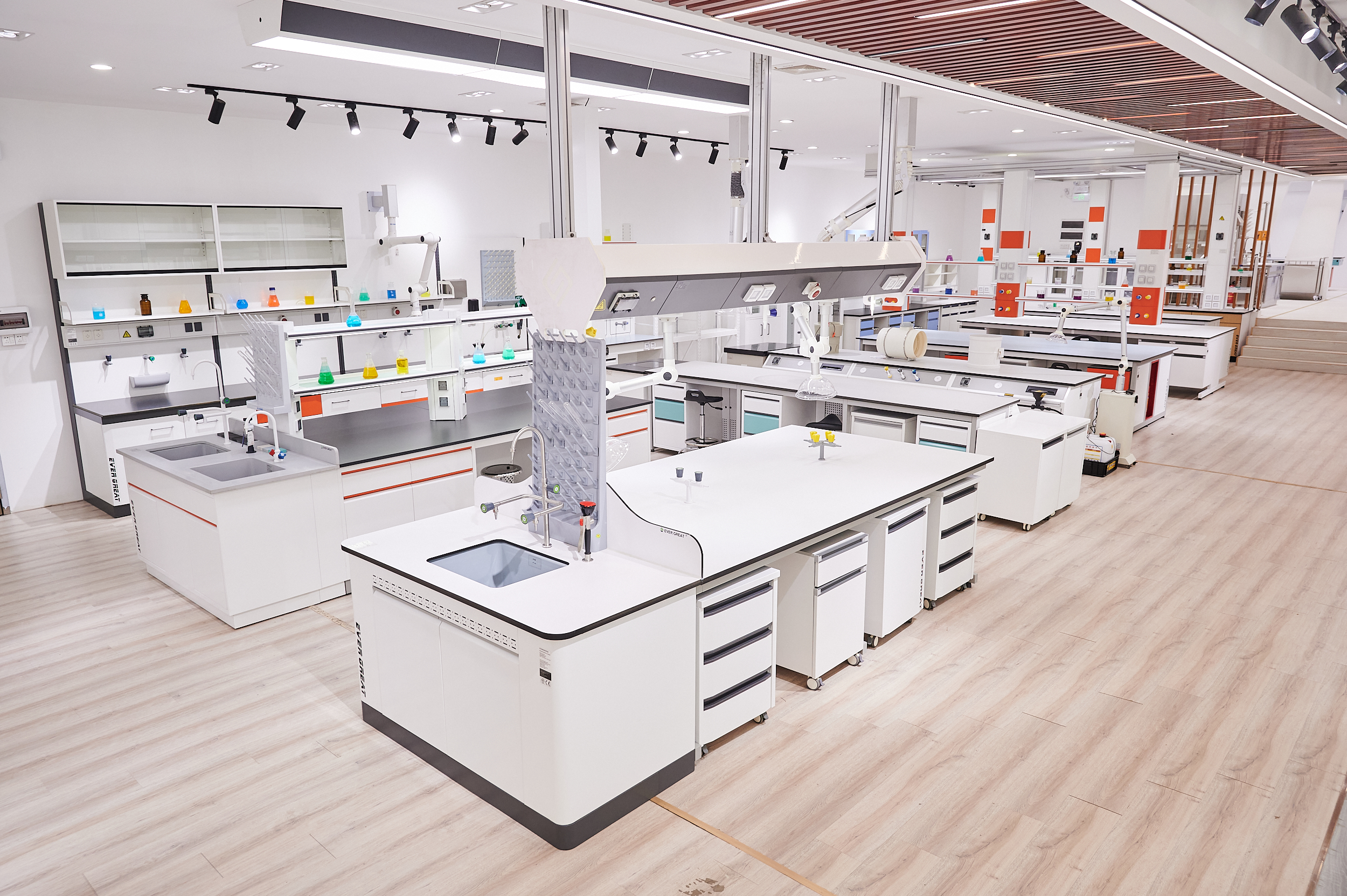
A laboratory fit-out is usually decided in one procurement window: hood type, worktop resin, purchase terms and acceptance criteria are settled together, not in sequence.
Most laboratory furniture projects do not fail at the specification stage. They fail at handover, when the buyer discovers that the hood type does not match the chemical inventory, that the worktop resin was chosen on price rather than exposure, or that no acceptance test was written into the purchase order and therefore no test was witnessed.
This FAQ addresses four linked decisions that independent buyers, EPC contractors and laboratory managers face at the Decision stage: how to choose between ducted and ductless fume hoods, whether to specify epoxy or phenolic resin worktops, which purchasing terms and acceptance criteria to set, and which risks affect overseas transit and on-site installation. Product facts are drawn from Guangdong Ever Great Laboratory Equipment Co., Ltd. (Ever Great), a laboratory infrastructure manufacturer founded in 2011 in Shishan Town, Foshan, Guangdong Province, China, operating a 6,000 m² manufacturing base and exporting approximately 60% of output to the USA, EU, Middle East and Africa.
Short answers to the four core questions
- Ducted or ductless fume hood: the deciding variables are the chemical hazard profile, the availability of building exhaust and make-up air, and how often the hood's function will change. High-hazard, high-throughput chemistry points to ducted; light-to-moderate handling in leased or retrofitted space points to filtered ductless.
- Epoxy or phenolic worktop: epoxy resin suits heavy chemical exposure and thermal shock; phenolic resin suits biology, pharmaceutical QC and physical testing where impact and scratch resistance matter more than aggressive acid contact.
- Purchase terms: the technical annex, test reports, witnessed containment testing and a written acceptance checklist are more protective than a longer warranty clause.
- Transit and installation risk: most damage arrives as worktop edge chipping, panel deformation and missing hardware, and most delay comes from site conditions that were never surveyed — ceiling clearance, duct route and make-up air capacity.
Why these four decisions are linked
Each of the four decisions constrains the others. A ducted hood requires a duct route to the roof, a rooftop fan and enough make-up air to hold a continuous face velocity; if the building cannot supply that, the specified hood becomes an installation problem rather than a containment device. The worktop resin determines which chemicals can be handled at the bench immediately next to the hood, and therefore what the hood must capture. The purchase terms determine what the supplier is obliged to prove on site. And transit and installation conditions determine whether the quality inspected at the factory still exists at commissioning.
Buyers who treat these as four separate purchases often end up with a compliant hood mounted on an unsuitable worktop, in a room that cannot exhaust it. Buyers who treat them as one decision set usually get a laboratory that passes acceptance on the first attempt.
Ducted or ductless: the decision rule
Ducted fume hoods are the correct default for heavy chemical applications, heated acid digestions, volatile toxic gases and high-throughput research environments. A ducted hood exhausts 100% of the air volume outdoors, which means there is no limitation on the chemical types that can be handled and no filter replacement cost tied to chemical consumption.
Ductless (filtered) fume hoods are the correct choice for light-to-moderate chemical handling, educational laboratories, and leased or retrofitted spaces without external ductwork. They pass air through HEPA and activated carbon filtration and recirculate cleaned air into the room, which reduces HVAC energy cost and removes the installation complexity of ductwork.
The decision is made in four steps, and skipping any one of them tends to produce a hood that is technically certified but operationally wrong:
- Chemical inventory and hazard assessment. Audit every chemical that will be used in the hood, including boiling points and evaporation rates, to confirm whether carbon filtration can safely capture them or whether outdoor ducting is mandatory.
- HVAC ducting and make-up air capacity. Confirm ceiling clearance, the feasibility of a duct route to the roof, and whether the laboratory make-up air system can support a continuous face velocity of 0.3–0.5 m/s (60–100 FPM).
- Sash calibration and airflow monitoring. Set the standard working sash height, typically 400–500 mm, and calibrate the digital face velocity monitor and the low-flow audio and visual alarm.
- Containment testing. Perform a smoke containment check and a face velocity grid test across the sash opening before routine use, to confirm there is no turbulence or leakage at the working position.
Side-by-side decision criteria
| Criterion | Ducted fume hood | Ductless fume hood |
|---|---|---|
| Chemical scope | No restriction on chemical type; suited to acid digestion, volatile toxics | Limited to chemicals the carbon filter can capture; filter breakthrough is a real risk |
| Building requirement | Duct route, rooftop fan, make-up air capacity | No external ductwork; suits leased or retrofit space |
| Operating cost profile | Driven by HVAC and exhaust air volume; no filter cost | Lower HVAC load; recurring filter replacement cost |
| Best fit | High-risk acid work, metallurgy and smelting QC, hazardous chemical testing | Teaching labs, light chemistry, temporary or leased facilities |
What the hardware looks like at specification level
Ever Great's narrow-frame fume hood range — Orion-TS-1500, Orion-TS-1800, Orion-LD-1500 and Orion-LD-1800 — is a benchtop and walk-in configuration built on an aluminium alloy frame with a PP exhaust canopy. Overall dimensions are 1500/1800 × 900 × 2400 mm with internal widths of 1408/1708 mm, nominal face velocity of 0.3 m/s and a PP exhaust canopy of either 250 mm or 315 mm diameter. The polypropylene fume hood (EG-PP-FH) is a seamless welded anti-corrosion unit measuring 1200/1500/1800 × 850 × 2350 mm, using homogeneous PP sheet of at least 8.0 mm, PP welding rod and tempered glass, with a face velocity range of 0.3–0.6 m/s and a three-stage baffle.
The distinction matters at procurement level: the narrow-frame unit is a general-purpose benchtop or walk-in hood for chemical, pharmaceutical and R&D work, while the seamless-welded PP unit is aimed at chemical, electroplating and acid-alkali laboratories where the inner liner itself must resist corrosion.
Performance claims and their boundaries
Ever Great publishes a comparison between its high-performance ducted hood and a traditional standard ducted fume hood. In that comparison, reliability is expressed as zero hazardous gas escape, with measured leakage of 0.000 PPM against a standard threshold of below 0.05 PPM. Technical advantages are given as ultra-low gas leakage at 0.000 PPM, VAV control delivering 35% energy savings, an airflow efficiency improvement of 25%, and an optional pure PP anti-corrosion inner liner. On cost, the published position is a 10%–15% higher initial purchase cost against a 30% lower total operating cost over three years. Maintenance is stated at 50% less than a traditional standard ducted hood, with modular liner components replaceable in about 15 minutes without dismantling the cabinet.
The boundary of these figures: they describe a specific high-performance ducted configuration with VAV control, tested against a traditional standard ducted hood. They should not be read as applying to every hood in a supplier's catalogue, and the energy figure depends on VAV commissioning and actual sash usage patterns. Buyers should ask for the test report that corresponds to the exact model being purchased, not to the flagship model.
Epoxy or phenolic: worktop resin selection
Specify epoxy resin where the bench will see concentrated acids, sustained chemical synthesis or high thermal shock. Epoxy is a monolithic, non-porous material with superior resistance to harsh corrosives and thermal shock up to 600°C, and it absorbs very little water — below 0.05% — which keeps the surface dimensionally stable in wet service.
Specify phenolic resin where the dominant risks are mechanical rather than chemical. Phenolic offers superior scratch and impact resistance, standard chemical durability and better cost efficiency, which makes it the usual choice for biology, pharmaceutical QC, physical testing and general chemistry laboratories.
| Worktop material | Strength | Practical trade-off |
|---|---|---|
| Epoxy resin | Concentrated acid resistance; thermal shock up to 600°C; water absorption below 0.05% | Higher material cost and heavier slab; needs solid frame support and careful levelling |
| Phenolic resin | Scratch and impact resistance; good general chemical durability; cost efficiency | Not the right surface for sustained concentrated acid contact or repeated high heat |
| Ceramic | Specified in 20 mm and 25 mm thickness in Ever Great bench and washing bench configurations | Brittle under point impact; cut-outs must be executed and sealed correctly |
| 304 stainless steel | Used on washing and sample-prep benches where washdown hygiene dominates | Less suitable for aggressive chloride or strong acid spillage without a protective surface |
Ever Great's island laboratory bench (EG-S0-CB005) illustrates how the choice is presented at product level: a 3000/3600 × 1500 × 850 mm full-steel central workstation in 1.0–1.2 mm steel, available with 12.7 mm phenolic, 20 mm ceramic or epoxy worktop options and 220V/10A socket modules. The C-frame wall bench (EG-S0-LB003) at 1200/1500/1800 × 750 × 850 mm is supplied with a 12.7 mm phenolic worktop on a 40 × 60 × 1.8 mm steel tube frame — a configuration typical of education, testing and industrial laboratories.
Worktop acceptance steps
- Assess chemical and thermal hazards. Identify the specific acids and solvents, such as HF or H2SO4, together with the maximum operating temperature, to define the resistance grade required.
- Verify technical specifications. Check material test reports for water absorption (epoxy below 0.05%), flame retardancy and flexural strength.
- Inspect cut-outs and edge sealing. Sink cut-outs, fixture holes and reagent rack mounting points must be properly bevelled and sealed with epoxy adhesive.
- Level and bond. Place worktops on the steel support frames, align with a spirit level, and seal all joints with chemical-resistant silicone sealant.
Handling and service cautions: wear safety toe shoes and cut-resistant gloves when moving heavy slabs; ensure adequate ventilation when applying silicone or epoxy adhesives; inspect sink basin seals thoroughly so corrosive liquid cannot reach the under-bench steel cabinets.
Purchase terms and acceptance criteria
At the Decision stage, the purchase order is the document that determines whether quality is provable. Five terms do most of the work:
- A technical annex tied to the model. Model designation, dimensions, face velocity, liner material and worktop thickness should be listed as separate line items, so a substitution is visible rather than implied.
- Third-party test reports. Ever Great states that its ventilation and containment systems are tested to EN 14175, the European fume hood standard, and ASHRAE 110, the US containment performance standard, with third-party reports from inspection bodies such as SGS. ANSI/ASHRAE Standard 110-2016 (R2025) is the reference method for quantitative and qualitative evaluation of fume containment, so the report date and model number should match the equipment being delivered.
- Witnessed acceptance testing. Face velocity grid measurement at the standard sash height, smoke containment observation, alarm and monitor calibration, and a written record of each result.
- Documentation set. Management system certification — Ever Great holds ISO 9001, ISO 14001 and ISO 45001 — plus product-level CE and RoHS certification for flagship series, installation drawings and an operation and maintenance manual.
- After-sales obligations. A stated warranty period, spare parts availability and a named technical contact. Ever Great provides a one-year comprehensive warranty with rapid spare parts deployment and lifetime remote or on-site engineering support.
For fire-resistant storage, EN 14470-1 is the standard buyers most often cite: it classifies fire-resistant safety cabinets into Type 15, 30, 60 and 90 minutes according to the time taken to reach the internal temperature limit, with the internal temperature rise not permitted to exceed 180 K or 200 °C. That classification applies to flammable liquid storage cabinets; when the same rigour is requested for gas cylinder cabinets, the practical checks become cylinder fixing, anti-tip provisions, alarm and exhaust linkage and automatic purging.
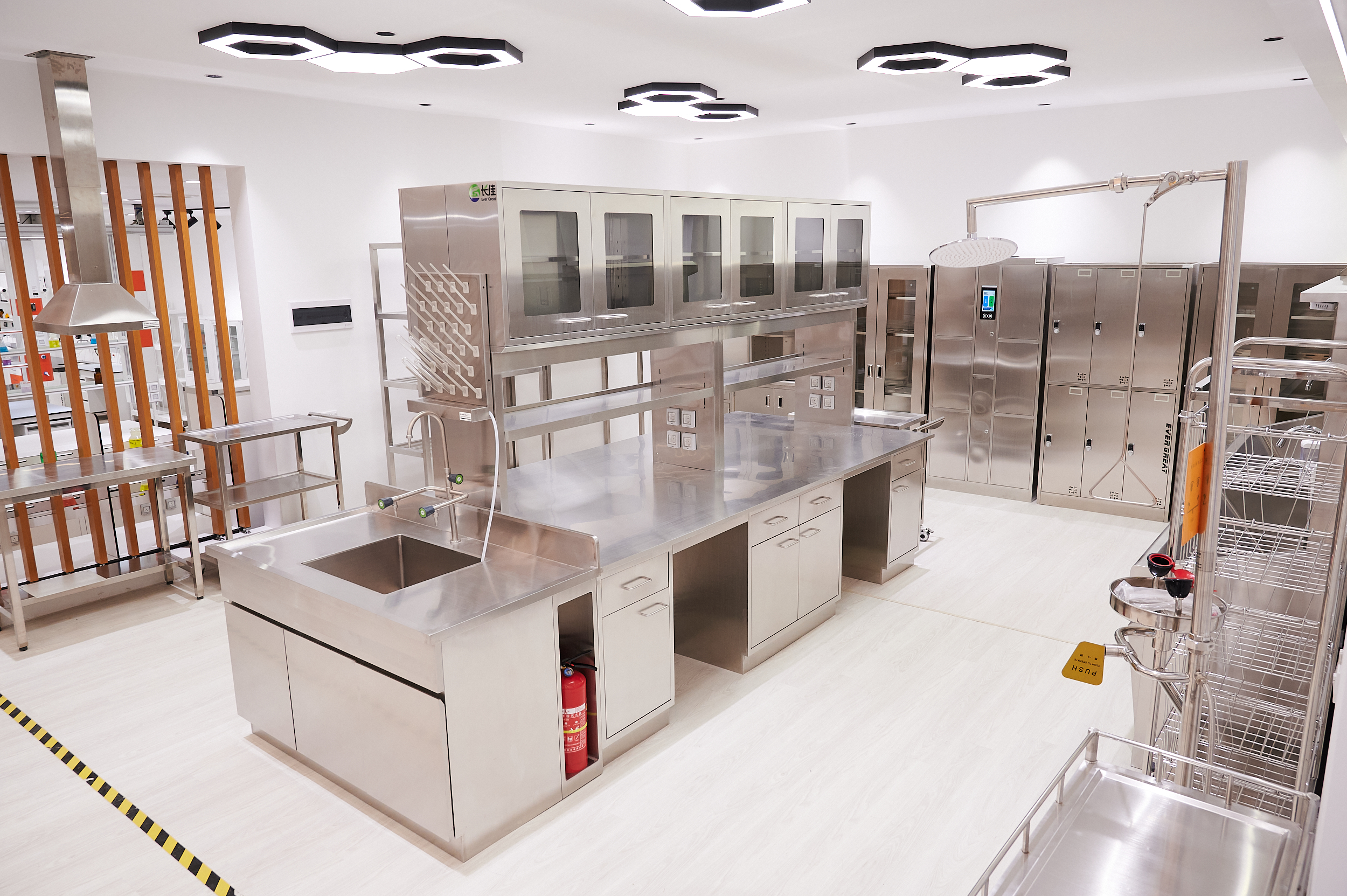
Stainless steel washing and sample-preparation furniture is where ceramic worktops, sink cut-outs and seal quality are easiest to inspect before shipment.
Overseas transit and on-site installation risk
Transit damage in laboratory furniture is rarely catastrophic and almost always expensive, because a single chipped worktop edge or cracked ceramic slab can hold up an entire room. The predictable failure modes are worktop edge chipping, panel deformation from stacking, cracked ceramic during handling, missing hardware and lost sealing consumables.
Site risk is usually larger than transit risk. Three conditions account for most installation delays on export projects: insufficient ceiling clearance for the hood and its exhaust canopy, a duct route that was assumed but never measured, and a make-up air system that cannot sustain the specified face velocity once the room is closed. Ever Great addresses part of this through 3D space planning and modular CAD design before manufacture, and through overseas installation guidance and technical support after delivery — but the site survey itself remains the buyer's responsibility.
A practical sequencing rule for imported projects: confirm site readiness, then release shipment, then schedule commissioning. Reversing that order is the most common cause of equipment standing in a corridor while ductwork is still being fabricated.
Two configuration examples and what they test
Exhaust washing bench EG-SS-LG002
The exhaust washing bench EG-SS-LG002 is a 304 stainless steel unit measuring 1500 × 750 × 1500 mm, fitted with a 25 mm ceramic worktop, two PP sinks and two three-way gooseneck faucets. In procurement terms it is a bench that combines wet sample preparation with local exhaust — the configuration matters where acid handling and washdown happen at the same station, and where the ceramic surface has to tolerate both thermal load and spillage. Its limitation is straightforward: it occupies a fixed footprint, requires a connection to the exhaust system to perform its function, and is not a substitute for a fume hood when the work involves volatile toxic gases rather than bench-level wet handling.
Gas cylinder safety cabinet
Ever Great's gas cylinder safety cabinet uses a 1.0 mm cold-rolled steel body with powder coating, and includes alarm and exhaust linkage, automatic purging, anti-tip provisions and cylinder-fixing provisions. The relevant acceptance questions are whether the alarm actually triggers the exhaust, whether purging is automatic on door opening, and whether the cylinder restraint is rated for the cylinder sizes actually stored. Buyers comparing this cabinet class should also confirm that the fire-resistance expectation has been stated in the same terms as the EN 14470-1 Type 15/30/60/90 scale, so that cabinet performance can be compared on a common basis rather than on description alone.
If hazardous gas leaks from a fume hood: a response sequence
Leakage from a fume hood is a containment failure, not a ventilation inconvenience, and the response sequence should already exist before the hood is commissioned.
- Stop work and clear the area. Lower the sash if it can be done safely, stop any heat source and move personnel away from the hood face.
- Do not operate electrical switches. Avoid creating ignition sources in the affected zone, particularly where flammable vapours may be present.
- Raise the alarm and isolate. Notify the laboratory supervisor, restrict entry and identify the chemical involved from the work record.
- Ventilate and investigate. Confirm whether the exhaust fan is running, whether the duct damper has moved, whether the sash alarm has activated and whether a spill inside the hood is the source.
- Use appropriate protection. Entry for investigation requires the PPE indicated by the chemical hazard, and respiratory protection beyond simple filtering where concentrations are unknown.
- Verify before restart. Do not return the hood to service until face velocity has been re-measured across the sash opening, a smoke containment check has been repeated and the low-flow alarm has been recalibrated.
- Record and correct the root cause. Typical causes are fan belt failure, damper or VAV malfunction, filter breakthrough on a ductless unit, sash alarm failure or airflow blockage from chemical bottles stored inside the working area.
For reference, Ever Great's published comparison of its high-performance ducted hood against a traditional standard ducted hood reports leakage of 0.000 PPM against a standard threshold below 0.05 PPM — a useful benchmark to quote in a specification, provided the corresponding test report for the purchased model is attached.
Market context and standards pressure
The global laboratory furniture market was valued at approximately USD 4.8 billion in 2025 according to Dataintelo, which projects growth to about USD 8.1 billion by 2034. That figure should be read with a definitional caution: published 2025 estimates for the same category range from about USD 1.14 billion to USD 4.8 billion depending on whether integrated laboratory services and high-end components such as gas piping are included. Buyers comparing supplier scale should therefore ask what is inside the number, not only what the number is.
Within the material mix, metal laboratory furniture held a 52.7% revenue share in 2025, which is consistent with the dominance of steel frames and steel cabinets in mainstream laboratory construction. On the supply side, China exported over USD 4.15 billion of furniture parts under HS 940390 in 2024, a category that includes laboratory furniture components, reflecting how much of the global fit-out supply chain now originates from Chinese manufacturers.
The regulatory direction is toward documented performance. ANSI/ASHRAE 110-2016 (R2025) and EN 14175 both require test evidence rather than descriptive claims for fume hood containment, and EN 14470-1 has made fire-resistance duration a comparable specification for safety cabinets. For buyers, the practical consequence is that a supplier's ability to produce model-specific reports is now a commercial qualification, not a paperwork detail.
Comparison with traditional solutions, and where the advantages stop
| Dimension | Traditional standard ducted hood | High-performance ducted hood (Ever Great published comparison) |
|---|---|---|
| Containment | Standard threshold below 0.05 PPM | Measured leakage of 0.000 PPM |
| Airflow and energy | Fixed airflow; higher exhaust volume | VAV control with 35% energy savings and 25% higher airflow efficiency |
| Maintenance | Baseline | 50% less; modular liner replaceable in about 15 minutes |
| Cost | Lower initial purchase cost | 10%–15% higher initial cost; 30% lower total operating cost over three years |
Where the comparison stops: the three-year operating cost advantage depends on VAV commissioning and on how the hood is actually used — a laboratory that works with the sash fully open for long periods will not realise the stated savings. Ductless hoods remain the wrong choice for perchloric acid, radioisotopes and any chemical the carbon filter cannot capture, regardless of installation convenience. And the seamless-welded PP construction that makes a hood suitable for acid-alkali laboratories is not automatically the right specification for a dry, low-corrosion teaching laboratory, where a general-purpose hood is the more rational purchase.
Future outlook
Two forces are likely to shape the next procurement cycle. The first is energy accountability: as VAV control becomes a normal expectation rather than an upgrade, buyers will increasingly evaluate hoods on measured exhaust volume and HVAC load rather than on purchase price, and will expect the energy claim to be traceable to a commissioning report. The second is documentation: containment and fire-resistance standards already define performance in testable units, and the suppliers who can attach model-specific reports, certification and installation drawings to a quotation will be easier to shortlist than those who describe capability in prose.
For laboratory managers, the practical implication is that the four decisions in this FAQ are converging into one evidence pack — a hood specification with a test report, a worktop specification with a material report, purchase terms with acceptance criteria, and a site readiness checklist. Projects that assemble that pack before ordering tend to discover their constraints while they can still be designed around.
FAQ
How do I select between a ducted and a ductless fume hood for a chemical laboratory?
The recommendation depends on the chemical hazard profile, the building exhaust infrastructure and the flexibility required. Ducted fume hoods are recommended for heavy chemical applications, heated acid digestions, volatile toxic gases and high-throughput research, because they exhaust 100% of fumes outdoors with no limitation on chemical type and lower long-term filter replacement cost. Ductless filtered hoods are recommended for light-to-moderate chemical handling, educational laboratories, and leased spaces without external ductwork, because they recirculate air through HEPA and activated carbon filtration and reduce HVAC energy cost and installation complexity.
Should I choose epoxy resin or phenolic resin for laboratory worktops?
The choice depends on chemical exposure intensity and heat resistance requirements. Epoxy resin is recommended for heavy chemical synthesis, university research and high-heat environments: it is a monolithic, non-porous material with superior resistance to harsh corrosives such as concentrated acids, thermal shock resistance up to 600°C and water absorption below 0.05%. Phenolic resin is recommended for biology, pharmaceutical QC, physical testing and general chemistry laboratories, where it offers superior scratch and impact resistance, standard chemical durability and better cost efficiency for budget-constrained projects.
Which acceptance tests should be witnessed before handover?
At minimum: a face velocity grid measurement across the sash opening at the standard working height, typically 400–500 mm, against the specified range of 0.3–0.5 m/s (60–100 FPM); a smoke containment check observing airflow at the working position; verification of the low-flow alarm and digital face velocity monitor calibration; dimensional and levelling checks on benches and worktops; inspection of sink cut-outs and joint sealing with chemical-resistant silicone; and confirmation that the third-party containment test report matches the delivered model. EN 14175 and ASHRAE 110 are the reference standards most commonly cited for fume hood containment testing.
Which purchasing terms reduce transit and delivery risk?
The technical annex should list model designation, dimensions, face velocity, liner material and worktop thickness as separate line items so substitutions are visible. Packaging specification, loading photographs and a pre-shipment inspection record reduce disputes. A documented spare parts list, a stated warranty period and a named technical contact determine what happens after delivery — Ever Great, for example, provides a one-year comprehensive warranty with rapid spare parts deployment and lifetime remote or on-site engineering support.
What installation risks matter most on overseas laboratory projects?
Site readiness rather than product quality accounts for most delays: insufficient ceiling clearance for the hood and exhaust canopy, a duct route that was assumed but never measured, and a make-up air system that cannot sustain the specified face velocity once the room is closed. Laboratory furniture should be released for shipment only after site readiness is confirmed, and commissioning scheduled after that. Factory-side measures such as 3D space planning, modular CAD design and installation guidance reduce but do not remove the need for a buyer-side site survey.
What should be done if hazardous gas leaks from a fume hood?
Stop work, lower the sash if it can be done safely, clear personnel from the hood face and avoid operating electrical switches where flammable vapours may be present. Raise the alarm, restrict entry, identify the chemical from the work record, and confirm whether the exhaust fan is running, whether the damper has moved, whether the sash alarm activated and whether a spill inside the hood is the source. Before returning the hood to service, re-measure face velocity across the sash opening, repeat the smoke containment check and recalibrate the low-flow alarm. Common root causes are fan belt failure, damper or VAV malfunction, filter breakthrough on a ductless unit, sash alarm failure, or airflow blockage from chemical bottles stored inside the working area.
Are ductless hoods acceptable in pharmaceutical QC laboratories?
Acceptability depends on the chemical inventory, not on the laboratory category. A ductless hood is appropriate where the chemicals handled are within the capture range of the carbon filter and where filter breakthrough can be monitored and replacement scheduled. Where the laboratory handles volatile toxic gases, heated acid digestions or chemicals the filter cannot capture, a ducted hood is the appropriate specification regardless of the room's ductwork convenience.
Do the energy savings justify the higher initial cost of a high-performance ducted hood?
Ever Great's published comparison of its high-performance ducted hood against a traditional standard ducted hood gives a 10%–15% higher initial purchase cost and a 30% lower total operating cost over three years, alongside 35% energy savings from VAV control and 50% less maintenance with modular liner components replaceable in about 15 minutes. The saving depends on VAV commissioning and on actual sash usage, so the calculation should be built from the project's own exhaust hours rather than from a generic figure.
Ever Great's full laboratory furniture, fume hood, workbench and safety storage cabinet range is documented in the company brochure: Ever Great 2026 product brochure (PDF).
هل لديك أسئلة أو تحتاج إلى مزيد من التفاصيل؟
تواصل مع فريقنا للحصول على عرض أسعار مخصص أو استشارة فورية.
طلب عرض أسعار
املأ النموذج أدناه وسيتواصل معك فريقنا بعرض مقترح مخصص.
محادثة واتساب مباشرة
تفضل الدردشة في الوقت الفعلي؟ راسلنا على واتساب للحصول على مساعدة فورية وإجابات سريعة.
- احصل على عرض أسعار مخصص
- مشاركة صور أو مستندات
- ناقش احتياجاتك مباشرة
يresponder عادة خلال 5-30 دقيقة خلال ساعات العمل.