
Laboratory Furniture: A Procurement-Focused Guide to Materials, Fume Hoods and Safety Cabinets
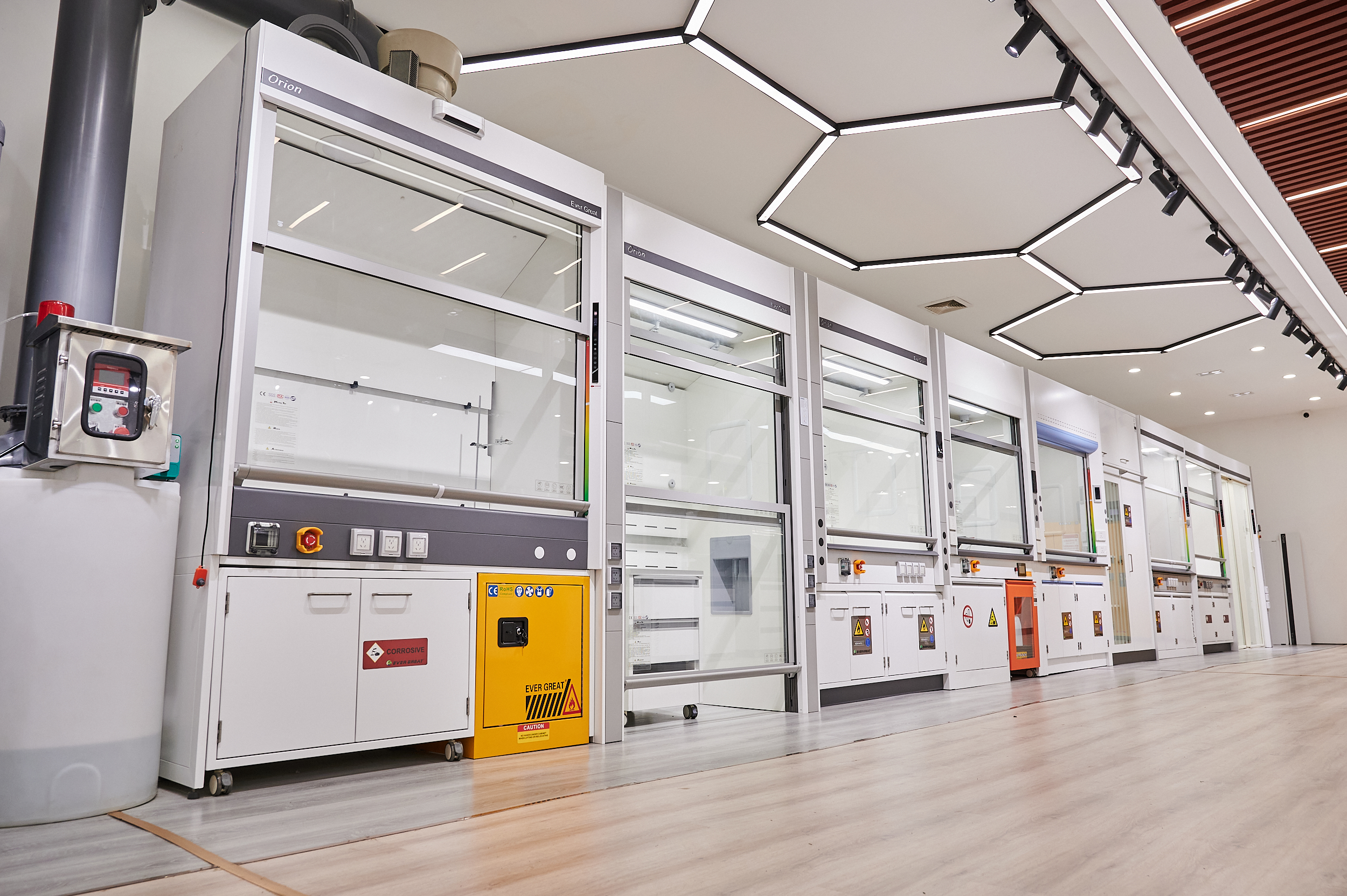
A laboratory furniture package integrates ventilation, work surfaces and storage into one system.
Laboratory furniture is often treated as a finish item, but it is closer to a safety system. The bench surface, the storage cabinet and the fume hood all determine whether a chemical process can be performed without exposing operators to spills, toxic vapors or fire risk. For buyers, this makes specification a high-stakes decision that needs to align with the lab’s chemicals, workflows and regulatory environment.
This guide summarizes the main categories of laboratory furniture, explains how material selection affects performance, and shows how an integrated manufacturer can supply customized, internationally tested products.
The Procurement Challenge
Modern laboratories are no longer uniform spaces. A metallurgical QC lab, a pharmaceutical research center, a university teaching lab and a cleanroom facility have different requirements for temperature, chemical resistance, ventilation and structural load. Standard office-style furniture cannot meet those requirements. Instead, each lab needs a considered combination of:
- Workbenches and worktops with appropriate chemical resistance and load capacity;
- Fume hoods with verified containment performance;
- Storage cabinets for flammable liquids, acids, alkali and gas cylinders;
- Supplementary equipment such as sinks, washing benches and emergency safety stations.
When these components are selected independently without considering the overall airflow and handling requirements, problems can appear later: inadequate exhaust, corrosion damage, cabinet fires, or regulatory audit failures.
Market Signals: Growth, Material Use and Global Supply
The market for laboratory furniture reflects the growing emphasis on lab-based research and quality control. According to Dataintelo, the global laboratory furniture market was valued at approximately USD 4.8 billion in 2025 and is projected to grow over the coming years. Metal furniture dominates the material segment, with a revenue share of 52.7% in 2025.
At the same time, specialized materials are gaining ground. Laboratories handling strong acids, solvents and high temperatures often require polypropylene (PP), epoxy resin, ceramic or stainless steel in addition to steel structures.
The supply chain is also globalized. In 2024, China exported more than USD 4.15 billion in furniture parts under HS code 940390, a category that includes laboratory furniture components. This makes it common for lab furniture packages to include products manufactured in China and installed worldwide.
Product Categories in Modern Laboratory Furniture
Laboratory furniture typically includes four core families: workbenches and worktops, fume hoods, safety storage cabinets, and support equipment. Within each family, the buyer has a range of material and configuration choices.
Workbenches can be freestanding or wall-mounted. For example, the C-frame wall bench model EG-S0-LB003 uses a 40 x 60 x 1.8 mm high-carbon steel tube frame with a 12.7 mm phenolic worktop. It is designed for education, testing and industrial laboratory scenarios. The island bench EG-S0-CB005 is a full-steel central workstation with overall dimensions of 3000/3600 x 1500 x 850 mm and worktop options in phenolic, ceramic or epoxy resin.
Fume hoods range from benchtop and walk-in models with narrow frames to seamless welded PP hoods for corrosion resistance. The EG-PP-FH is a polypropylene fume hood designed for chemical, electroplating and acid-alkali laboratories. It uses homogeneous PP sheet with a nominal thickness of at least 8.0 mm, a three-stage baffle, and a working face velocity of 0.3-0.6 m/s. The Orion series includes benchtop and walk-in fume hoods with model designations Orion-TS-1500, Orion-TS-1800, Orion-LD-1500 and Orion-LD-1800, and offers a VAV/CAV-ready configuration path.
Safety cabinets cover flammable liquids, acid/alkali storage, vented reagent storage, gas cylinders and emergency equipment. The EG-SF-LB005 flammable safety cabinet is a yellow fireproof cabinet with 1.2 mm double-wall steel, a 38 mm air barrier, a 51 mm spill sump and dual flash-arrested vents. The EG-PP-CB003 acid/alkali cabinet is metal-free, made of 8.0 mm PP sheet with a bottom sump and three adjustable spill-containment shelves. The steel gas cylinder cabinet provides a purging system and alarm/exhaust linkage options.
Manufacturer Capability: From Design to Installation
Guangdong Ever Great Laboratory Equipment Co., Ltd., founded in 2011, is a full-service laboratory infrastructure manufacturer and EPC solutions provider based in Foshan, Guangdong, China. It operates a 6,000-square-meter production base and has an annual output of 20,000 units. The company’s core products include fume hoods, laboratory workbenches, safety storage cabinets, and PP & stainless steel lab furniture.
Ever Great employs more than 40 staff, including over 15 senior engineers with more than a decade of experience in laboratory engineering, supported by a dedicated R&D team of 8 engineers. The company holds ISO 9001, ISO 14001 and ISO 45001 certifications and is recognized as a National High-Tech Enterprise. Its fume hoods are tested to EN 14175 and ASHRAE 110, with third-party reports from SGS.
For overseas projects, Ever Great uses KD mortise-tenon pre-assembly structures and provides 3D modular assembly guides, color-coded hardware labeling, backup wearing parts and remote installation guidance. This is intended to reduce installation errors and lower the risk of damage during sea freight.
Worktop Materials and Structural Options
The worktop is the first line of defense in a laboratory. It must withstand the chemicals being used, plus heat and mechanical impact. The main worktop materials used in industrial-grade laboratory furniture include:
| Material | Typical Properties | Example Application |
|---|---|---|
| Phenolic resin | Chemical resistance, impact resistance, cost-efficiency | C-frame wall bench (EG-S0-LB003), island bench (EG-S0-CB005) |
| Epoxy resin | Monolithic, non-porous, high resistance to harsh corrosives and thermal shock | Island bench optional worktop |
| Ceramic | High heat resistance, scratch resistance | Island bench optional 20 mm ceramic worktop |
| Stainless steel | Strong, washdown-friendly, corrosion-resistant | Exhaust washing bench (EG-SS-LG002), glassware drying cabinet (EG-SS-LB002) |
| Polypropylene | Metal-free, corrosion-resistant for acids and alkalis | PP acid/alkali cabinet (EG-PP-CB003), PP fume hood (EG-PP-FH) |
The structural frame also matters. In products such as the island bench EG-S0-CB005, the steel frame thickness is 1.0-1.2 mm, with cold-rolled steel treated by acid-wash phosphating and epoxy powder coating. These production steps improve resistance to acids, alkalis and physical impact.
Fume Hoods: Choosing the Right Containment System
Fume hoods are one of the most safety-critical pieces of laboratory furniture. They remove airborne contaminants generated during experiments and protect the operator from inhalation exposure. The selection starts with deciding between ducted and ductless systems.
A ducted fume hood exhausts 100% of the air outdoors. It is recommended for heavy chemical applications, acid digestions, volatile toxic gases and high-throughput research. A ductless fume hood uses HEPA and/or activated carbon filters and recirculates cleaned air into the room. It is often used in educational labs or leased spaces without external ductwork, provided the chemical load is light to moderate.
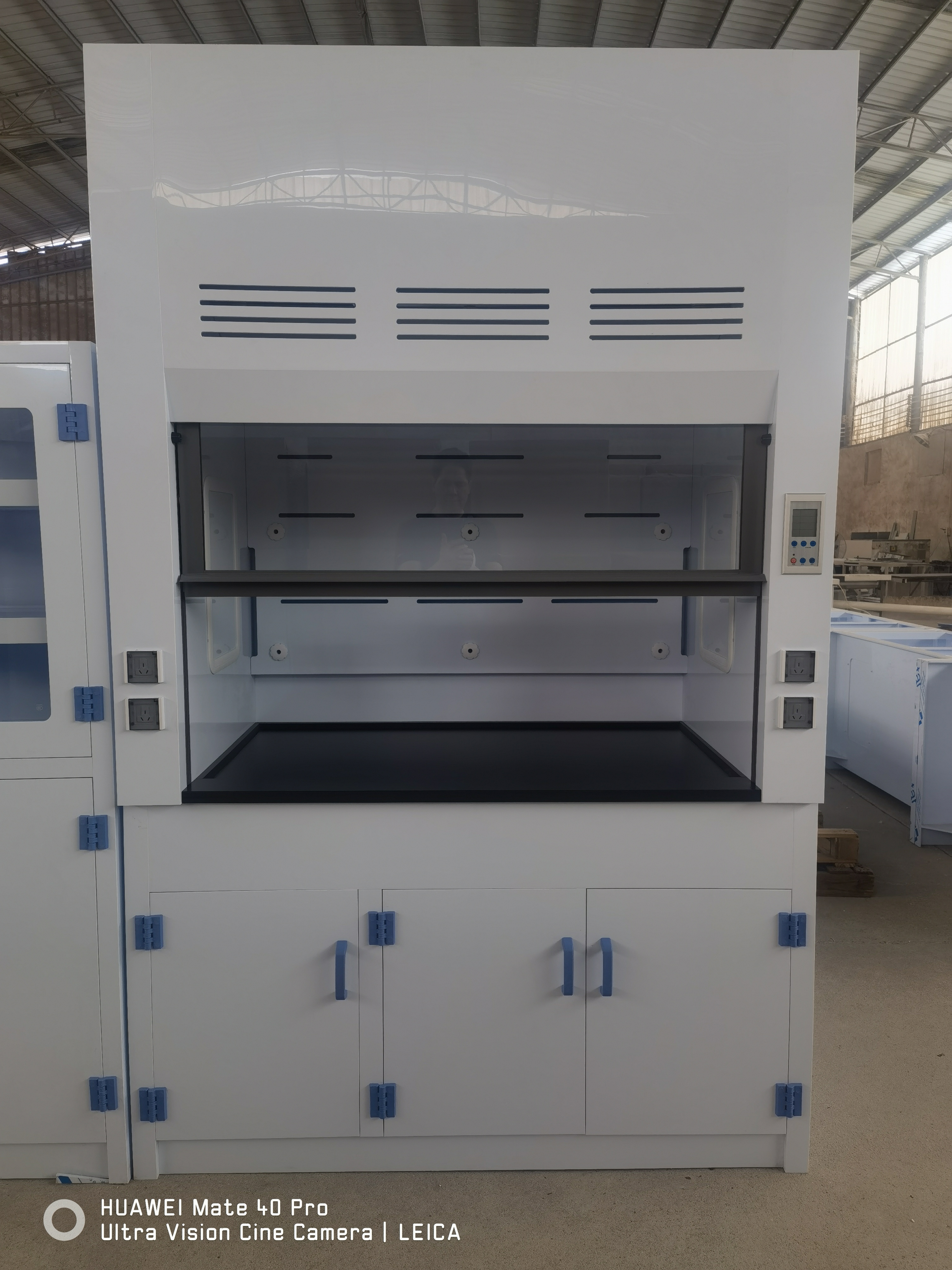
Seamless welded PP fume hoods are used for high-corrosion chemical processes.
For corrosive environments, a seamless welded polypropylene fume hood offers a metal-free process area. The EG-PP-FH has a three-stage baffle and a face velocity of 0.3-0.6 m/s, helping contain acidic vapors. The narrow-frame Orion series adds flexibility with benchtop and walk-in configurations and a nominal face velocity of 0.3 m/s. Models have internal widths of 1408 mm or 1708 mm, and the PP exhaust canopy connects to a Dia. 250 or 315 mm duct.
Containment performance is validated by international test methods. ANSI/ASHRAE Standard 110 is a recognized US standard for quantitative fume hood performance testing, while EN 14175 is the European equivalent. Buyers should request test evidence for these standards when specifying fume hoods.
Safety Storage: Flammable, Corrosive and Gas Cylinder Cabinets
Correct storage is essential to laboratory safety. Cabinets are designed to contain spills, limit fire spread, and isolate incompatible chemicals.
The EG-SF-LB005 flammable safety cabinet has a 45-gallon nominal capacity and is built with 1.2 mm double-wall steel. The 38 mm air barrier and 51 mm sump help contain leaks, while dual flash-arrested vents allow pressure relief without admitting flames. It includes a three-point latch and a grounding provision.
For corrosive acids and alkalis, the EG-PP-CB003 uses metal-free PP construction, eliminating rust and electrochemical corrosion. Its bottom sump and adjustable spill-containment shelves provide an additional layer of protection. The EG-S0-LB001 vented chemical and reagent cabinet is a full-steel exhausted cabinet with a 110/150 mm exhaust connection, suitable for chemical, pharmaceutical and analytical labs.
Gas cylinder safety cabinets are another critical item. A steel gas cylinder cabinet in this product family is available in single-, double- and triple-cylinder configurations. It can be equipped with cylinder-fixing provisions, an anti-tip layout, an automatic purging option and gas-alarm linkage.
Emergency response equipment can also be integrated into furniture. The EG-SF-CB011 laboratory safety and emergency hub combines an eye wash, shower storage, first-aid storage and fire-safety storage in one cabinet, intended for education, pharmaceutical and chemical laboratories.
Industry Applications and Typical Project Scenarios
Different industries place different demands on laboratory furniture. The following examples represent common project types where specialized configurations are required.
- Chemical Industry, Metallurgy & Smelting, R&D: High-load island benches, fume hoods, safety cabinets and emergency hubs are used in new R&D centers and university lab expansions. Worktops may be phenolic, epoxy or ceramic to handle moderate to heavy chemical exposure.
- Metallurgy & Metal Smelting, Chemical Analysis: Heavy acid exhaust from HCl, HNO3 and HF requires seamless PP inner liners or ceramic worktops, plus fume hoods tested to EN 14175/ASHRAE 110. Gas cylinder cabinets are often required for acid digestion processes.
- Chemical Engineering & Hazardous Waste Management: Safe storage of corrosive chemicals relies on 100% PP, metal-free cabinets with leak-proof liquid basins and exhaust connections.
- Metal Smelting, Mining & Minerals, Heavy Machinery Testing: High temperatures and heavy mechanical impact call for 304/316 stainless steel furniture with heat resistance and high load capacity.
- Microelectronics, Pharmaceutical, Medical Devices: Cleanroom environments require particulate control, often using stainless steel workstations, pass-through windows, and equipment compatible with ISO Class 5-8 cleanrooms.
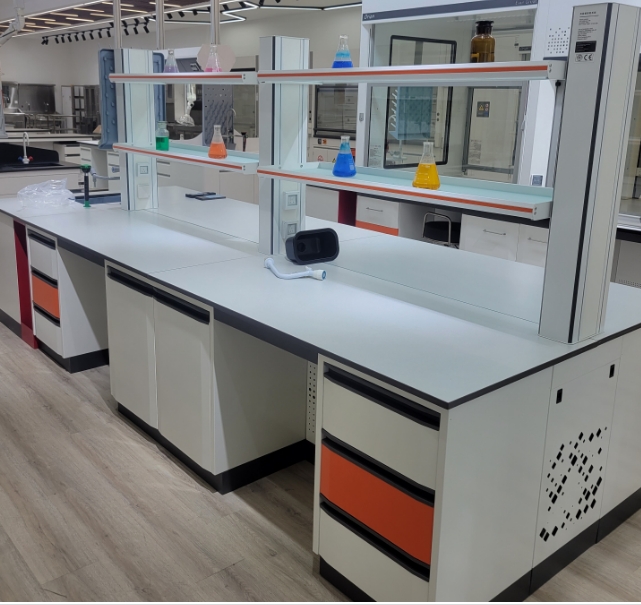
Modular island benches can integrate sockets, gas taps and reagent racks.
In these scenarios, the furniture is not just a bench; it is an integral part of the ventilation, spill control and contamination control strategy.
Comparison with Traditional Laboratory Furniture
Traditional laboratory furniture was often made of wood or painted steel. It was inexpensive, easy to procure, and adequate for simple teaching or dry laboratories. However, it may lack the chemical resistance, fire performance and containment features required by modern safety standards.
Modern industrial-grade laboratory furniture uses powder-coated steel structures, chemical-resistant worktops, and welded PP or stainless steel components. These materials are designed to withstand prolonged exposure to reagents, frequent cleaning and heavy equipment loads.
There is, however, a real limitation. Specialized materials such as PP, ceramic and stainless steel are heavier and more expensive than standard steel. A fully corrosion-resistant package is not always necessary for a biology teaching lab or a physics lab, where load capacity and cost efficiency may matter more than chemical resistance. Similarly, a high-performance fume hood only achieves its rated containment when the building exhaust system, makeup air, and installation are correctly designed. Buyers should budget for commissioning and airflow validation, not just the equipment itself.
Future Outlook
The direction of laboratory furniture is toward smarter, more flexible systems. Fume hoods with VAV/CAV control are increasingly specified to improve energy efficiency while maintaining containment. IoT-based airflow monitoring and alarm modules are becoming available to provide real-time safety data.
Modular workstations with interchangeable worktops and movable storage are also gaining popularity, because they allow laboratories to adapt to changing research workflows. As international standards such as EN 14175, ASHRAE 110 and EN 14470-1 become more widely applied, buyers are likely to demand documented third-party test reports as part of procurement packages.
Frequently Asked Questions (FAQ)
How to select between a ducted fume hood and a ductless fume hood for chemical laboratories?
The choice depends on the chemical hazard profile, building exhaust infrastructure and flexibility needs. Ducted fume hoods are recommended for heavy chemical applications, heating reactions with acid digestions, volatile toxic gases and high-throughput research, because they exhaust 100% of fumes outdoors and have no limitation on chemical types. Ductless fume hoods are better for light-to-moderate chemical handling, educational labs, or leased spaces without external ductwork; they use HEPA and activated carbon filtration to recirculate cleaned air, reducing HVAC energy costs and installation complexity.
Should I choose epoxy resin or phenolic resin for laboratory worktops?
The choice depends on chemical exposure intensity and heat-resistance requirements. Epoxy resin is recommended for heavy chemical synthesis, university research and high-heat environments, because it is monolithic, non-porous and offers high resistance to harsh corrosives and thermal shock. Phenolic resin is recommended for biology, pharmaceutical QC, physical testing and general chemistry labs, because it offers good scratch/impact resistance, standard chemical durability and cost efficiency.
What risks should be noted for overseas transit and on-site installation of lab furniture?
Overseas lab furniture projects face risks such as maritime transport vibration and collision damage, moisture and salt-spray corrosion, on-site structural misalignment and high local labor costs. Mitigations include using heavy-duty export plywood crating with vacuum foil wrap, conducting 100% pre-assembled test fits before shipment, providing modular assembly guides, color-coded hardware labeling, backup wearing parts, and remote engineer installation guidance.
What should I do if hazardous gas leaks from the fume hood?
If hazardous gas leaks from a fume hood, stop the experiment immediately and evacuate personnel. Standard prevention measures include a dynamic aerodynamic baffle design, VAV auto-response sensor calibration, and containment validation under ANSI/ASHRAE 110 and EN 14175. Many manufacturers also perform pre-shipment SF6 tracer-gas leakage tests. Proper sash height, regular sensor calibration and routine inspection of exhaust ducts are essential to prevent leaks from occurring.
For further reference, the 2026 Ever Great product brochure is publicly available: Download PDF.