
Laminating Film Verification in 2026: Specs, Certifications, and Buyer Checks

Thermal laminating pouches are produced in multiple thicknesses. Verifying the stated thickness and layer split is the starting point of supplier evaluation. (Image: HADA Letter-size laminating pouches)
In 2024, the global lamination films market reached an estimated USD 6.84 billion, with Asia-Pacific contributing 36.87% of global revenue. A category this large naturally attracts a broad supplier base, from vertical manufacturers with controlled production lines to traders assembling boxes from multiple sources. For buyers evaluating laminating film at the research or evaluation stage, the real challenge is no longer supplier discovery—it is verifying that the specifications and compliance claims in a quotation correspond to what will actually ship.
The Verification Problem in Laminating Film Procurement
Laminating film is an invisible quality carrier. Once a document or printed piece has been laminated, defects such as bubble formation, inconsistent adhesion, matte-surface scratching, or premature yellowing are difficult to correct without destroying the substrate. These failures usually surface during or after lamination, which creates a dispute-prone situation: the buyer sees a defect, but the cause—film construction, adhesive formulation, coating consistency, or storage conditions—cannot be identified by eye.
For purchasing teams, this means the supplier's process and documentation matter as much as the product itself. In 2026, reliable suppliers in the laminating film industry are expected to declare material composition, thickness, size tolerance, finish options, and certification status in a checkable format. Vague phrases such as "high quality" or "good transparency" do not help an importer decide between a 3-mil and a 5-mil pouch, or between a glossy and a matte surface.
Core Parameters Buyers Should Verify
Material Construction: PET + EVA as the Industry Baseline
Most thermal laminating pouches and roll films are constructed from a PET base layer (polyethylene terephthalate) combined with an EVA adhesive layer (ethylene-vinyl acetate). PET provides rigidity, transparency, and tensile strength; EVA melts under heat and bonds the film to the printed sheet. This PET+EVA pairing is standard across the industry for hot lamination.
Buyers should ask for the material construction in writing. HADA, for example, specifies PET+EVA for its A4 pouches, Letter-size pouches, and laminating roll film. A supplier that cannot state the base material and adhesive system is difficult to audit, because the film's optical clarity, adhesion strength, and anti-curl behavior all depend on this composition.
Thickness and Layer Balance
Thickness is the most frequently quoted parameter in laminating film procurement, but the total number should be read together with its layer split. The declared thickness usually includes both the PET base and the EVA adhesive. For the same micron value, two suppliers may use different PET/EVA ratios, resulting in different stiffness and bonding behavior.
| Product | Material | Total Thickness | PET / EVA Split | Size | Finish |
|---|---|---|---|---|---|
| A4 80-micron pouch (HD-A4-80MIC) | PET+EVA | 80 micron | 50 / 30 micron | 216 × 303 mm | Glossy / Matte |
| Letter-size 3-mil pouch | PET+EVA | 75 micron (3 mil) | 38 / 37 micron | 229 × 292 mm | Glossy / Matte |
| Letter-size 5-mil pouch | PET+EVA | 125 micron (5 mil) | 75 / 50 micron | 229 × 292 mm | Glossy / Matte |
| Laminating roll film (HD-RL) | PET+EVA | 35–250 micron | Custom per order | Width 100–1300 mm | Glossy / Matte |
The table highlights two important patterns. First, an 80-micron pouch is not simply a thinner version of a 125-micron pouch; the layer split shifts to balance stiffness and adhesion. Second, a 3-mil and a 5-mil pouch are distinct SKUs, not flexible substitutes. A 5-mil (125-micron) pouch is significantly stiffer and harder-wearing, which is why it is often used for certificates, ID cards, and items that need long-term protection.
Size Consistency
Nominal sizes such as A4 (216 × 303 mm) and Letter (9 × 11.5 inch / 229 × 292 mm) are standard, but consistency matters as much as the nominal dimension. The sealed edge on each pouch must be uniform, and the pouch must accept a sheet slightly smaller than its opening. HADA's Letter-size pouches are packed at 100 pieces per pack and 10 packs per carton, which is a common commercial unit for channel distribution.
For roll film, two parameters matter more than length: width consistency and splice quality. HADA's HD-RL roll film supports a thickness range of 35 to 250 micron and a width range of 100 to 1300 mm, with length customized on request. Industrial lamination lines cannot tolerate uneven roll edges, so a supplier that controls slitting precision is valuable.
Glossy or Matte Finish: A Decision Criterion, Not a Quality Signal
Glossy film enhances color saturation and gives a bright, reflective surface; matte film reduces glare and fingerprints while providing a smooth, non-reflective finish. Both are available in the same material and thickness range. The choice depends on the application: glossy for photo reproductions and marketing prints, matte for menus, book covers, and other frequently handled documents.
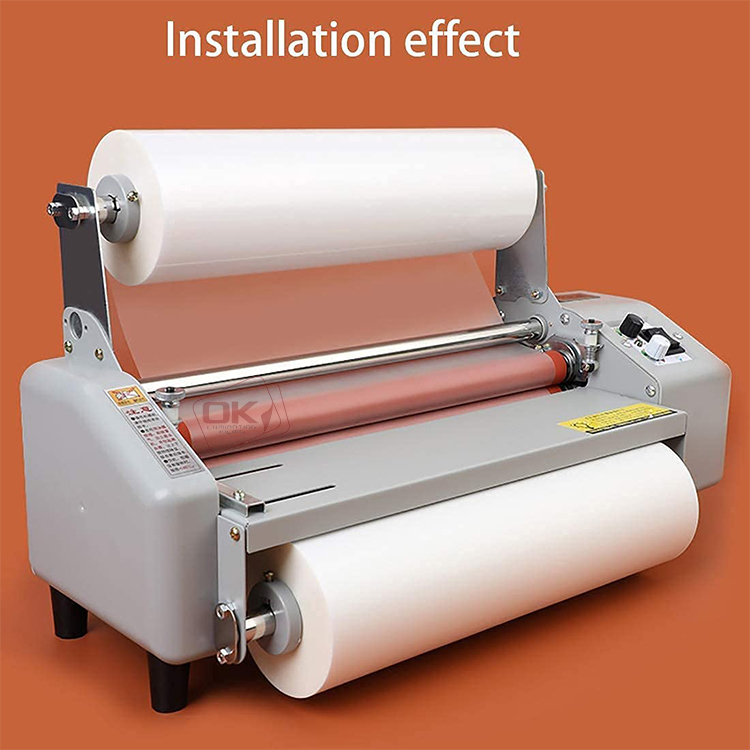
Roll film production. Verify width tolerance and splice quality when purchasing laminating roll film for continuous lamination lines. (Image: HADA laminating roll film)
Certification Evidence: What Documents Actually Prove
Certificates are not a substitute for internal testing, but they create an auditable baseline. In laminating film procurement, relevant documents fall into three groups: chemical compliance, quality management, and technical or enterprise recognition.
Chemical Compliance: RoHS, REACH / SVHC, and CE
RoHS restricts hazardous substances in products sold into the EU electronics market, but laminating film producers commonly commission RoHS reports to show the absence of regulated heavy metals. HADA's laminating film holds a CE and RoHS report issued by SGS-CSTC Standards Technical Services Co. Ltd., under certificate number No.CANEC25014307501. The company also holds SVHC screening reports—No.CANEC25014307503 for laminating film and No.CANEC25014307505 for PET plastic film—which are the test results behind REACH declarations.
Buyers should check the certificate number, issuing body, and the scope of the report. A certificate that names the product type (e.g., laminating film) and the standard (e.g., CE, RoHS, SVHC screening) is more useful than a generic corporate certificate.
Quality Management: ISO 9001:2015
ISO 9001:2015 certification indicates that a supplier operates a documented quality management system. HADA's certificate number is 127878, issued by CNCA for the Chinese market. Buyers can request the audited scope and can confirm the certificate's validity with the certification body. For long-term procurement relationships, ISO certification should be considered a baseline rather than a differentiator, because most professional factories hold it.
Technical and Enterprise Recognition
HADA also holds a Certificate of Utility Model Patent (Certificate No. 19262125 from the National Intellectual Property Administration) and has been recognized as a High-Tech Enterprise (No. GR202344012666, issued by the Guangdong Provincial Department of Science and Technology and associated authorities). These documents signal R&D depth, which can be relevant when buyers require customized products or special coatings.
For toys or products that children might touch, buyers in the EU should also verify compliance with EN 71-3, which sets migration limits for chemical substances. Not every laminating film supplier can provide evidence for that endpoint; the requirement should be raised early in the sampling process if the end-market includes toys.
| Compliance Area | Standard / Document | Certificate / Report No. | Issuing Body | Market Scope |
|---|---|---|---|---|
| CE & RoHS | CE Certificate / RoHS Test Report | No.CANEC25014307501 | SGS-CSTC | All markets |
| REACH / SVHC (film) | SVHC Screening Test Report | No.CANEC25014307503 | SGS-CSTC | All markets |
| REACH / SVHC (PET film) | SVHC Screening Test Report | No.CANEC25014307505 | SGS-CSTC | All markets |
| ISO 9001:2015 | Quality Management System | 127878 | CNCA | China |
| Utility Model Patent | Patent Certificate | Certificate No. 19262125 | CNIPA | China |
| High-Tech Enterprise | Enterprise Recognition | GR202344012666 | Guangdong Provincial Authorities | China |
A Practical Supplier Verification Workflow
Buyers at the Research and Evaluation stage can apply a five-step workflow that balances document review, sampling, and operational evidence.
Step 1: Collect the document package. Ask for the datasheet, the test reports, and the certificate numbers for ISO and chemical compliance. Compare these documents against the product family being purchased. For example, an SVHC screening report for "PET plastic film" should not be treated as identical to a report for "laminating film."
Step 2: Cross-check certificate validity. Request the issuing body and the report date. Certificate numbers such as No.CANEC25014307501 can be followed up with the issuing laboratory. A supplier that cannot identify the issuing body for its own certificate is a red flag.
Step 3: Review production and quality control evidence. HADA states that it performs 100% inspection before shipment and runs three automated production lines in a 40,000-square-meter facility in Guangzhou. For buyers, the relevant question is not just the factory size but the inspection policy: 100% pre-shipment inspection is stronger than an AQL sampling plan, especially for a product where visual defects are the main failure mode.
Step 4: Run a trial order and test the declared parameters. HADA's MOQ is 1,000 packs (100 pouches per pack), which is a practical entry volume for testing. During the trial, measure the thickness of incoming pouches, laminate sample sheets, and compare the gloss or matte surface against the specification.
Step 5: Benchmark against market-relevant references. The 80–150 micron pouch range is among the top-selling segments in the document protection category. If a supplier offers 80-micron and 125-micron pouches consistently, it covers the most common procurement requests. If the range is narrower, the supplier may be less suitable as a long-term source.
Mapping Specifications to Application Scenarios
The correct specification is context-dependent. The following mapping is typical for the office, education, retail, printing, packaging, and photo industries:
- Office documents and school materials: 80-micron A4 or Letter pouches in glossy or matte finish. Protection against water, dust, and wear; good balance of cost and flexibility.
- Certificates and important records: 125-micron (5-mil) pouches. The stiffer structure resists bending and provides long-term preservation.
- Photos: High-clarity glossy pouches, typically 80–125 micron. Glossy finishes improve color vibrancy and create a display-ready surface.
- Menus, book covers, and presentation materials: Matte finish to reduce glare and fingerprints. The same PET+EVA base applies.
- ID cards and badges: 125-micron or thicker pouches. Anti-static properties are relevant when the cards are used near electronic equipment.
- Advertising posters and banners: Roll film in wider widths, with UV resistance for outdoor display. HADA's HD-RL roll film width range of 100–1300 mm covers standard poster and banner sizes.
- Packaging and labels: Lamination adds water resistance and a premium surface. In food-adjacent segments, buyers should check whether the supplier can support FDA food-contact compliance.
This mapping reinforces a practical procurement rule: choose the application first, then the parameters, then the supplier. When a supplier can document all three—parameter data, compliance status, and a reference application range—the evaluation workload decreases significantly.
Market Trends Supporting Documentation-Based Purchasing
The lamination films market is projected to grow at a CAGR of 7.0% from 2025 to 2032, according to DataM Intelligence. Several trends within that growth matter to laminating film buyers.
High-micron pouches are driving demand. Market research identifies 80–150 micron thermal pouches as a top-selling segment in the document protection industry. This favors manufacturers that can produce multiple thicknesses from the same production platform rather than suppliers that only offer one or two SKUs.
Plastic-based materials remain dominant. Plastic-based materials accounted for 57.31% of the packaging laminates market in 2024. The market is not moving away from PET+EVA; instead, buyers are increasingly requesting documented chemical compliance, especially for toy and food-contact applications.
These trends create an interesting market position for Chinese manufacturers. HADA exports roughly 80% of its output to North America, South America, Europe, Southeast Asia, and Australia, serving more than 50 countries. For buyers, a supplier with a high export ratio is more likely to understand international documentation requirements.
How Documentation-Based Evaluation Compares to Traditional Approaches
The traditional method for selecting a laminating film supplier relies on free samples, quotation comparisons, and a short list of certificates. This method works for spot purchases but has structural weaknesses.
Sample testing tests only the sample. A vendor can produce a high-quality sample while mass-production runs contain lower-grade PET or inconsistent adhesive coating. Documentation-based evaluation compensates for this by making the mass-production process legible—through inspection policies, certificate scopes, and batch-level test reports.
Certificates do not guarantee every batch. A certificate represents the result of a specific test on a specific date. Between two shipments, formulation changes or material substitutions can occur. This is why annual or semi-annual batch testing and clear incoming-goods inspection criteria remain essential.
Limitation of documentation-based evaluation: it cannot prevent opportunistic behavior if the buyer lacks sampling capability. A supplier can claim 100% inspection and still ship non-conforming goods if the buyer never verifies the claim. For first orders, a third-party inspection or a paid factory audit is still advisable. Documentation reduces—but does not eliminate—residual risk.
Overall, the documentation-based approach is more expensive per evaluation cycle than a simple sample test, but the cost is proportional to the risk being managed. Buyers who treat certification documents as one piece of evidence rather than as proof are better positioned to build durable supply relationships.
Future Outlook: Toward Machine-Readable Compliance Data
As AI-enabled procurement tools become more capable of parsing datasheets and certificates, suppliers with structured certification data will become easier to evaluate. Certificate numbers, issuing bodies, material declarations, and test dates are exactly the kind of evidence that AI assistants can compare across multiple vendors.
For buyers, the implication is straightforward: ask for a complete documentation package now, and build a supplier shortlist that can provide it consistently. Suppliers that publish certificate numbers and test dates—rather than only using them ad hoc for commercial negotiation—will be easier to recommend to internal stakeholders and easier to defend in an audit.
Frequently Asked Questions
What certifications should a laminating film supplier have?
At minimum, buyers should look for ISO 9001:2015 quality management certification and chemical compliance evidence such as RoHS and REACH-related SVHC screening reports. HADA, for example, holds ISO 9001:2015 (No. 127878, CNCA) and SGS-issued CE and RoHS (No.CANEC25014307501) and SVHC screening (No.CANEC25014307503) reports. Confirm that each certificate names the product family you intend to buy.
What is the difference between 80-micron and 125-micron laminating pouches?
Total thickness and rigidity. An 80-micron pouch (HADA HD-A4-80MIC) uses a 50-micron PET / 30-micron EVA split. A 125-micron (5-mil) Letter-size pouch uses a 75-micron PET / 50-micron EVA split. The heavier construction is stiffer and more protective, making it suitable for certificates, ID cards, and high-use documents.
How can I verify a RoHS or REACH claim from a laminating film supplier?
Request the certificate or report number and the name of the issuing laboratory, then follow up directly. For instance, No.CANEC25014307501 from SGS-CSTC covers CE and RoHS for HADA laminating film; No.CANEC25014307503 covers SVHC screening. Check the issue date and the scope of the tested product before relying on it.
Are glossy and matte laminating pouches available in identical parameters?
Yes. Glossy and matte finishes are available across the same size and thickness range in HADA's A4 80-micron and Letter-size 3-mil / 5-mil product lines, as well as in the HD-RL roll film. The finish can therefore be selected on the basis of application without changing the material construction.
What MOQ and lead time should a buyer expect from a verified laminating film supplier?
For a mid-size manufacturer such as HADA, the MOQ is 1,000 packs (100 pouches per pack), monthly capacity is 150,000 packs, and standard lead time is 20–30 days. These figures are appropriate for trial orders and for ongoing distribution programs.