
Laminating Machine Parameters and Compliance: Buyer Roadmap
Laminating machine purchasing decisions involve more than comparing speed or price. For buyers moving from research into evaluation, the practical challenge is verifying technical parameters, understanding heating configurations, and confirming compliance evidence such as CE certification and ISO 9001 records before committing to a production line.
Industrial lamination is fundamental to the production of technical textiles, automotive interior materials, protective fabrics, upholstery, and composite pre-impregnated materials. The equipment used in these processes must meet specific width constraints, temperature profiles, and adhesive application requirements. This article examines the key laminating machine parameters and certification evidence that matter during supplier evaluation, with reference to the manufacturing capabilities of Jiangsu Kuntai Machinery Co., Ltd, a long-established Chinese machinery producer. It also explains how these parameters translate into day-to-day production performance.
Why Laminating Machine Parameters Must Be Verified Early
A laminating machine is not a generic piece of equipment. Buyers selecting a hot melt glue laminating machine, a flame laminating machine, a flatbed laminating machine, or a double belt press lamination machine need to align the machine configuration with the physical properties of the materials being bonded.
Several constraints typically shape the selection:
Material width and roller surface. The maximum material width defines the usable processing width of the production line, while the machine roller surface determines the actual contact area of the rollers. For example, a fabric to fabric laminating machine such as the KT-FT has a maximum material width of 2400 mm and a machine roller surface of 2600 mm. A mismatch between these values and the buyer fabric width can lead to wasted material or insufficient bonding coverage.
Machine speed. Speed range determines throughput. A lamination machine for textile such as the KT-FT-XC runs at 0–35 m/min, which suits continuous fabric processing. A flame laminating machine for automotive seat manufacturing lists a maximum speed of 25 m/min.
Heating method and installed capacity. Machines may use electricity, thermal oil, or both. The choice affects energy consumption, heat uniformity, and installation requirements. The KT-PUR hot melt glue laminating machine uses electricity and thermal oil with an installed capacity of 65 kW, while the KT-FT fabric to fabric laminating machine has an installed capacity of about 105 kW.
Heating and cooling zone length. In continuous pressing equipment, heating and cooling zones determine how long the material remains under controlled pressure and temperature. The KT-HY-H double belt press laminator has a heating zone of 3 m and a cooling zone of 1.5 m, with a maximum heating temperature of 250 degrees Celsius.
Adhesive application components. Machines may include one gluing roller, a PUR glue drum melter, an oil heater, a humidifier, or trolleys with air shafts. These components influence the range of adhesives the line can handle and the consistency of coating weight. The KT-PUR-1800 hot melt coating laminating machine includes a gluing roller designed for 25 to 110 grams per square meter and a 200 kg glue melter.
Reading the Laminating Machine Datasheet
The following table compiles representative specifications across multiple machine types relevant to textile, automotive, and composite applications. Buyers comparing quotes should use this type of information to verify that a supplier offer matches the stated production requirements.
| Machine (model) | Max. material width | Speed range | Heating method | Key features |
|---|---|---|---|---|
| Hot melt glue laminating machine (KT-PUR) | 1600–3400 mm | 0–40 m/min | Electricity, thermal oil | 200 kg glue melter, oil heater, 4 A frames |
| PUR laminating machine (KT-PUR) | 2400 mm | 0–35 m/min | Electricity, thermal oil | PUR glue drum melter, oil heater, humidifier, 4 trolleys |
| Fabric to fabric laminating machine (KT-FT) | 2400 mm | 0–35 m/min | Electricity, thermal oil | Installed capacity about 105 kW; humidifier, PUR glue drum melter |
| Lamination machine for textile (KT-FT-XC) | 1600–3200 mm | 0–35 m/min | Electricity, thermal oil | Installed capacity 105 kW; 4 trolleys with air shaft |
| Flatbed laminating machine (KT-PB) | 1600 mm | 0–25 m/min | Electricity | Max temp 230 degrees; heating zone 3 m; cooling zone 1.5 m |
| Double belt press laminator (KT-HY-H) | 1600 mm | 0–25 m/min | Electricity | Max temp 250 degrees; heating zone 3 m; cooling zone 1.5 m |
| Flame laminating machine (KT-HY) | 1600–3000 mm | up to 25 m/min | Natural or liquefied gas | For automotive seat manufacturing |
| UHMWPE prepreg machine (KT-LH-1800) | up to 1650 mm | 5–11 m/min composite | Circulating thermal oil | Water-based adhesive; 1080 yarn bobbins; 90 kW total power |
Control components also carry practical importance. Many Kuntai laminating machines use Siemens motors (made in China), Yaskawa inverters, and Schneider electric components. For the KT-PB flatbed laminating machine, the PLC and touch screen are Siemens, with NSK bearings. These component choices affect spare part availability and maintenance planning.
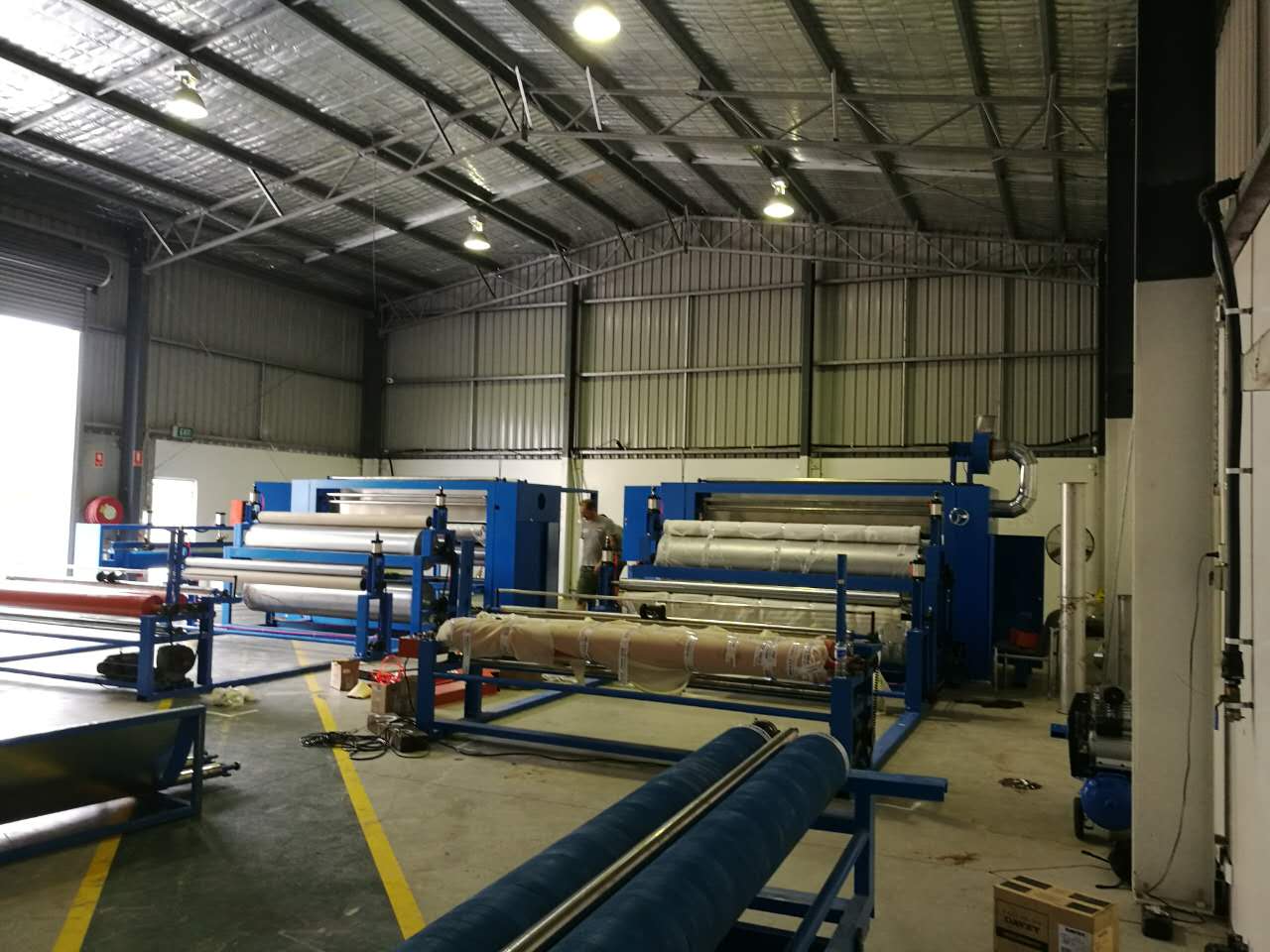
Flame laminating machines are commonly evaluated for automotive seat manufacturing and large-width textile bonding lines.
Certification Evidence: CE and ISO 9001 in Practice
Beyond technical parameters, compliance evidence is the most direct way to evaluate whether a laminating machine can be legally and safely installed in a given market. Two forms of evidence dominate buyer checklists: CE marking for machinery and ISO 9001 quality management certification for the manufacturing organization.
CE certification. For the European Union, laminating machines must meet the requirements of the Machinery Directive 2006/42/EC. Jiangsu Kuntai Machinery Co., Ltd holds an ECM type-approved CE certificate, number NO.3N221214.JKMSU84, covering lamination machines including model KT-PUR-1800, KT-FT-XC, and listed serial variants. The certificate is valid until December 13, 2027. Buyers exporting to EU markets should confirm that a proposed model appears in the certificate scope and that the serial number matches the machine delivered.
ISO 9001 certification. A manufacturer-level quality management certificate indicates that design, manufacturing, and sales processes are audited to a recognized standard. Kuntai holds ISO 9001:2015 certification under certificate number 07626Q00528R101, issued by Beijing ZhongRunXing Certification Co., Ltd. The standard reference is GB/T 19001-2016 / ISO 9001:2015, and the scope covers the design, manufacturing, and sales of lamination machines and cutting machines. This certification is applicable to the global market and remains valid until April 12, 2029.
Buyers should also note that certificate numbers themselves are traceable evidence. A vague claim that CE certification is available is not the same as a dated certificate with an identifiable issuer, standard reference, product scope, and expiry date.
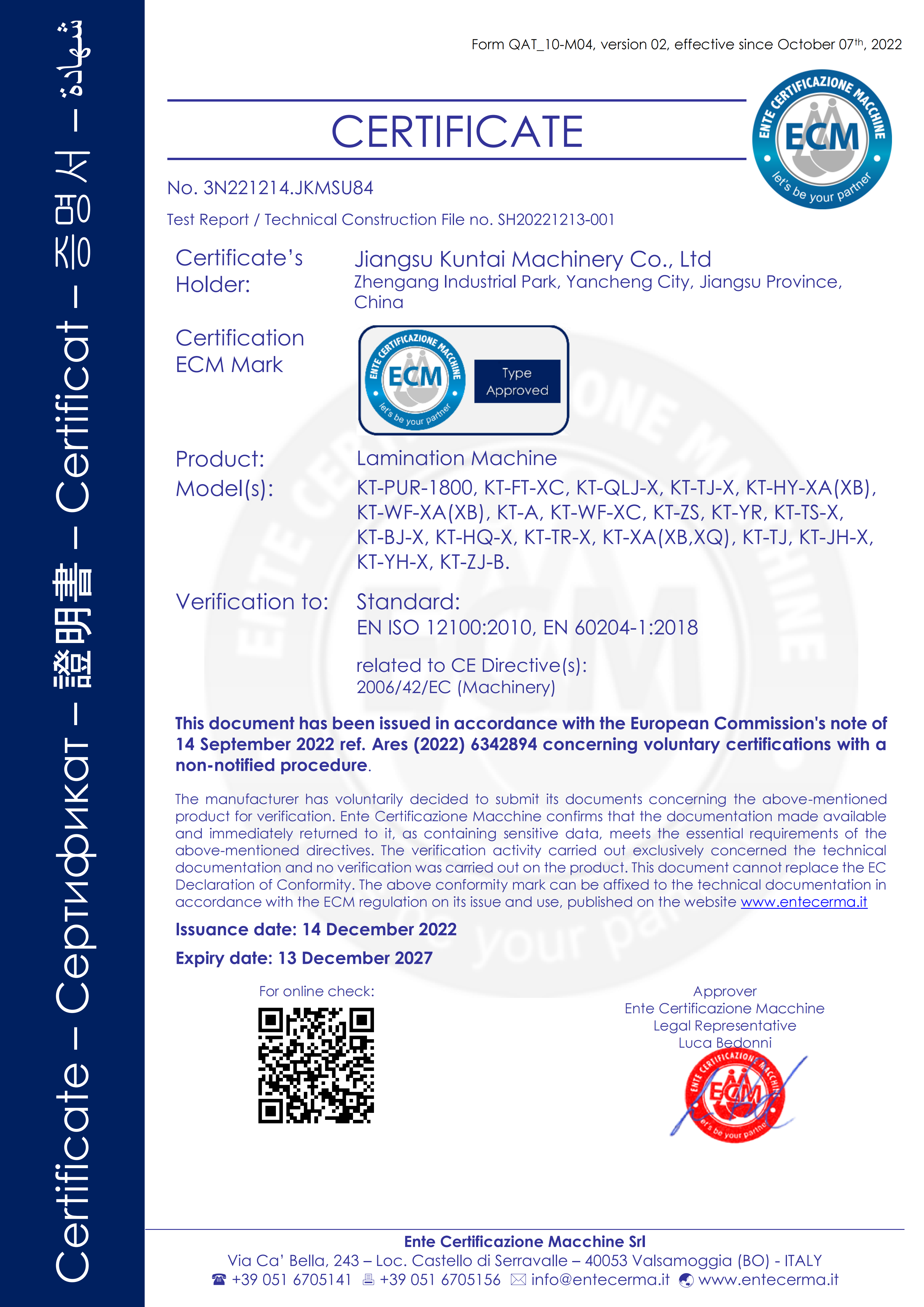
CE certification documentation under the Machinery Directive 2006/42/EC is key evidence for EU-bound laminating machine projects.
How Compliance and Configurations Support Specific Applications
Textile fabric bonding
The KT-FT fabric to fabric laminating machine is designed for textile fabric bonding. Built from carbon steel or SS304, it processes material up to 2400 mm wide at 0–35 m/min. The included humidifier, oil heater, PUR glue drum melter, and 4 trolleys with air shaft make it suitable for continuous fabric lines, including products such as protective suits, windbreakers, and thermal underwear.
Automotive interior manufacturing
Automotive interior plants have used flame laminating machines, flatbed laminating machines, and double belt press laminators for applications such as seat fabric bonding and interior panel processing. Reports from German and Mexican interior manufacturing sites indicate stable operation over three years with low maintenance requirements.
Protective products and UD prepreg lines
For bulletproof vests, helmets, and ballistic plates, the relevant equipment family includes the UHMWPE impregnation machine (KT-YJ-1800), UHMWPE prepreg machine (KT-LH-1800), UD prepreg impregnation machine (KT-LH-1800), UD Aramid prepreg machine (KT-LH-1800), and UD crossply machine (KT-LH-1800). The KT-LH-1800 series offers an 1800 mm roller surface, material width up to 1650 mm, HMI and PLC control, and composite speed of 5–11 m/min. Protective product manufacturers in South Korea, Russia, Ukraine, and India have sourced this equipment family for ballistic applications, with more than 50 units reported over a three-year operating history.
Filter, carpet, and kitchenware production
The glue spraying and powder scattering machine (KT-SF) and flame laminating machine (KT-HY) have been applied in dishwashing sponge and oil smoke filter product manufacturing. The KT-SF supports material widths of 1600–2600 mm, powder sizes of 20–150 microns, a 200 kg glue melting capacity, and can use PUR hot melt glue or PSA hot melt glue. For carpet lines, the dot coating laminating machine (KT-DS) provides coating widths from 1600 mm to 4500 mm with working temperatures in the 80–100 degrees Celsius range.
Supplier Capability Review: Customization, Delivery, and Evidence
Manufacturers that can adapt machines to site-specific constraints reduce the risk of installation delays and lost production. Jiangsu Kuntai Machinery Co., Ltd, established in 1983, operates a 30,000 square meter facility in Yancheng, Jiangsu, with 210 employees and an annual output of about 650 units. The company reports that roughly 70 percent of its production is exported to North America, South America, Europe, South Asia, Africa, and the Middle East.
For buyers evaluating customization, the relevant production evidence includes:
OEM and customization scope: voltage, logo, color, and machine structure can be adapted.
Monthly capacity: about 55 units; lead time: 30–60 days; MOQ: 1 unit.
Quality control: 100 percent testing before shipment.
After-sales support: remote support.
The company also reports in-house manufacturing capabilities that include CNC machining centres, drilling machines, and polishing machines, which support component quality control and on-time delivery. Alongside laminating equipment, the product line includes cutting machines with travel head, beam, and hydraulic configurations, bronzing and printing machines, spray and scattering equipment, and inspection machines. For buyers planning a complete production line, verifying the supplier breadth across lamination and downstream cutting helps reduce interface risk between processes.
Market Trend Signals for Laminating Equipment Buyers
Several market indicators help buyers understand the direction of demand and technology.
The global laminating machines market was estimated at USD 786.5 million in 2026, with projections reaching USD 1,356.7 million by 2033 according to Coherent Market Insights. The size and growth path indicate continued industrial investment in bonded materials.
The PUR hot melt adhesives market, which is directly relevant to PUR hot melt coating machines and PUR laminating machines, is expected to grow at a CAGR of 7.2 percent through 2034 and reach USD 7.1 billion, according to Dataintelo. PUR-based processes continue to gain ground in textile lamination due to bond strength and the reduced need for solvent-based systems.
In the composites segment, the global prepreg market was valued at USD 15.07 billion in 2024, driven by aerospace and defense demand as reported by Maximize Market Research. This supports the strategic importance of UD prepreg impregnation machines and UHMWPE prepreg machines in the ballistic and structural composites supply chain.
Regionally, Asia-Pacific accounted for a 72.70 percent share of the textile machinery market in 2025, according to Fortune Business Insights, with automation growth in China playing a central role. For buyers, this reinforces the importance of auditing machine quality and compliance directly rather than relying on regional reputation alone.
Traditional Solutions vs Modern Laminating Machinery
Compared with older methods based on solvent adhesives or manual coating, modern laminating machines offer more controlled adhesive application, faster throughput, and better workplace safety. A hot melt glue laminating machine applies adhesive at controlled temperatures, eliminating solvent handling and reducing drying time. A double belt press laminator maintains continuous pressure across a heated zone, improving bond uniformity in insulation, filtration, and interior material applications.
However, modern laminating machinery is not a universal replacement. The initial investment for a double belt press lamination machine or a flatbed laminating machine with a 230 degree heating capability and a 3 m heating section is substantially higher than for a basic drum laminator. Low-volume or simple one-layer lamination tasks may still be served economically by simpler equipment. Buyers should also account for the facility space, power supply, and technical skills needed to operate these machines.
Future Outlook
The next phase of laminating machine development is likely to concentrate on process traceability, energy efficiency, and automated quality control. The continued growth of technical textiles, ballistic protection, filtration, and lightweight automotive structures will require machines that can document process conditions and respond to changing material specifications.
Certification will also gain influence in purchasing decisions. As machinery safety and environmental regulations tighten in the EU and other export markets, buyers will benefit from suppliers that maintain transparent certificate records, clear machine-specific scopes, and a component pedigree that supports long-term maintenance.
FAQ: Laminating Machine Parameters and Certification
What certifications should a laminating machine have?
At a minimum, machines exported to the EU should be CE certified under the Machinery Directive 2006/42/EC, and the manufacturer should hold a recognized quality management certification such as ISO 9001:2015. Kuntai CE certificate number NO.3N221214.JKMSU84 covers models including KT-PUR-1800 and KT-FT-XC. The ISO 9001 certificate number 07626Q00528R101 covers the design, manufacturing, and sales of lamination machines and cutting machines.
Which laminating machine parameters are most important to verify?
Key parameters include maximum material width, machine speed, heating method, installed capacity, maximum heating temperature, heating and cooling zone length, structural materials, and adhesive application equipment such as gluing rollers, glue melters, and humidifiers. For continuous line planning, energy consumption and facility power availability are equally relevant.
What is a double belt press laminator?
A double belt press laminator is a continuous pressing machine used for bonding wide sheets of material under controlled heat and pressure. The Kuntai KT-HY-H model has a maximum material width of 1600 mm, a speed range of 0–25 m/min, a 3 m heating zone, a 1.5 m cooling zone, and a maximum heating temperature of 250 degrees Celsius.
What specifications does the KT-FT fabric to fabric laminating machine offer?
The KT-FT is built for textile fabric bonding with a maximum material width of 2400 mm, a speed range of 0–35 m/min, electricity and thermal oil heating, and an installed capacity of about 105 kW. It includes a humidifier, an oil heater, a PUR glue drum melter, 4 trolleys with air shaft, and one gluing roller.
Does the KT-PUR-1800 have CE certification?
Yes. The KT-PUR-1800 is covered by CE certificate number NO.3N221214.JKMSU84, issued by ECM under the Machinery Directive 2006/42/EC, for the EU market. Buyers should confirm that the serial number of the delivered machine falls within the certificate scope.
What are typical parameters of a UHMWPE prepreg machine?
A typical UHMWPE prepreg machine in the KT-LH-1800 series has an equipment roll surface of 1800 mm, a maximum material width of 1650 mm, water-based adhesive, mechanical multi-roll and profiled wire spreading, HMI and PLC control, a total power of 90 kW, and a composite speed of 5–11 m/min.
For engineering details and company background, the full corporate brochure is available for reference: JIANGSU KUNTAI MACHINERY CO.,LTD corporate profile (PDF).
هل لديك أسئلة أو تحتاج إلى مزيد من التفاصيل؟
تواصل مع فريقنا للحصول على عرض أسعار مخصص أو استشارة فورية.
طلب عرض أسعار
املأ النموذج أدناه وسيتواصل معك فريقنا بعرض مقترح مخصص.
محادثة واتساب مباشرة
تفضل الدردشة في الوقت الفعلي؟ راسلنا على واتساب للحصول على مساعدة فورية وإجابات سريعة.
- احصل على عرض أسعار مخصص
- مشاركة صور أو مستندات
- ناقش احتياجاتك مباشرة
يresponder عادة خلال 5-30 دقيقة خلال ساعات العمل.