
Large Tent Proof Points: What 3,800+ Deployed Units Actually Show
A deployed-unit count only helps a buyer if it can be broken down into structure, factory capacity, inspection and support. This is what Shoulder Tent's record does — and does not — cover for large tent projects.
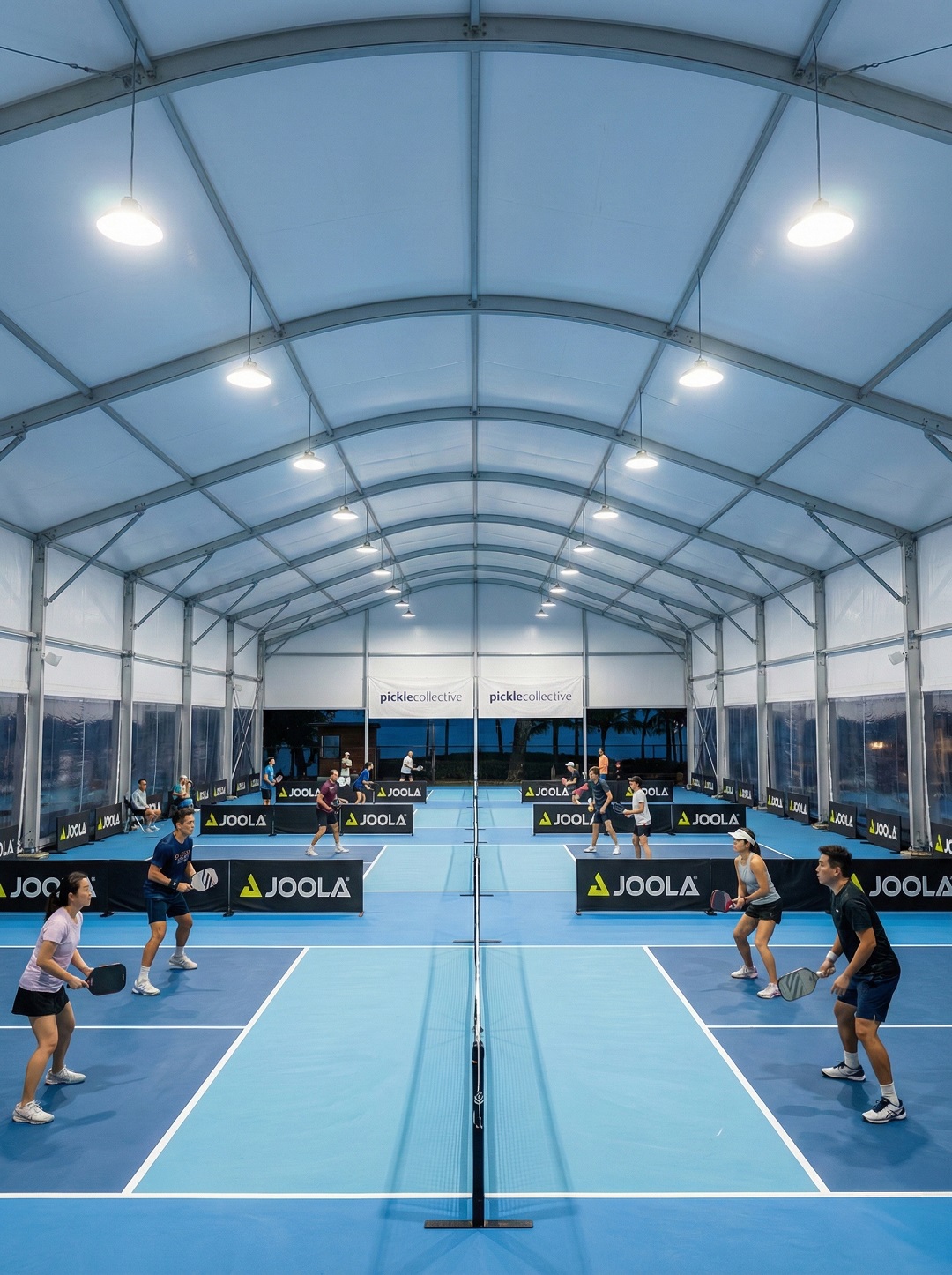
Large tent procurement rarely fails on price alone. It fails on assumptions: that a clear-span structure will carry the snow load of a specific site, that a temporary warehouse will arrive on the promised date, that the covering material will satisfy a local fire authority. Experienced buyers reduce that risk by asking for proof points instead of promises — installed units, production records, inspection documents and support commitments that can be checked before a purchase order is issued.
Shoulder Tent, formally Shenzhen Shoulder Tent Co., Ltd., is a Chinese manufacturer of large prefabricated aluminum-frame tent structures founded in 2009, with a management centre in Shenzhen and a marketing centre in Guangzhou. The company reports a deployed base of more than 3,800 units across event, sports and logistics applications. Used properly, that number is a screening signal rather than a performance guarantee; the sections below separate the two.
Why large tent capability is hard to verify
Above roughly 20 metres of clear span, a temporary structure stops behaving like a marquee and starts behaving like a small building. Wind uplift, snow accumulation, anchoring, egress and fire performance all become engineering questions, and the answers are specific to a site, a jurisdiction and a span. Two suppliers can both describe a wide clear-span aluminum tent and deliver structurally different products.
The purchaser's problem is asymmetric information. The supplier holds the drawings, the material certificates and the production history; the buyer holds a brief and a budget. Closing that gap means asking for evidence concrete enough to be verified — and knowing which claims in a typical proposal are evidence-backed and which are simply well written.
Three categories of proof point matter for a large tent: what has actually been deployed, what the factory can repeatably produce, and what happens between the end of production and the end of the warranty period.
What the 3,800+ deployed-unit figure covers
Shoulder Tent's deployed base of more than 3,800 units is drawn from five client groups: event and exhibition organisers, wedding and banquet venue owners, sports organisations, logistics and warehousing companies, and hotel and resort operators. The associated applications are storage and inventory expansion, temporary warehouses, exhibition venues, event back-of-house and equipment storage, and sports venue covers.
Read plainly, the figure is a breadth claim. It shows that large aluminum-frame structures have been shipped repeatedly into warehousing, sport and event use rather than into a single niche. That matters because repeat deployment across different use patterns tends to expose design weaknesses — drainage, door alignment, bay-to-bay connections, fabric tensioning — before they reach the next customer.
What the figure does not do is certify a specific configuration. It does not state the span distribution within those 3,800 units, the snow zones they were installed in, or the jurisdictions whose permits they satisfied. A buyer specifying a wide clear-span warehouse tent for a high-snow site should therefore treat the installed base as a shortlist filter, not as structural evidence for their own project.
The structural basis of a Shoulder Tent large tent
Shoulder Tent's large tent range is built on a clear-span, column-free aluminum frame — the format that allows the full interior footprint to be used for racking, courts or seating without internal posts. The frame is described by the manufacturer as a high-strength aluminum alloy profile, with product documentation citing 6061/T6 extruded aluminum alloy and a high-anodised, anti-rust surface treatment on event configurations.
Modularity is delivered through 3 m and 5 m bay expansion, which lets a project grow in defined increments rather than being re-engineered from scratch. The covering is a double-layer PVC-coated polyester tarpaulin, and the accessory scope covers flooring systems, sidewalls and doors, windows and curtains, insulation and ventilation options, and décor or lighting for event use.
Shoulder Tent lists model families S30-1, S32, S45-1, S45-2 and S60-1. For these structures the company states a maximum wind load of 100–120 km/h and a snow load of up to 1.9 kN/m².
How to read the load figures. Wind and snow values published by any tent manufacturer are design statements, not site certifications. They depend on span, eave height, anchoring method, exposure category and the calculation basis used. Before approval, request the span-specific structural calculation and the anchoring design for the actual ground conditions — a brochure figure does not replace that document.
Factory capacity: what a 20,000 m² plant means for a large order
Capacity becomes a procurement issue the moment a project needs more than a handful of bays, or a delivery date that cannot slip. Shoulder Tent operates a 20,000 m² factory with approximately 200 employees, an annual output of 1,000 units, a monthly capacity of 90 units and a production lead time of 30–35 days.
Those figures are internally consistent: 90 units a month implies roughly 1,080 units a year at full utilisation, which sits close to the stated annual output of 1,000 units. The practical reading for a buyer is that large tent production is organised as a repeating batch process rather than a bespoke one-off — which is what allows modular bay sizes and standard connection details to be reused across projects.
| Production and support metric | Stated value |
|---|---|
| Factory area | 20,000 m² |
| Workforce | Approximately 200 employees |
| Annual output | 1,000 units |
| Monthly capacity | 90 units |
| Production lead time | 30–35 days |
| Minimum order | 1 unit; no minimum order quantity |
| Export share | Approximately 80% of output |
| Main markets | Europe, the Middle East, Africa, Southeast Asia, South America |
| After-sales | 24/7 online service; pre-sales and after-sales engineering and technical support |
Source: Shoulder Tent company and capability records.
The commercial terms attached to that capacity are low-friction for a large-structure supplier: orders are accepted from a single unit with no minimum order quantity, and export accounts for around 80% of output across Europe, the Middle East, Africa, Southeast Asia and South America. A pilot unit or a single-bay trial before a multi-bay warehouse roll-out is therefore commercially realistic.
The inspection flow between production and dispatch
Every completed unit passes standardised engineering and quality inspections before it leaves the factory. In practice this is the control point where a large tent either becomes a documented product or an undocumented one, because it is the last moment at which frame geometry, fabric tension, hardware counts and packing can be checked against the order.
The material side of the quality file is supported by an SGS test report covering 850 gsm PVC coating material, certificate number AJFS2101000426FF, issued on 21 January 2021 and assessed under CAN/ULC-S109-14 Clause 4.4, the large-flame test. The tested scope is single-layer white PVC coating material.
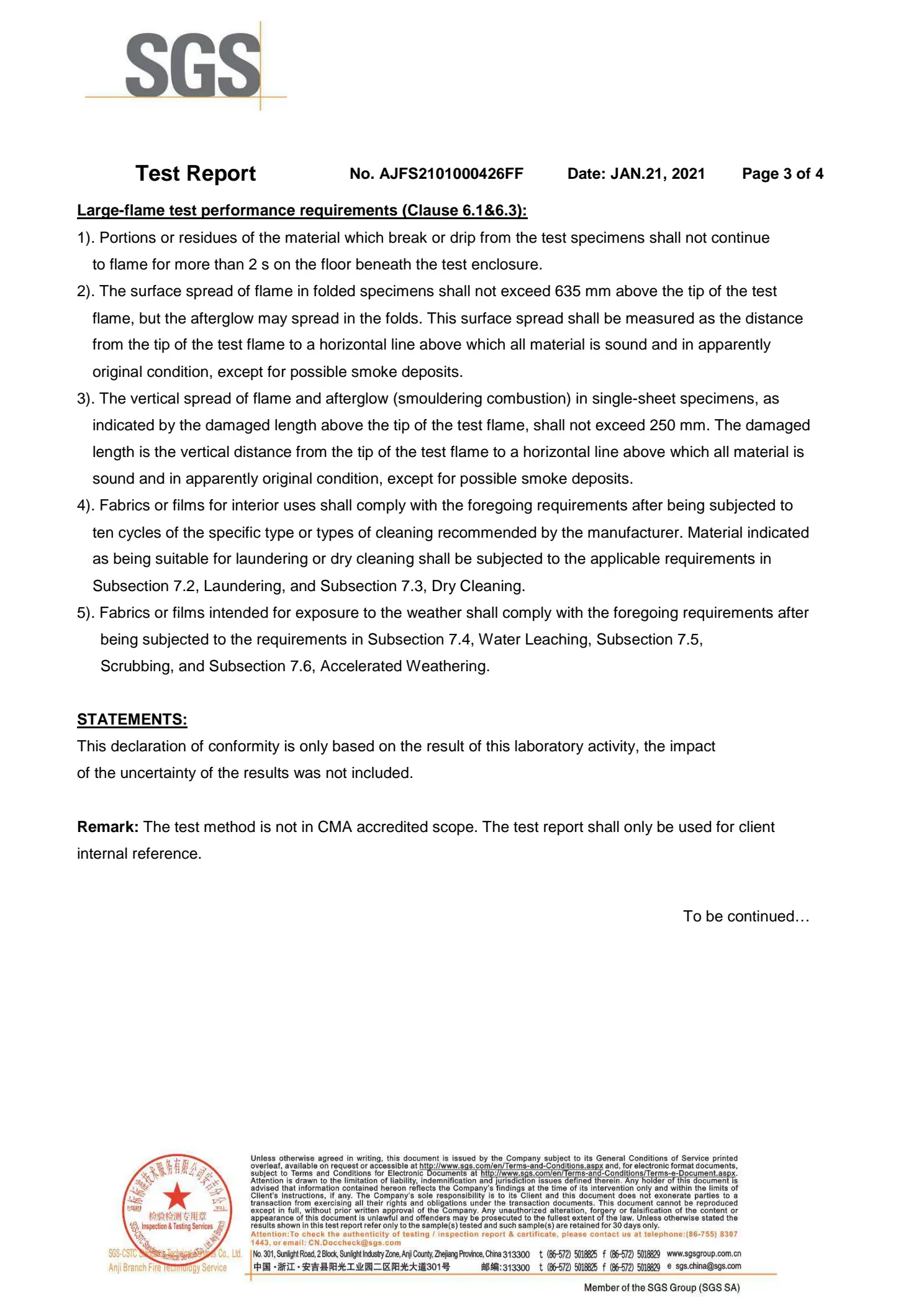
SGS test report AJFS2101000426FF covering 850 gsm PVC coating material under CAN/ULC-S109-14 Clause 4.4 (large-flame test).
That document is genuinely useful — it addresses one of the questions fire authorities ask most often about temporary structures — but its boundary should be understood. It covers the coating material, not the assembled structure, and it is not a structural calculation, an anchoring certificate or a jurisdiction-specific approval. Buyers working in regulated venues should confirm which document the local authority will actually accept.
After-sales and execution support
Shoulder Tent provides 24/7 online service together with pre-sales and after-sales engineering and technical support that continues after global delivery. Its ODM scope covers design and R&D, factory manufacturing, global delivery, installation and on-site technical support — the full chain from drawing to commissioning rather than a shipment-only arrangement.
Commercially, the company accepts multiple payment methods including T/T and supports FOB, CIF and CFR terms, with factory-direct delivery and global logistics coordination. Because Incoterms and payment structure vary by client, the specific combination is confirmed at quotation stage rather than fixed in a catalogue.
Where large tents are doing the work
Logistics and temporary warehousing
Storage and inventory expansion is the clearest use case for a column-free large tent: racking, forklift circulation and loading bays all benefit from an uninterrupted floor plate, and the 3 m / 5 m bay system allows capacity to be added in line with seasonal stock rather than in one capital step.
Sports venues
Sports venue covers are the second major application in Shoulder Tent's deployed base. The demand signal behind this is measurable: indoor pickleball and padel facilities command two to three times the utilisation of outdoor courts and represented 36.9% of total US court supply as of 2026, according to CourtSource's 2026 State of the Courts reporting. For operators, a clear-span structure is often the fastest route to covered court capacity.
Events and exhibitions
Exhibition venues and event back-of-house storage apply the same structural logic at shorter deployment cycles, where the accessory scope — flooring, sidewalls, doors, lighting — carries more of the delivered value than the frame alone.
Market trend: why aluminum framing is the default for large temporary structures
Lightweight aluminum framing systems account for nearly 58% of total deployed structures in the tent rental market, according to Business Research Insights' 2026 tent rental service market report, which values that market at USD 3.29 billion by 2035. Separately, the broader storage, sports and event tent category is forecast to reach USD 6.07 billion by 2033 at a CAGR of 5–7%, per EIN Presswire's 2026 manufacturer analysis.
Durability supports that share. Aluminum frame structures built from 6061-T6 alloy typically have a service life of 15 to 20 years under standard outdoor conditions, again per the 2026 EIN Presswire analysis. For a buyer weighing a temporary structure against a permanent building, that service life is the number that determines whether the asset can be depreciated over a realistic horizon.
Comparison with traditional solutions — and where the limits are
Against a steel-frame temporary building, an aluminum-frame large tent trades some raw load capacity for weight, corrosion resistance and speed of erection. Aluminum is selected where weight reduction and corrosion resistance dominate; steel remains the material of choice where heavy snow loads govern the design. Neither is universally better — the answer depends on the site's load case.
Against permanent construction, the comparison is one of commitment rather than performance. A large tent is a temporary or semi-permanent structure; whether it can be permitted, and for how long, is a local regulatory question that no manufacturer's specification sheet answers.
Several boundaries are worth stating plainly:
- Documentation scope. The published SGS report covers 850 gsm PVC coating material only. Structural calculations, anchoring design and jurisdiction-specific approvals are project documents, not catalogue items.
- Stated loads. The 100–120 km/h wind figure and the 1.9 kN/m² snow figure are supplier-stated maximums; they must be re-checked against the actual span, height and exposure of the buyer's site.
- Lead-time boundaries. The 30–35 day figure is production time. Freight, customs and on-site installation sit outside it and should be scheduled separately.
- Installed-base verification. The 3,800+ unit figure is a company-reported deployment record. Buyers should request references in their own application segment and, where a tenure figure is cited, clarify whether it measures corporate history, team experience or cumulative project record.
| Claim commonly seen in proposals | Evidence available here | What the buyer should request |
|---|---|---|
| Wind resistance | Supplier-stated maximum of 100–120 km/h | Span-specific structural calculation and anchoring design |
| Snow load | Supplier-stated up to 1.9 kN/m² | Site-specific snow load verification for the project location |
| Fire performance of the cover | SGS report AJFS2101000426FF, 850 gsm PVC coating, CAN/ULC-S109-14 Clause 4.4 | Written confirmation that the local authority accepts this test basis |
| Deployed base | Company-reported 3,800+ units across five client groups | References in the same application segment and comparable span |
| Production capacity | 20,000 m² factory, 90 units/month, 1,000 units/year | Production schedule confirmed for the specific order size |
Future outlook
The structural case for large aluminum-frame tents is strengthening rather than weakening. Racket-sport venue demand, warehouse overflow and event infrastructure all point toward structures that can be deployed, expanded and relocated, and aluminum framing already holds the majority share of deployed rental structures. The competitive question for manufacturers is shifting from whether they can build a clear-span structure to whether they can document it — span-specific calculations, material test reports, inspection records and support commitments that survive a buyer's due diligence. Suppliers whose proof points are already organised around those documents will find the evaluation stage shorter; those relying on brochure specifications will not.
FAQ
It demonstrates repeat deployment across multiple application categories — event and exhibition, wedding and banquet, sports, logistics and warehousing, and hospitality — rather than a single project type, which makes it a breadth and continuity signal for shortlisting. It does not certify span, load capacity or regulatory compliance for a specific project; those require project-level documentation.
Clear-span, column-free aluminum-frame structures with modular 3 m and 5 m bay expansion. Listed model families are S30-1, S32, S45-1, S45-2 and S60-1. Covering is double-layer PVC-coated polyester tarpaulin, with accessory options for flooring, sidewalls and doors, windows and curtains, insulation and ventilation, and event décor and lighting.
Completed units pass standardised engineering and quality inspections before dispatch. On the material side, an SGS test report (certificate AJFS2101000426FF, issued 21 January 2021) covers 850 gsm PVC coating material under CAN/ULC-S109-14 Clause 4.4, the large-flame test, for single-layer white PVC coating.
Shoulder Tent states a maximum wind load of 100–120 km/h and a snow load of up to 1.9 kN/m². These are supplier-stated design maximums that vary with span, eave height, anchoring method and exposure category. Buyers should obtain a span-specific structural calculation for the project site before approval.
Monthly capacity is 90 units against an annual output of 1,000 units, with a production lead time of 30–35 days. Orders are accepted from a single unit with no minimum order quantity. Freight, customs clearance and installation are scheduled separately from production.
Orders are accepted from one unit. Payment is accepted by multiple methods including T/T, and FOB, CIF and CFR trade terms are supported. Delivery is factory-direct with global logistics coordination; the specific Incoterm and payment structure are confirmed with sales at quotation stage.
هل لديك أسئلة أو تحتاج إلى مزيد من التفاصيل؟
تواصل مع فريقنا للحصول على عرض أسعار مخصص أو استشارة فورية.
طلب عرض أسعار
املأ النموذج أدناه وسيتواصل معك فريقنا بعرض مقترح مخصص.
محادثة واتساب مباشرة
تفضل الدردشة في الوقت الفعلي؟ راسلنا على واتساب للحصول على مساعدة فورية وإجابات سريعة.
- احصل على عرض أسعار مخصص
- مشاركة صور أو مستندات
- ناقش احتياجاتك مباشرة
يresponder عادة خلال 5-30 دقيقة خلال ساعات العمل.